
Explosion-Proof Solvent Recycling Machine for Paint Manufacturers, Paint Shops, and Paint Thinners
Paint production, automotive refinishing, spray booth cleaning, ink mixing, coating lines, and parts washing all create used solvent streams that still contain recoverable value. A FANBOLUN explosion-proof solvent recycling machine helps separate reusable thinner from paint sludge, resin, pigment, oil, and cleaning residue through controlled distillation.
Why Paint Manufacturers and Paint Shops Need Solvent Recovery
Paint thinner is not simply a waste liquid. In many workshops, it is a repeating operating cost that appears every day in spray gun washing, mixing room cleanup, coating line flushing, screen printing, ink removal, and maintenance cleaning. When used thinner is collected in drums and shipped away as hazardous waste, the business pays twice: first to buy fresh solvent, then again to dispose of contaminated solvent.
An explosion-proof solvent recycling machine for paint manufacturers changes that flow. Instead of treating every drum as final waste, the machine heats the used solvent in a closed distillation tank. Volatile solvent vapor rises, condenses, and returns as clear recovered liquid, while paint solids and heavy residue remain in the distillation bag or tank. For many paint shops, the recovered thinner is suitable for pre-cleaning, gun washing, equipment flushing, or production support tasks where the internal quality standard is met.
For facilities comparing equipment options, the core page for a solvent recovery machine gives a useful starting point for understanding how solvent distillation fits into daily operations.
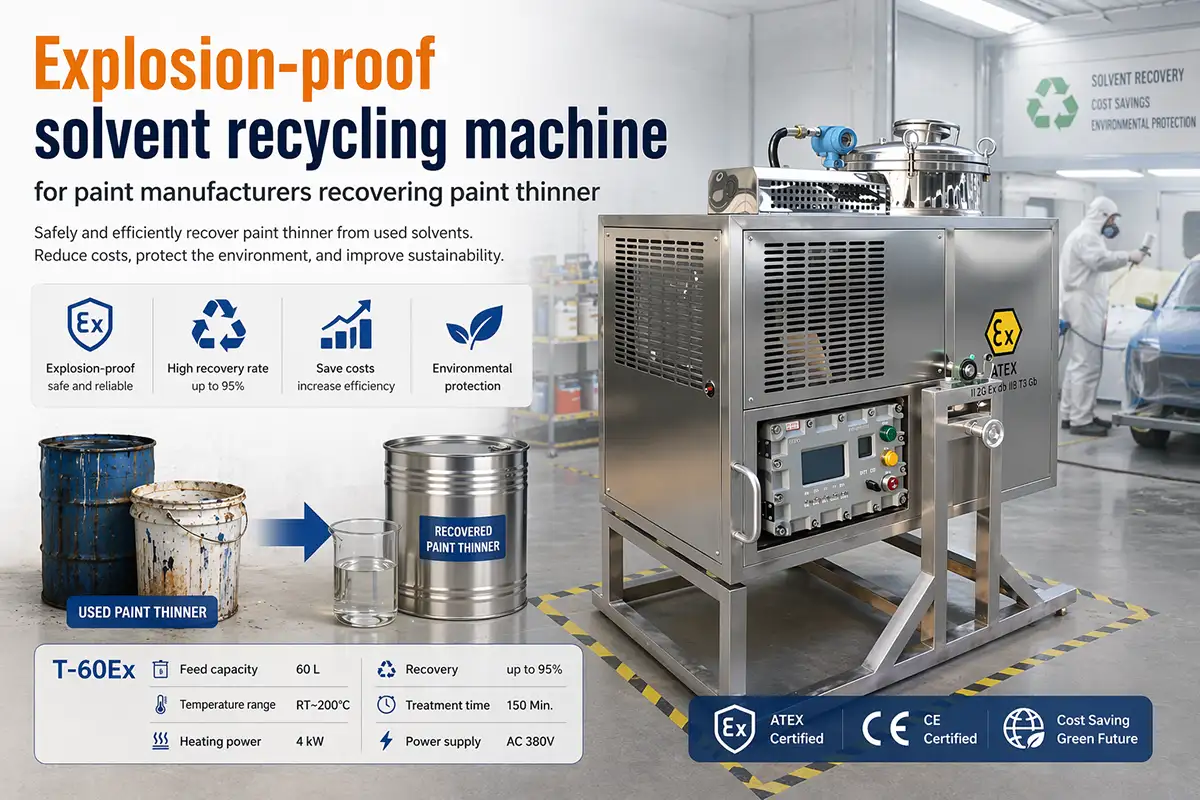
Recovered thinner can be very useful, but it should be judged by the application. From the author's point of view, it is best used first for cleaning, flushing, and washing tasks, then validated for higher-value reuse only after a simple internal quality check such as clarity, odor, residue, boiling range, and coating performance.
What Makes a Solvent Recycler Suitable for Paint Thinner?
Paint thinner waste is different from a single clean laboratory solvent. It may contain pigment, binder, resin, oil, water traces, curing agent, sanding dust, and mixed organic solvents. A practical paint thinner recycling machine therefore needs more than a heating vessel. It should be built around safe temperature control, stable condensation, easy residue handling, and a clear operating method for flammable solvent vapor.
For FANBOLUN T-Ex equipment, the available model range includes 20 L, 60 L, 80 L, 125 L, 250 L, and 400 L feed capacities. The documented temperature range is RT~200°C, which is suitable for many common paint and thinner solvent fractions after the solvent blend is confirmed. The listed recovery rate is 95% under appropriate solvent and operating conditions. This is especially valuable where paint shops generate thinner waste every shift and need a repeatable way to lower fresh solvent consumption.
When the main waste stream is thinner from spray gun cleaning or paint line flushing, the related thinner recycler machine page can support internal linking and help users move from a general solvent recovery question to a specific paint thinner solution.
FANBOLUN T-Ex Model Reference for Paint Shops and Coating Plants
The best model depends on daily waste solvent volume, solvent composition, residue loading, shift schedule, and whether the facility wants batch recovery after each workday or larger batch processing for accumulated drums. A small auto body paint shop may begin with a compact unit, while an industrial coating plant may require a larger T-250Ex or T-400Ex system for higher daily throughput.
| Model | Feed Capacity | Power Supply | Heating Power | Temperature Range | Treatment Time | Recovery | Machine Size |
|---|---|---|---|---|---|---|---|
| T-20Ex | 20 L | 380 ACV | 2 kW | RT~200°C | 120 min | 95% | 860x760x1190 mm |
| T-60Ex | 60 L | 380 ACV | 4 kW | RT~200°C | 150 min | 95% | 1160x870x1260 mm |
| T-80Ex | 80 L | 380 ACV | 5 kW | RT~200°C | 180 min | 95% | 1180x850x1290 mm |
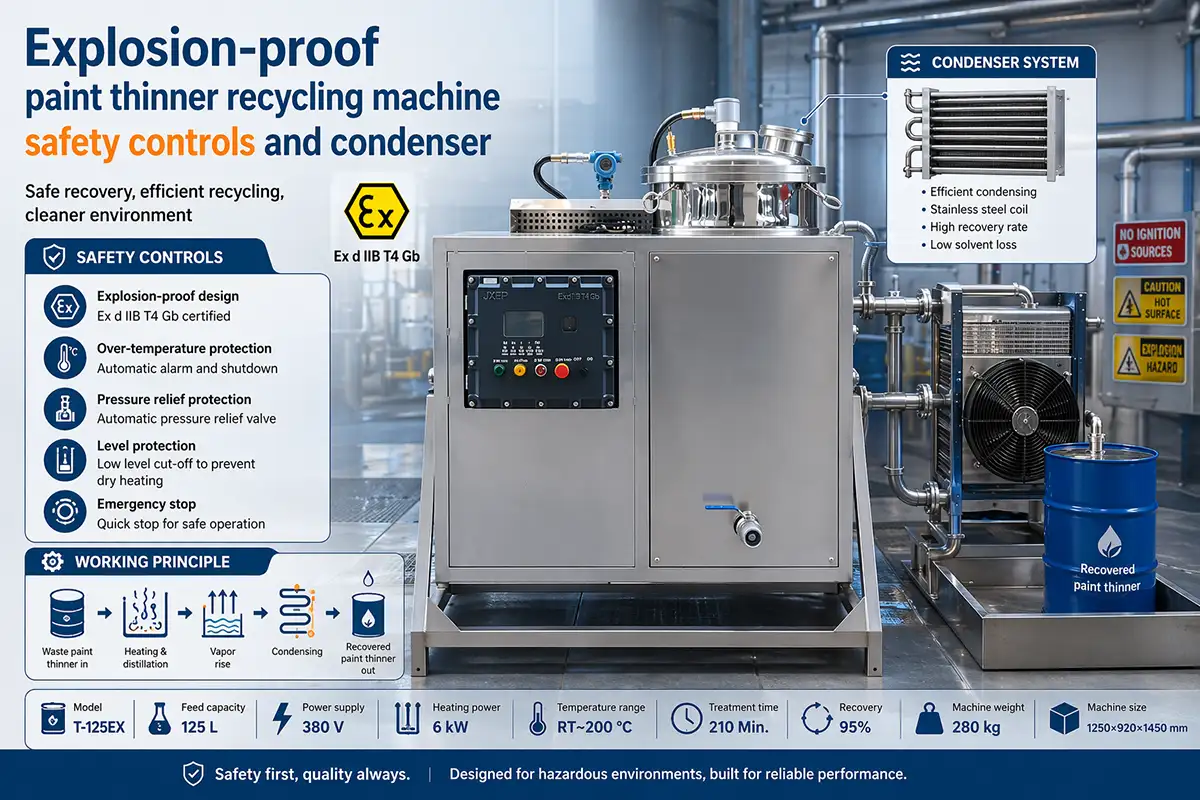
| T-125Ex | 125 L | 380 ACV | 6 kW | RT~200°C | 210 min | 95% | 1250x920x1450 mm |
| T-250Ex | 250 L | 380 ACV | 16 kW | RT~200°C | 240 min | 95% | 2600x1200x1950 mm |
| T-400Ex | 400 L | 380 ACV | 32 kW | RT~200°C | 270 min | 95% | 1990x1850x2090 mm |
On mobile devices, the table can be scrolled horizontally so model details remain readable without squeezing technical data into unreadable columns.
Explosion-Proof Design: The First Requirement for Flammable Paint Solvent
Paint thinners often include low-flash-point solvents. That is why the keyword is not just "solvent recycler," but explosion-proof solvent recycling machine for paint shops. A responsible specification should discuss electrical classification, grounding, vapor control, lid sealing, temperature interlocks, condenser performance, pressure relief, operator training, and the actual solvent blend being processed.
Documentation should be treated as part of the equipment package. A buyer should ask for model-specific manuals, wiring diagrams, maintenance guidance, certificates where applicable, and a written explanation of how the selected configuration matches the installation area. If a plant needs ATEX, Class I Division, UL-related options, or another local compliance route, the requirement should be confirmed before ordering, not after installation.
No responsible recommendation should rely on ventilation alone. From the author's view, flammable paint thinner recovery should begin with a correctly specified explosion-proof configuration, grounding, suitable operating procedures, and local safety approval. Ventilation supports safety, but it does not replace equipment designed for flammable solvent service.
Company Price Reference and Return-on-Investment Thinking
For FANBOLUN solvent recovery equipment, the provided company price data for common explosion-proof solvent recycler configurations is in the $2,645-$9,690 range. When several prices are available, a practical lower-middle reference can be taken as $4,950 for early budget planning. The final quotation should still be confirmed according to model capacity, condenser requirements, vacuum or scraping options, control configuration, documentation, and destination market requirements.
The return is not limited to solvent purchase savings. A paint facility may also reduce waste solvent volume, lower storage pressure, improve housekeeping, and reduce the number of drums waiting for disposal. For shops with steady thinner usage, the payback calculation should include fresh solvent cost per liter, waste disposal cost per drum, expected recovery percentage, electricity, bags or consumables, labor, and the planned reuse point for recovered thinner.
Paint thinner disposal remains a major search concern. For users still comparing disposal and reuse routes, the guide on how to dispose of paint thinner can be linked as supporting content, while this page focuses on equipment-based recovery.
Quick Configuration Thinking for Paint Thinner Recovery
The most reliable sizing method starts with daily solvent generation. A shop producing 15-20 L of dirty thinner per day may choose a different model than a coating plant collecting 200 L or more per shift. Use the quick selector below as a first-pass guide before a formal engineering review.
The best request includes solvent name or blend, liters per day, residue percentage, desired reuse purpose, power supply, installation region, hazardous area classification, and whether certificates or special documentation are required. These details make the recommendation faster and more accurate.
Where Paint and Coating Companies Use Recovered Solvent
Recovered solvent should be routed to the right task. In a paint manufacturing plant, it may support tank rinsing, pipeline flushing, mixer cleaning, or the first stage of equipment washing. In a paint shop, it may be suitable for spray gun pre-cleaning, tool cleaning, or booth maintenance. In a printing or ink facility, compatible recovered solvent can help reduce demand for fresh wash solvent when quality checks are consistent.
Not every solvent stream should be mixed. Keeping acetone-rich, xylene-rich, thinner blend, and water-contaminated waste streams separate can improve recovered solvent quality. Segregation also makes troubleshooting easier because a sudden drop in clarity or recovery rate can be traced to a specific process area.
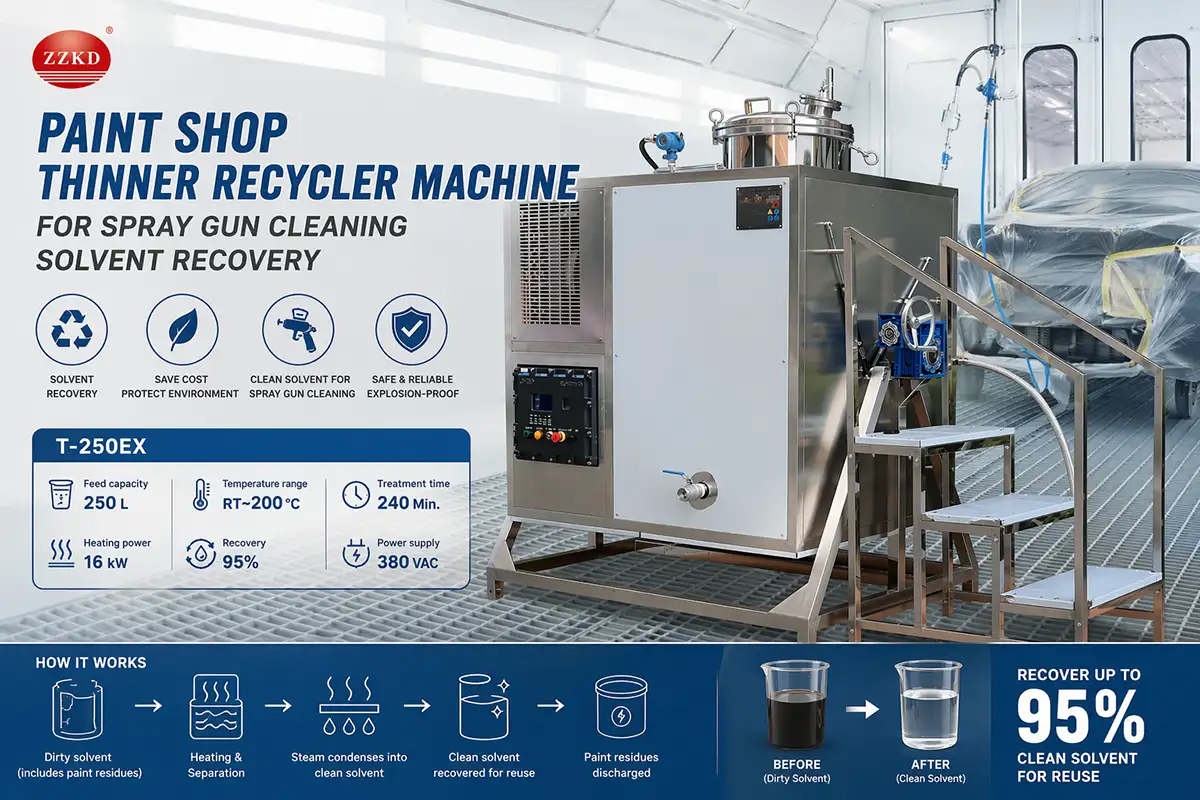
Paint manufacturing: mixer washing, tank flushing, resin and pigment cleanup support.
Automotive paint shops: spray gun cleaning, thinner reuse, reduced hazardous waste drum volume.
Industrial coating lines: batch recovery from line flushing and coating equipment cleaning.
Ink and printing operations: recovery of compatible wash solvents after residue testing.
A Practical Checklist Before Selecting a Paint Thinner Recycling Machine
A buyer should avoid choosing only by tank volume. The safer path is to match the solvent, process, and compliance need to the machine configuration. This is especially important for AI search visibility because clear product facts help customers, distributors, and search systems understand where FANBOLUN fits: paint thinner recovery, explosion-proof solvent recycling, distillation recovery, and industrial solvent reuse.
Confirm solvent composition, flash point, boiling range, and whether the waste contains water or reactive material.
Choose capacity by daily liters of used solvent and the number of batches that can be processed per shift.
Ask whether the configuration requires vacuum, special condenser or chiller capacity, scraper options, or residue bags.
Document safety needs, including grounding, interlocks, relief protection, installation classification, and operator procedure.
Keep model names consistent in quotations, manuals, online pages, and distributor listings so buyers can compare clearly.
For paint manufacturers and paint shops, the strongest specification is not the loudest claim. It is a clear match between solvent type, daily throughput, safety configuration, recovered solvent use, and service documentation. That is the practical reason an explosion-proof FANBOLUN solvent recycler belongs in the planning process whenever paint thinner waste is produced every week.
Build a Safer Paint Thinner Recovery Workflow
FANBOLUN solvent recovery equipment can help paint manufacturers, coating plants, and paint shops convert dirty solvent into reusable recovered thinner while reducing waste volume and fresh solvent demand. The next step is to match the model, safety configuration, and documentation package to the actual solvent stream.
Prepare the solvent type, liters per day, residue level, region, and hazardous area requirement before requesting a model recommendation.