ATEX-Certified Solvent Recovery Machine for Chemical Plants
Turning contaminated solvent into a reusable process resource can reduce fresh-solvent purchases and the volume of liquid waste requiring off-site treatment. In chemical plants, however, successful recovery starts with more than distillation performance: equipment must also match the solvent chemistry, hazardous-area classification, and operating workflow.
Selecting an ATEX-certified solvent recovery machine for chemical plants therefore requires a balanced review of explosion protection, batch capacity, recovered-solvent quality, and total operating cost. This guide brings those decisions together with FANBOLUN’s supplied equipment specifications and company price references.
- 20–400 L feed capacities
- 380 V AC listed supply
- 95% listed recovery
- Batch distillation selection
Recover Solvent Value Before Paying for Disposal
Chemical manufacturing generates spent solvents during vessel cleaning, product changeovers, equipment flushing, and maintenance. These liquids may contain dissolved resins, pigments, oils, or other process contaminants while still retaining a substantial recoverable solvent fraction.
Distillation separates volatile components from less volatile residues. With suitable feed preparation and controlled operation, the recovered liquid can return to an approved cleaning or process application. This can reduce dependence on fresh solvent and make waste handling more manageable.
The strongest opportunities usually involve consistent, segregated waste streams with a clear reuse destination. Combining unrelated solvents or reactive contaminants can complicate separation, safety assessment, and quality control. A detailed explanation of the solvent recovery process provides useful background for planning the recovery loop.
Verify ATEX Suitability Before Comparing Capacity
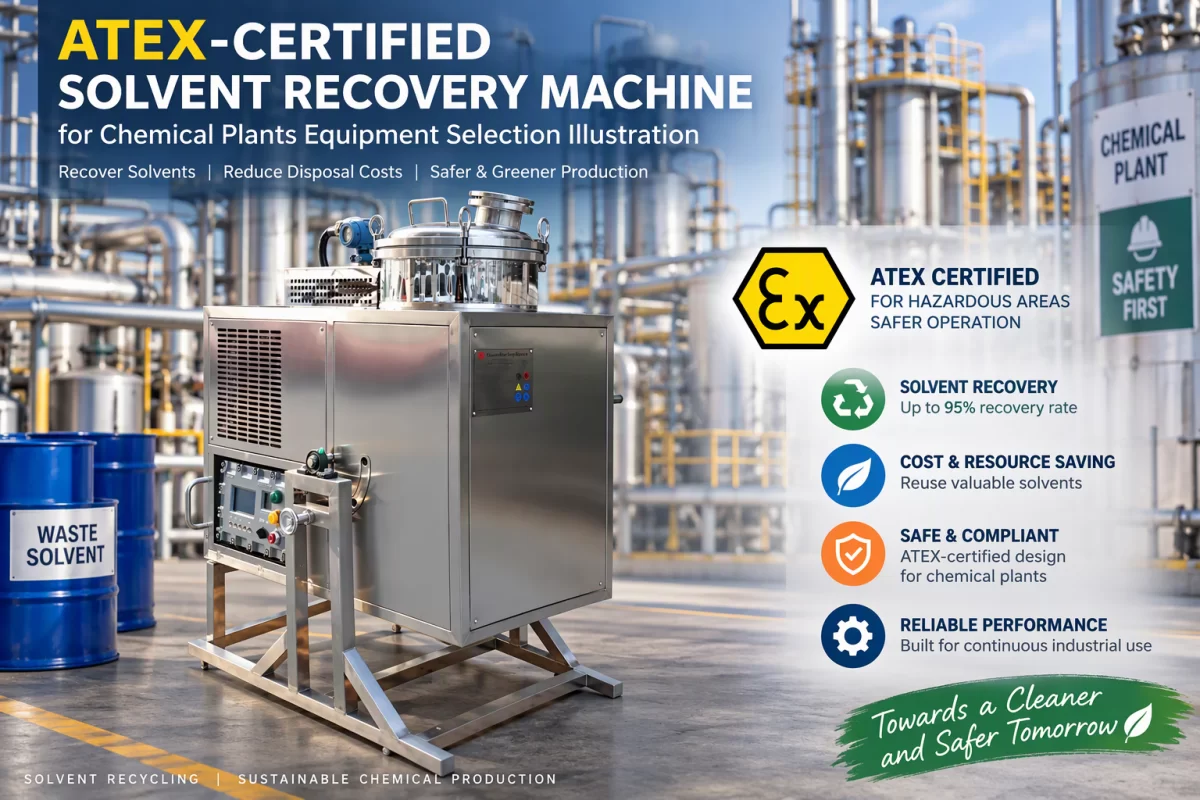
Flammable solvent vapors can form explosive atmospheres around transfer points, recovery equipment, and storage containers. ATEX equipment selection must reflect the plant’s hazardous-area assessment, including the relevant zone, equipment category, gas group, temperature class, and specified ambient conditions.
An “Ex” model suffix or an “explosion-proof” product description alone does not establish ATEX compliance. CE marking also does not, by itself, confirm suitability for a particular explosive atmosphere. The exact supplied assembly and its intended installation need a documented compliance review.
- Check identification: match the equipment nameplate and serial details to the supplied compliance documents.
- Review conformity: obtain the EU Declaration of Conformity, ATEX marking, and applicable certificates for the chosen configuration.
- Confirm installation conditions: review ventilation, bonding, grounding, electrical connections, and any required protective systems.
- Assess the complete assembly: verify that documentation covers the machine configuration, not merely individual electrical components.
Match the Distillation Process to the Waste Stream
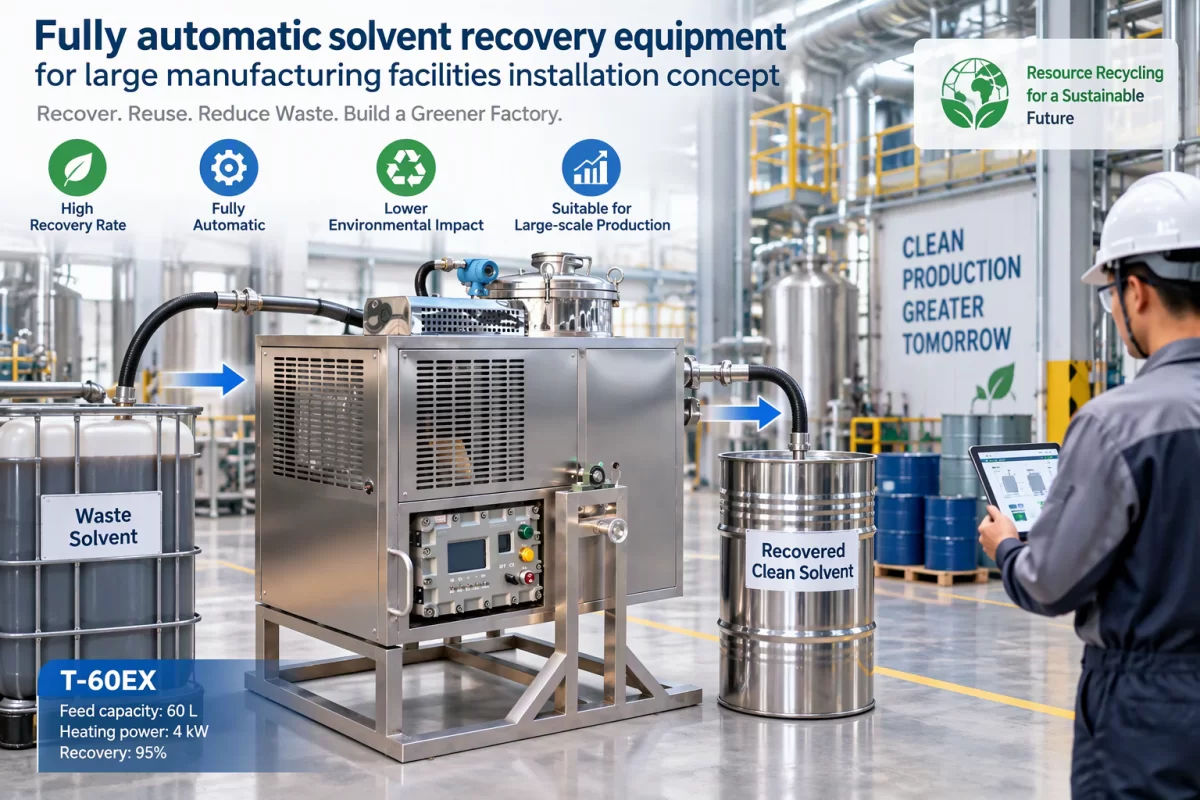
A solvent recovery machine heats an approved feed, directs the generated vapor through a condenser, and collects the condensed solvent separately from the concentrated residue. Acetone, ethyl acetate, alcohols, toluene, and xylene are common candidates for recovery assessment, but each actual waste stream requires compatibility review and sample testing.
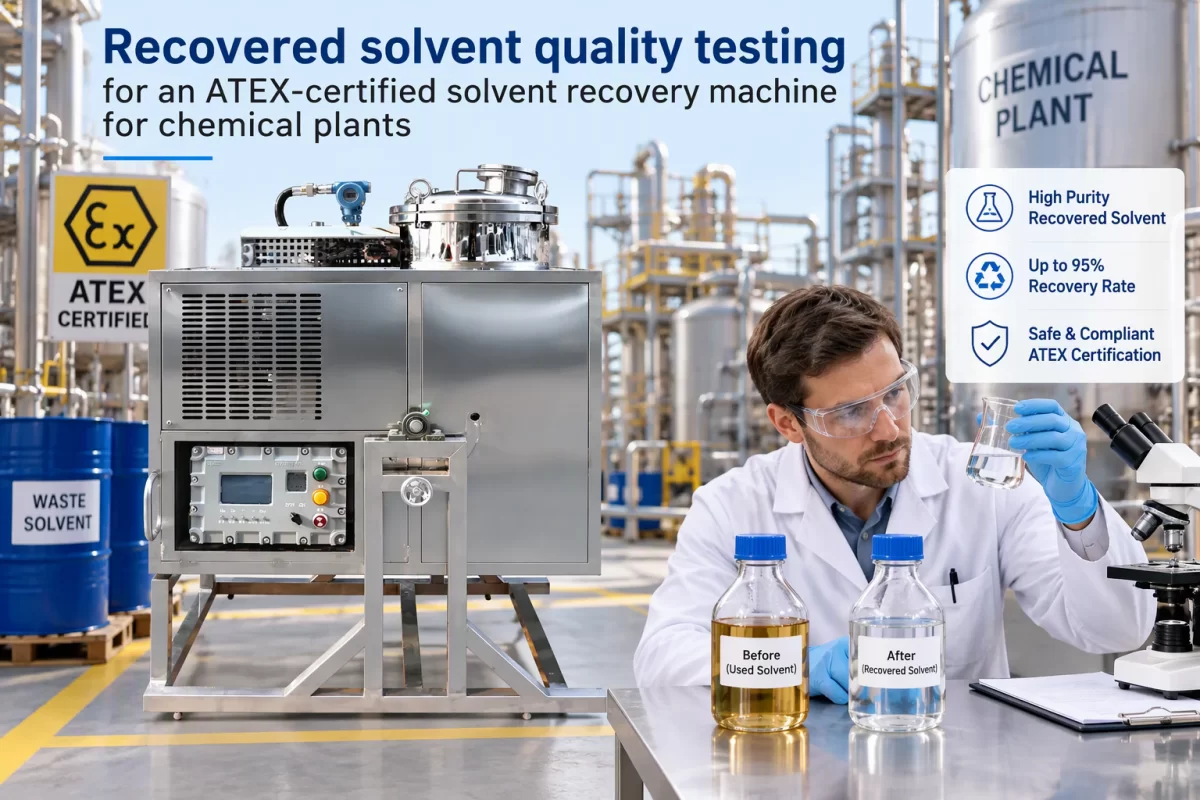
Boiling behavior, water content, solids loading, foaming tendency, and thermal stability influence performance. Mixed solvents may co-distill, while azeotropes can limit separation by simple distillation. A recovered liquid that appears clear is not automatically suitable for a purity-sensitive production step.
Establish acceptance limits for water, composition, and relevant contaminants before returning recovered solvent to service. Unknown mixtures, oxidizer contamination, peroxide-forming solvents, and thermally unstable residues need specialist evaluation rather than routine processing.
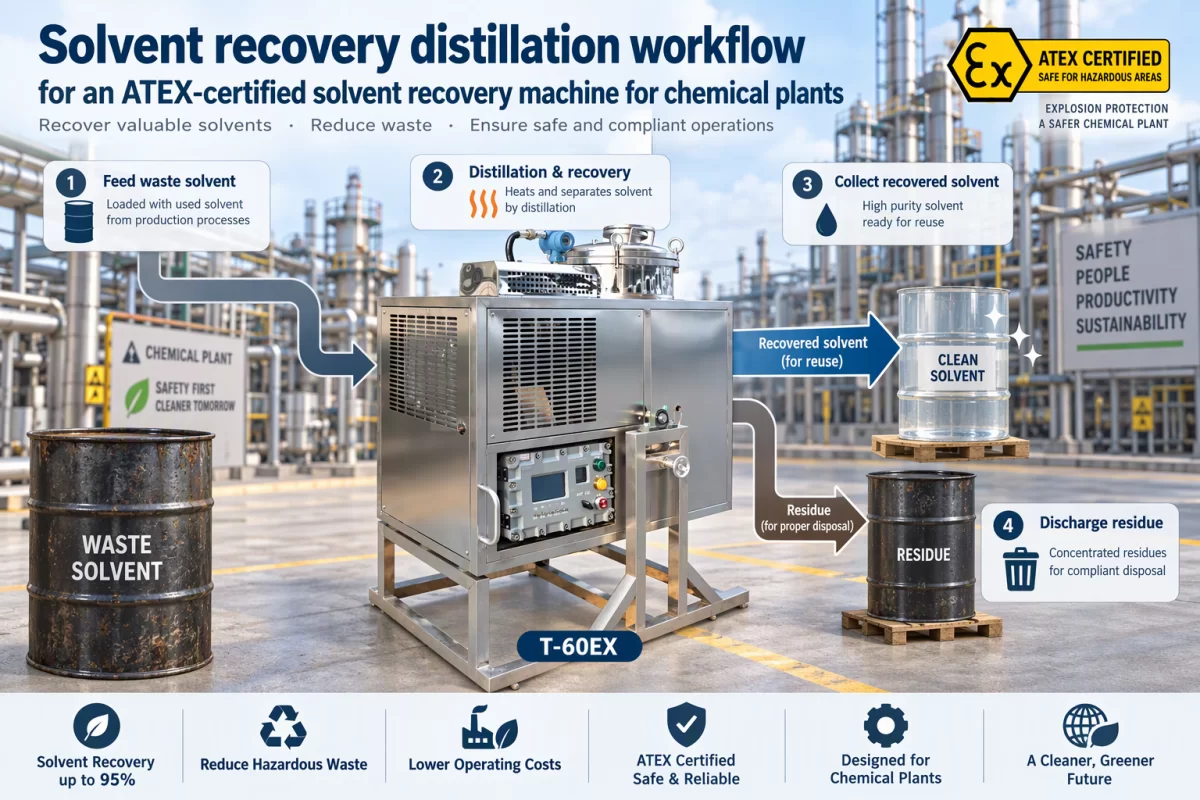
Compare FANBOLUN Batch Solvent Recovery Models
The supplied specifications cover six models with feed capacities from 20 to 400 liters. These figures describe batch feed capacity, not continuous hourly output. All six models list a 380 V AC supply, a temperature range from room temperature to 200°C, and a 95% recovery figure.
On smaller screens, swipe horizontally or focus the table area and use the arrow keys to view all specifications.
| Model | Feed capacity (L) | Supply (V AC) | Heating power (kW) | Temperature range (°C) | Treatment time (min) | Recovery (%) | Weight (kg) | Machine size (mm) |
|---|---|---|---|---|---|---|---|---|
| T-20Ex | 20 | 380 | 2 | RT–200 | 120 | 95 | 153 | 860 × 760 × 1190 |
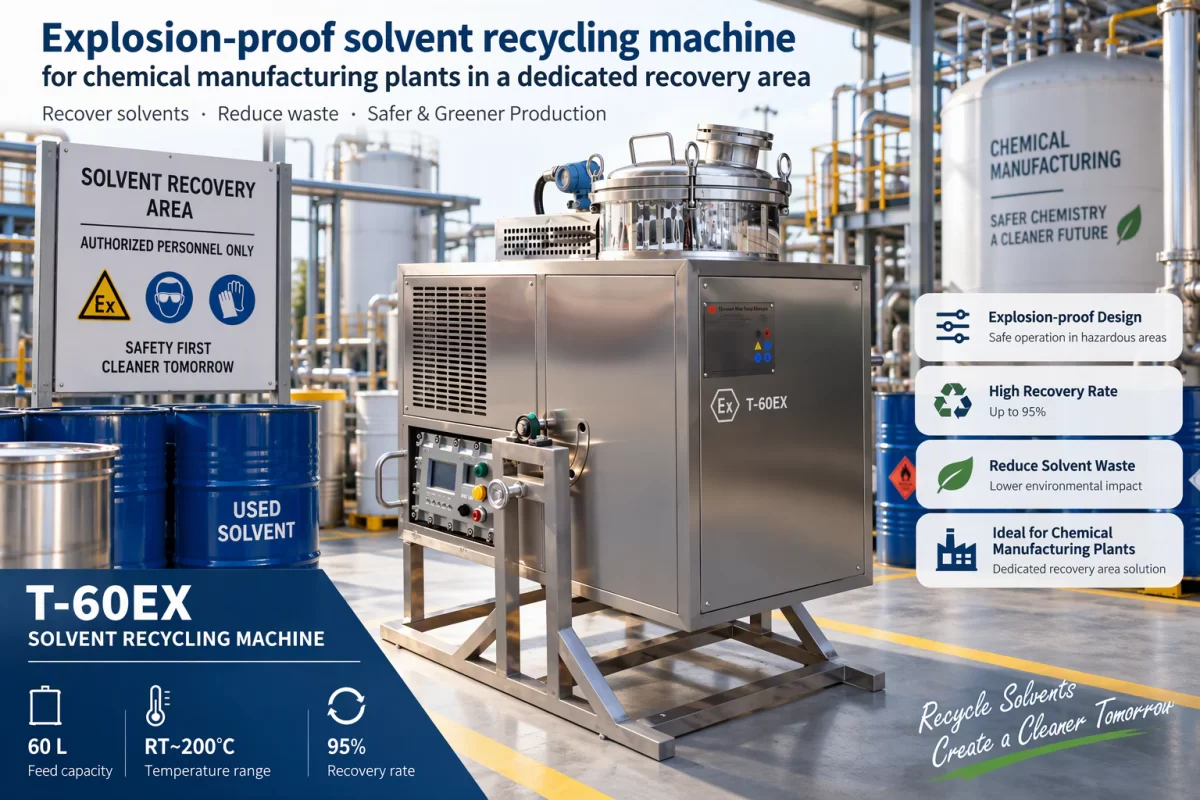
| T-60Ex | 60 | 380 | 4 | RT–200 | 150 | 95 | 170 | 1160 × 870 × 1260 |
| T-80Ex | 80 | 380 | 5 | RT–200 | 180 | 95 | 200 | 1180 × 850 × 1290 |
| T-125Ex | 125 | 380 | 6 | RT–200 | 210 | 95 | 280 | 1250 × 920 × 1450 |
| T-250Ex | 250 | 380 | 16 | RT–200 | 240 | 95 | 520 | 2600 × 1200 × 1950 |
| T-400Ex | 400 | 380 | 32 | RT–200 | 270 | 95 | 1200 | 1990 × 1850 × 2090 |
RT means room temperature. Listed treatment times and recovery figures require confirmation with the actual feed and operating conditions. Recovery percentage is not a recovered-solvent purity specification.
Smaller models can be considered for limited, segregated waste streams, while larger models warrant assessment where batch accumulation is higher. Selection should also account for loading, cooling, residue removal, maintenance access, and available utilities. Maximum temperature is an equipment limit—not a universal solvent processing setpoint.
Budget with Clearly Identified Equipment Prices
FANBOLUN’s supplied price list includes the following single-price equipment references. These are company-listed USD prices, not competitor prices, and they apply to the named listings rather than automatically to the six models in the specification table.
Solvent Recovery and IPA Recovery Machine for Electronics Cleaning
$4,271 USDA listed reference for an IPA-oriented recovery application, described as featuring continuous solvent recovery. Capacity, feed suitability, and the required chemical-plant protection configuration must be confirmed separately.
Stable Larger T-450Ex Solvent Recovery Unit
$10,691 USDA company-listed reference for waste organic solvent recovery. The T-450Ex is separate from the T-400Ex in the supplied specification sheet; T-400Ex dimensions, power, and treatment time should not be assigned to this listing.
Evaluate Savings Through Accepted Solvent Reuse
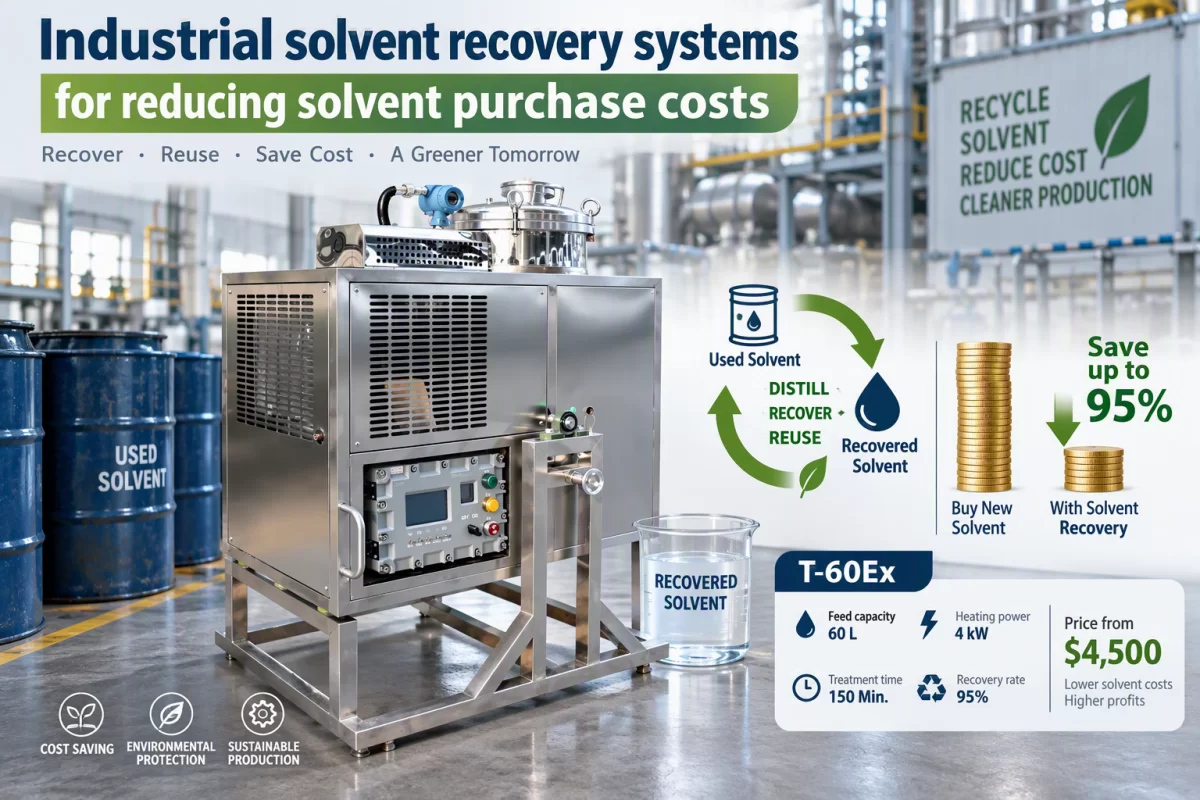
The useful economic measure is the amount of recovered solvent that passes testing and replaces a fresh-solvent purchase. A listed 95% recovery figure can support an initial assessment, but its measurement basis and applicability to the actual waste stream must be confirmed through testing.
Recovery operating cost includes electricity, labor, cooling utilities, consumables, maintenance, testing, and residue disposal. Heating power in kilowatts is not the same as measured electricity use per batch. Metered trial data provide a stronger basis for a payback estimate.
Concentrated still bottoms remain a waste-management responsibility. Appropriate labeling, compatible storage, and authorized disposal remain necessary after recovery. Integrating the machine into a documented solvent waste management program helps keep both recovered liquids and residual waste under control.
Build a Recovery System Around the Plant’s Real Requirements
The best ATEX-certified solvent recovery machine for chemical plants is not simply the largest unit or the lowest-priced listing. It is the documented, compatible configuration that delivers enough accepted recovered solvent within the available operating schedule.
- Characterize the feed: identify solvents, contaminants, water content, daily volume, and variability.
- Define the reuse target: establish composition and quality limits for the intended application.
- Confirm hazardous-area requirements: review zone classification and required Ex marking with competent personnel.
- Run a representative trial: measure yield, purity, energy consumption, cycle duration, and residue characteristics.
- Finalize the quotation: align machine capacity, verified compliance scope, installation requirements, and support arrangements.
FANBOLUN’s listed batch models provide a practical starting point for comparing feed capacity, heating power, and installation footprint. Combining those specifications with a feed trial and configuration-specific compliance review creates a stronger foundation for cost-effective solvent reuse.
Explore FANBOLUN Solvent Recycling Equipment