
Industrial Solvent Recovery Systems for Reducing Solvent Purchase Costs
Recovering usable solvent from contaminated process liquid can transform a recurring purchasing expense into a controlled, circular production resource.
Why Fresh Solvent Purchasing Becomes a Major Operating Expense
Solvents are essential in printing, painting, coating, electronics cleaning, automotive maintenance, chemical processing, pharmaceutical production, and composite manufacturing. However, a large portion of the solvent removed after cleaning or production is not chemically exhausted. It is simply contaminated by ink, resin, pigment, oil, adhesive, or suspended solids.
Disposing of this liquid and purchasing an equal volume of fresh material creates two expenses at the same time: solvent replacement and waste treatment. Industrial solvent recovery systems interrupt this costly cycle. Through controlled evaporation, condensation, and separation, the equipment recovers the volatile solvent while concentrating non-volatile contaminants into a smaller residue volume.
The recovered liquid can often return to cleaning, flushing, degreasing, or suitable production processes after its purity is verified. As a result, fewer drums of new solvent are required, less liquid waste leaves the facility, and inventory exposure can be reduced.
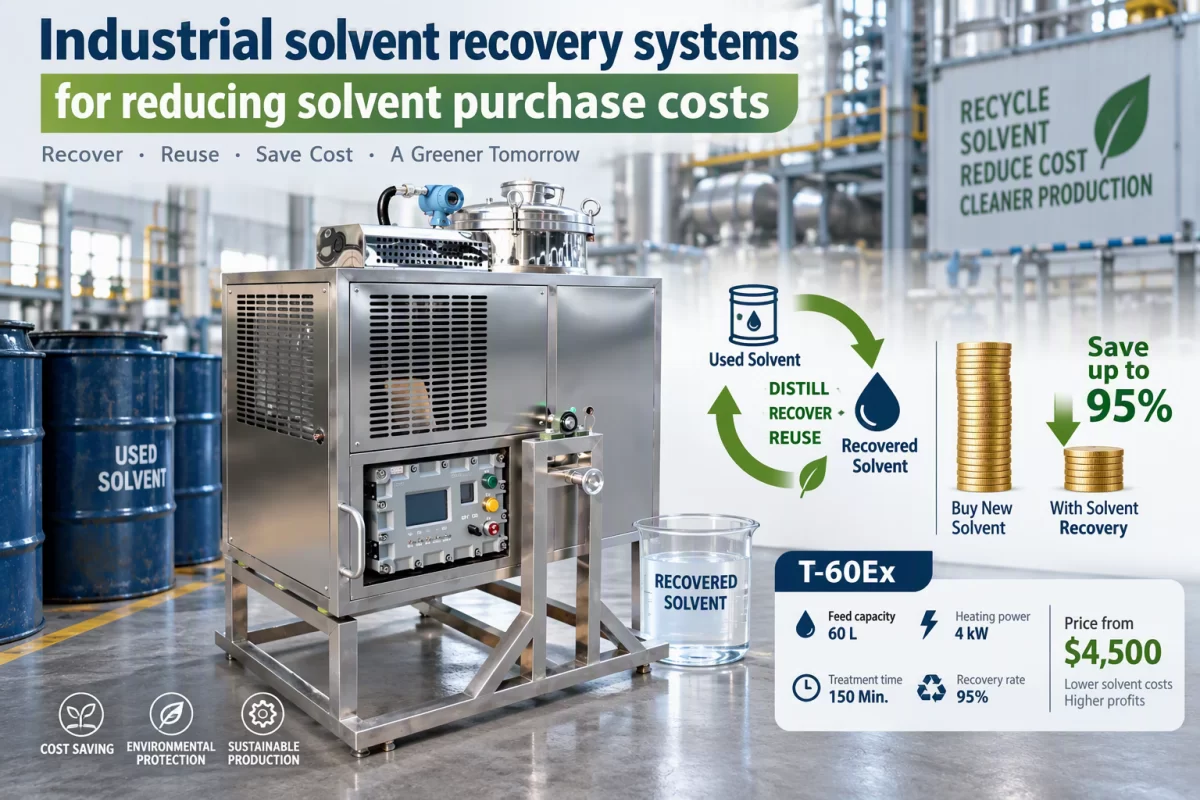
A properly sized recovery unit can turn contaminated solvent into a reusable production resource.
Can contaminated solvent really replace a meaningful portion of fresh solvent purchases?
My answer: Yes, provided that the contamination is suitable for distillation and the recovered material meets the required reuse specification. With a stated recovery level of up to 95%, these systems can return a substantial portion of each compatible batch instead of sending the entire liquid volume for disposal.
How an Industrial Solvent Recovery System Works
Most industrial recovery machines use batch distillation. Dirty solvent is loaded into a heated vessel, where the temperature rises under controlled conditions. The solvent reaches its boiling range and changes into vapor, while higher-boiling contaminants generally remain in the tank. The vapor passes through a cooling system, condenses, and is collected as recovered liquid.
Feed preparation: Used solvent is identified, segregated, and checked for incompatible substances or excessive water content.
Controlled heating: The recovery vessel heats the contaminated liquid within the selected operating range.
Vapor separation: Volatile solvent vapor leaves pigments, oils, resins, and other less-volatile contaminants behind.
Condensation: The vapor is cooled and converted back into a liquid solvent.
Quality verification: Recovered material is inspected or tested before being approved for reuse.
Residue removal: Concentrated waste is removed according to operating procedures and applicable regulations.
For a more detailed explanation of distillation, condensation, and collection, see how a solvent recovery system works. Facilities comparing machine configurations can also review dedicated solvent recovery machine options.
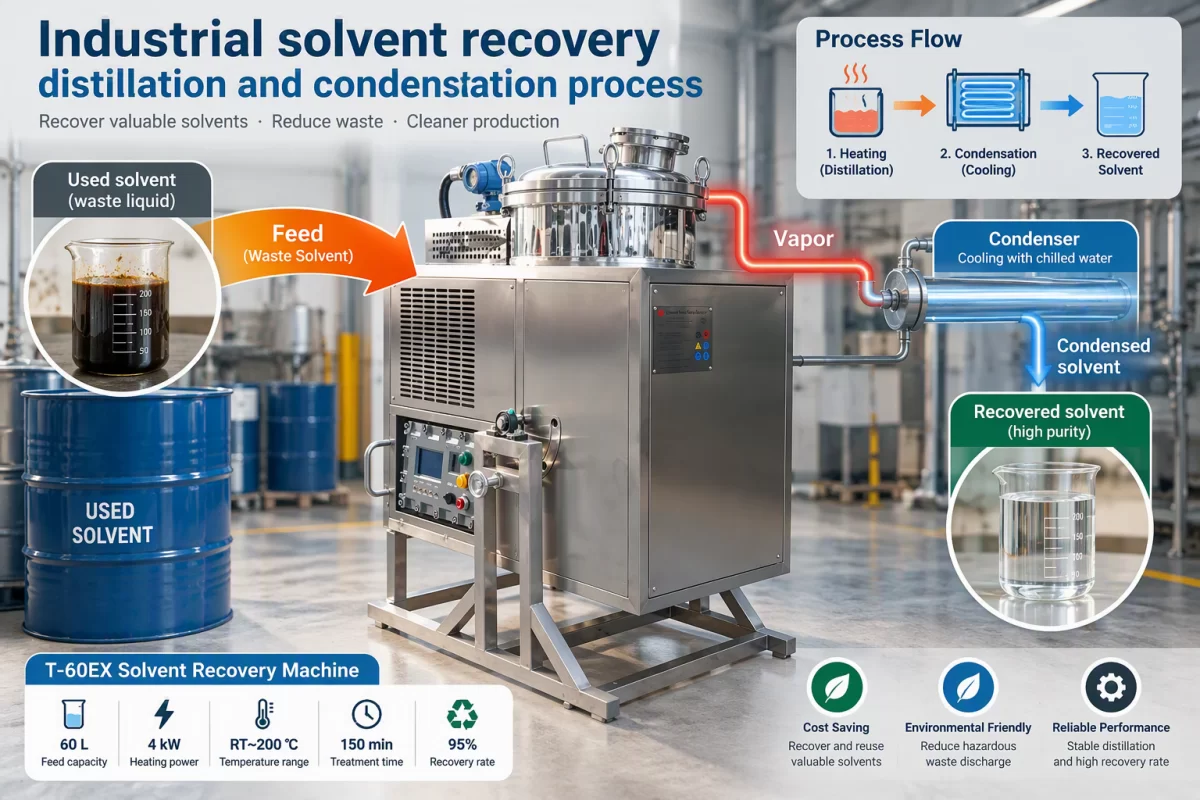
Distillation separates reusable volatile solvent from less-volatile process contamination.
Where the Cost Savings Come From
The most visible benefit is reduced fresh solvent purchasing, but the complete economic value includes several connected savings. A reliable evaluation should examine the entire solvent flow rather than focusing only on the purchase price of the machine.
Lower Fresh Solvent Demand
Each approved liter of recovered solvent offsets part of the requirement for newly purchased material.
Reduced Waste Volume
Distillation concentrates contaminants, so the waste stream remaining after recovery can be much smaller than the original liquid volume.
More Predictable Inventory
On-site reuse provides an internal solvent source and can reduce dependence on frequent replacement orders.
Better Material Utilization
Solvent is used across multiple cleaning cycles instead of becoming waste after one application.
Which operating factor has the greatest influence on payback?
My answer: Solvent volume is usually the leading factor, followed by solvent purchase cost, actual recovery yield, disposal expense, and machine utilization. A unit operated consistently on a compatible, high-volume waste stream generally creates a clearer economic return than oversized equipment used only occasionally.
A Simple Savings Formula
A preliminary estimate can be calculated as: monthly recoverable volume × usable recovery rate × solvent purchase cost per liter. Disposal savings may then be added, while electricity, maintenance, labor, consumables, and residue handling should be subtracted. This approach produces a more realistic operating estimate than relying on recovery percentage alone.
Industrial Solvent Recovery Machine Capacity Guide
Selecting the correct feed capacity is essential. A machine that is too small may create a processing backlog, while an unnecessarily large system can increase capital and utility requirements. The following models cover batch capacities from 20 to 400 liters and provide a stated recovery rate of up to 95%.
| Model | Feed Capacity | Power Supply | Heating Power | Temperature | Treatment Time | Recovery | Weight | Machine Size |
|---|---|---|---|---|---|---|---|---|
| T-20Ex | 20 L | 380 ACV | 2 kW | RT–200°C | 120 min. | 95% | 153 kg | 860 × 760 × 1190 mm |
| T-60Ex | 60 L | 380 ACV | 4 kW | RT–200°C | 150 min. | 95% | 170 kg | 1160 × 870 × 1260 mm |
| T-80Ex | 80 L | 380 ACV | 5 kW | RT–200°C | 180 min. | 95% | 200 kg | 1180 × 850 × 1290 mm |
| T-125Ex | 125 L | 380 ACV | 6 kW | RT–200°C | 210 min. | 95% | 280 kg | 1250 × 920 × 1450 mm |
| T-250Ex | 250 L | 380 ACV | 16 kW | RT–200°C | 240 min. | 95% | 520 kg | 2600 × 1200 × 1950 mm |
| T-400Ex | 400 L | 380 ACV | 32 kW | RT–200°C | 270 min. | 95% | 1200 kg | 1990 × 1850 × 2090 mm |
RT indicates room temperature. Actual treatment time and recovered quality depend on solvent composition, contamination, boiling characteristics, loading conditions, and operating settings.
Budgeting for Solvent Recovery Equipment
Selected company planning reference
US$5,900This relatively affordable mid-range reference is selected from the company-listed US$2,645–US$9,690 price range for several industrial solvent recovery machine configurations.
The final company quotation may change according to capacity, construction material, explosion-proof requirements, electrical configuration, automation, scraper design, condensation system, shipping, and customization. Market products may be priced higher; no third-party pricing is included here.
Why Capacity Alone Does Not Determine Price
Two machines with similar tank volumes may have different heating methods, control systems, safety structures, cooling arrangements, and residue discharge designs. Solvents with flammable vapors may require an appropriately engineered explosion-proof configuration. Sticky resin, ink, or paint residue may also justify a scraper or other cleaning assistance.
Before requesting a quotation, useful process information includes the solvent name, waste composition, daily or weekly volume, expected purity, boiling range, water content, required batch frequency, electrical supply, installation area, and intended reuse application. Accurate information helps match the machine to the process instead of selecting equipment from tank volume alone.
Is the lowest equipment price always the least expensive long-term choice?
My answer: No. Correct sizing, solvent compatibility, safe configuration, manageable cleaning, and dependable recovery performance matter more than the initial figure alone. An unsuitable low-cost unit can create processing delays, excessive maintenance, or recovered solvent that fails the required reuse standard.
Estimate Monthly Solvent Purchase Savings
The calculator below provides a simple gross estimate based on monthly waste volume, expected usable recovery rate, and fresh solvent purchase cost. It does not include energy, labor, maintenance, consumables, taxes, freight, or residue disposal.
How to Select the Right Recovery System
Successful solvent recycling starts with chemistry and production data. A recovery percentage should never be treated as the only selection criterion. Recovered solvent must also have acceptable purity, color, moisture content, and process performance.
Identify each solvent: Confirm chemical names, mixtures, boiling ranges, flash points, and safety data.
Measure actual volume: Use monthly or weekly waste records rather than rough estimates.
Characterize contamination: Determine whether the waste contains resin, ink, oil, pigment, adhesive, solids, acid, or water.
Define the reuse target: Cleaning applications may accept a different purity level from sensitive production processes.
Calculate batch frequency: Compare feed capacity and treatment time with the daily waste generation rate.
Evaluate installation requirements: Confirm ventilation, utilities, electrical supply, cooling, floor loading, and operating space.
Plan quality control: Establish a practical test for approving recovered solvent before reuse.
Review residue handling: Recovery reduces waste volume but does not eliminate the need for compliant residue management.
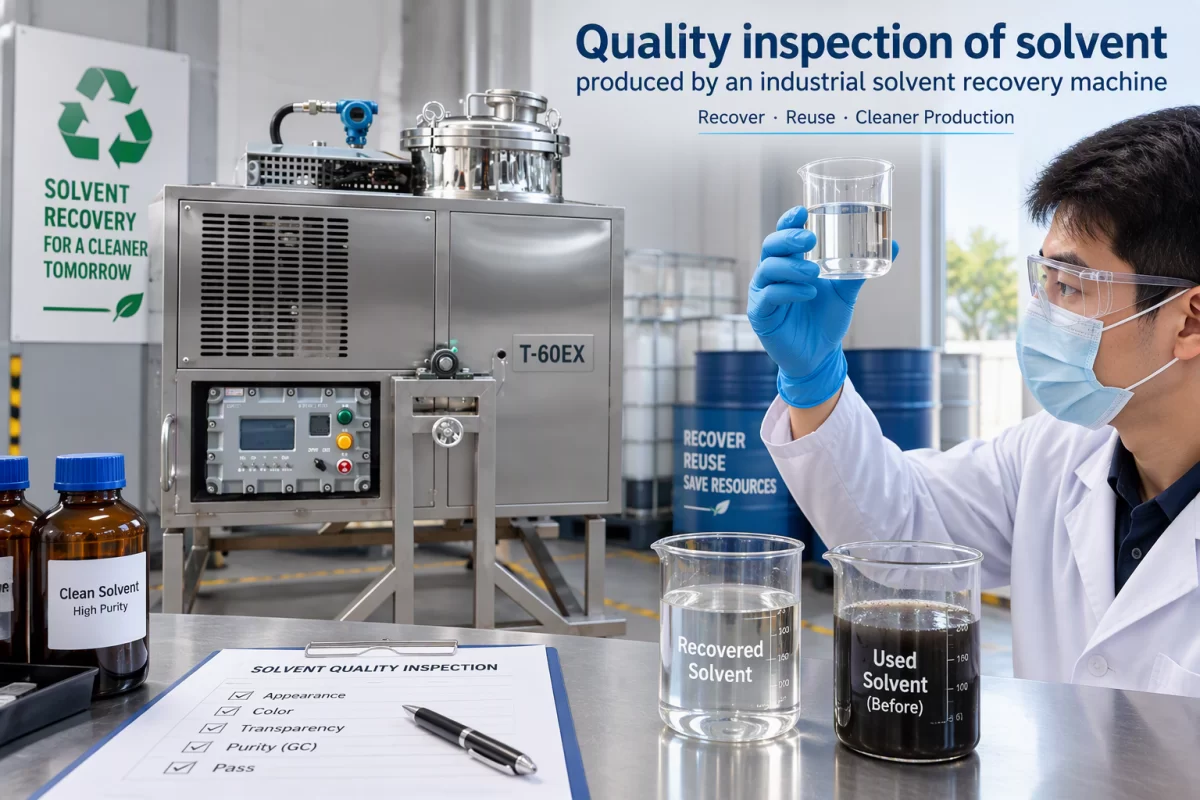
Recovered solvent should be checked against a defined reuse specification before returning to production.
Recovery Must Be Part of a Complete Solvent Management Program
Industrial solvent recovery systems reduce purchases most effectively when supported by source segregation, labeled storage, trained operators, preventive maintenance, and quality control. Mixing incompatible solvents or introducing excessive water can reduce recovery efficiency and create operational problems. Separate collection streams often produce cleaner recovered solvent and more predictable batches.
Safety requirements should be determined from the solvent properties and local regulations. Relevant considerations may include grounding, ventilation, ignition control, approved containers, vapor management, temperature protection, suitable electrical components, personal protective equipment, and emergency procedures. Equipment must be installed and operated according to its technical documentation.
Recovery also supports broader solvent waste management and recycling. Nevertheless, concentrated residue still requires proper characterization, storage, and disposal. Solvent recycling is a waste-reduction method, not permission to bypass applicable environmental or workplace rules.
Turning Used Solvent Into Measurable Purchasing Savings
Industrial solvent recovery systems for reducing solvent purchase costs provide a practical route toward lower material consumption and more efficient waste handling. By separating reusable solvent from ink, resin, pigment, oil, adhesive, and other contaminants, a facility can reduce the volume of fresh material entering the site and minimize the amount of liquid waste leaving it.
The strongest results come from a well-matched system: suitable chemistry, realistic feed capacity, safe machine configuration, consistent operation, and a defined recovered-solvent quality standard. Models ranging from 20 to 400 liters allow equipment capacity to be aligned with different production volumes, while a stated recovery rate of up to 95% creates significant reuse potential for compatible waste streams.
A project should begin with accurate solvent data and a complete cost calculation. When those foundations are in place, solvent recovery can become more than a waste treatment step—it can become a stable internal supply strategy that protects purchasing budgets and improves resource efficiency.