
How to Select ATEX-Certified Solvent Recycling Equipment?
A practical framework for comparing hazardous-area compliance, solvent compatibility, processing capacity, recovery performance, heating power, and operational safety.
Why ATEX Selection Requires More Than Comparing Capacity
Solvent recycling can reduce the purchase of fresh solvent, lower the volume of hazardous waste sent off site, and create a more controlled waste-management process. However, many commonly recovered solvents—including acetone, ethanol, isopropyl alcohol, MEK, xylene, and paint thinner—produce flammable vapors. Equipment operating near those vapors must be selected according to the actual hazardous-area conditions, not simply by tank size or advertised recovery percentage.
ATEX-certified solvent recycling equipment is designed for use within the European explosion-protection framework. The relevant requirements cover equipment intended for potentially explosive atmospheres and the workplace in which that equipment is installed. A suitable machine must therefore be matched to the designated zone, equipment category, gas group, temperature class, ambient conditions, electrical supply, ventilation, and characteristics of the solvent mixture.
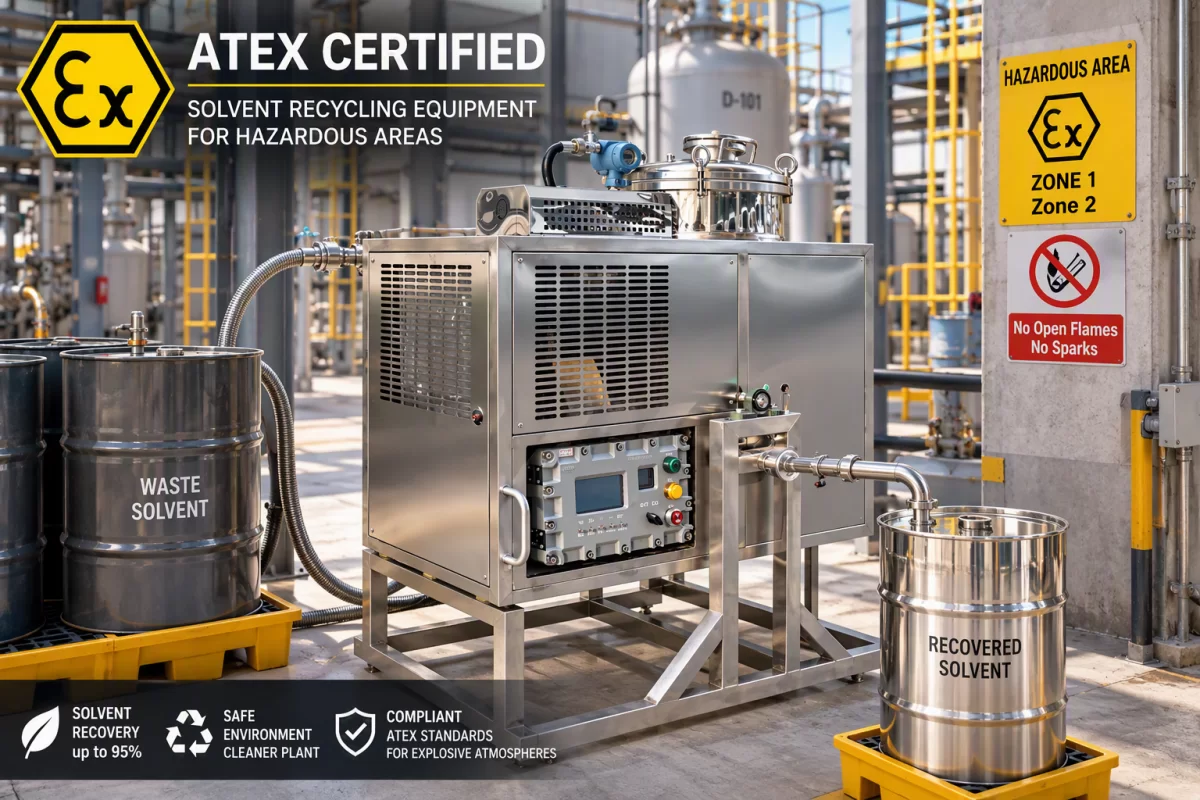
1. Confirm the Hazardous-Area Classification
The first selection step is to obtain the hazardous-area classification from a qualified safety professional. ATEX zones indicate how frequently an explosive gas or vapor atmosphere is present. Zone 0 describes an atmosphere present continuously or for long periods, Zone 1 covers conditions likely to occur occasionally during normal operation, and Zone 2 applies when an explosive atmosphere is not likely during normal operation or exists only briefly.
The selected equipment category and protection concept must be appropriate for the zone. Buyers should also verify the gas group and temperature class. A machine whose maximum permitted surface temperature is too high for the solvent’s ignition characteristics may be unsuitable, even when it is generally described as explosion-proof.
Author’s answer No. In my assessment, an Ex designation is a useful model identifier, but it does not replace certification evidence. The supplier should provide the applicable certificate details, ATEX marking, declaration of conformity, notified-body information where relevant, and installation limitations for the exact configuration being purchased.
Documentation to request from the supplier
ATEX certificate or applicable conformity documentation for the offered configuration.
Complete Ex marking, including equipment group, category, gas group, and temperature class.
EU Declaration of Conformity and a list of applicable standards.
Operating, installation, grounding, maintenance, and emergency instructions.
Drawings identifying certified components and any non-certified accessories.
Permitted ambient temperature, pressure, solvent, and installation conditions.
2. Analyze the Solvent Waste Before Choosing a Machine
A solvent recovery machine separates reusable volatile components from paint solids, resin, oil, pigment, adhesive, ink, or other contaminants, usually through controlled distillation. The boiling behavior of the complete waste stream—not only the name of the main solvent—determines the appropriate operating temperature, cycle time, condenser capacity, residue handling method, and potential recovery yield.
Prepare a solvent profile that includes the composition, approximate contamination level, boiling range, flash point, auto-ignition temperature, water content, acidity, tendency to foam, and possibility of forming peroxides or unstable compounds. Safety data sheets are a starting point, but laboratory testing may be necessary for mixed or variable waste. Solvents that react, polymerize, decompose, or form hazardous residues require specialized evaluation.
Author’s answer No. I recommend confirming each feed mixture individually. Seal materials, tank construction, heating temperature, condenser performance, and residue-discharge design must all be chemically and thermally compatible with the intended waste.
For a clearer explanation of the separation process, review how a solvent recovery system works . Facilities handling paint and cleaning chemicals can also compare purpose-built solvent recycling equipment before establishing a shortlist.
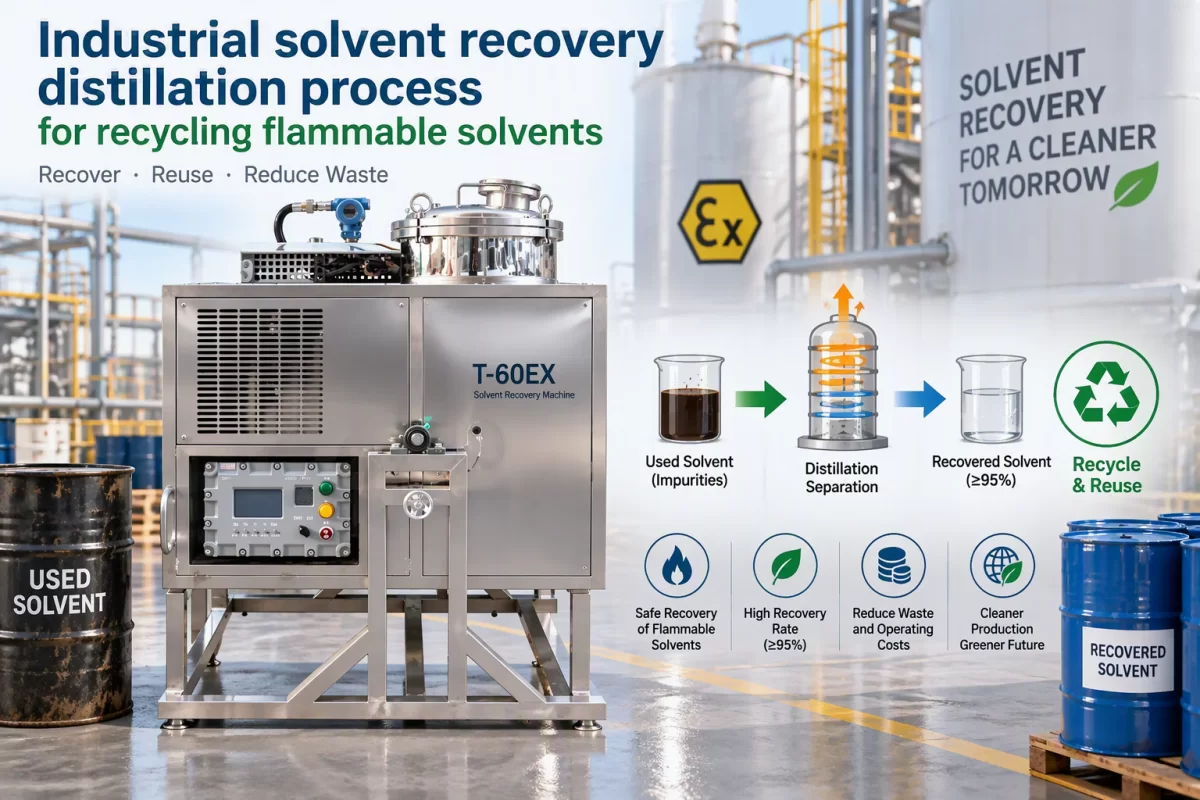
Calculate the required feed capacity
Capacity should be based on the quantity of waste generated per shift or per week. A machine that is too small can create a backlog, while an oversized unit may operate with inefficient partial batches. The calculation should include filling, heating, distillation, cooling, residue removal, cleaning, and preparation for the next cycle.
Evaluate recovered-solvent quality, not recovery rate alone
A stated recovery rate of up to 95% indicates the potential volume recovered under suitable feed and operating conditions. Actual performance depends on solvent content, boiling range, contamination, residue retention, operating settings, and unavoidable process losses. More importantly, the recovered solvent must meet the quality required by the intended application.
Paint-gun washing may accept a different purity level than precision electronics cleaning. Representative feed samples should be tested, and the recovered product can be evaluated for purity, moisture, color, residue after evaporation, or application-specific cleaning performance. Further information is available in this guide to the solvent recovery distillation unit .
3. Compare Explosion-Protected Solvent Recycler Specifications
The following models provide feed capacities from 20 to 400 liters. All listed units use a 380 VAC power supply, offer an operating range from room temperature to 200°C, and have a stated recovery performance of up to 95% under appropriate processing conditions. Treatment time increases with machine capacity and should be incorporated into the facility’s production plan.
| Model | Feed Capacity (L) | Power Supply (ACV) | Heating Power (kW) | Temperature Range (°C) | Treatment Time (min) | Recovery (%) | Weight (kg) | Dimensions (mm) |
|---|---|---|---|---|---|---|---|---|
| T-20Ex | 20 | 380 | 2 | RT–200 | 120 | Up to 95 | 153 | 860 × 760 × 1190 |
| T-60Ex | 60 | 380 | 4 | RT–200 | 150 | Up to 95 | 170 | 1160 × 870 × 1260 |
| T-80Ex | 80 | 380 | 5 | RT–200 | 180 | Up to 95 | 200 | 1180 × 850 × 1290 |
| T-125Ex | 125 | 380 | 6 | RT–200 | 210 | Up to 95 | 280 | 1250 × 920 × 1450 |
| T-250Ex | 250 | 380 | 16 | RT–200 | 240 | Up to 95 | 520 | 2600 × 1200 × 1950 |
| T-400Ex | 400 | 380 | 32 | RT–200 | 270 | Up to 95 | 1200 | 1990 × 1850 × 2090 |
Author’s answer No. I would match usable batch capacity to real waste generation and the number of practical cycles available per shift. Floor loading, doorway dimensions, ventilation, power supply, residue handling, and future production growth should then be checked before the final model is selected.
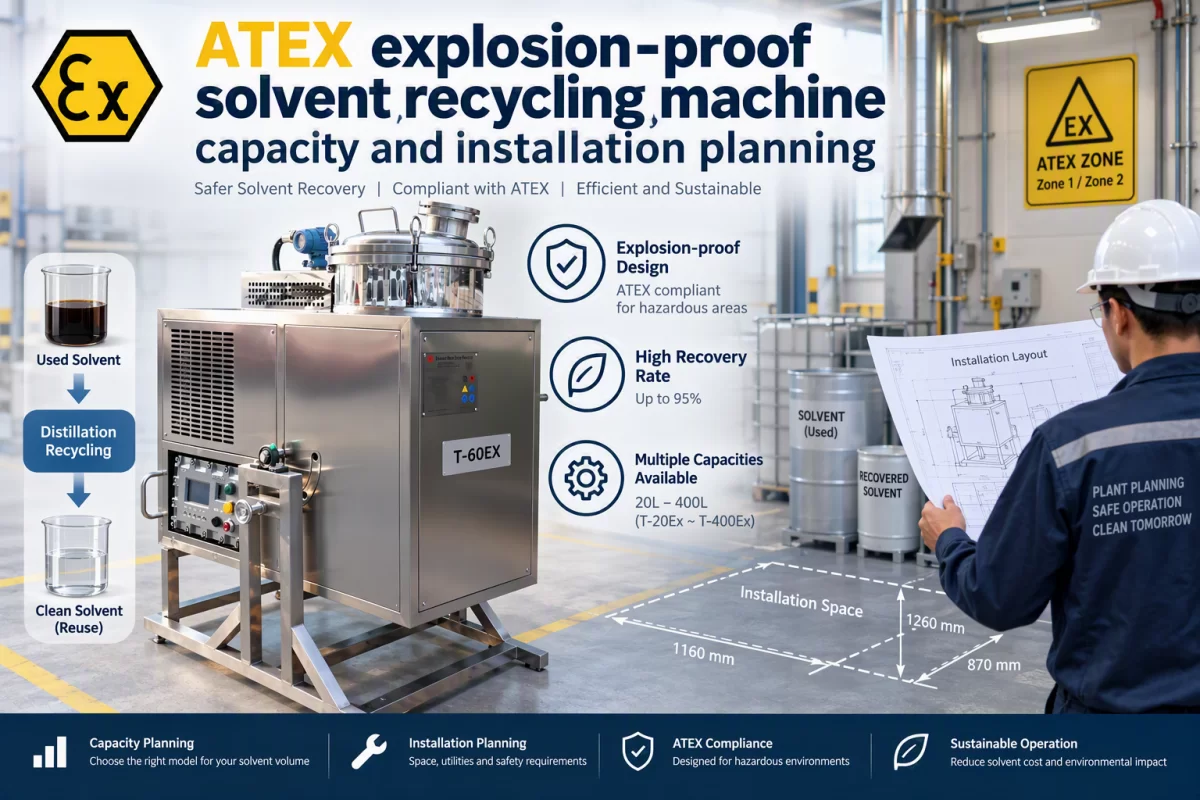
4. Inspect Safety, Automation, and Installation Details
Safe solvent recovery depends on more than the distillation tank. Heating controls, temperature sensors, vapor piping, condenser performance, grounding connections, seals, cable entries, motors, and control enclosures should form a coordinated protection system. The installation must also comply with local electrical, fire, environmental, occupational-safety, and hazardous-waste regulations.
Essential safety functions to evaluate
Independent over-temperature protection and clearly defined alarm responses.
Reliable grounding and bonding points to control static electricity.
Certified electrical components appropriate for the designated hazardous zone.
Controlled vapor condensation with sufficient cooling capacity.
Secure lid closure, suitable gaskets, and vapor-tight process connections.
Emergency shutdown functions that move the machine to a safe condition.
Clear residue-removal procedures that minimize operator exposure.
Accessible preventive-maintenance points and approved replacement components.
Automation can improve consistency by controlling heating stages, monitoring vapor temperature, ending the cycle at a defined point, and displaying alarms. Nevertheless, automatic operation does not make an incompatible or unstable feed safe. Operators must be trained to identify prohibited materials, verify fill levels, inspect grounding, and respond correctly to abnormal conditions.
Site preparation and total operating cost
Verify that 380 VAC power is available and suitable for the selected heating load. The installation area must provide adequate ventilation, cooling services where required, safe storage for feed and recovered solvent, spill containment, fire-protection measures, and enough clearance for operation and maintenance. Larger units also require an assessment of floor loading and material-handling access.
Purchase price is only one part of the economic decision. A useful comparison includes fresh-solvent savings, hazardous-waste disposal reduction, electricity consumption, cooling demand, labor, recovery bags or liners, maintenance, spare parts, testing, and expected service life. A sample recovery test offers better economic evidence than a generic percentage because it estimates both recoverable volume and the suitability of the recovered product for reuse.
Final Procurement Checklist
Before issuing a purchase order for ATEX-certified solvent recycling equipment, confirm each of the following points in writing:
The hazardous zone, equipment category, gas group, and temperature class have been defined.
The offered configuration has traceable ATEX conformity documentation.
The complete solvent mixture has been reviewed for compatibility and stability.
Feed capacity and treatment time match actual waste generation.
Recovered solvent quality has been evaluated using a representative sample.
The electrical supply, ventilation, cooling, floor loading, and service clearances are adequate.
Operators can receive installation, operation, and emergency-response training.
Approved spare parts, technical support, and maintenance procedures are available.
Local fire, environmental, electrical, and hazardous-waste rules have been addressed.
The best selection is not automatically the machine with the greatest capacity or heating power. It is the system whose certified protection level matches the installation, whose materials and operating range suit the actual solvent waste, and whose capacity supports the plant’s daily workflow. A disciplined review of documentation, samples, specifications, and site conditions produces a safer and more economical solvent recovery project.
Select a Solvent Recycler for the Actual Application
Prepare the solvent safety data sheets, daily waste volume, contamination percentage, required recovered-solvent quality, hazardous-area classification, and available utilities. These details allow an appropriate T-20Ex, T-60Ex, T-80Ex, T-125Ex, T-250Ex, or T-400Ex configuration to be evaluated efficiently.
Explore Solvent Recovery MachinesTechnical suitability and ATEX compliance should be confirmed for the exact machine, solvent mixture, and installation location before operation.