Practical guide · Solvent Recovery Machine
How can I recycle used solvents to cut disposal costs?
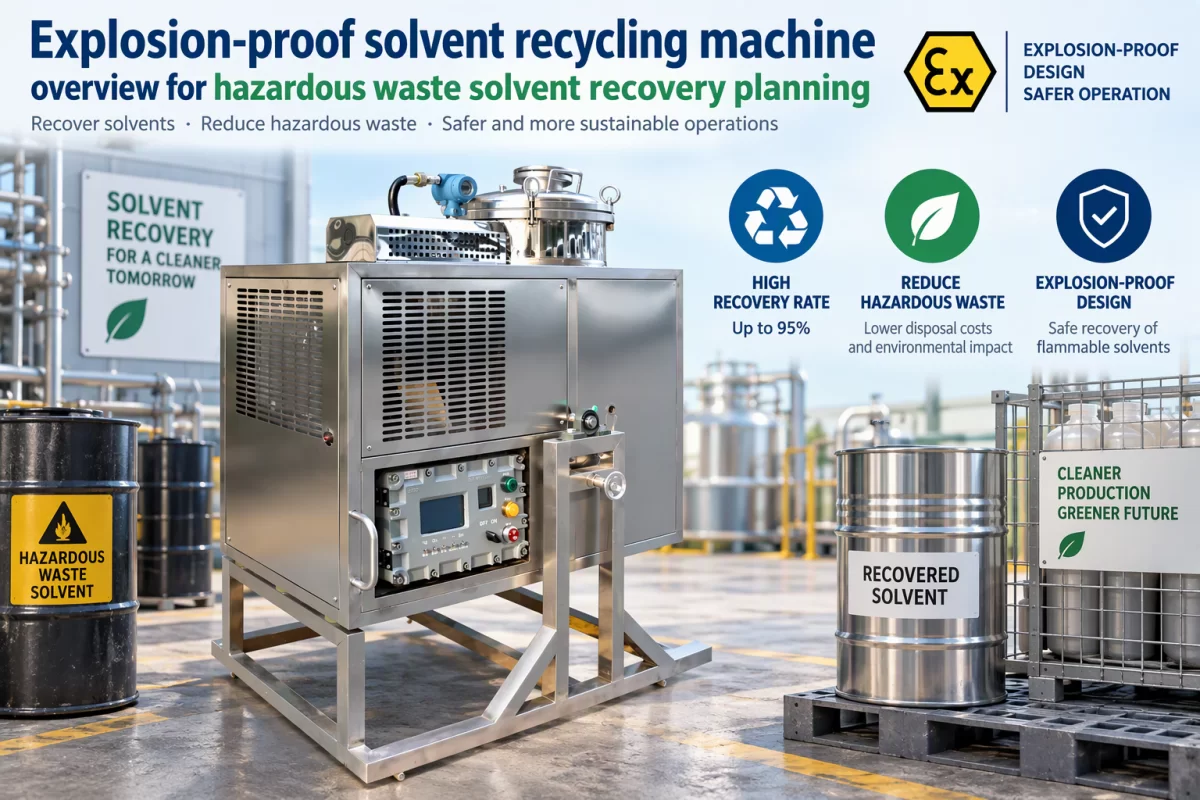
Start by separating suitable waste streams, confirming that distillation can recover solvent fit for reuse, and matching a Solvent Recovery Machine to the volume generated. The financial benefit comes from reducing both fresh-solvent purchases and the amount of waste sent for disposal—not from eliminating waste management altogether.
Begin with a used-solvent waste audit
Used cleaning solvents often contain material removed during production or maintenance. A Solvent Recovery Machine is intended to reclaim the solvent fraction from suitable contaminated liquids so that it can be considered for another cleaning or process cycle. Before buying equipment, record the solvent identity, contamination, water content, waste volume, current disposal charges, and fresh-solvent consumption.
Keep known, compatible streams separate. Combining unrelated wastes can make recovery more difficult and create safety or quality problems. Review safety data sheets and obtain a supplier assessment of a representative sample. Unknown mixtures, reactive contaminants, and materials that may become hazardous when concentrated require specialist evaluation rather than a routine recovery trial.
How solvent distillation supports lower disposal costs
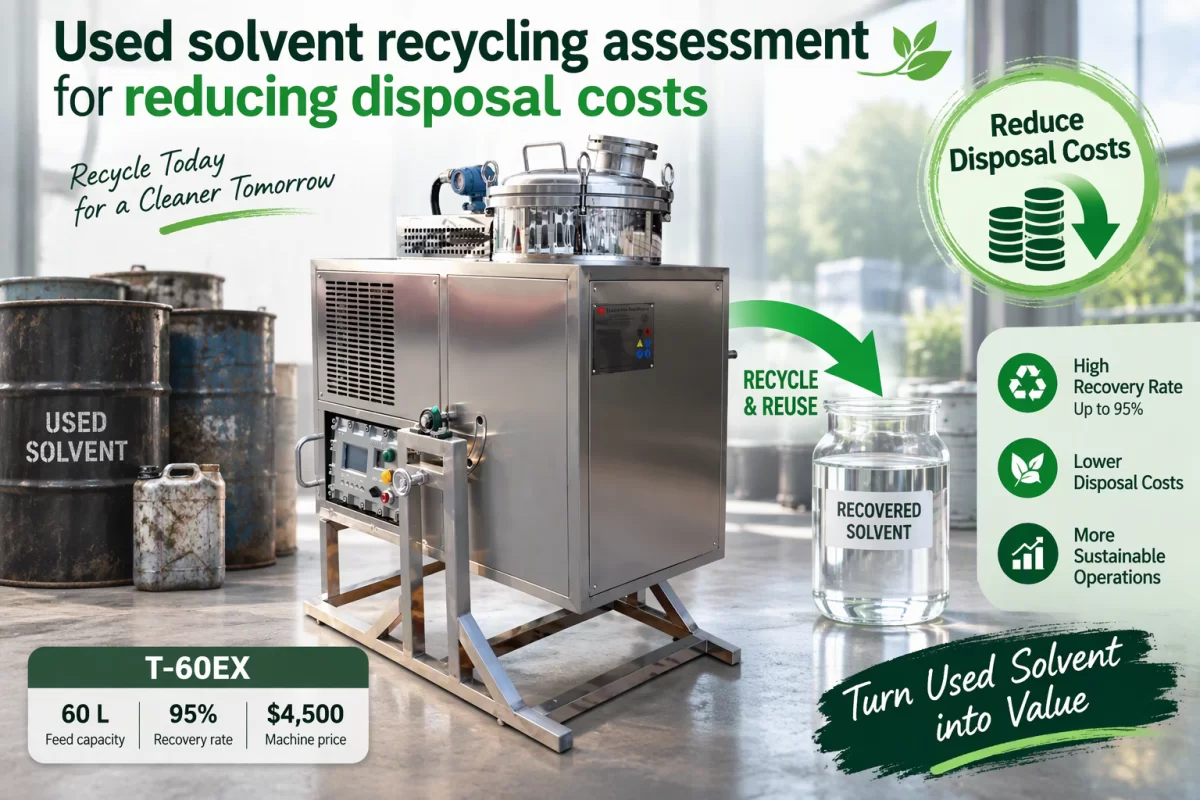
Distillation separates materials according to their volatility. In a typical solvent recovery process, controlled heating produces solvent vapor, which is cooled in a condenser and collected as liquid. Less-volatile contamination remains as concentrated residue. The recovered liquid must then be checked against the requirements of its intended reuse.
This principle does not mean every mixture will produce a pure solvent. Water, volatile contaminants, and multiple solvents may carry into the distillate or affect its composition. Recovery percentage and product purity are different measurements. For more background, read our explanation of how a solvent recovery system works.
Operation should follow the supplied manual and a site-specific safety assessment. Qualified personnel should confirm electrical installation, ventilation, grounding and bonding, solvent handling arrangements, and any applicable hazardous-area requirements. Do not treat a model suffix or a general sales description as proof of suitability for a particular installation.
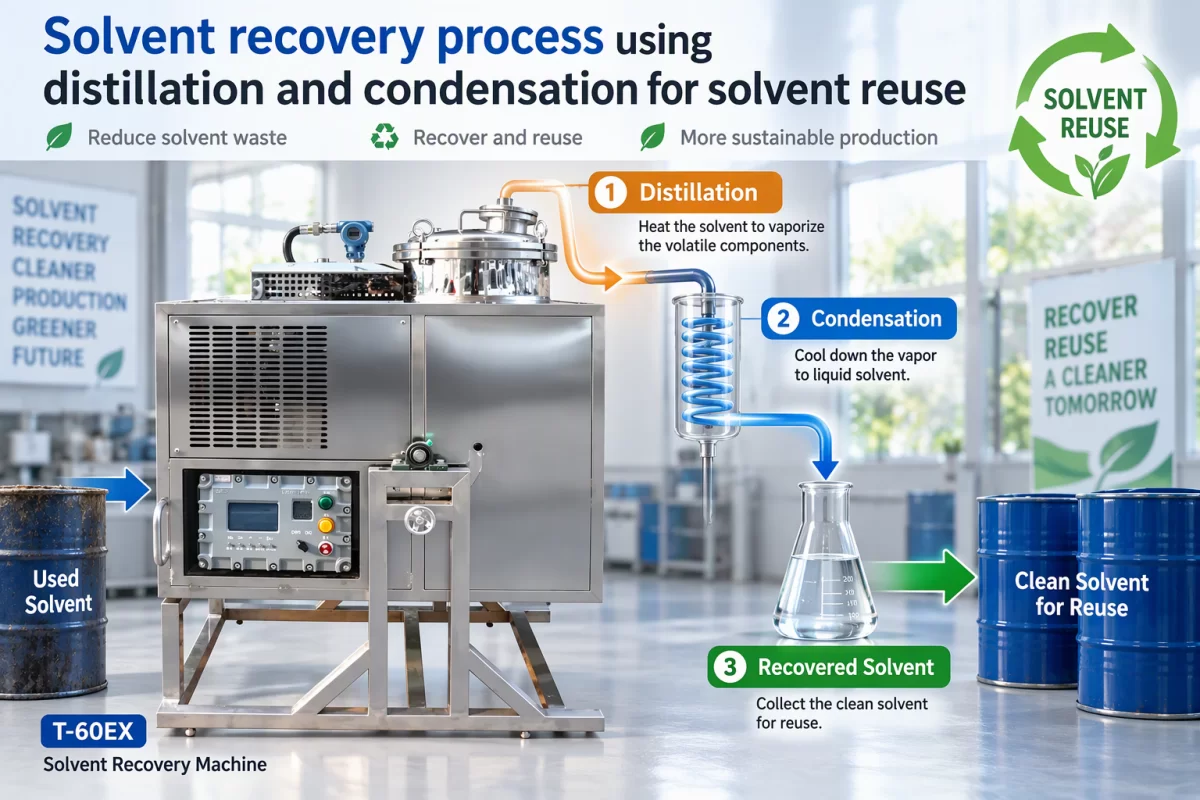
Compare Solvent Recovery Machine specifications
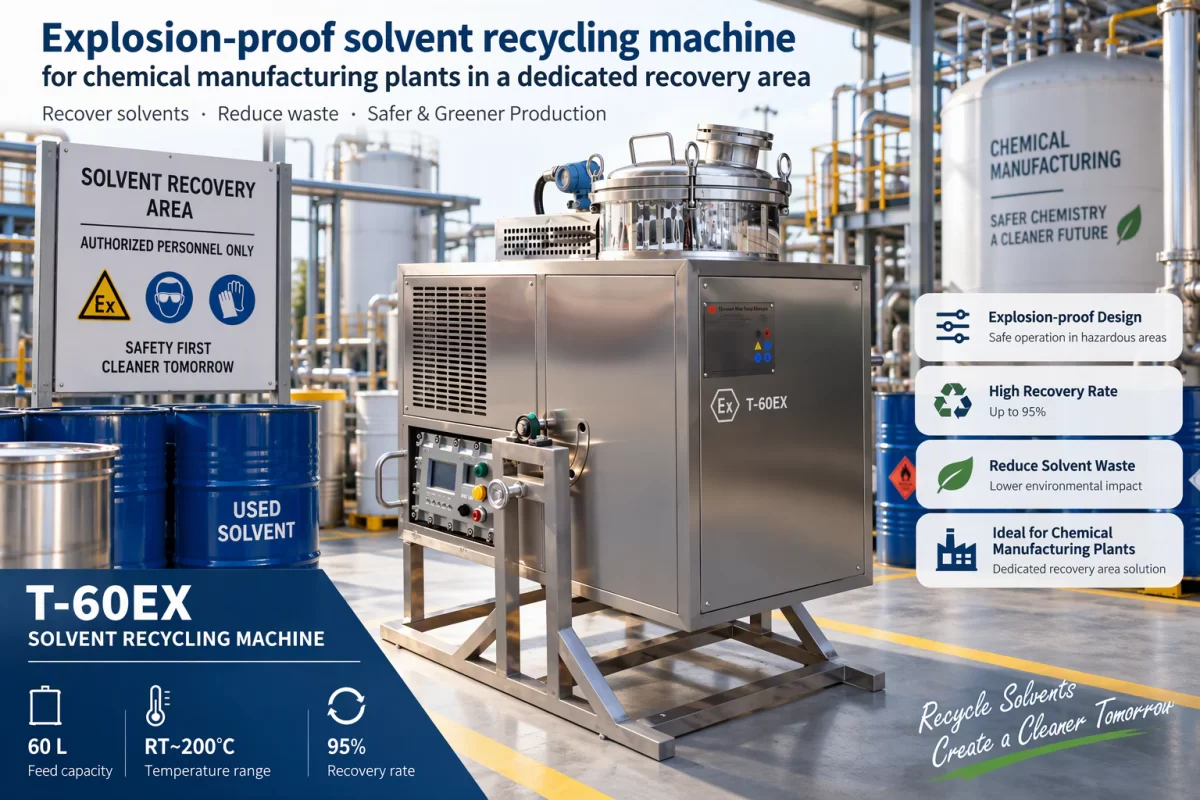
The supplied parameter sheet lists six models, from the 20 L T-20Ex to the 400 L T-400Ex. Every listed model specifies a 380 V AC power supply, a temperature range from room temperature to 200°C, and 95% recovery. Heating power, treatment time, weight, and machine dimensions vary by model.
| Model | Feed capacity (L) | Supply (V AC) | Heating power (kW) | Temperature (°C) | Treatment time (min) | Recovery (%) | Weight (kg) | Machine size (mm) |
|---|---|---|---|---|---|---|---|---|
| T-20Ex | 20 | 380 | 2 | RT–200 | 120 | 95 | 153 | 860 × 760 × 1190 |
| T-60Ex | 60 | 380 | 4 | RT–200 | 150 | 95 | 170 | 1160 × 870 × 1260 |
| T-80Ex | 80 | 380 | 5 | RT–200 | 180 | 95 | 200 | 1180 × 850 × 1290 |
| T-125Ex | 125 | 380 | 6 | RT–200 | 210 | 95 | 280 | 1250 × 920 × 1450 |
| T-250Ex | 250 | 380 | 16 | RT–200 | 240 | 95 | 520 | 2600 × 1200 × 1950 |
| T-400Ex | 400 | 380 | 32 | RT–200 | 270 | 95 | 1200 | 1990 × 1850 × 2090 |
Reading the data: RT means room temperature. Feed capacity is not an hourly throughput rating. The sheet does not define recovery test conditions, dimension-axis order, or total cycle time including loading, cooling, and residue removal. Confirm these details for the proposed application. The listed temperature range is not a recommended operating setpoint for every solvent.
Relevant applications and model-selection priorities
The supplied product listings cover printing-industry solvent recovery, electronics cleaning with IPA, ethyl acetate recovery, dirty xylene and toluene distillation, hydrocarbon cleaning solvents, and alcohol recovery for cosmetics-related production. These listings indicate application categories to discuss with the supplier; they do not establish that every model in the table is suitable for every listed solvent.
For an electronics-cleaning operation, recovered IPA should be evaluated against the process requirements before returning it to use. Water and trace contamination can matter even when the liquid appears clear. Our guide to isopropyl alcohol disposal and recycling considerations provides relevant waste-handling context.
- Match capacity to waste generation: Compare the collected volume with the listed feed capacity and available operating hours. Include handling, cleaning, and downtime rather than sizing from treatment time alone.
- Confirm utilities and installation space: Check the 380 V AC requirement, heating-power demand, floor loading, access route, and service clearances. Machine dimensions alone do not define the complete installation footprint.
- Define reuse quality: Agree on suitable tests and acceptance criteria for the intended cleaning or production task. More demanding applications may need additional treatment or a different recovery approach.
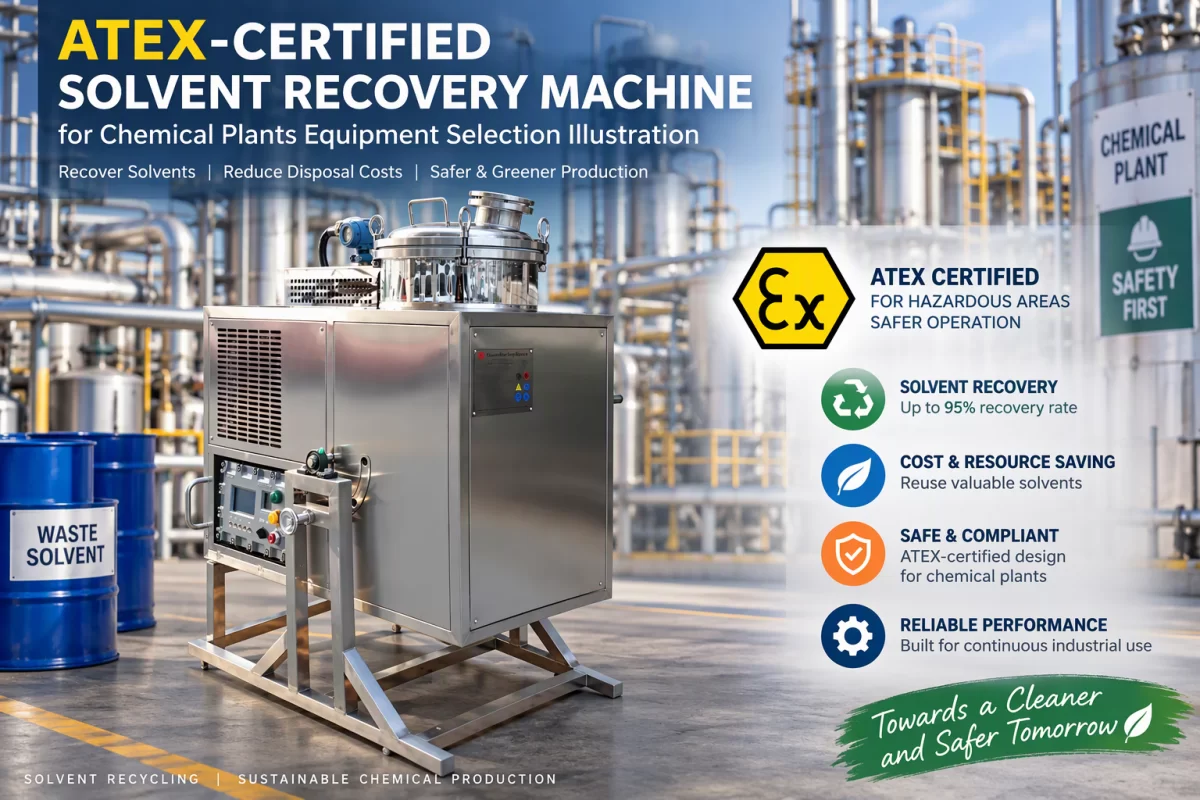
- Verify safety and documentation: Some supplied listings use “explosion-proof” descriptions, and one printing-industry listing states CE certification. Do not extend those claims to the entire series; request documentation for the exact quoted machine and its intended use.
- Plan maintenance and residue handling: Ask about cleaning access, consumables, spare parts, operator training, and disposal of concentrated residue.
Evaluate reference pricing and the value of solvent reuse
A recovery investment should be evaluated against the current combined cost of solvent purchasing and waste disposal. The supplied company price list contains repeated price ranges alongside several other listed prices. Sorting the listed price entries from low to high places the repeated range below at the middle entry.
This is a reference range from the supplied company listings, not a model-specific quotation. Actual pricing is subject to configuration and the quotation issued following an inquiry.
The supplied files do not map this reference range to each of the six parameter-sheet models. Request an itemized quotation covering the selected machine, required options, installation scope, and any additional charges before calculating project payback.
Operating costs should include electricity, labor, consumables, maintenance, quality testing, and residual-waste disposal. Only count recovered solvent that actually replaces fresh purchases. Use measured electricity consumption from a representative trial where possible: heating power in kW is not the same as energy consumption in kWh.
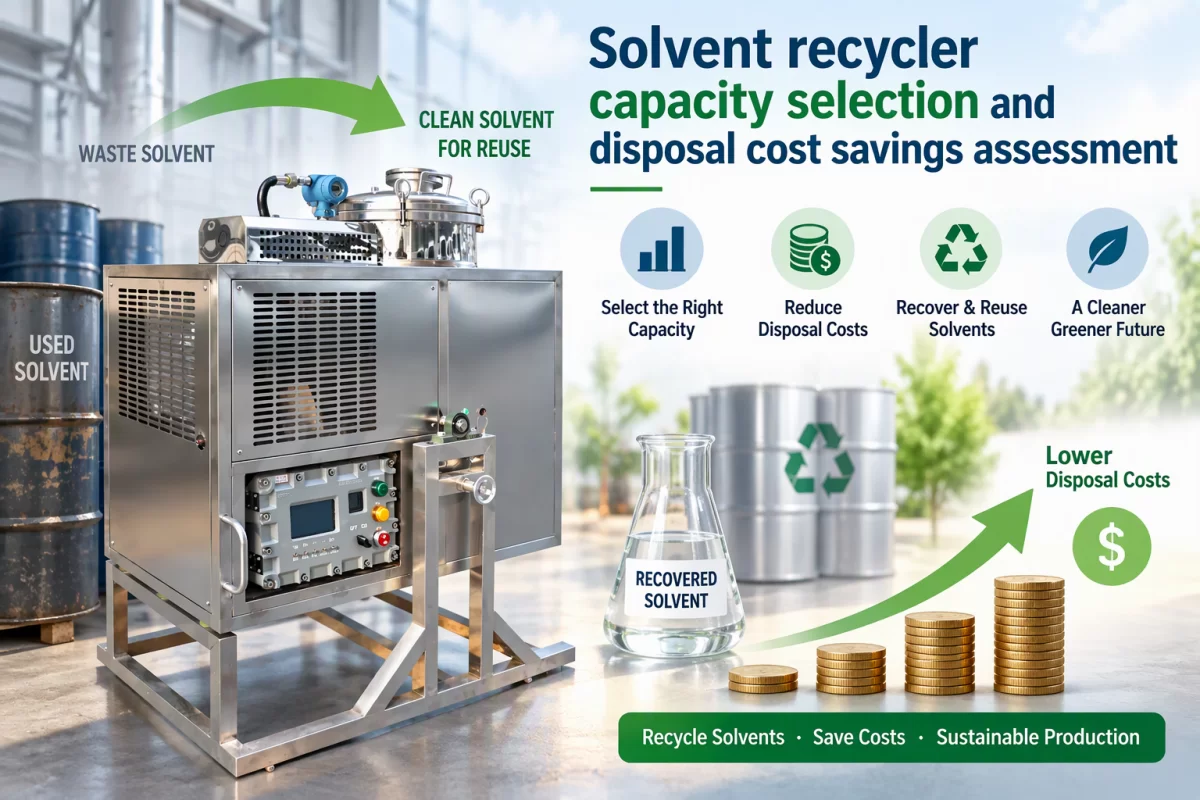
Recycle used solvents with a measured cost-reduction plan
The practical answer to cutting solvent disposal costs is to recover a suitable solvent stream, validate the recovered liquid, and reuse it where it meets process requirements. A Solvent Recovery Machine can support that approach, but its purchasing value depends on waste compatibility, realistic capacity planning, installation suitability, and verified operating economics.
Use the six-model specification table as a starting point—not a substitute for an application review. Bring waste data and reuse criteria to the supplier, request a configuration-specific quotation, and base the decision on demonstrated usable recovery rather than an assumed savings percentage.
Explore solvent recycling equipment