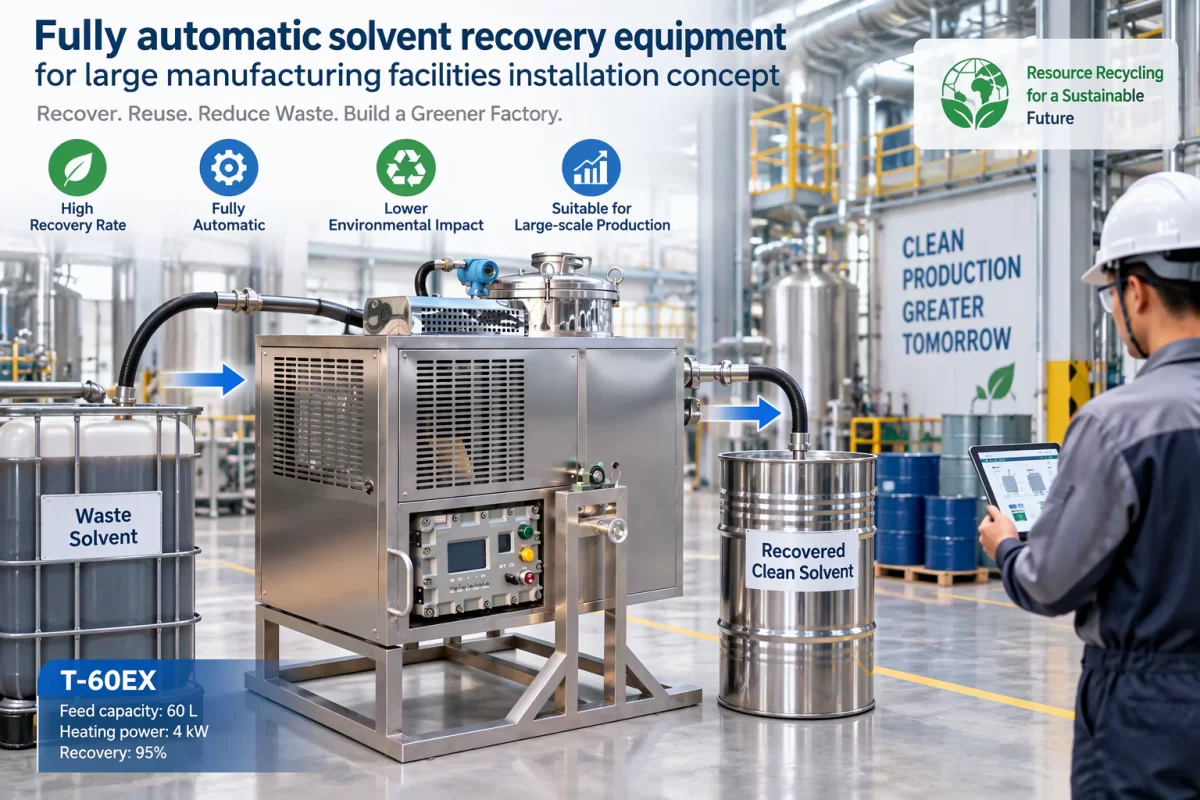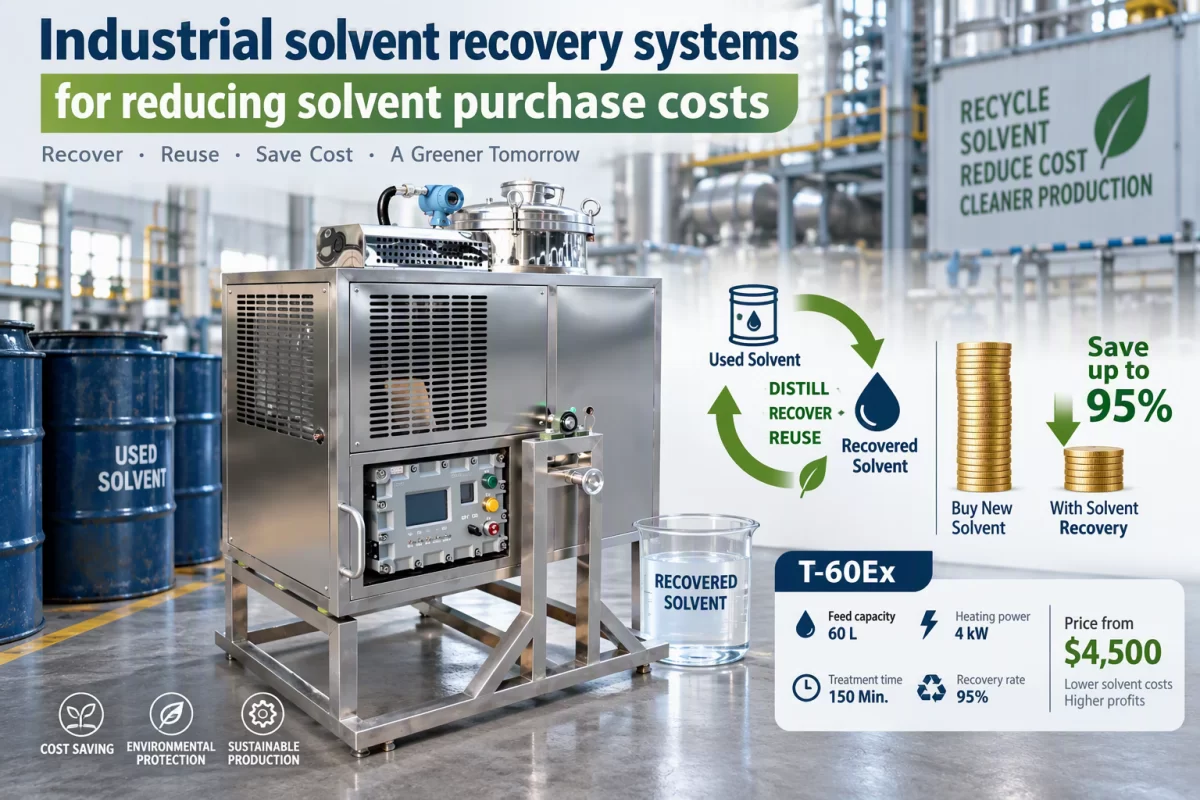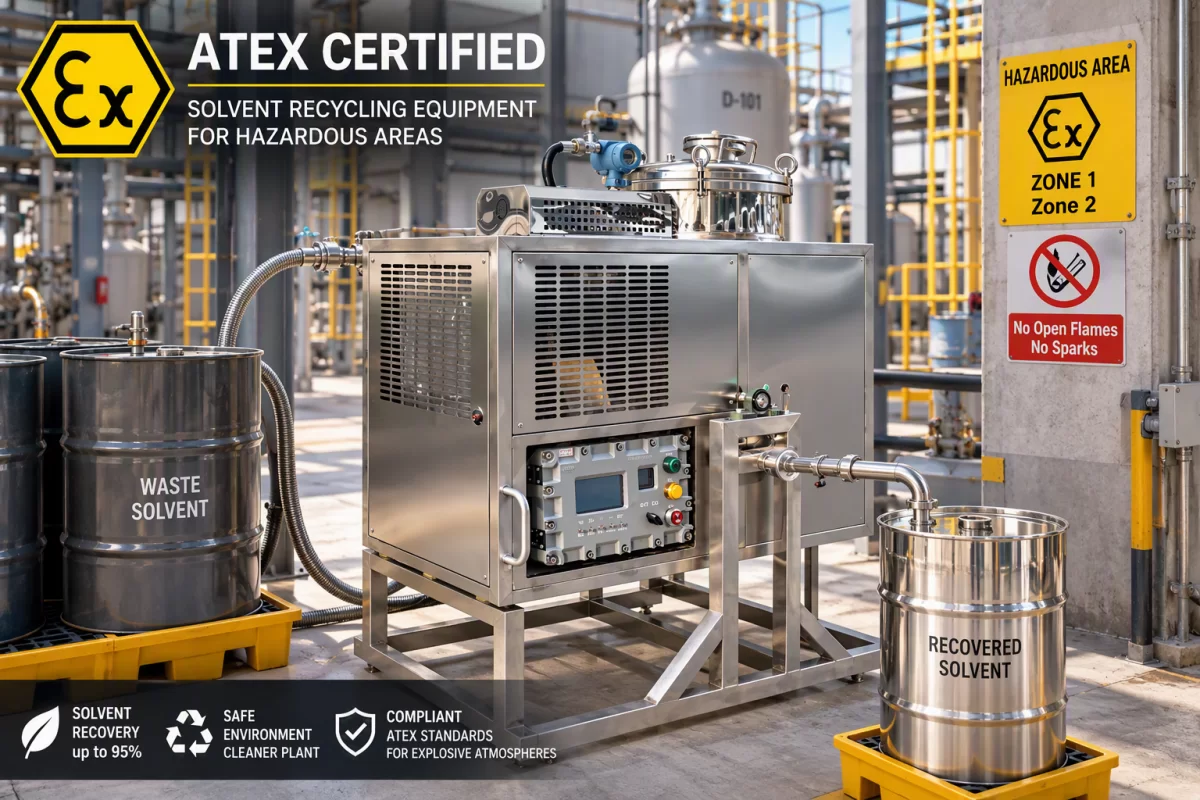
Explosion-Proof Solvent Recycling Machine for Chemical Manufacturing Plants
Turn suitable spent solvents into reusable process resources with a recovery system selected around solvent chemistry, production demand, and hazardous-area requirements.
Recover Value from Everyday Chemical Plant Waste
Chemical manufacturing generates spent solvents during reactor cleaning, equipment flushing, formulation changes, and production-line maintenance. These liquids may contain resin, oil, pigment, or other process residues, yet a substantial portion can still be valuable solvent. Discarding the entire stream means paying for replacement solvent while also managing a larger waste volume.
An explosion-proof solvent recycling machine for chemical manufacturing plants can help establish an on-site recovery loop for suitable feed streams. Distillation separates volatile solvent from less volatile contamination, allowing approved recovered liquid to return to a defined cleaning or production application. The commercial advantage is strongest when waste composition is reasonably consistent and there is an ongoing demand for the recovered solvent.
Recovery is not simply a waste-treatment purchase. It is a process improvement that connects purchasing, production, quality control, and environmental management. FANBOLUN’s listed equipment capacities provide a practical starting point for matching this improvement to plant-scale requirements.
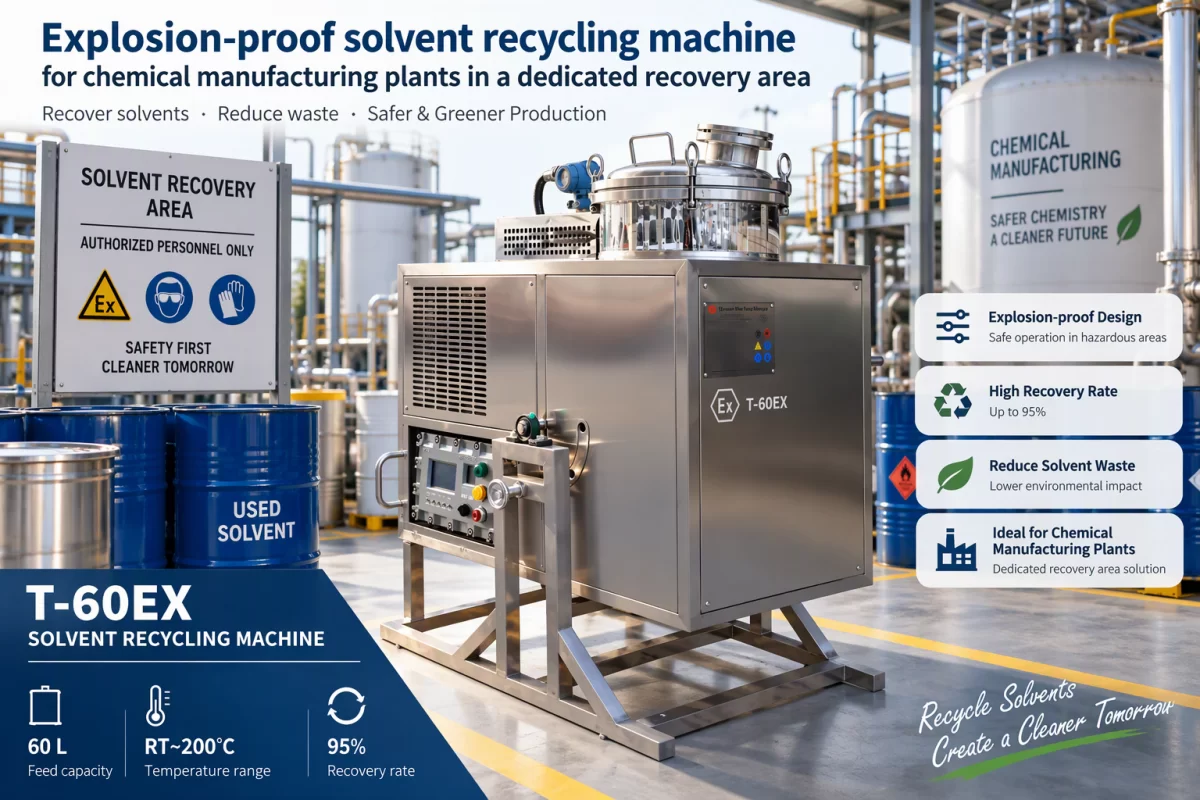
Explosion-Proof Selection Starts with Verified Suitability
Flammable solvent vapor makes equipment selection especially important in chemical plants. However, an “Ex” model designation or an explosion-proof product description is not, by itself, proof that a machine is suitable for every hazardous location. The actual protection method, certification scope, gas group, temperature class, and permitted installation conditions must match the plant’s assessment.
Before procurement, request the relevant certificates and technical documentation for the exact supplied configuration. Where applicable, confirm ATEX or IECEx requirements; for other jurisdictions, verify the locally accepted hazardous-location approvals. The specification information presented here does not establish a particular certification status.
Assess the feed: document solvent identity, flash point, boiling behavior, contamination, water content, and chemical stability.
Check the installation: evaluate ventilation, electrical classification, bonding and grounding, transfer connections, and spill containment.
Review protective functions: confirm the required temperature limits, shutdown logic, cooling safeguards, and pressure or vacuum protections for the proposed system.
Define operating controls: establish approved feed limits, maintenance routines, operator training, and residue-handling procedures.
How the Solvent Recovery Loop Works
In a typical batch distillation process, an approved quantity of spent solvent enters the recovery vessel. Controlled heating vaporizes the recoverable fraction, and a condenser returns that vapor to liquid form. Less volatile contaminants remain in the vessel as concentrated residue. The collected distillate is then tested against its intended reuse specification.
This principle is useful for many solvent-rich cleaning streams, but not every chemical waste is suitable. Mixed solvents may change composition during distillation, and water-containing mixtures can encounter separation limits such as azeotropes. Reactive, unstable, or peroxide-forming materials require specialist evaluation rather than routine acceptance.
A closer explanation of the solvent recovery process can support discussions between production staff and the equipment supplier. The essential objective is a controlled, documented recovery route—not simply collecting a clear-looking liquid.
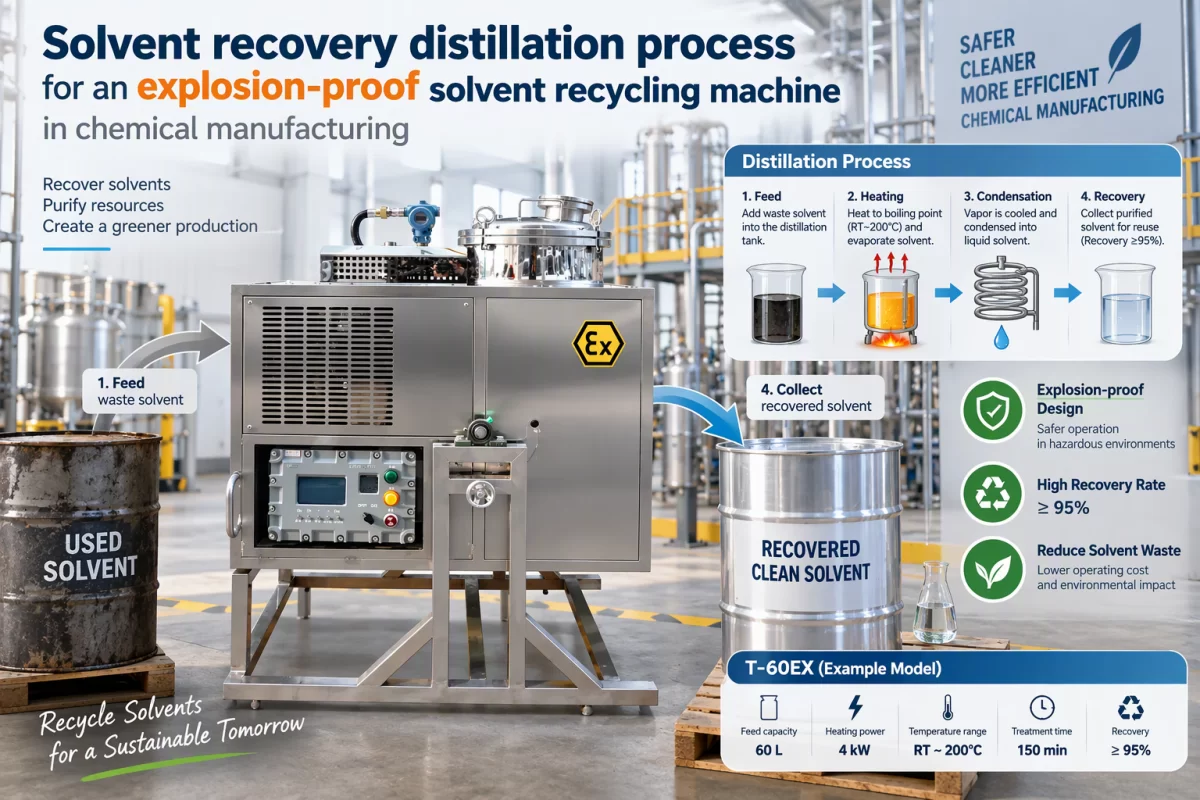
Compare FANBOLUN T-Series Batch Specifications
The following specifications show six listed T-series models, from the compact T-20Ex to the larger T-400Ex. Feed capacity is expressed in liters per batch, not liters per hour. Heating power and listed treatment time help frame utility requirements and scheduling, but neither figure alone determines real daily throughput.
On smaller screens, swipe or scroll horizontally to view all specification columns.
| Model | Feed capacity (L) | Supply (V AC) | Heating power (kW) | Temperature range (°C) | Treatment time (min) | Recovery (%) | Weight (kg) | Dimensions (mm) |
|---|---|---|---|---|---|---|---|---|
| T-20Ex | 20 | 380 | 2 | RT–200 | 120 | 95 | 153 | 860 × 760 × 1190 |
| T-60Ex | 60 | 380 | 4 | RT–200 | 150 | 95 | 170 | 1160 × 870 × 1260 |
| T-80Ex | 80 | 380 | 5 | RT–200 | 180 | 95 | 200 | 1180 × 850 × 1290 |
| T-125Ex | 125 | 380 | 6 | RT–200 | 210 | 95 | 280 | 1250 × 920 × 1450 |
| T-250Ex | 250 | 380 | 16 | RT–200 | 240 | 95 | 520 | 2600 × 1200 × 1950 |
| T-400Ex | 400 | 380 | 32 | RT–200 | 270 | 95 | 1200 | 1990 × 1850 × 2090 |
Size the Machine Around the Complete Operating Cycle
For preliminary planning, a 125-liter waste stream appears to align with the listed capacity of the T-125Ex. Nevertheless, permitted fill levels, foaming behavior, loading time, cooling, cleaning, and residue removal must be confirmed before establishing a production schedule. Larger plants should also consider maintenance downtime and changing waste volumes rather than selecting capacity solely from average daily generation.
Make Reuse Quality Part of the Recovery Plan
Acetone, ethyl acetate, alcohols, toluene, and xylene may be candidates for recovery when the feed and equipment are compatible. Their suitability still depends on the contaminants present and the required output quality. Solvent recovered for general equipment cleaning may have different acceptance limits from solvent used in a sensitive chemical formulation.
Establish application-specific tests for water content, composition, nonvolatile residue, and other critical contaminants. Clear appearance alone does not demonstrate purity. For acetone-rich cleaning streams, the guidance on acetone recycling provides useful application context.
Segregating incompatible waste streams before recovery can improve consistency and simplify validation. Distillation residue, rejected batches, and unsuitable feed still require compliant handling. Integrating recovery with a documented solvent waste management program helps keep material tracking and disposal responsibilities clear.
FANBOLUN Equipment Price References
Equipment cost should be reviewed together with process suitability and the final supply scope. The following are FANBOLUN company price references from the supplied product listings. They are not competitor prices and should not be treated as model-specific quotations for the six machines in the specification table.
Grade Solvent Recovery Machine and IPA Recovery Machine for Electronics Cleaning, Featuring Continuous Solvent Recovery
An application-specific price reference for IPA-related recovery discussions. Chemical plant use, continuous-operation capability for the intended feed, and explosion-protection suitability require separate confirmation.
Stable Larger T-450Ex Solvent Recovery Unit for Recovering Waste Organic Solvent
A larger-unit purchasing reference from a separate product listing. The T-450Ex is not included in the T-series parameter table above; its capacity, utilities, dimensions, and approval documentation must be confirmed independently.
A final quotation should identify the exact model, solvent application, protection requirements, accessories, and delivery terms. Confirm freight, taxes, installation, commissioning, and any optional equipment before calculating the complete project investment.
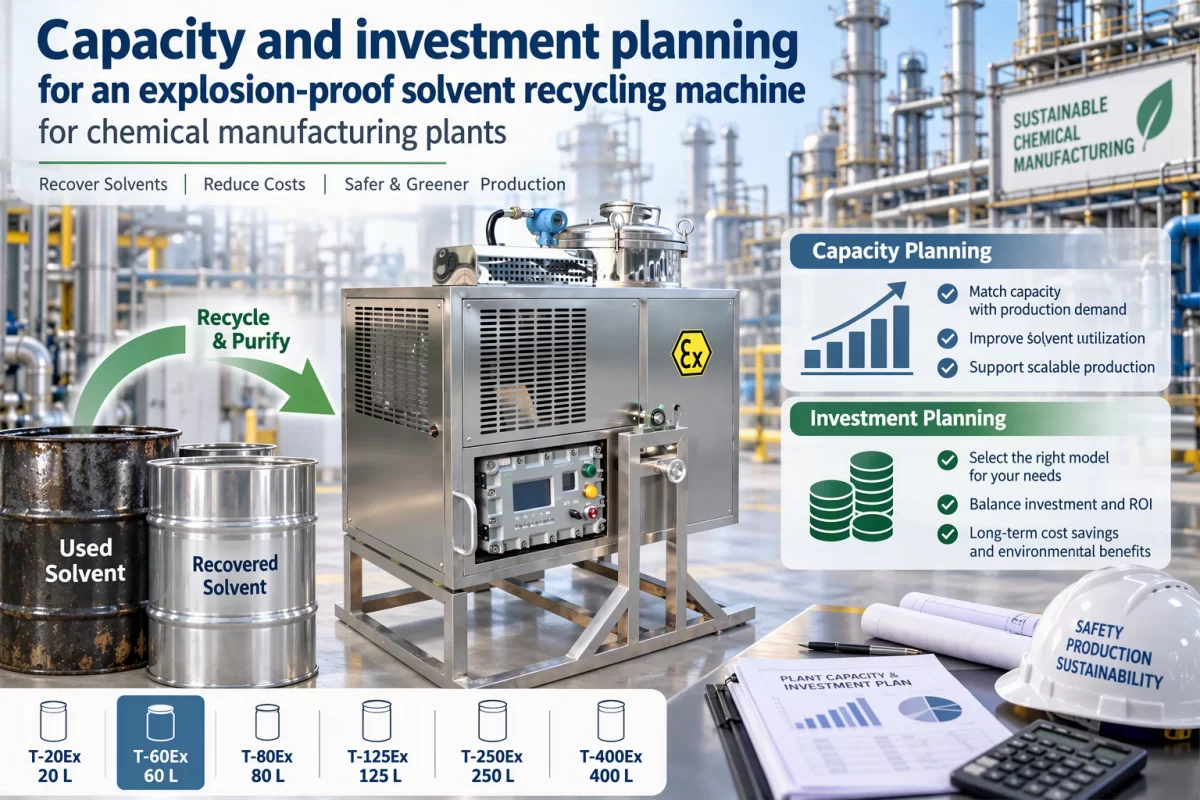
Measure Savings with Plant-Specific Operating Data
The economic case for solvent recycling comes from replacing some fresh-solvent purchases and potentially reducing the quantity sent for external disposal. These benefits must be balanced against electricity, cooling, labor, maintenance, quality testing, and remaining residue disposal.
Calculate savings using the volume of recovered solvent that actually passes acceptance testing and displaces a fresh purchase. Heating power is an installed rating, not a direct measurement of electricity consumed per batch. Metered trial data provide a more reliable cost estimate than multiplying nameplate power by an assumed operating schedule.
Build a Practical Solvent Recovery Project
Selecting an explosion-proof solvent recycling machine for chemical manufacturing plants requires a balanced view of safety, capacity, quality, and operating economics. FANBOLUN’s listed T-series specifications and company price references offer useful starting points, while feed testing and verified hazardous-area suitability establish the basis for a responsible purchase.
For a focused equipment assessment, prepare the solvent names, representative waste composition, daily volume, intended reuse specification, available utilities, and site classification. These details allow the proposed recovery configuration to be evaluated against real production conditions. With the right fit, on-site solvent recycling can help reduce fresh-solvent demand, concentrate waste into a more manageable residue stream, and support a more resource-efficient chemical manufacturing operation.