Explosion-proof solvent recycling machine for hazardous waste solvents
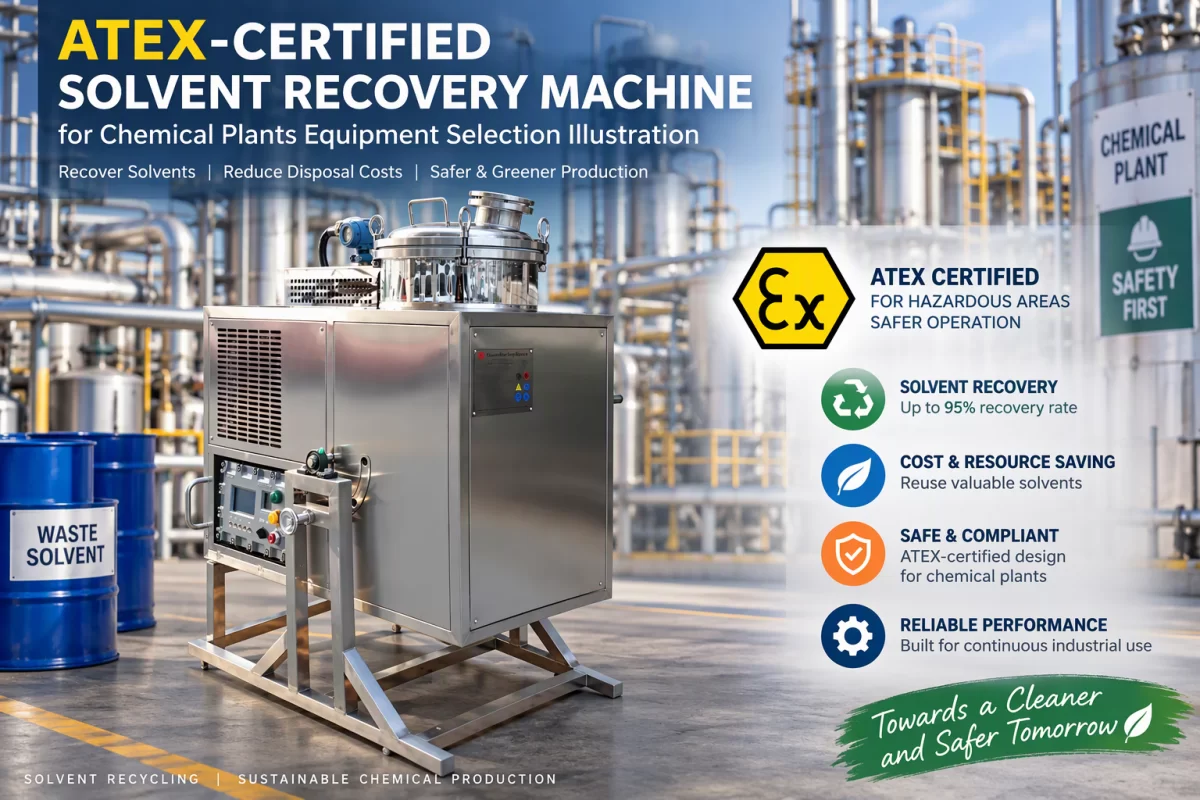
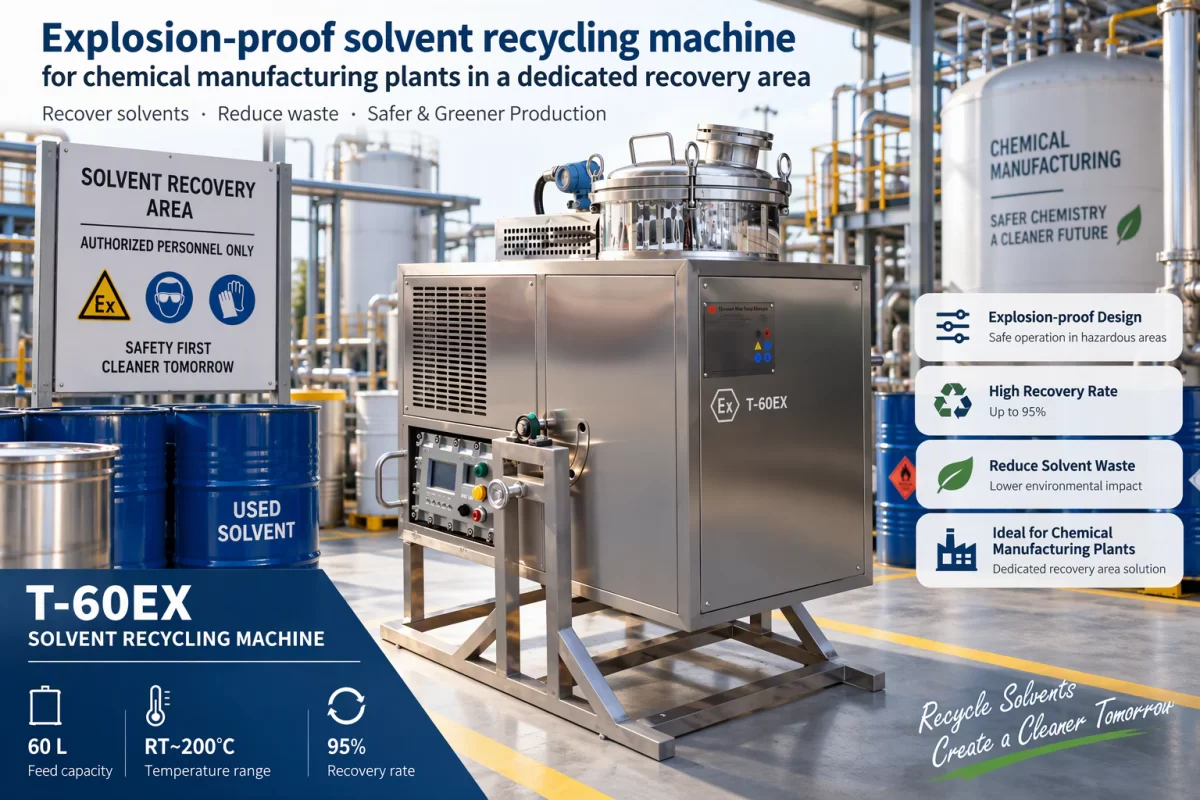
Selecting an explosion-proof solvent recycling machine for hazardous waste solvents starts with understanding the waste stream—not simply choosing the largest tank. The Solvent Recovery Machine range offers documented feed capacities from 20 to 400 liters, giving laboratories and industrial operations several sizes to evaluate for reclaiming suitable waste organic solvents.
This guide brings together the supplied model specifications and company pricing information, while separating listed performance data from the compatibility and hazardous-area checks that still require confirmation before purchase.
Recover usable solvent from suitable hazardous waste streams
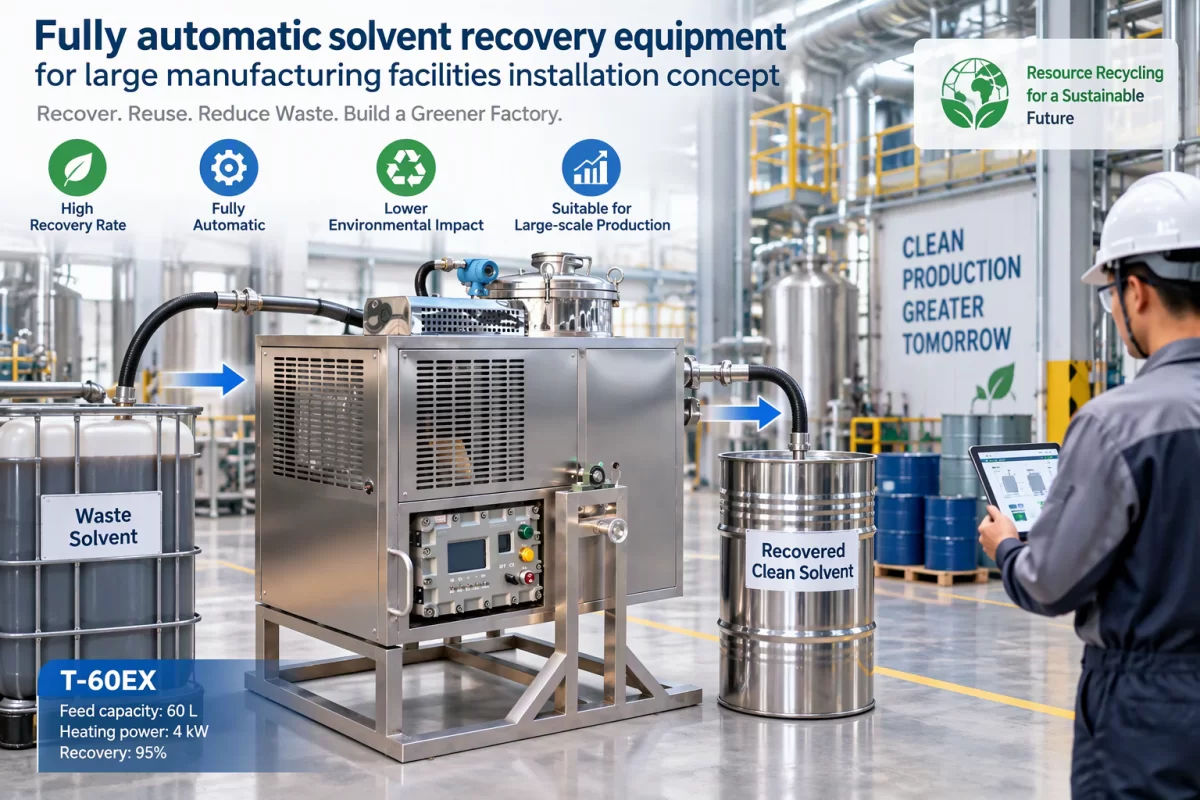
A Solvent Recovery Machine is intended to reclaim solvent from contaminated liquid so that the recovered fraction can be considered for reuse. The supplied product listings describe waste organic solvent recovery and distillation applications involving ethyl acetate, dirty xylene, toluene, mixed chemical solvents and hydrocarbon cleaning liquids. Other listings mention printing, electronics cleaning with IPA, and alcohol recovery for cosmetics-related production.
These listings identify application areas across the product portfolio; they do not establish that every T-series model is approved for every solvent or process. A laboratory collecting cleaning solvent, for example, should evaluate the actual solvent composition, water content and contaminants before selecting equipment. Unknown mixtures require characterization rather than an assumption of compatibility.
How solvent distillation supports recycling
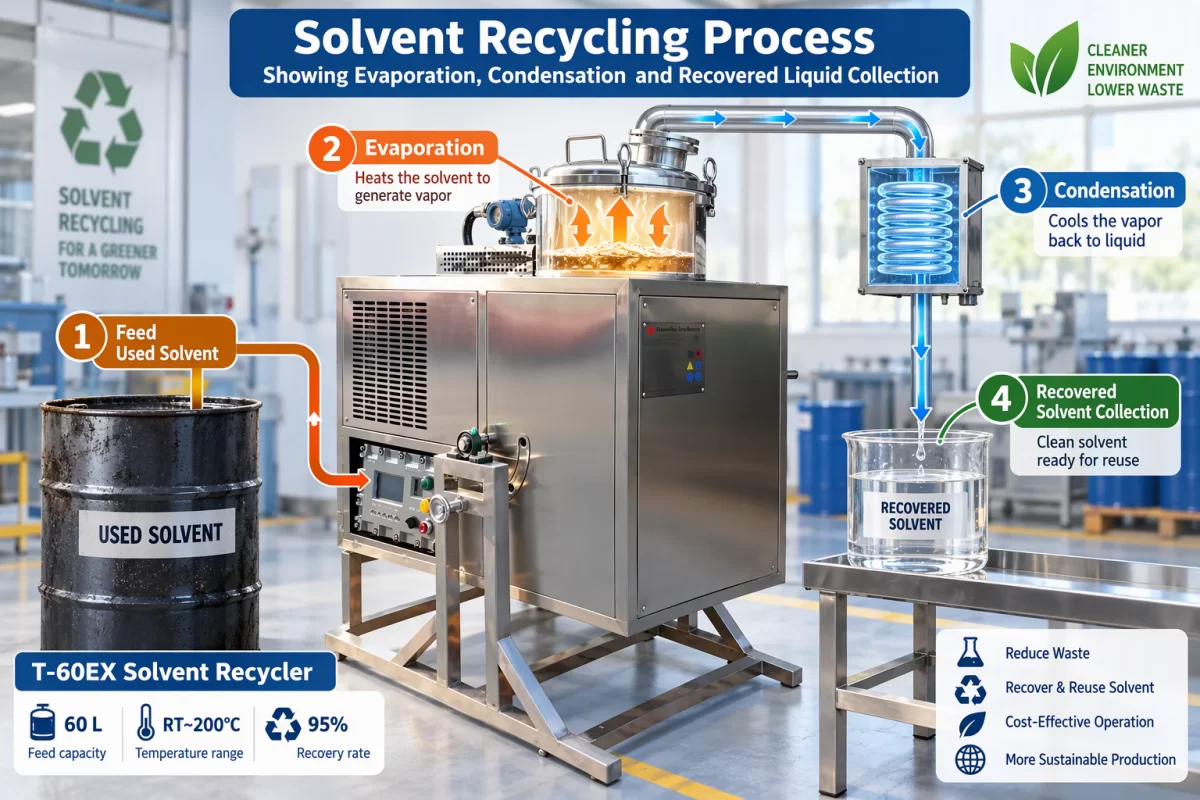
The supplied listings describe distillation-based recovery. In general, this process separates volatile solvent from less-volatile contamination by evaporation and condensation. The exact heating arrangement, condenser design, operating pressure and control functions must be confirmed for the quoted model; they are not specified in the supplied parameter sheet.
- Feed assessment and loading: An identified, compatible waste solvent stream is prepared and loaded within the model’s permitted operating limits.
- Controlled evaporation: Heating vaporizes the recoverable solvent fraction. Less-volatile material can remain as concentrated residue.
- Condensation and collection: Cooling converts solvent vapor back into liquid for collection.
- Reuse verification and residue management: The recovered liquid is checked against its intended reuse specification, while residue is managed through the applicable waste-handling route.
Mixed solvents may co-distill, and water or volatile contaminants may affect the collected liquid. Recovery should therefore not be described as a guarantee of a particular purity. For additional process context, read the guide to how a solvent recovery system works.
Solvent Recovery Machine model comparison
The following values reproduce the supplied parameter sheet. Feed capacity is stated in liters and should not be confused with continuous throughput in liters per hour. All six models list a 380 V AC supply, a temperature range from room temperature to 200°C, and 95% recovery.
On smaller screens, scroll horizontally to view all specifications and units.
| Model | Feed capacityL | Power supplyV AC | Heating powerkW | Temperature range°C | Treatment timemin | Recovery% | Machine weightkg | Machine sizemm |
|---|---|---|---|---|---|---|---|---|
| T-20Ex | 20 | 380 | 2 | RT–200 | 120 | 95 | 153 | 860 × 760 × 1190 |
| T-60Ex | 60 | 380 | 4 | RT–200 | 150 | 95 | 170 | 1160 × 870 × 1260 |
| T-80Ex | 80 | 380 | 5 | RT–200 | 180 | 95 | 200 | 1180 × 850 × 1290 |
| T-125Ex | 125 | 380 | 6 | RT–200 | 210 | 95 | 280 | 1250 × 920 × 1450 |
| T-250Ex | 250 | 380 | 16 | RT–200 | 240 | 95 | 520 | 2600 × 1200 × 1950 |
| T-400Ex | 400 | 380 | 32 | RT–200 | 270 | 95 | 1200 | 1990 × 1850 × 2090 |
RT means room temperature. Dimensions retain the sequence supplied in the source; the document does not label the individual axes. Treatment-time and recovery test conditions are not provided.
The T-20Ex combines a 20 L feed capacity with 2 kW heating power, while the T-400Ex lists 400 L and 32 kW. Between these endpoints, the T-60Ex, T-80Ex, T-125Ex and T-250Ex provide intermediate capacities. Larger capacity also changes handling and installation needs: the listed machine weights range from 153 to 1200 kg.
Selecting explosion-proof solvent recycling equipment responsibly
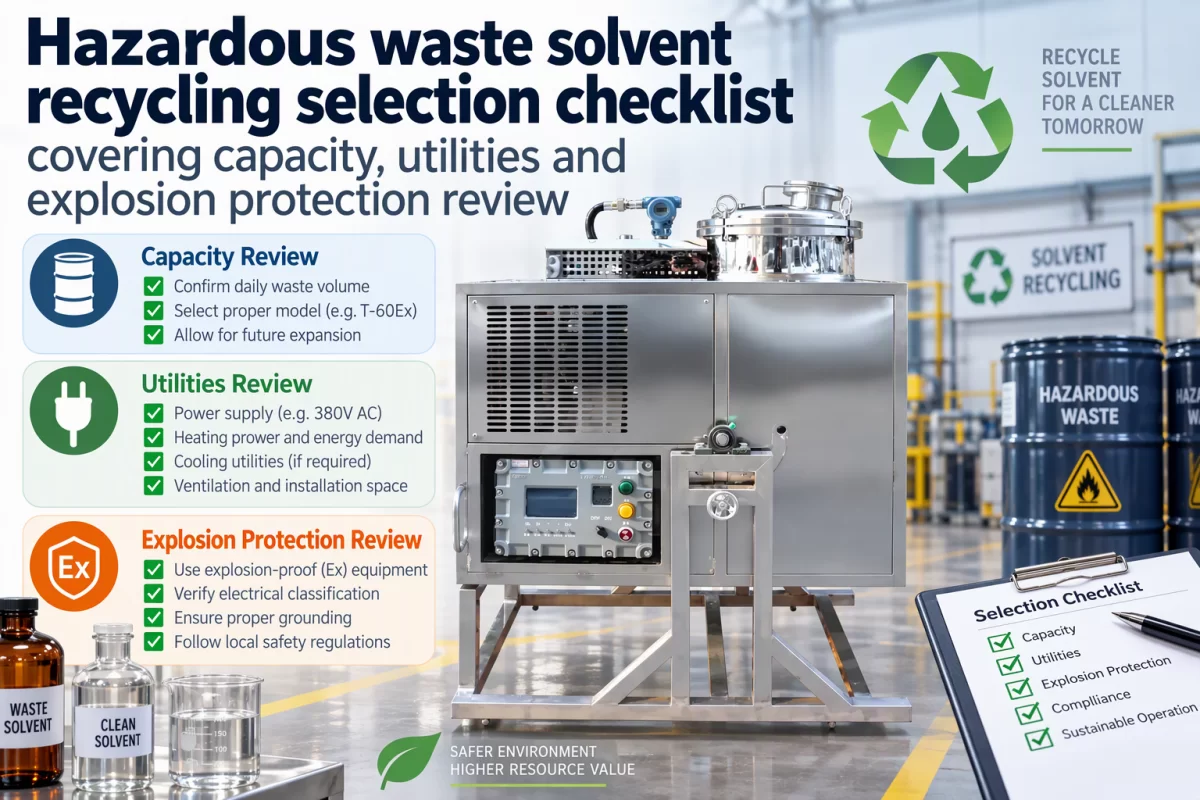
For printing operations, electronics cleaning, laboratory support and other solvent-using facilities, the most useful quotation is one matched to an identified waste stream. The portfolio listings provide a starting point, but a technically complete selection requires the following checks:
- Solvent and contamination profile: Provide solvent names, approximate proportions, water content and information on solids, resins or other residues. Ask for written confirmation of material and process compatibility.
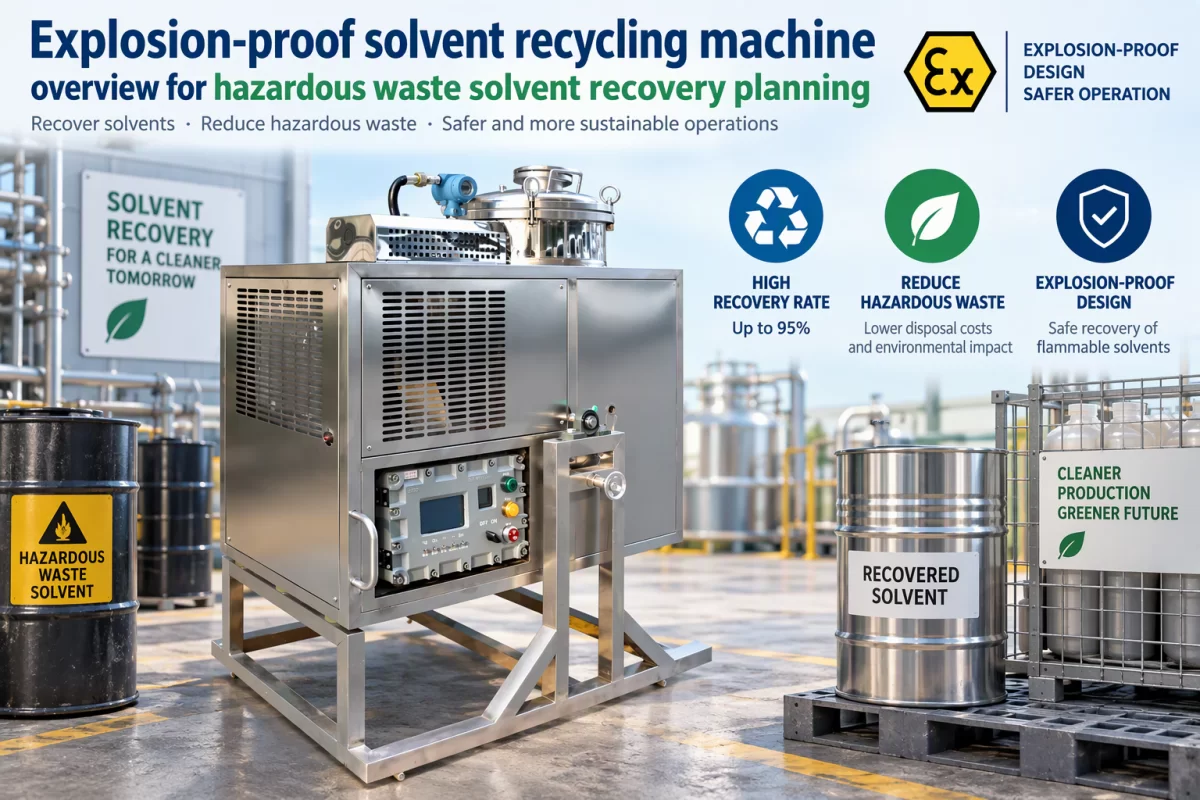
- Hazardous-area suitability: Request the applicable explosion-protection documentation and confirm that its scope matches the proposed installation and solvent hazards. An Ex model suffix alone is insufficient evidence.
- Electrical and cooling requirements: Compare the listed 380 V AC supply and heating power with available site services. Confirm phase, frequency, total electrical demand and condenser utility requirements separately.
- Space and handling: Check machine dimensions and weight against access routes, floor-loading limits and operating space. Obtain a layout drawing that includes service clearance.
- Recovered-solvent acceptance: Define the quality checks required for reuse. Cleaning applications and sensitive electronics processes may have different acceptance criteria.
- Residue and operating procedures: Confirm cleaning access, residue removal, operator training and the waste-management arrangements that remain necessary after recovery.
Recycling does not automatically remove the regulatory obligations associated with hazardous waste. A site-specific review should address collection, storage, recovered-liquid use and residual waste. The solvent waste management guide provides related background for planning those steps.
Company reference pricing and the value of solvent reuse
The supplied company listings contain both fixed prices and price ranges. Ordering the listed price entries from low to high places the repeated range below at the middle entry. It is presented only as a company reference, not as a confirmed quotation for any particular T-series model.
US$2,645–9,690
The actual quotation is subject to the selected configuration and the result of an inquiry. The supplied pricing information does not establish a model-by-model price match for the parameter table above.
The purchase value of solvent recovery comes from the possibility of returning acceptable liquid to use rather than replacing the entire waste volume with fresh solvent. Where recovery is technically suitable, it may reduce fresh-solvent purchases and the volume of liquid sent for disposal. However, no verified energy-consumption figures, operating-cost results or payback calculations are supplied, so a specific savings percentage would be unsupported.
Turn hazardous solvent recovery goals into a practical equipment choice
An explosion-proof solvent recycling machine for hazardous waste solvents should be selected on both process fit and verified safety suitability. The Solvent Recovery Machine range provides documented capacity, heating-power, treatment-time, size and weight data for comparing six Ex models. Those specifications are a useful starting point—not a substitute for solvent testing, installation review or applicable explosion-protection documentation.
For a productive purchasing discussion, prepare a waste-stream description, expected batch volume, available electrical supply, installation constraints and recovered-solvent quality requirements. These details help narrow the model choice and support a meaningful quotation. Explore the solvent recycling equipment page as a starting point for reviewing the equipment offering.
Prepare the inquiry
Request a recommended model, written solvent compatibility confirmation, relevant safety documentation, complete utility requirements and a configuration-specific price. A carefully matched system offers a more credible route to solvent reuse than a decision based on capacity or reference price alone.