
Fully automatic solvent recovery unit with continuous feeding capability
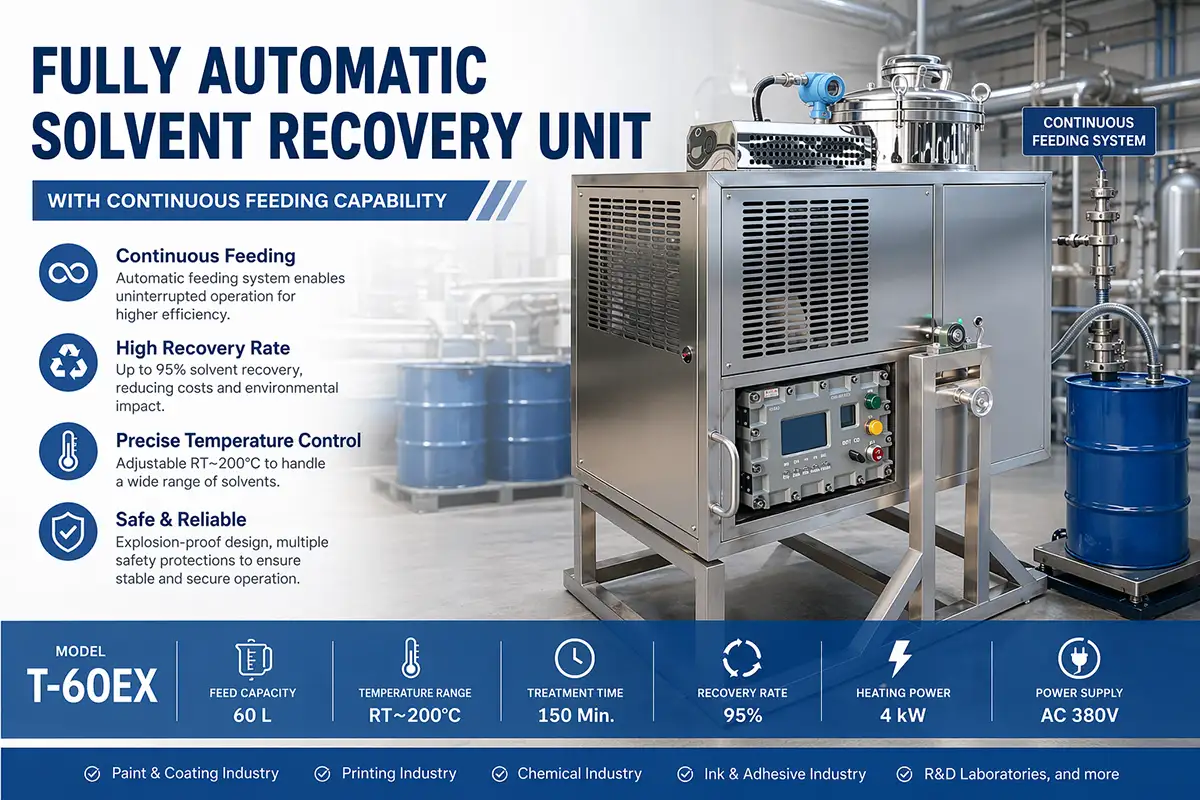
A fully automatic solvent recovery unit with continuous feeding capability is designed for factories that need stable recycling, lower fresh solvent purchasing costs, and safer handling of waste organic solvent without frequent manual batching.
Why continuous feeding changes solvent recycling efficiency
In many coating, printing, electronics cleaning, adhesive, and chemical processing workshops, waste solvent is generated every shift. When the recovery process depends only on small manual batches, operators must stop, load, wait, discharge residue, and reload again. That rhythm may be acceptable for low-volume use, but it becomes inefficient when solvent waste appears every day. A fully automatic solvent recovery unit with continuous feeding capability solves this problem by keeping the distillation workflow steadier and more predictable.
The purpose is simple: dirty solvent enters the recovery unit in a controlled way, the heating system separates usable solvent from contaminants, and recovered solvent is condensed for reuse. Instead of treating solvent recovery as an occasional cleanup task, the unit turns it into a regular production support system. This is especially useful where thinner, IPA, ethanol, acetone, xylene, toluene, ethyl acetate, or mixed cleaning solvent must be reused consistently.
How the automatic recovery process works
A continuous feeding solvent recovery unit is based on distillation. Waste solvent is heated inside the recovery chamber, the solvent vapor rises, and the cooling system condenses it into clean reusable liquid. Paint sludge, resin, pigment, oil, ink residue, and other high-boiling contaminants remain in the tank or residue collection area. The recovered solvent can then return to washing, dilution, extraction, degreasing, or cleaning operations, depending on the solvent type and purity requirement.
For users comparing equipment categories, a standard solvent recovery machine is often the first place to start. The continuous feeding version is more suitable when waste solvent output is regular and the factory wants to reduce operator involvement. It helps avoid long idle periods between batches and keeps recovery closer to the real pace of production.
From my perspective, continuous feeding is better when solvent waste is produced steadily and the factory wants a smoother workflow. For smaller workshops that generate only occasional waste solvent, a batch-type unit may still be practical. The right choice depends on daily solvent volume, contamination level, required automation, and how quickly recovered solvent needs to return to production.
Reduced manual loading: Continuous feeding decreases repeated open-load-close cycles and supports a cleaner operating routine.
Stable recovery output: A controlled feed rate helps the system maintain steady evaporation, condensation, and solvent collection.
Better cost control: Reusing recovered solvent reduces fresh solvent purchasing frequency and waste disposal volume.
Safer production support: Explosion-proof models are suitable for flammable organic solvent environments when correctly selected and installed.
Key technical specifications for industrial selection
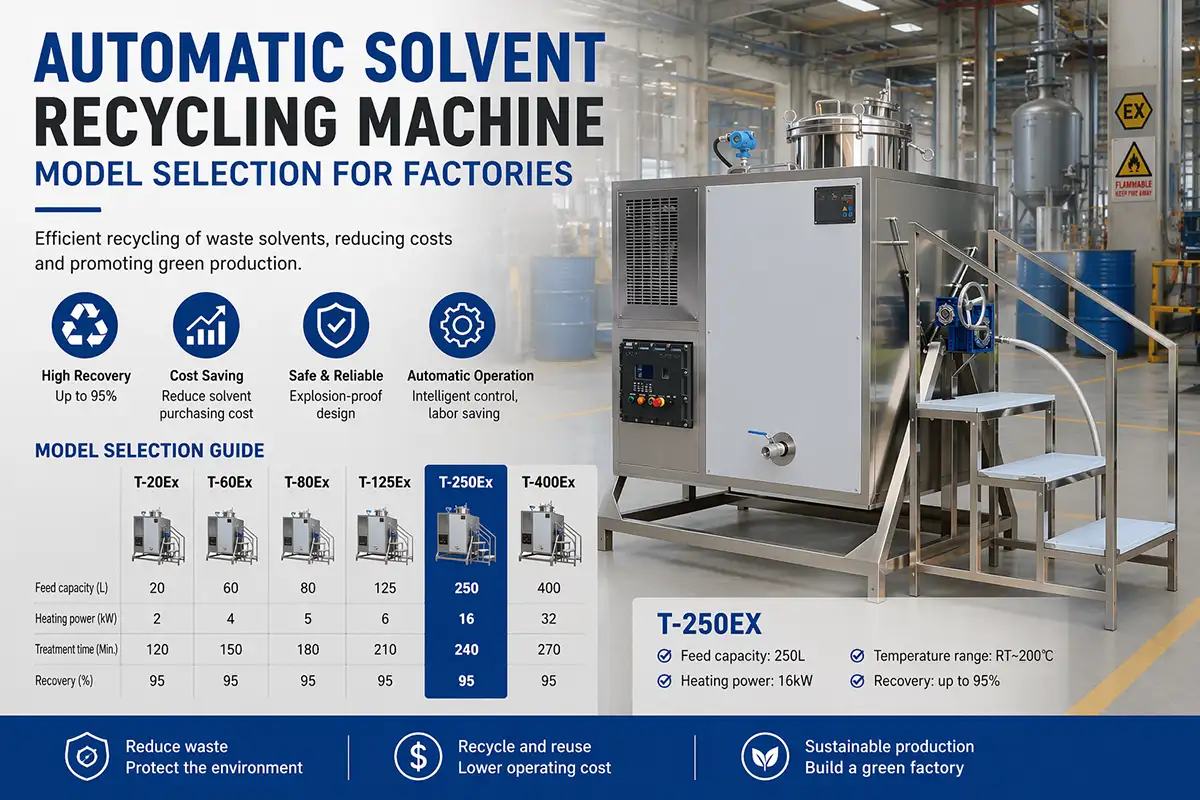
Capacity should be selected according to the volume of waste solvent produced per shift, not only the maximum tank size. The available machine series covers compact to large industrial requirements. According to the provided technical parameters, feed capacity ranges from 20 L to 400 L, heating power ranges from 2 kW to 32 kW, and the recovery rate can reach about 95% under suitable solvent conditions. The operating temperature range is RT to 200 ℃, which is suitable for many common organic solvents used in manufacturing.
| Model | Feed Capacity (L) | Power Supply (ACV) | Heating Power (kW) | Temperature Range | Treatment Time | Recovery | Machine Weight | Machine Size (mm) |
|---|---|---|---|---|---|---|---|---|
| T-20Ex | 20 | 380 | 2 | RT-200 ℃ | 120 min | 95% | 153 kg | 860*760*1190 |
| T-60Ex | 60 | 380 | 4 | RT-200 ℃ | 150 min | 95% | 170 kg | 1160*870*1260 |
| T-80Ex | 80 | 380 | 5 | RT-200 ℃ | 180 min | 95% | 200 kg | 1180*850*1290 |
| T-125Ex | 125 | 380 | 6 | RT-200 ℃ | 210 min | 95% | 280 kg | 1250*920*1450 |
| T-250Ex | 250 | 380 | 16 | RT-200 ℃ | 240 min | 95% | 520 kg | 2600*1200*1950 |
| T-400Ex | 400 | 380 | 32 | RT-200 ℃ | 270 min | 95% | 1200 kg | 1990*1850*2090 |
On mobile screens, swipe the specification table horizontally to compare models clearly.
Company reference price and what affects the final configuration
For a continuous solvent recovery configuration in the provided company price list, a practical reference price is:
This is a company reference price for planning. Final quotation depends on capacity, explosion-proof requirements, condenser configuration, scraper or residue handling design, material contact requirements, and the solvent type being recovered.
When several models share a wider price range, it is more useful to plan around a lower-middle configuration rather than the highest specification. A small or medium factory may begin with a compact automatic unit, while a high-volume workshop should consider a larger tank, stronger heating power, and continuous feeding accessories. The important point is not to buy the largest unit automatically, but to match the recovery capacity to daily solvent waste output.
I usually compare three figures: monthly fresh solvent purchasing cost, monthly waste disposal cost, and the amount of solvent that can realistically be recovered. If a workshop recovers about 95% under suitable conditions, the savings can accumulate quickly, especially for high-use solvents such as thinner, IPA, ethanol, acetone, and ethyl acetate.
Where continuous solvent recovery units are most valuable
Continuous feeding capability is especially valuable in factories where solvent waste is not a rare byproduct but a daily operating reality. Paint manufacturers and coating workshops often use large volumes of thinner and cleaning solvent. For those users, a dedicated thinner recycler machine can reduce the amount of new thinner purchased and lower the volume of hazardous waste sent out for disposal.
Electronics cleaning, precision metal degreasing, gravure printing, flexographic printing, resin production, adhesive manufacturing, and pharmaceutical extraction can also benefit from stable solvent reuse. In alcohol-based operations, an ethanol recovery system may help reclaim ethanol for repeated industrial use. For acetone-heavy cleaning processes, a solvent recovery system can separate acetone from dissolved resin, paint, or oil residue and return usable solvent to the cleaning line.
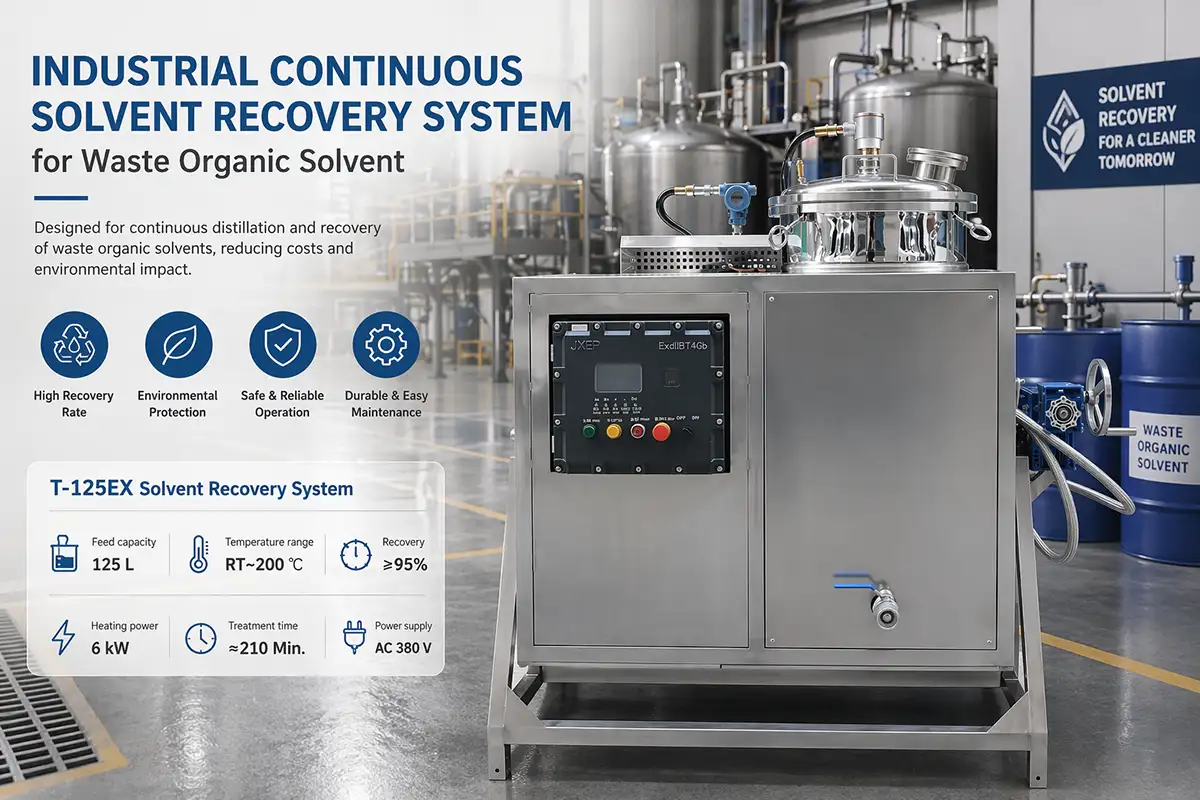
In many cleaning and dilution applications, recovered solvent can replace a large share of new solvent. However, complete replacement depends on the required purity, solvent mixture, contamination type, and final product sensitivity. My recommendation is to test recovered solvent in the actual process, then decide whether it should be reused directly, blended with new solvent, or reserved for cleaning steps.
Safety, automation, and daily operation details
Because many organic solvents are flammable, safety should be part of the selection process from the beginning. Explosion-proof electrical design, correct grounding, temperature control, pressure relief, suitable seals, and proper ventilation all matter. Operators should confirm the flash point of the solvent, avoid incompatible mixtures, and follow local safety rules for hazardous liquid handling. The machine should be installed in a suitable area with enough space for feeding, solvent collection, residue removal, and maintenance.
Automation also improves consistency. A well-configured automatic solvent recovery unit can control heating, condensation, feeding, and shutdown logic more reliably than a manual process. This helps reduce operator fatigue and makes the recovery result easier to repeat. For factories that generate solvent waste in multiple production lines, continuous feeding can also support centralized recycling, where waste solvent is collected and treated through one properly sized recovery system.
Choose capacity by daily waste volume: Match tank size and feed rhythm to real production data.
Check solvent compatibility: Confirm boiling point, flash point, residue type, and corrosiveness before ordering.
Plan residue handling: High-solid paint, ink, and resin waste may require scraper or easier discharge design.
Protect recovered quality: Use proper condensation and clean collection containers to avoid secondary contamination.
How to choose the right model
The T-20Ex and T-60Ex models are practical for smaller workshops, laboratories, and production areas where solvent waste is limited but recurring. The T-80Ex and T-125Ex models suit medium-volume manufacturing, especially where cleaning solvent is used every day. The T-250Ex and T-400Ex models are better for larger factories that need higher throughput and more robust industrial operation.
For a fully automatic solvent recovery unit with continuous feeding capability, the model should be selected together with the feeding method, condensation capacity, control system, residue discharge method, and explosion-proof level. If the solvent contains heavy resin, pigment, or paint solids, residue management is just as important as evaporation speed. If the recovered solvent must be reused in a sensitive process, the factory should also define purity expectations before finalizing the machine.
Final recommendation
A fully automatic solvent recovery unit with continuous feeding capability is a smart investment for factories that want to treat solvent recycling as part of normal production rather than a separate waste task. With suitable capacity, explosion-proof configuration, and proper solvent testing, the system can reduce fresh solvent purchasing, cut hazardous waste output, and improve day-to-day operating stability.
For most buyers, the best decision starts with three facts: how much waste solvent is produced per day, what solvent or solvent mixture is being recovered, and how clean the recovered solvent must be for reuse. Once those details are clear, the unit can be sized accurately and configured for safer, more efficient long-term operation.