How In-House Solvent Recycling Supports a Circular Manufacturing Process
In-house solvent recycling sustainability starts with a practical question: does recovered solvent actually replace fresh solvent in a controlled manufacturing process? A Solvent Recovery Machine can help create that loop, but the environmental case depends on accepted reuse, residue management, and measured energy—not simply on the quantity fed into the equipment.
This article explains how to build the records needed to evaluate circular solvent use and how to interpret the nominal specifications of the T-125Ex without turning catalog values into unsupported operating guarantees.
A circular solvent loop must return usable material
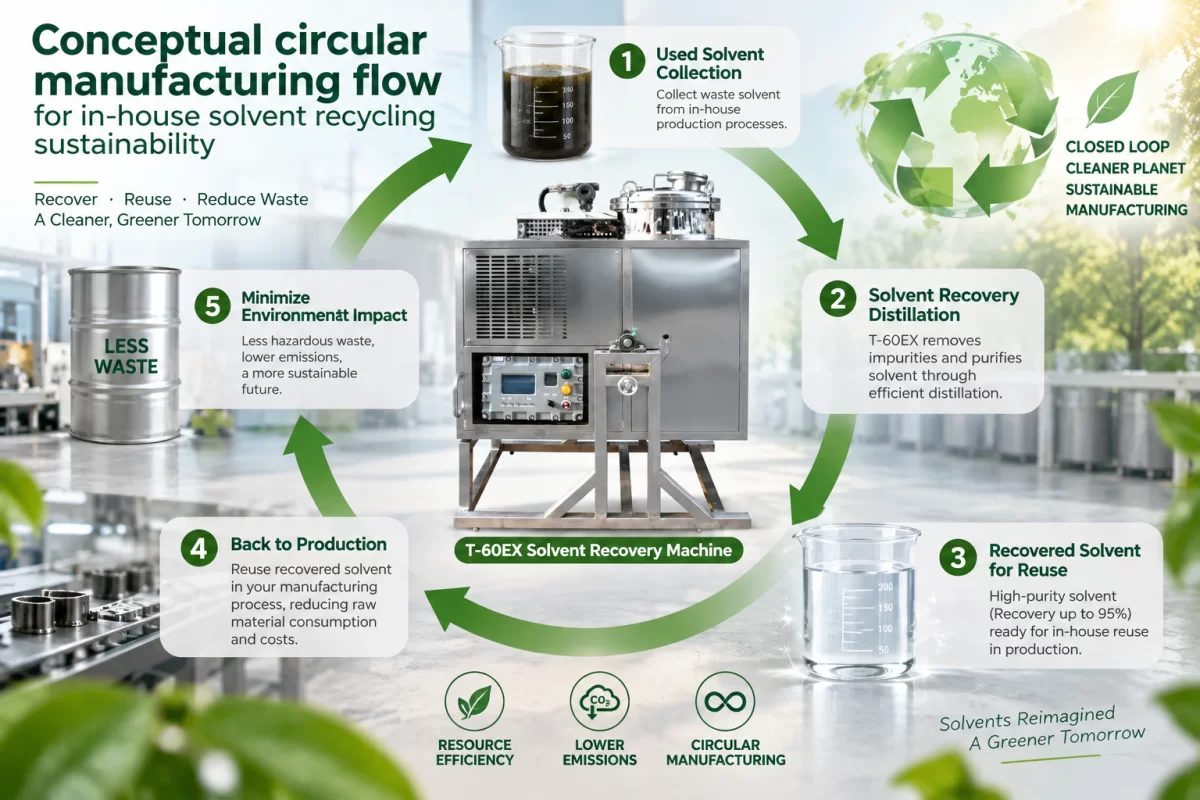
In a linear process, fresh solvent enters production or cleaning, becomes contaminated, and leaves the site for treatment or disposal. In-house recovery introduces a potential return route: segregate suitable spent solvent, process it, assess the recovered liquid, and release acceptable material back to an approved application.
The important word is acceptable. Collected recovered liquid is not automatically equivalent to fresh solvent. Water, mixed solvent composition, dissolved contaminants, and application-specific quality requirements can limit reuse. A manufacturing site needs a defined acceptance procedure and traceable release records before claiming that the recovered stream replaces new material.
Does every liter of recovered liquid replace a liter of fresh solvent?
I would count substitution only after the recovered batch passes the relevant acceptance checks and its use is documented. Liquid awaiting approval, held in storage, rejected, or used in an application that did not previously consume fresh solvent should not automatically be credited as fresh solvent replacement.
Build a material and energy ledger before claiming benefits
Choose a reporting period and establish a comparable baseline. Keep solvent grades and waste streams separate, and record production activity so that lower purchasing caused by reduced output is not mistaken for a recycling benefit. Opening and closing inventories matter: a temporary drawdown in stored fresh solvent can make purchasing look lower without changing actual consumption.
A useful ledger connects purchasing, recovery, quality control, manufacturing use, waste dispatch, and utilities. Each batch should have an identifier that follows it from the source process through recovery and final disposition.
- Fresh solvent records: Record purchase quantities, solvent grades, stock movements, and process issues. Match approved recovered solvent use to the fresh solvent demand it replaces. This is the evidence needed to demonstrate efforts to reduce fresh solvent purchases.
- Recovered liquid acceptance: Record collected quantity, sample identification, test method, acceptance criteria, results, release decision, and destination. Keep rejected or reprocessed batches visible rather than treating all output as usable solvent.
- Residue and outbound waste: Record residue mass, remaining liquid shipped off-site, waste classification, dispatch dates, and contractor documentation. Track other relevant wastes, such as contaminated cleaning materials, where they arise.
- Metered energy: Record electricity consumption for recovery and identify whether cooling, pumps, ventilation, or other supporting equipment are included. Document operating time and any additional utilities within the chosen boundary.
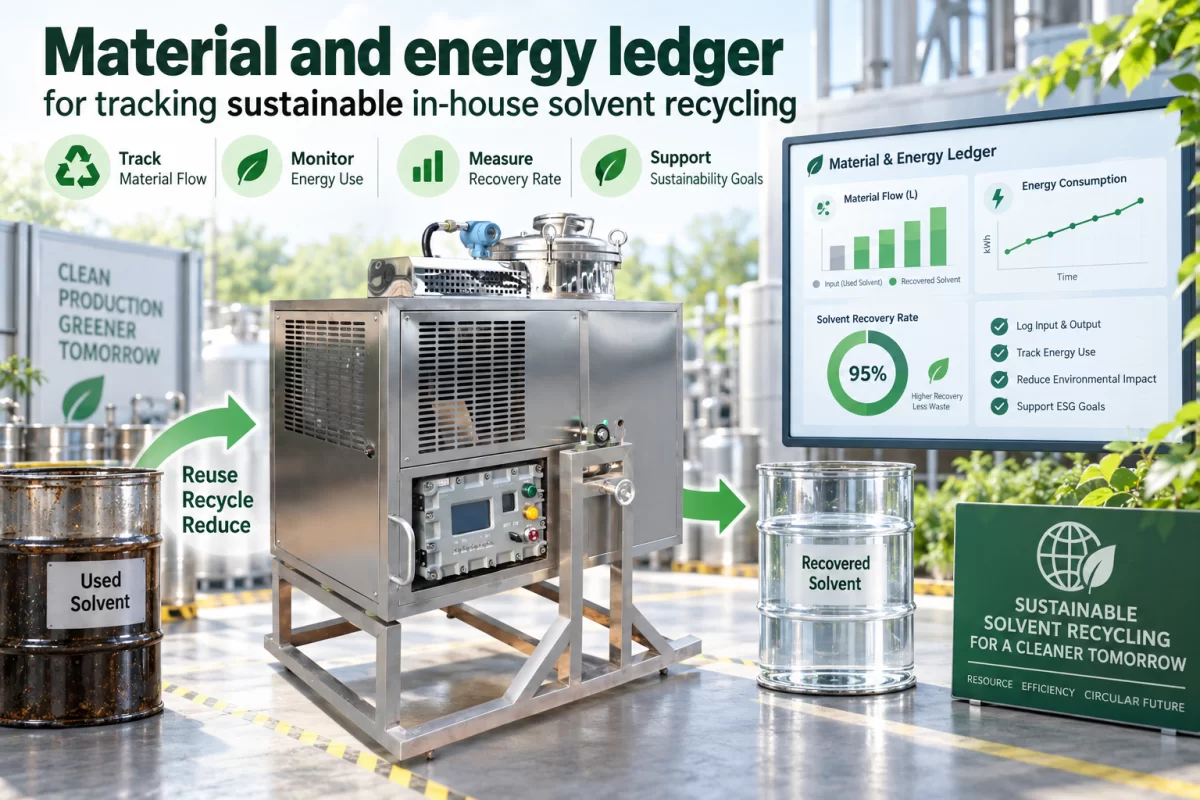
Use consistent units. Mass is useful for reconciling streams with different compositions. If volume is converted to mass, record the applicable density and measurement conditions; do not assume all solvent mixtures have the same density. Investigate unexplained balance differences, including inventory changes, retained material, sampling, and potential losses.
Separate resource savings from environmental impact
Three claims require different evidence. Lower fresh solvent use is supported by documented substitution and inventory-adjusted consumption. Less liquid sent off-site is supported by comparable waste shipment records. Lower environmental impact requires a broader assessment of the burdens avoided and the burdens added.
Recovery may concentrate contaminants into a smaller residue stream, but this does not mean that waste disappears or becomes nonhazardous. Compare all relevant outbound streams, not just the original spent liquid. A structured approach to industrial solvent waste reduction should retain waste classification, storage, and disposal responsibilities.
Can reduced solvent purchasing be reported as a carbon reduction?
I would report the verified purchasing or consumption change first. Without suitable emission factors and a defined assessment boundary, I would not convert it into a carbon figure. A defensible comparison also needs the recovery system’s actual energy use and relevant information on solvent supply, transport, waste treatment, and process losses.
For ESG reporting, these operational records can support transparent resource-use and waste indicators. Governance includes documented methods, named data owners, and review of exceptions. Worker training and safe handling remain important operational responsibilities. Installing recycling equipment does not automatically establish regulatory compliance or satisfy every ESG reporting requirement.
T-125Ex Solvent Recovery Machine: interpret nominal data correctly
The supplied model table identifies the T-125Ex with a nominal feed capacity of 125 L and heating power of 6 kW. These values help frame an equipment discussion, but they do not establish effective working volume, hourly throughput, daily output, or suitability for every waste solvent. When evaluating on-site solvent recycling equipment, request confirmation for the exact model, configuration, and intended feed.
| Parameter | Supplied value | Interpretation or confirmation needed |
|---|---|---|
| Model | T-125Ex | Model designation in the supplied parameter table. |
| Nominal feed capacity | 125 L | Nominal feed class; confirm permitted working charge for the actual feed. |
| Power supply | 380 V AC | Confirm site electrical requirements and installation details. |
| Heating power | 6 kW | Heating rating, not measured energy per batch or total site demand. |
| Temperature range | RT–200 °C | Listed range from room temperature; operating settings require feed-specific review. |
| Treatment time | 210 min | Listed nominal time; test conditions and complete cycle duration are not supplied. |
| Recovery | 95% | Listed recovery value, not purity. Basis and test conditions require confirmation. |
| Machine weight | 280 kg | Confirm installed weight and site support requirements. |
| Machine size | 1250 × 920 × 1450 mm | Listed dimensions; allow separately for access, connections, and servicing. |
Source: supplied English parameter document. Nominal specifications are not site performance measurements.
Product information also uses a 100 L description. Its relationship to the 125 L nominal feed class needs written clarification; neither figure should be assumed to be a validated working charge. Continuous feeding and discharge depend on configuration and should not be treated as standard across all models.
Does the 6 kW rating establish energy consumption per recovery batch?
I would use a meter rather than the nameplate rating for the sustainability ledger. Heating demand can vary during operation, and the supplied table does not establish total cycle energy or auxiliary consumption. The 210-minute nominal treatment time alone is not a measured energy record.
The supplied materials do not establish model-specific certification scope. Certification or safety claims appearing in other listing titles should not be transferred to the T-125Ex. Request the applicable documentation and have qualified personnel assess solvent compatibility, installation conditions, and local requirements.
Our company’s reference price
US$2,645–9,690
This is the median listed price entry from our supplied company price sheet, retaining the original range rather than inventing a single price. It is a company reference only, not a confirmed T-125Ex quotation. Actual pricing is subject to configuration and the inquiry quotation.
Validate the reuse route before expanding the loop
A practical evaluation starts with a characterized waste stream and a defined reuse application. Confirm solvent composition, contamination, water content, and any hazards that affect processing. Ask the supplier to review the actual feed and proposed configuration rather than selecting equipment solely from nominal capacity.
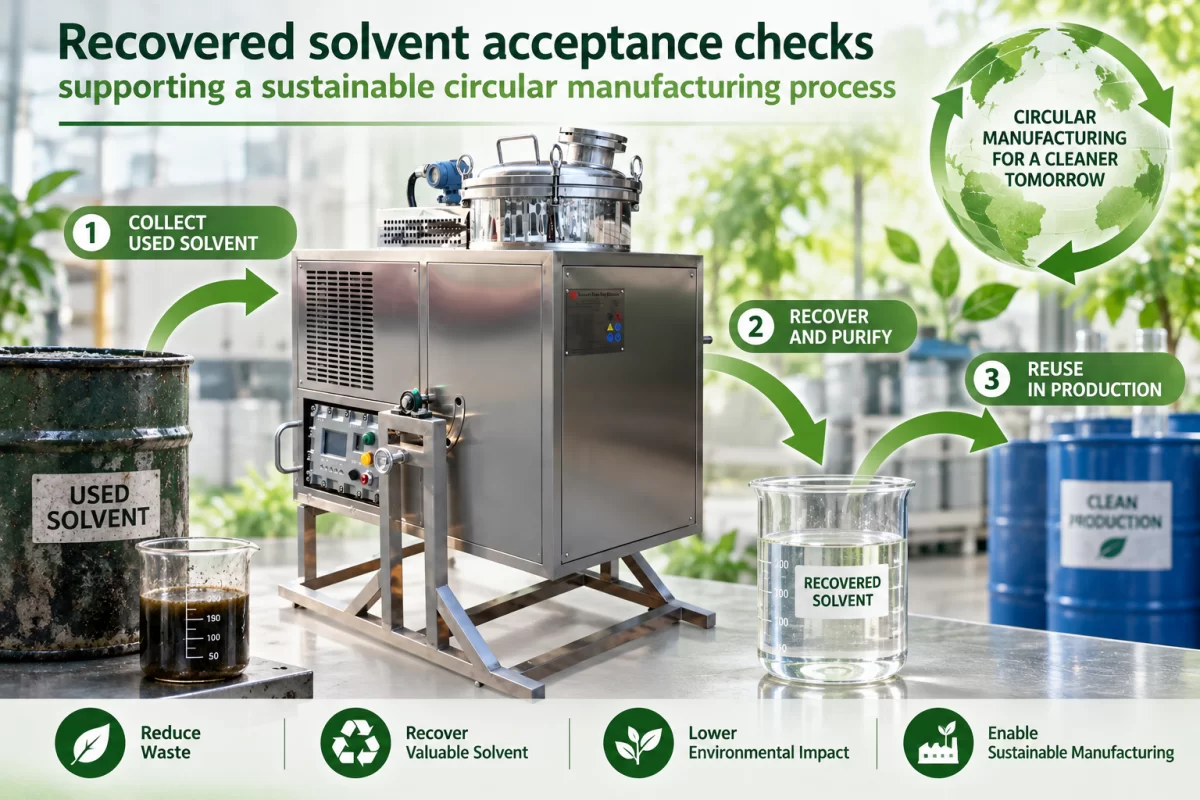
During evaluation, measure the actual charge, accepted recovered liquid, rejected output, residue, cycle duration, and energy. Assess recovered material against the intended process requirements, which may include composition, water, nonvolatile residue, or functional cleaning performance. Acceptance limits must come from the application—not from a general recovery percentage.
Repeated reuse also needs monitoring. Mixture composition can change, contaminants can accumulate, and fresh solvent makeup may remain necessary. If rejected material requires additional treatment or causes rework, include those consequences in the ledger. Circularity is strongest when recovery remains compatible with product quality, safe operation, and manageable residual waste.
Make in-house solvent recycling sustainability measurable
A Solvent Recovery Machine can support circular manufacturing by returning accepted solvent to a productive use. The credible case rests on four connected records: fresh solvent substitution, recovered-liquid acceptance, residue and waste shipments, and metered energy.
For the T-125Ex, use the supplied nominal specifications as a starting point for technical discussion, then confirm working charge, configuration, feed compatibility, and operating results. Before requesting a quotation, prepare the waste-stream details and reuse criteria. This gives the supplier a clearer basis for equipment selection and gives the manufacturing team an evidence-led route to evaluating sustainability—without unsupported carbon claims or automatic compliance promises.