
How to reduce new solvent purchasing costs with recycling?
Solvent recycling reduces the amount of fresh solvent a factory needs to buy by turning contaminated, used solvent back into usable liquid through controlled distillation. For plants using IPA, ethanol, acetone, thinner, xylene, MEK, ethyl acetate, or mixed cleaning solvents, the most direct saving is simple: recover more of what is already paid for, and purchase less new solvent every month.
The real cost problem
New solvent purchasing costs often rise quietly because the expense is spread across many production steps: printing wash-up, paint line cleaning, electronics degreasing, resin removal, adhesive cleanup, extraction, and general equipment washing. Each drum looks like a routine consumable purchase, but the total monthly cost can become one of the most controllable chemical expenses in the plant.
A solvent recovery machine changes that cost structure. Instead of treating every batch of dirty solvent as waste, the machine heats the used solvent, vaporizes the recoverable solvent fraction, condenses it, and separates it from sludge, pigment, resin, oil, ink, or other non-volatile contaminants. The recovered solvent can then be reused for cleaning, pre-washing, dilution, or other approved production tasks.
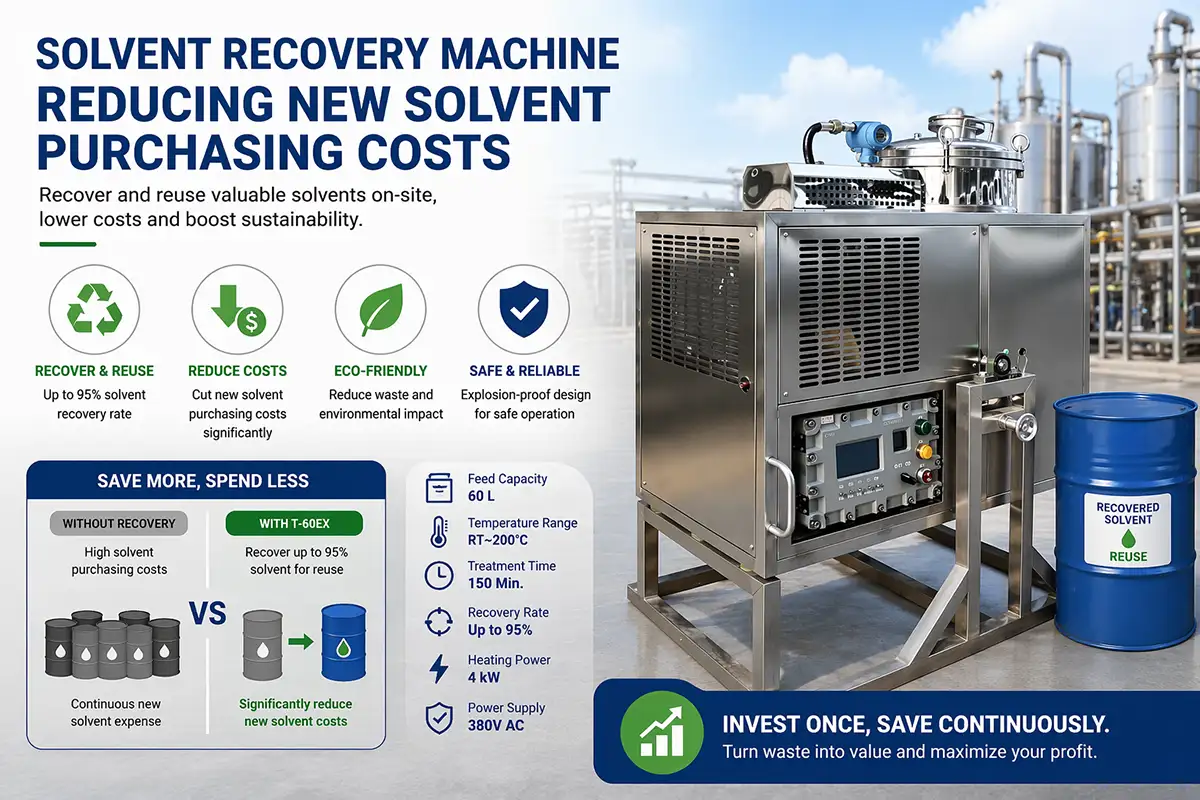
Solvent recovery equipment used to reduce fresh solvent purchasing.
How recycling lowers fresh solvent demand
The purchasing reduction comes from a repeatable loop. Used solvent is collected before it becomes mixed with water, trash, or incompatible chemicals. It is loaded into the recovery unit. The distillation process separates clean solvent vapor from heavy residue. After condensation, recovered solvent returns to storage and can replace part of the next fresh solvent order.
When this loop is managed consistently, fresh solvent becomes a top-up item rather than the only source of cleaning liquid. That is the difference between buying 100% new solvent each cycle and buying only the percentage needed to replace process loss, evaporation, drag-out, or quality-sensitive applications where virgin solvent is still required.
Is recovered solvent clean enough for every production task?
Not every task should be treated the same. In my view, the strongest cost-saving plan uses recovered solvent first for washing, pre-cleaning, paint gun flushing, parts cleaning, and other applications where a small variation in purity is acceptable. For final precision cleaning or regulated processes, quality testing should decide whether recovered solvent can fully replace virgin solvent.
For example, a factory using solvent for two-stage cleaning can often use recovered solvent in the first wash, then use a smaller amount of new solvent for the final rinse. This simple adjustment can reduce fresh solvent demand without forcing a risky change to the final product quality standard.
Capacity and equipment selection
The right equipment size depends on the amount of waste solvent generated per shift, the solvent boiling range, residue content, available power supply, and how quickly recovered solvent needs to return to production. The provided Solvent Recyclers parameters show a practical range from compact 20 L machines to 400 L industrial units. All listed models use 380 ACV power, support a room-temperature to 200°C operating range, and show a 95% recovery rate.
| Model | Feed Capacity | Heating Power | Temperature Range | Treatment Time | Recovery | Machine Size |
|---|---|---|---|---|---|---|
| T-20Ex | 20 L | 2 kW | RT-200°C | 120 min. | 95% | 860*760*1190 mm |
| T-60Ex | 60 L | 4 kW | RT-200°C | 150 min. | 95% | 1160*870*1260 mm |
| T-80Ex | 80 L | 5 kW | RT-200°C | 180 min. | 95% | 1180*850*1290 mm |
| T-125Ex | 125 L | 6 kW | RT-200°C | 210 min. | 95% | 1250*920*1450 mm |
| T-250Ex | 250 L | 16 kW | RT-200°C | 240 min. | 95% | 2600*1200*1950 mm |
| T-400Ex | 400 L | 32 kW | RT-200°C | 270 min. | 95% | 1990*1850*2090 mm |
Smaller machines are suitable when solvent use is frequent but batch volume is modest. Larger models are better for factories that generate solvent waste from multiple production lines and need recovery to become part of daily production flow. For plants comparing different solvent recycling equipment, capacity should be matched to real waste volume rather than the largest theoretical purchase budget.
Price planning and payback
Cost reduction is easiest to justify when the investment is compared with actual monthly solvent purchases. Based on the provided company price list, many common solvent recovery units shown with a price range can be budgeted with a lower-middle planning value of about $4,950. A larger T-450Ex solvent recovery unit is listed at $10,691. These figures are company price references and should be treated as practical planning points for selecting the right capacity.
The payback logic is direct. If a plant spends $8,000 per month on new solvent and can recover 60% to 80% of usable solvent for appropriate cleaning tasks, the purchasing reduction can become larger than the machine cost in a short period. The exact result depends on the solvent value, contamination level, operator discipline, and whether recovered solvent can be returned to the highest-volume cleaning steps.
What cost should be checked before selecting a machine size?
I always start with monthly fresh solvent purchasing, not machine capacity. A 400 L unit may look attractive, but the better question is whether enough waste solvent is generated every day to keep that capacity useful. The best investment is the machine that recovers solvent fast enough to reduce purchases without sitting idle.
Quick savings estimator
Enter a monthly fresh solvent purchasing cost and estimate the purchasing reduction created by reuse.
Estimated monthly solvent purchase reduction:
$4,800Estimated payback period:
0.1 monthsWhere the biggest savings usually appear
The largest reduction normally appears in high-volume, repeatable solvent use. Paint and coating operations can recover thinner, xylene, toluene, acetone, ethyl acetate, and mixed cleaning solvent from spray gun washing or tank cleaning. Printing operations can reuse recovered solvent for ink wash-up. Electronics and precision manufacturing plants may recover IPA or other cleaning solvents for pre-cleaning, depending on purity requirements.
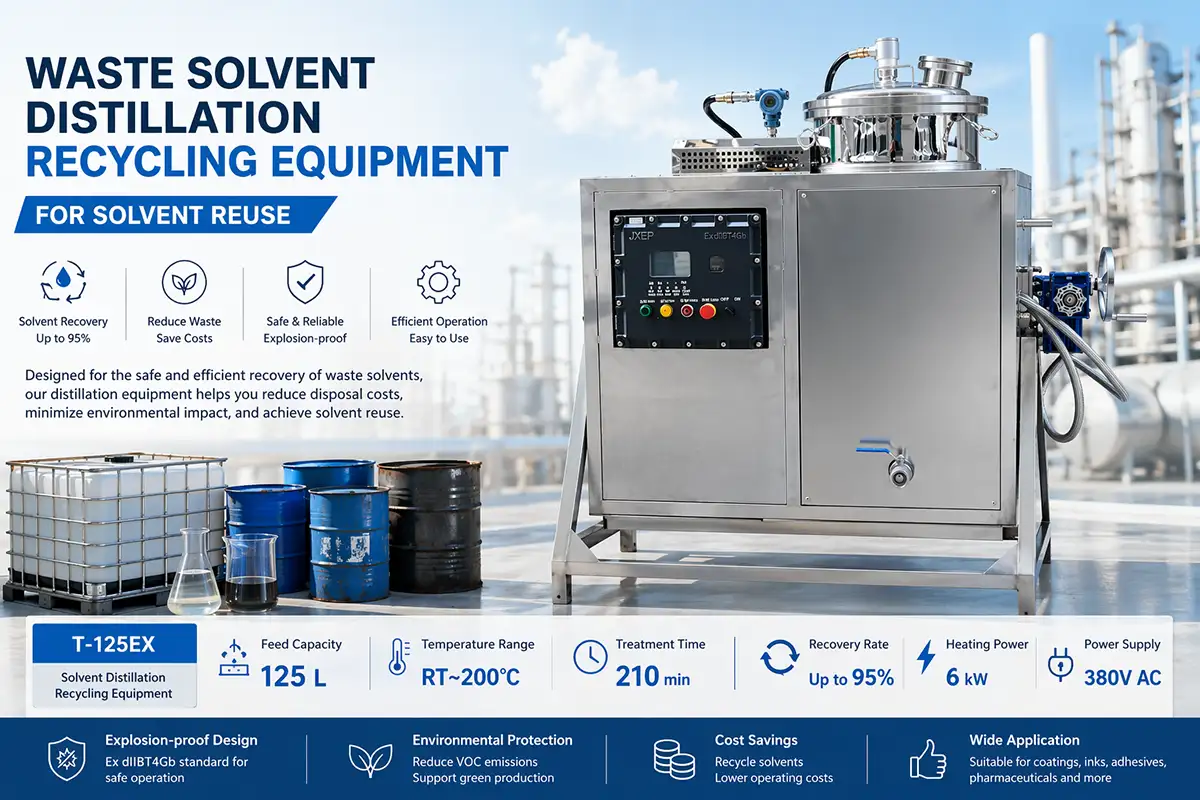
Waste solvent distillation and condensation process.
Waste handling is another source of savings. When less liquid solvent waste leaves the facility, disposal volume may fall, storage pressure is reduced, and the team has better control over flammable waste accumulation. For more background on safe waste handling and reuse planning, the guide to solvent waste disposal and recycling provides a useful next step.
Practical action steps
Quality, safety, and operating discipline
Solvent recovery should be treated as a controlled industrial process. Explosion-proof configuration, proper grounding, ventilation, temperature control, compatible gaskets, correct residue handling, and operator training all matter. A solvent recycling unit is designed to recover valuable solvent, but it should never become a place for unknown chemical mixtures.
Can recycling reduce new solvent purchasing without changing production quality?
Yes, when reuse is introduced with testing and clear boundaries. My preferred method is to reuse recovered solvent in cleaning stages first, confirm performance, and then expand only where the recovered solvent meets the required quality. This approach protects production while still reducing new solvent purchases.
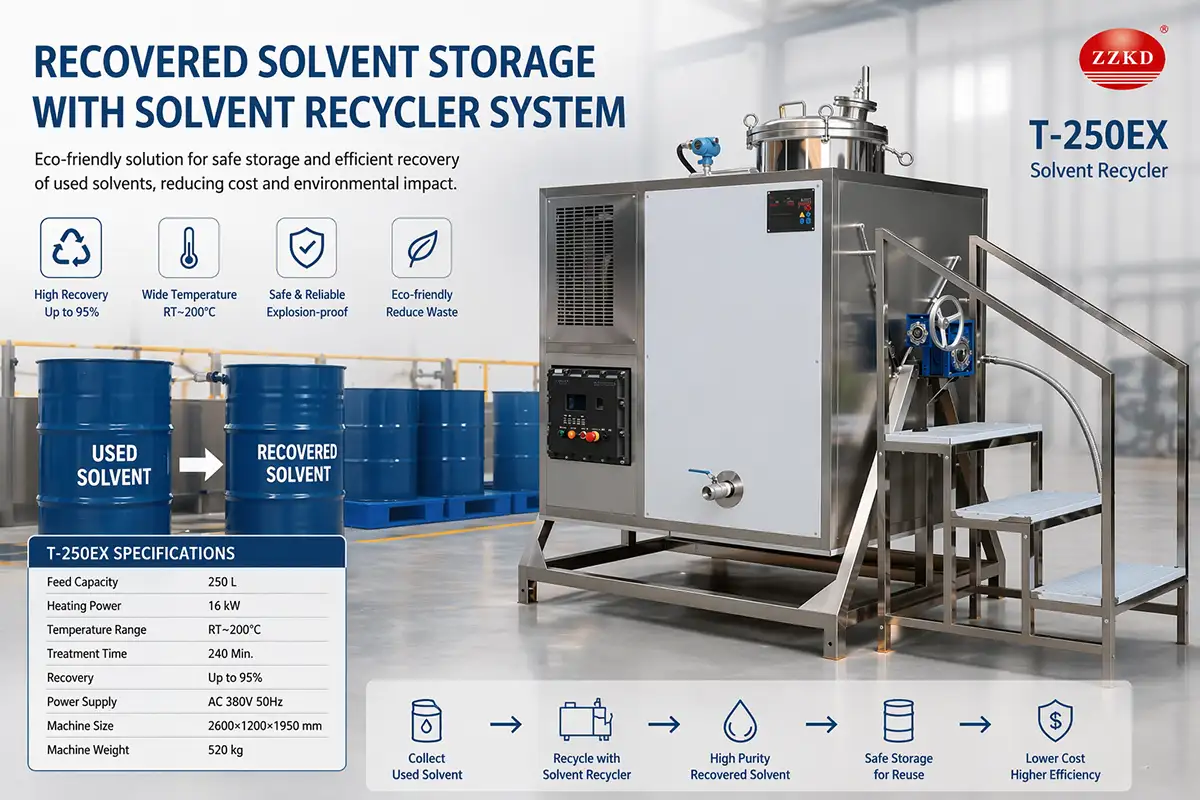
Recovered solvent prepared for reuse in cleaning operations.
Conclusion
Reducing new solvent purchasing costs with recycling is not a theoretical sustainability idea. It is a practical manufacturing cost-control method. With a 95% recovery-rated machine, a clear collection process, and the right reuse strategy, a factory can turn waste solvent into a recurring source of savings. The best results come from matching equipment capacity to real solvent volume, using recovered solvent in suitable applications, and measuring purchase reduction every month.
For many plants, the question is not whether solvent can be recycled. The stronger question is how much paid-for solvent is currently being discarded, and how quickly that value can be brought back into production.
Lower solvent purchasing by reusing what is already paid for
Start with the solvent stream that costs the most each month, match it to the correct recovery capacity, and build a simple reuse loop that turns solvent waste into purchasing control.