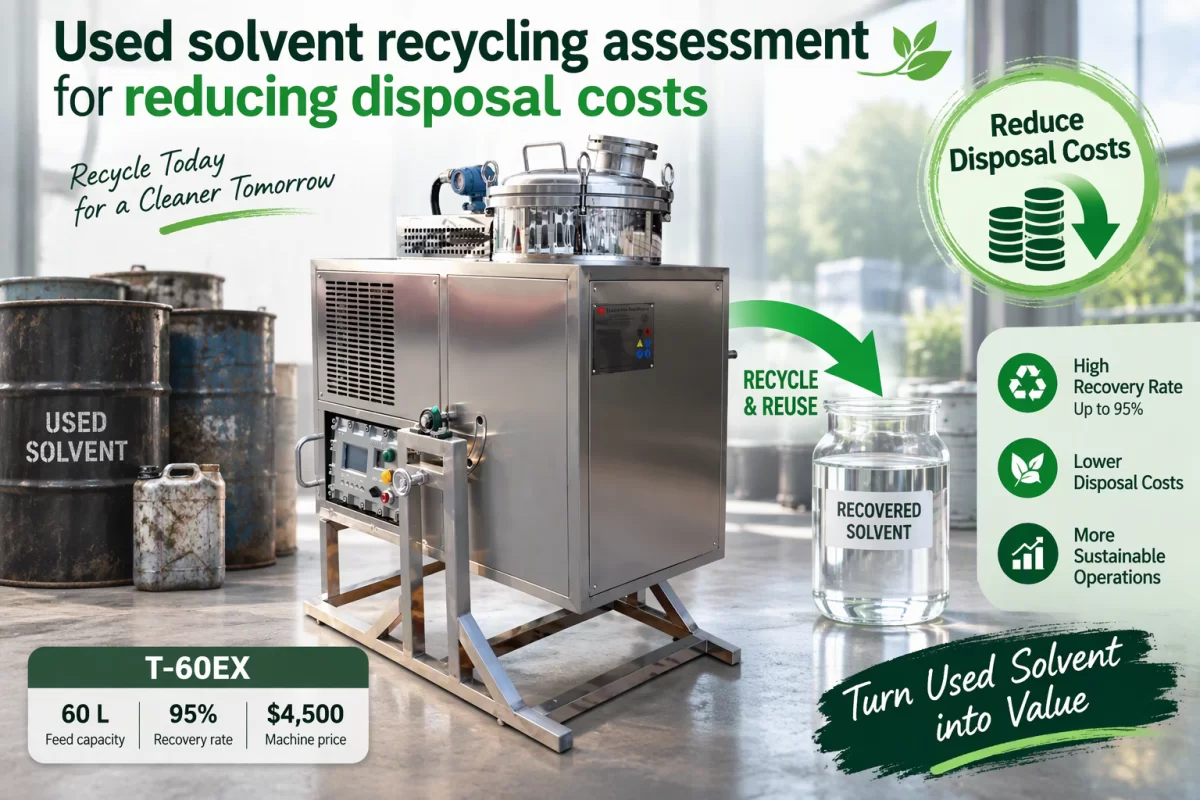
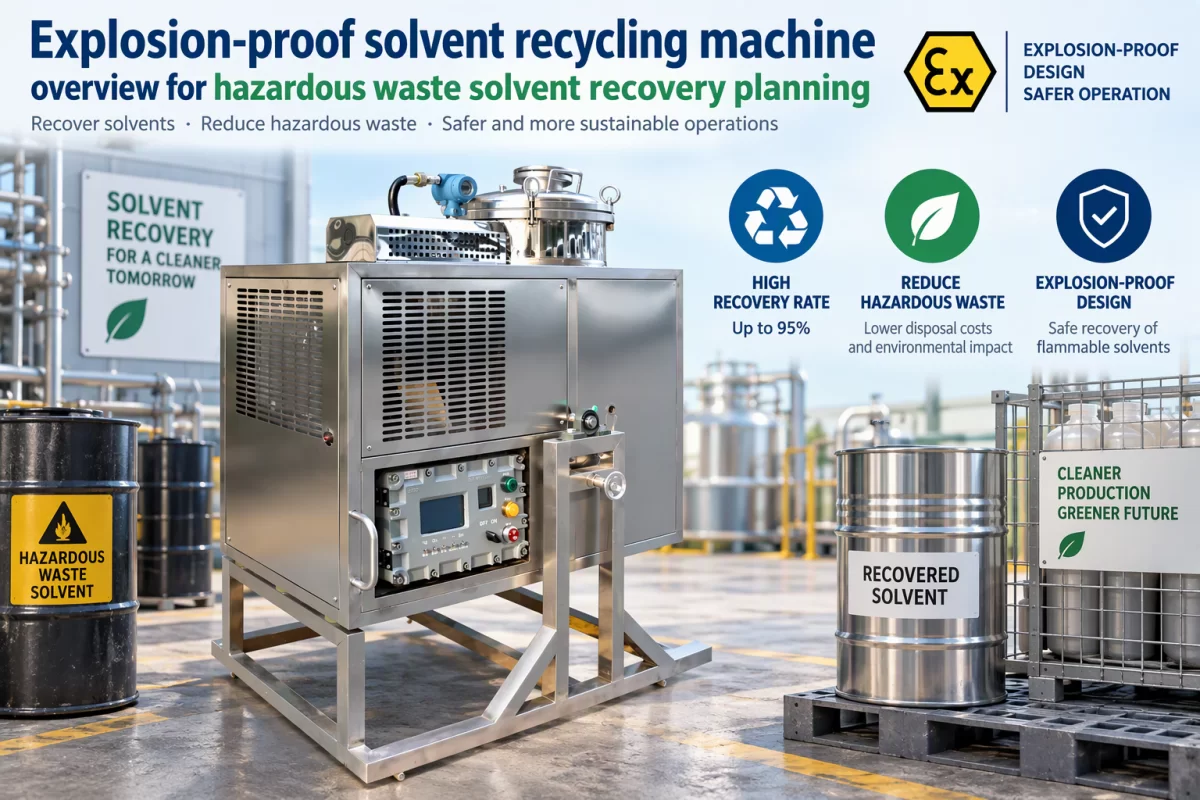
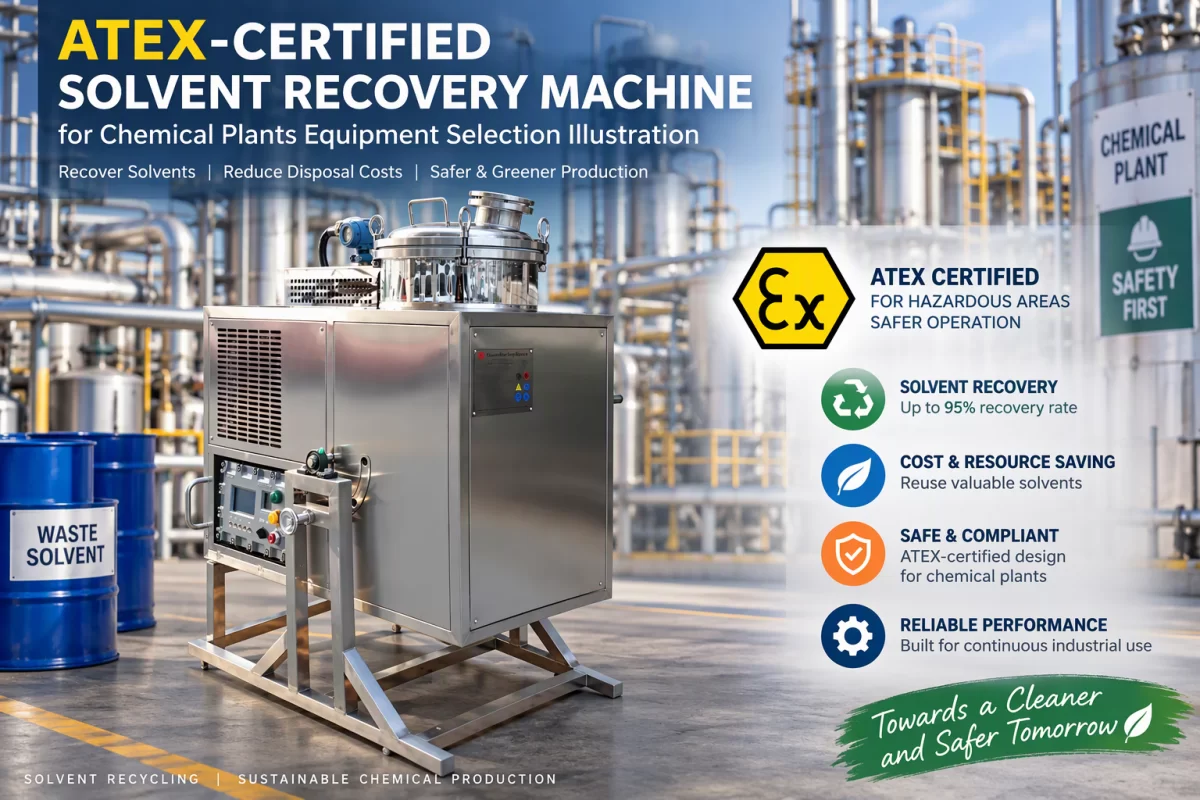
What equipment recovers waste solvent to reduce disposal costs?
A Solvent Recovery Machine, also called a solvent recycler or solvent distillation unit, is equipment used to reclaim suitable spent solvents for reuse. Instead of treating every contaminated batch as a complete disposal loss, a facility can evaluate whether distillation can separate reusable solvent from the contaminants it carries.
How waste solvent recovery can reduce disposal costs
Waste solvent often contains a valuable liquid component mixed with oils, inks, resins, or other process residues. Where these contaminants can be separated by distillation, solvent recovery offers two potential financial benefits: less waste liquid requiring off-site handling and less fresh solvent needed for an approved reuse application.
The purchasing case is therefore broader than reducing disposal invoices alone. A Solvent Recovery Machine can support a more controlled solvent-management workflow, with segregated collection, scheduled processing, recovered-liquid testing, and documented residue handling. The value depends on the actual waste stream, the amount processed, and whether the recovered solvent meets the intended process requirements.
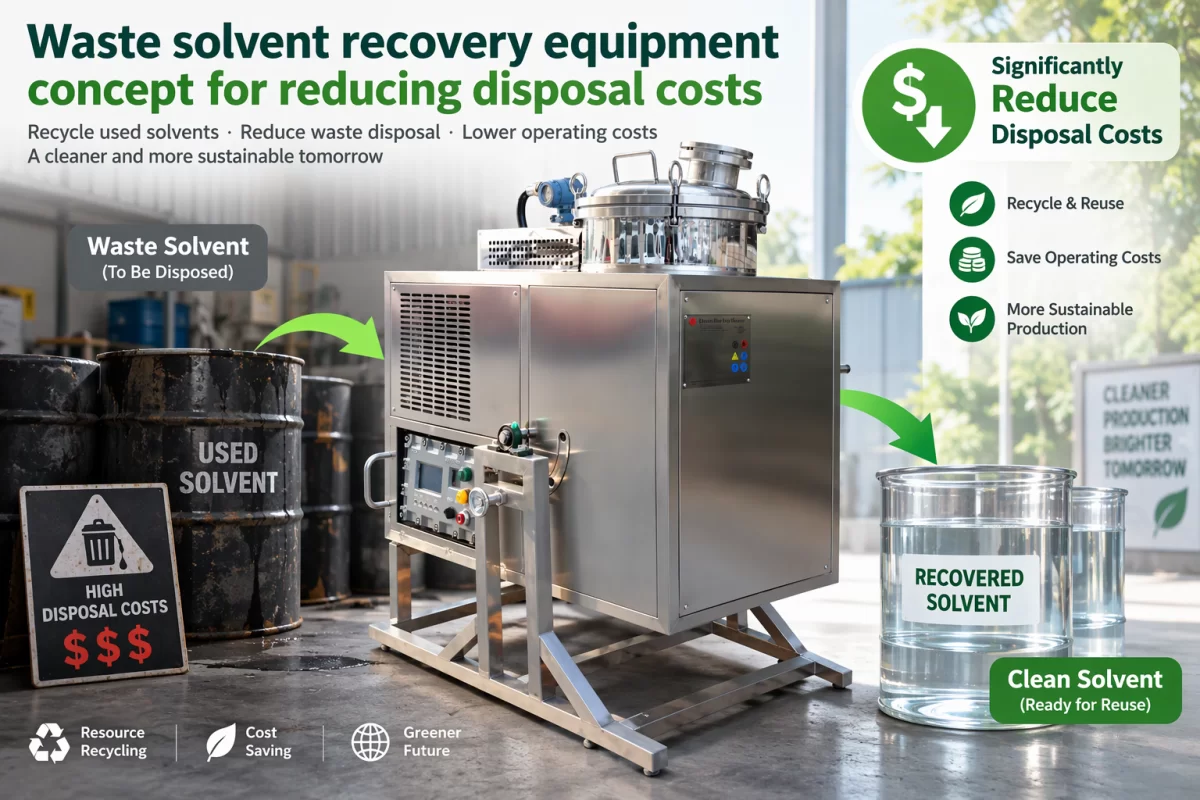
How a Solvent Recovery Machine works
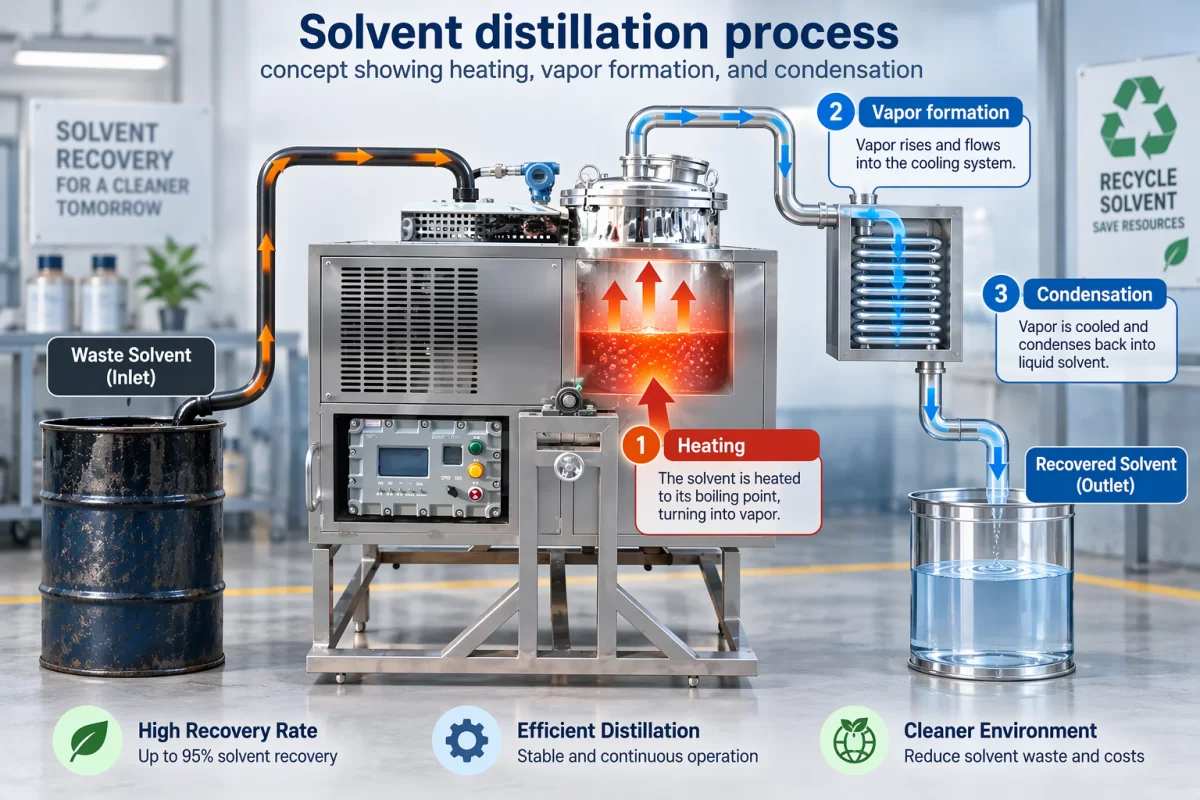
Distillation separates materials according to their volatility under the operating conditions. In a typical solvent-recovery workflow, heating vaporizes recoverable solvent, a condenser turns that vapor back into liquid, and less volatile contamination remains in the processing vessel. This is different from simple filtration, which primarily removes particles rather than separating dissolved contaminants.
- Characterize and segregate the feed. Identify the solvent composition, water content, contamination, and chemical hazards before choosing a recovery route.
- Process a suitable batch. Use an operating procedure matched to the solvent, equipment, and required separation.
- Condense and collect the recovered liquid. Keep the collected solvent identified and separate from unprocessed waste.
- Assess reuse quality and manage residue. Release recovered solvent only for applications whose acceptance criteria it satisfies.
For a fuller explanation of these stages, explore how the solvent recovery process works. Mixed solvents deserve particular attention: the recovered blend may not have the same composition as the original purchased solvent, and recovery yield is not the same measurement as solvent purity.
Key specifications for T-series solvent recovery models
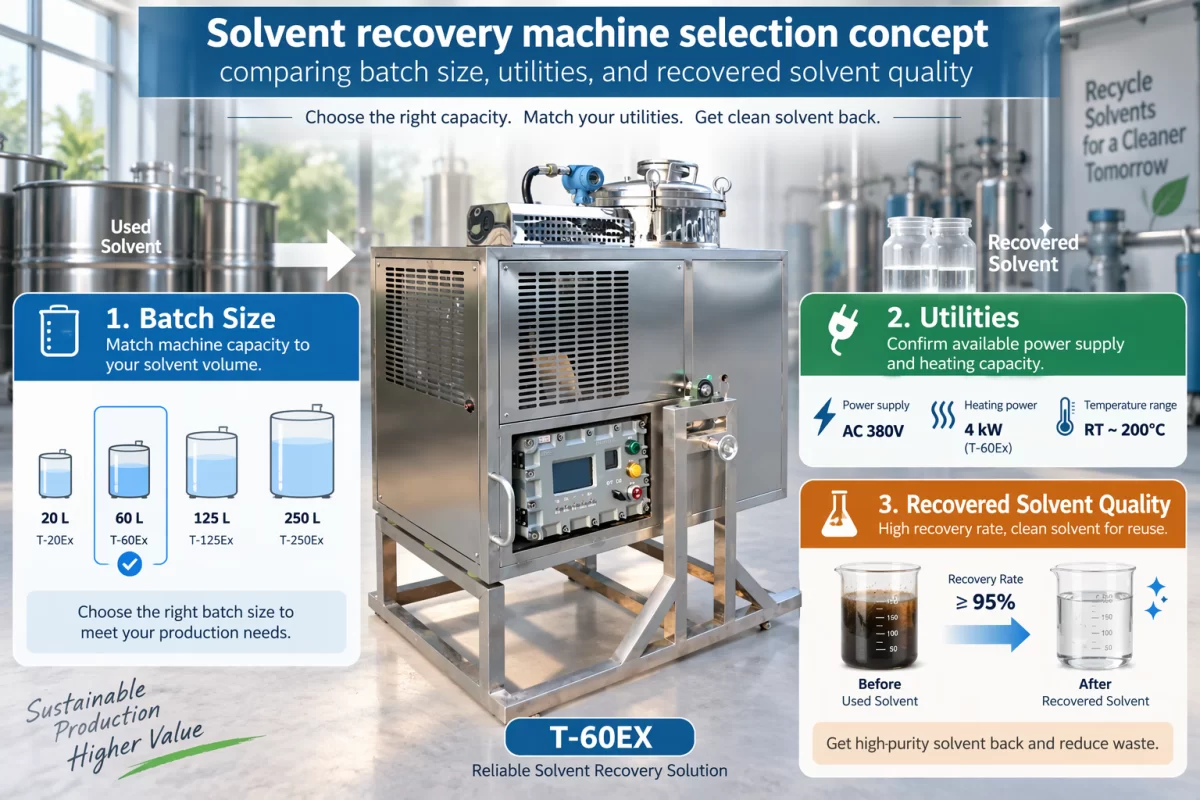
The following models provide different feed capacities, heating-power ratings, weights, and machine dimensions. Compare each model as a complete specification set rather than combining the capacity of one model with the power or footprint of another.
| Model | Feed capacityL | Power supplyV AC | Heating powerkW | Temperature range°C | Machine weightkg | Machine sizemm |
|---|---|---|---|---|---|---|
| T-20Ex | 20 | 380 | 2 | RT–200 | 153 | 860 × 760 × 1190 |
| T-60Ex | 60 | 380 | 4 | RT–200 | 170 | 1160 × 870 × 1260 |
| T-80Ex | 80 | 380 | 5 | RT–200 | 200 | 1180 × 850 × 1290 |
| T-125Ex | 125 | 380 | 6 | RT–200 | 280 | 1250 × 920 × 1450 |
| T-250Ex | 250 | 380 | 16 | RT–200 | 520 | 2600 × 1200 × 1950 |
| T-400Ex | 400 | 380 | 32 | RT–200 | 1200 | 1990 × 1850 × 2090 |
RT means room temperature. Feed capacity is expressed in liters, not liters per hour. Heating power is a power rating, not a measurement of energy consumed per batch. Machine dimensions do not include the additional space needed for access, servicing, and material handling.
A higher temperature limit does not mean that every solvent should be heated to that limit. Operating conditions must suit the feed’s boiling behavior, thermal stability, and safety requirements. Electrical installation planning should also account for the specified supply and the selected model’s heating demand.
Applications and selection criteria for solvent recycling
Potential applications include printing-related cleaning waste, industrial parts-cleaning solvents, coating-related solvent streams, and segregated laboratory cleaning waste. Product listings also cover ethyl acetate, xylene, toluene, hydrocarbon cleaning solvents, and IPA recovery applications. These application categories are starting points for evaluation, not proof that every T-series model is suitable for every formulation.
In laboratories, keep cleaning-solvent recovery separate from assumptions about analytical-grade reuse. Recovered liquid intended for instrument rinsing, sample preparation, or sensitive electronics cleaning needs acceptance testing appropriate to that task. Unknown mixtures and reactive contamination should not enter a recovery machine without a qualified compatibility and hazard assessment.
- Solvent and contamination: Provide the solvent identity or mixture composition, safety data sheets, water content, and expected oils, resins, or solids.
- Working batch and schedule: Identify the usual collected volume, waste-generation frequency, and time available for loading, processing, cooling, and residue removal.
- Installation conditions: Review electrical supply, machine footprint, floor loading, ventilation, and access for maintenance and containers.
- Safety and configuration: Specify the installation environment and required protection measures. Evaluate model-specific safety documentation and any required certifications before purchase.
- Reuse objective: Define measurable acceptance criteria, such as composition, water content, or cleaning performance, rather than judging quality only by appearance.
Reference pricing and the purchasing value of solvent recovery
Equipment cost should be evaluated alongside the recurring costs it may help reduce. A facility with a consistent, recoverable waste stream and an established reuse destination has a clearer basis for assessing value than a facility collecting small quantities of changing, unidentified mixtures.
Our company’s reference price range
$2,645–$9,690
This is a company reference price range, not a model-specific quotation. The actual quotation depends on the selected configuration and the results of the inquiry.
Build the business case using current solvent purchase records, actual disposal invoices, and expected operating expenses. Include operator time, electricity, maintenance, quality testing, remaining residue disposal, and installation costs. Avoid assuming that all recovered liquid will replace fresh solvent on a one-for-one basis.
For the remaining waste stream, establish suitable storage and disposal arrangements as part of the same project. This guide to solvent waste management and disposal provides related context for planning the non-recoverable portion.
Choose waste solvent recovery equipment around a practical reuse plan
The answer to “What equipment recovers waste solvent to reduce disposal costs?” is a Solvent Recovery Machine when the waste stream is suitable for its separation process. Its potential value comes from reclaiming useful solvent while reducing the quantity of liquid sent for disposal—not from an automatic guarantee of purity, savings, or universal compatibility.
Start with the material, working batch, installation conditions, and reuse target. Then compare the corresponding model specifications and request a configuration-based quotation. A well-matched recovery system can become a practical part of a more economical solvent-handling workflow.
Explore solvent recycling equipment