
Industrial Waste Solvent Recovery: A Practical Guide to Cutting Costs and Improving Compliance
Industrial waste solvent recovery is no longer a niche sustainability topic. For printing plants, paint and coating workshops, electronics cleaning lines, chemical processing facilities, and extraction-related operations, solvent recovery has become a direct path to lower solvent purchasing costs, lower hazardous waste volume, and more controlled production economics. In many factories, the most expensive solvent is not the one being bought fresh, but the one being discarded before its useful value is fully recovered.
Why industrial waste solvent recovery matters now
Across modern manufacturing, solvents such as acetone, IPA, ethanol, toluene, xylene, ethyl acetate, and mixed organic cleaning fluids are used for washing, extraction, stripping, thinning, and formulation. After use, these solvents are often contaminated by oils, inks, resins, pigments, dissolved solids, or moisture. Disposing of them as waste creates a double cost: paying for fresh solvent and paying again for waste handling.
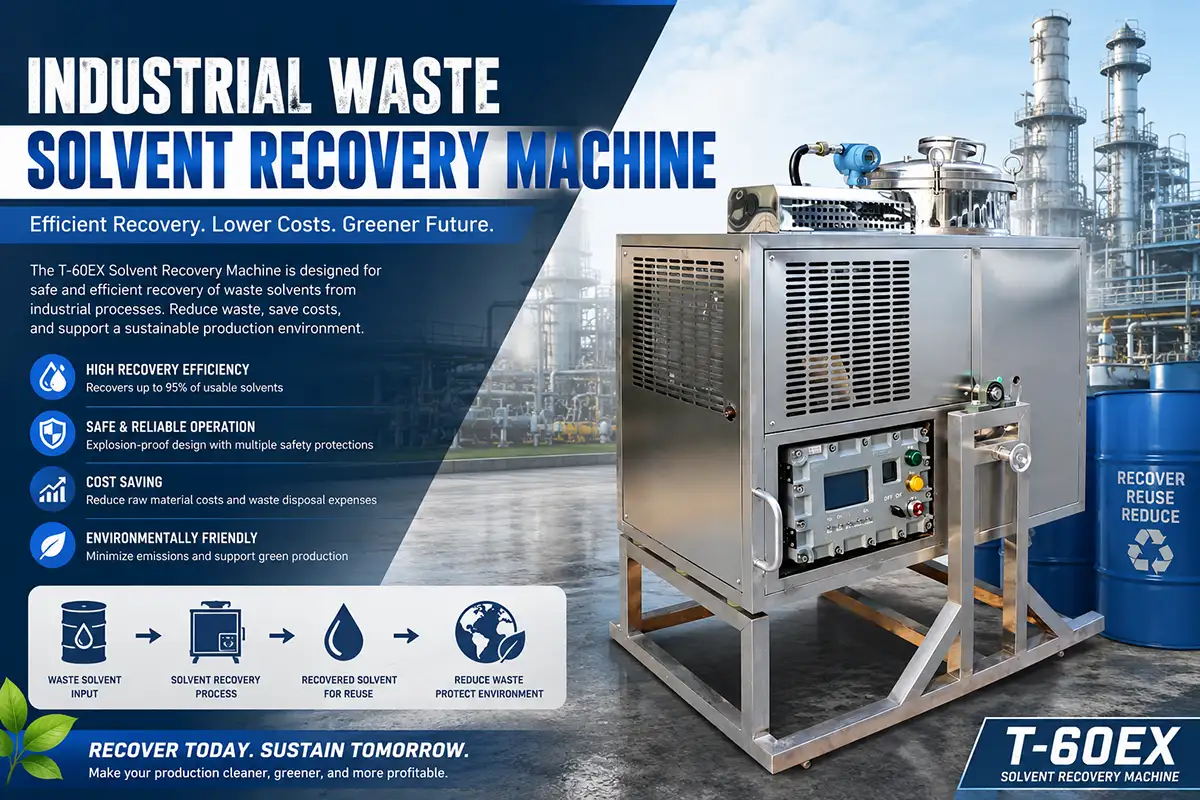
Industrial waste solvent recovery changes that equation. By separating reusable solvent from contaminants through controlled distillation and condensation, companies can reclaim a high percentage of usable solvent, often around 95% under suitable conditions. This recovered solvent can then be returned to selected production steps, reducing dependence on virgin material and stabilizing day-to-day operating expenses.
Could a solvent recovery machine really reduce both purchasing and disposal pressure at the same time?
Yes. In the author’s view, this is exactly why adoption keeps expanding. A properly matched system reduces the amount of fresh solvent entering the plant while also shrinking the hazardous waste stream leaving it. That dual benefit is what makes industrial waste solvent recovery financially attractive, not only environmentally responsible.
How the recovery process works in real industrial settings
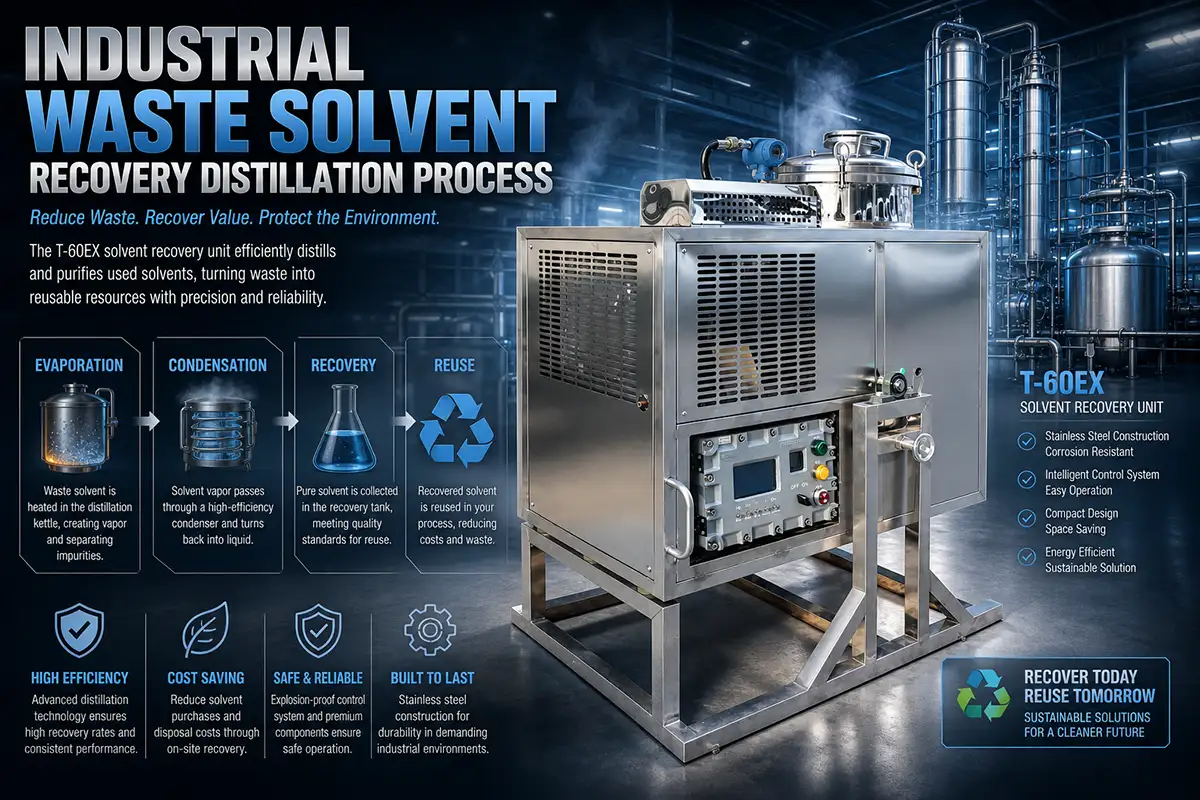
The core principle is straightforward: contaminated solvent is heated under controlled temperature conditions, the solvent fraction vaporizes, vapors move into a cooling section, and the purified liquid is collected separately from residues. In practice, however, successful recovery depends on several engineering details, including solvent boiling behavior, contamination level, heating power, treatment time, condenser efficiency, material compatibility, and hazardous-area safety design.
Facilities comparing options often benefit from reviewing a broader explanation of how a solvent recovery system works. That process perspective helps decision-makers connect technical specifications with actual plant requirements.
Typical process flow
Collect spent solvent from cleaning, coating, printing, or extraction processes.
Load waste solvent into a sealed recovery chamber.
Heat the solvent to the required temperature range, typically up to 200℃ depending on application.
Condense the vapor into a separate recovery vessel.
Remove sludge, paint solids, oils, or other residues from the still.
Reuse the recovered solvent where process purity allows.
Main benefits of industrial waste solvent recovery
Plants that install a suitable solvent recycler usually do so for a combination of economic, operational, and compliance reasons. The strongest projects are rarely driven by only one benefit.
Reduced virgin solvent purchases: recovered solvent can return to compatible cleaning or process steps.
Lower hazardous waste disposal volume: only concentrated residue remains for disposal.
More stable operating cost: solvent consumption becomes less exposed to supply and price fluctuation.
Cleaner plant operations: centralized recovery is often easier to manage than scattered solvent waste handling.
Support for compliance goals: documented solvent management can support internal EHS targets.
Improved sustainability reporting: recycling and reuse contribute to waste reduction metrics.
Is recovery only useful for very large factories?
No. The author’s answer is that recovery creates value wherever solvent use is frequent and repetitive. A medium-sized workshop generating a steady stream of waste solvent can often see meaningful savings, especially when the same solvent family is reused every week.
Choosing the right machine: capacity, safety, and throughput
Many buyers begin with one question: which model size fits the process? In reality, the right answer depends on daily solvent generation, batch frequency, solvent type, heating demand, required turnaround time, and site utilities. A mismatch in capacity can lead to underuse, bottlenecks, or unnecessary capital cost.
For operations comparing industrial-scale equipment, the following explosion-proof models provide a useful capacity framework for industrial waste solvent recovery applications.
| Model | Feed Capacity (L) | Power Supply (ACV) | Heating Power (kW) | Temperature Range (℃) | Treatment Time (Min.) | Recovery (%) | Weight (kg) | Machine Size (mm) |
|---|---|---|---|---|---|---|---|---|
| T-20Ex | 20 | 380 | 2 | RT~200 | 120 | 95 | 153 | 860×760×1190 |
| T-60Ex | 60 | 380 | 4 | RT~200 | 150 | 95 | 170 | 1160×870×1260 |
| T-80Ex | 80 | 380 | 5 | RT~200 | 180 | 95 | 200 | 1180×850×1290 |
| T-125Ex | 125 | 380 | 6 | RT~200 | 210 | 95 | 280 | 1250×920×1450 |
| T-250Ex | 250 | 380 | 16 | RT~200 | 240 | 95 | 520 | 2600×1200×1950 |
| T-400Ex | 400 | 380 | 32 | RT~200 | 270 | 95 | 1200 | 1990×1850×2090 |
These specifications show why sizing must be practical rather than theoretical. A plant recovering 40 to 60 liters per batch may not need a large 250L or 400L system, while a high-throughput facility may quickly outgrow a small batch unit.
Companies also searching for equipment comparisons may want to review our solvent recycler machine page for additional application context.
Safety and compliance factors that should never be vague
When evaluating industrial waste solvent recovery systems, safety is not a secondary consideration. It is often the deciding factor. Solvents can be flammable, volatile, and highly regulated depending on chemistry and site conditions. For that reason, factories usually focus on explosion-proof design, grounding, temperature control, sealed operation, and compatibility with hazardous-area expectations.
The author strongly recommends confirming the following before selection:
Solvent type and flash point
Need for explosion-proof or hazardous-location configuration
Material compatibility with seals, gaskets, tank surfaces, and piping
Required recovery purity for reuse
Batch versus continuous operating preference
Local electrical standards and plant utility conditions
Maintenance access, residue discharge method, and cleaning convenience
Why do some recovery projects underperform even when the equipment looks powerful on paper?
Because paper specifications alone do not guarantee process fit. In the author’s experience, the common causes are mixed solvent streams, underestimated residue load, unclear hazardous-area requirements, and unrealistic expectations about output purity. Good industrial waste solvent recovery begins with clear feed data, not just a bigger heater.
Typical application sectors for industrial waste solvent recovery
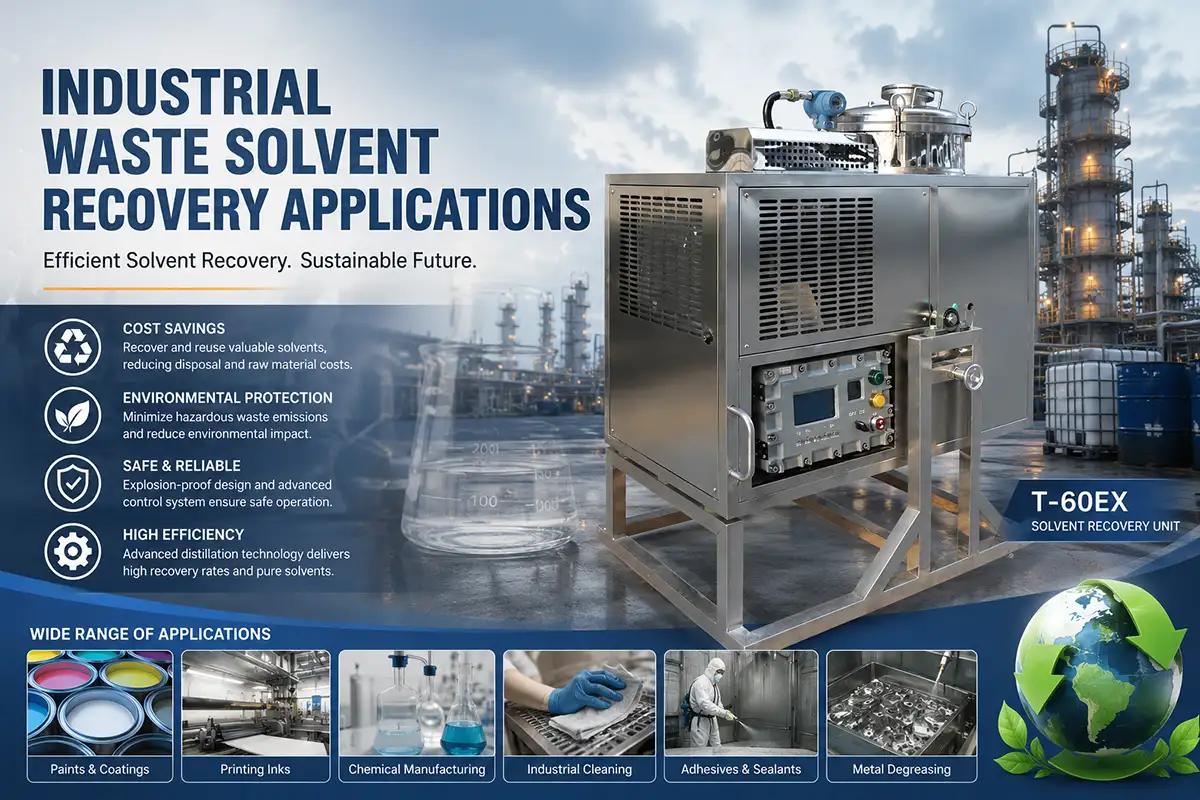
Industrial waste solvent recovery is widely used in sectors where solvent loss is repetitive and contamination is manageable. Common examples include:
Printing and packaging: recovery of cleaning solvent, ink-related solvent, and thinner streams.
Paints and coatings: recycling of thinner, washing solvent, and color-change cleaning fluids.
Electronics manufacturing: IPA and precision cleaning solvent reuse in qualified processes.
Chemical processing: solvent reclamation from intermediate cleaning and formulation workflows.
Automotive and metal finishing: parts washing solvent recovery to reduce disposal frequency.
Extraction and ingredient production: alcohol or organic solvent reuse where process design permits.
Budget expectations and value for industrial buyers
Price is important, but value depends on fit. A lower-cost unit that cannot handle the solvent load, residue profile, or safety requirement is rarely economical in the long run. For buyers reviewing entry-level industrial configurations, several products in the current range show pricing around the same level, with a representative company price of $2,645 for applicable models where multiple listing prices exist. More advanced or specialized systems may be priced higher depending on size and configuration.
For example, a larger solvent recovery unit in the company range is listed at $10,691, reflecting increased system scale. This price structure illustrates a key point: industrial waste solvent recovery should be selected based on process demand, not only initial budget. In many cases, the correct mid-sized system offers a faster return than an oversized machine or an undersized unit that creates production delays.
Buyers looking into cost drivers may also find useful detail in this article on solvent recovery system price.
Final thoughts: turning waste solvent into a controlled resource
Industrial waste solvent recovery is best understood as a production efficiency tool. It helps factories recover value from solvent streams that would otherwise become recurring cost centers. The strongest installations are those that align solvent chemistry, batch size, safety design, and throughput requirements from the beginning.
For facilities handling acetone, IPA, ethanol, xylene, toluene, ethyl acetate, or other reusable organic solvents, a properly selected recovery system can support lower solvent consumption, reduced waste handling, and more disciplined process control. That is why industrial waste solvent recovery continues to move from optional upgrade to standard operating strategy across many industrial sectors.