Solvent Recovery System Price: What Really Drives the Cost and When It Pays Off
Solvent recovery systems no longer belong only to giant chemical plants. With stricter regulations and higher solvent prices, even small workshops and laboratories are now installing compact solvent recycler machines. But how much does a solvent recovery system really cost, and what determines whether the investment pays back in 1 year or in 5 years?
1. Typical Solvent Recovery System Price Range
Solvent recovery system price depends strongly on capacity, explosion‑proof rating, level of automation, and local safety requirements. Based on current market data from industrial equipment distributors in North America and Europe, compact batch solvent recyclers for flammable solvents usually fall into these broad ranges:
Small units (10–25 L per batch): approx. US$2,000 – US$4,000
Medium units (60–125 L per batch): approx. US$4,000 – US$8,000
Large units (250–400 L per batch and above): approx. US$8,000 – US$12,000+
Within each capacity band, the price can easily double when adding advanced automation, higher explosion‑proof levels, or special materials for corrosive solvents (such as nitric acid or chlorinated solvents).
2. What Actually Drives Solvent Recovery System Price?
A solvent recycler is more than a heated tank. For industrial use, it must be safe, robust, and compliant. From reviewing many projects with users in coatings, printing, pharmaceuticals, and metalworking, the main cost drivers can be summarized clearly.
2.1 Capacity and throughput
Capacity is usually specified as feed volume per batch (L). For example, the following explosion‑proof batch models are typical:
| Model | Feed capacity (L) | Heating power (kW) | Temp. range (°C) | Typical treatment time (min) | Recovery rate (%) | Machine weight (kg) | Machine size (mm) |
|---|---|---|---|---|---|---|---|
| T-20Ex | 20 | 2 | RT–200 | 120 | 95 | 153 | 860 × 760 × 1190 |
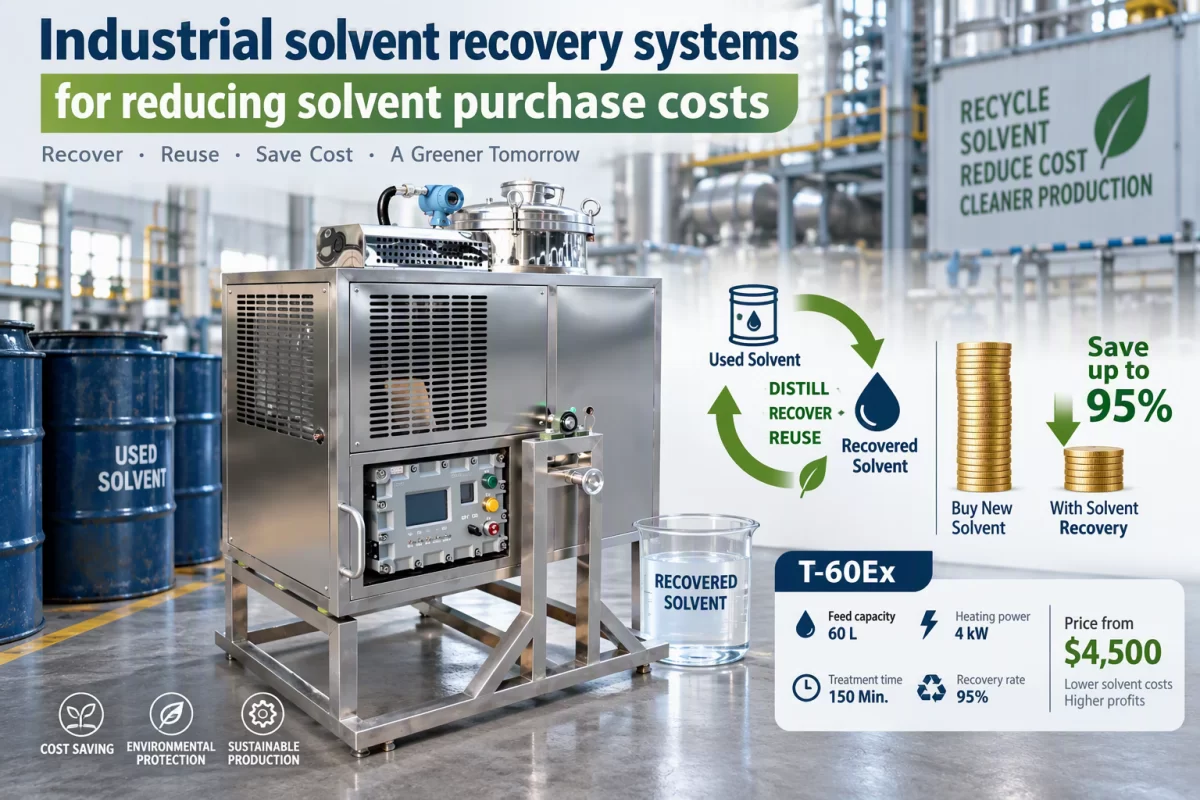
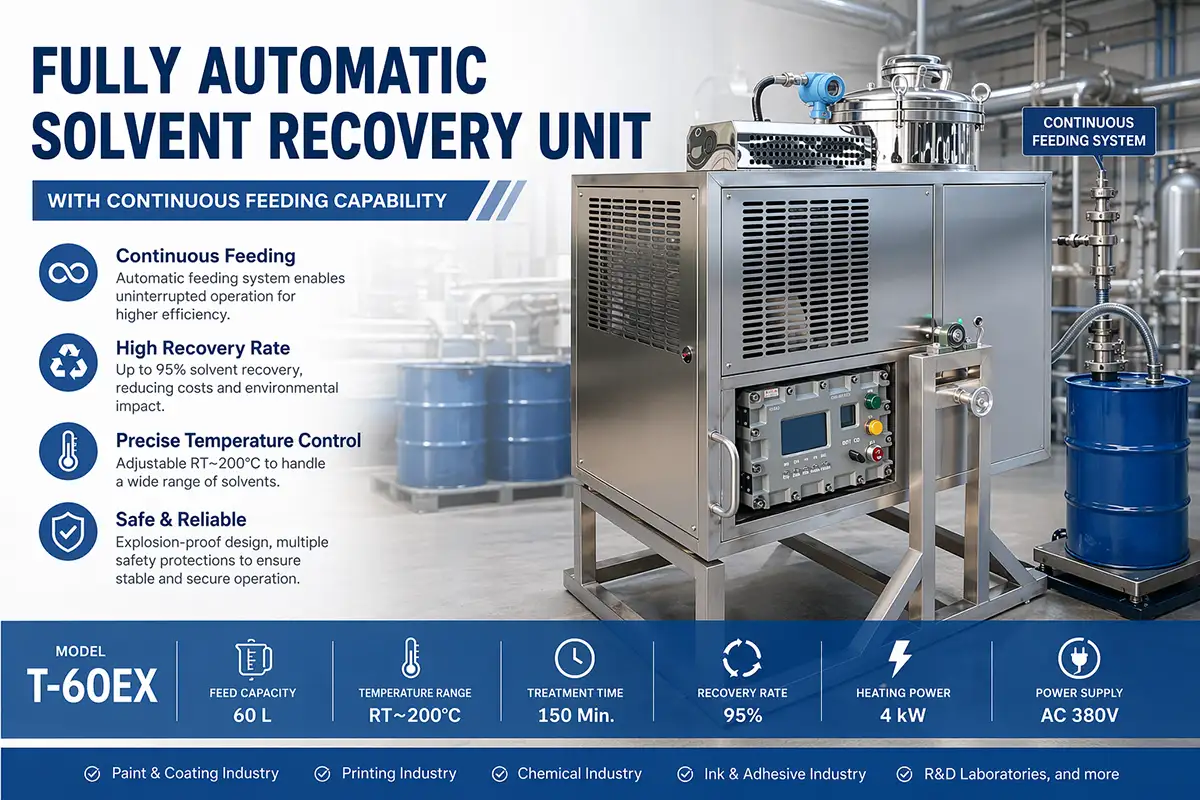
| T-60Ex | 60 | 4 | RT–200 | 150 | 95 | 170 | 1160 × 870 × 1260 |
| T-80Ex | 80 | 5 | RT–200 | 180 | 95 | 200 | 1180 × 850 × 1290 |
| T-125Ex | 125 | 6 | RT–200 | 210 | 95 | 280 | 1250 × 920 × 1450 |
| T-250Ex | 250 | 16 | RT–200 | 240 | 95 | 520 | 2600 × 1200 × 1950 |
| T-400Ex | 400 | 32 | RT–200 | 270 | 95 | 1200 | 1990 × 1850 × 2090 |
Higher feed capacity and heating power mean larger heat exchangers, stronger frames, and more robust safety systems, which naturally increase price.
2.2 Explosion‑proof and safety design
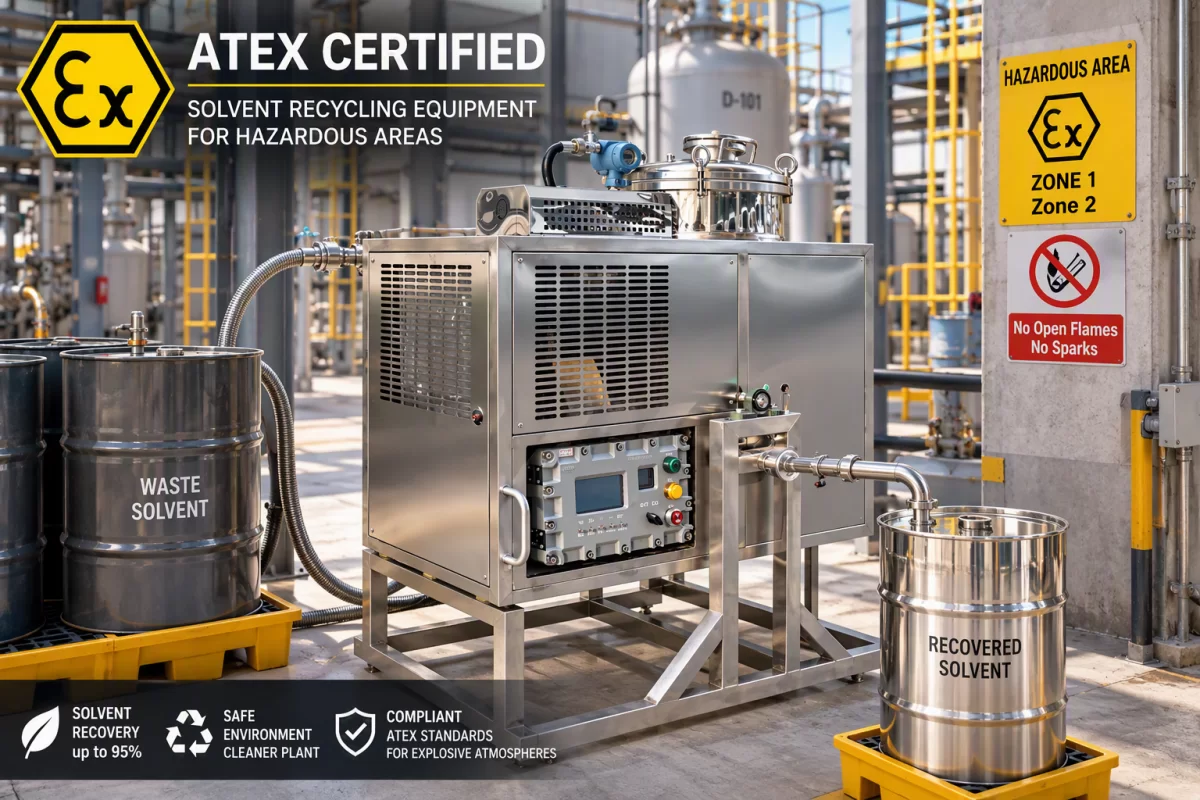
Most spent solvents (acetone, MEK, toluene, xylene, ethanol, IPA) are flammable. This is why serious manufacturers offer Ex‑rated solvent recycler machines rather than simple heating kettles.
Explosion‑proof design often includes:
Ex‑rated motors, control panels, and heaters
Temperature and level sensors with automatic shutdown
Over‑pressure protection and safe venting paths
Grounding and bonding points to control static electricity
These components can account for 20–40% of total equipment cost. Cutting corners here may reduce the initial solvent recovery system price but dramatically increases safety risk and regulatory problems.
2.3 Automation level and options
Automation affects both price and ongoing operating cost. Common options include:
Automatic filling and discharge instead of manual drums
Touchscreen PLC control, recipes for different solvents
Integration with solvent storage tanks and level monitoring
Remote diagnostics and data logging
According to a 2022 survey by an EU industrial engineering association, plants with automated solvent recovery equipment reported up to 25% lower labor time per ton of solvent processed, compared with manually operated units. That labor saving often justifies a higher purchase price over several years.
3. How to Estimate Payback Time (ROI) in Simple Terms
For most buyers, the key question is not only “What is the solvent recovery system price?” but “How fast will it pay for itself?” Fortunately, ROI can be estimated with a straightforward calculation.
3.1 Core variables
To estimate payback, four numbers are critical:
Fresh solvent cost (US$/L)
Disposal cost for waste solvent (US$/L)
Daily or monthly waste volume (L)
Recovery rate of the system (typically around 90–95%)
3.2 A realistic ROI example
Assume the following situation:
Waste solvent generated: 80 L/day
Fresh solvent cost: US$2.5/L
Disposal cost: US$1.0/L
Recovery rate: 95% (like the T‑80Ex and other models in the table)
Working days: 22 days/month
A suitable system might be a 60–80 L per batch unit such as a solvent recycling machine for sale.
In one month:
Waste generated = 80 L/day × 22 = 1,760 L
Recovered clean solvent (95%) ≈ 1,672 L
Savings on buying fresh solvent: 1,672 L × US$2.5 ≈ US$4,180
Savings on disposal (reduced waste volume): 1,672 L × US$1.0 ≈ US$1,672
Combined gross savings ≈ US$5,852 per month. Even after subtracting electricity and small consumables (often only a few hundred dollars per month), the system could pay back a US$20,000 investment in around 4–5 months.
A 2021 report by the European Environment Agency indicated that solvent management and recycling projects frequently achieve payback periods below 3 years, primarily due to combined savings in purchase, waste handling, and compliance costs.
4. Choosing the Right Size: Matching Price to Real Needs
Oversizing drives up solvent recovery system price unnecessarily, while undersizing causes bottlenecks and frequent batch changes. A simple sizing approach works well in most plants:
4.1 Step-by-step sizing logic
Calculate average daily waste volume over at least 2–4 weeks.
Decide how many batches per day are practical (1–3 batches is typical).
Select a feed capacity so that daily waste ≈ 1–2 batches.
Check that treatment time fits into your operating schedule.
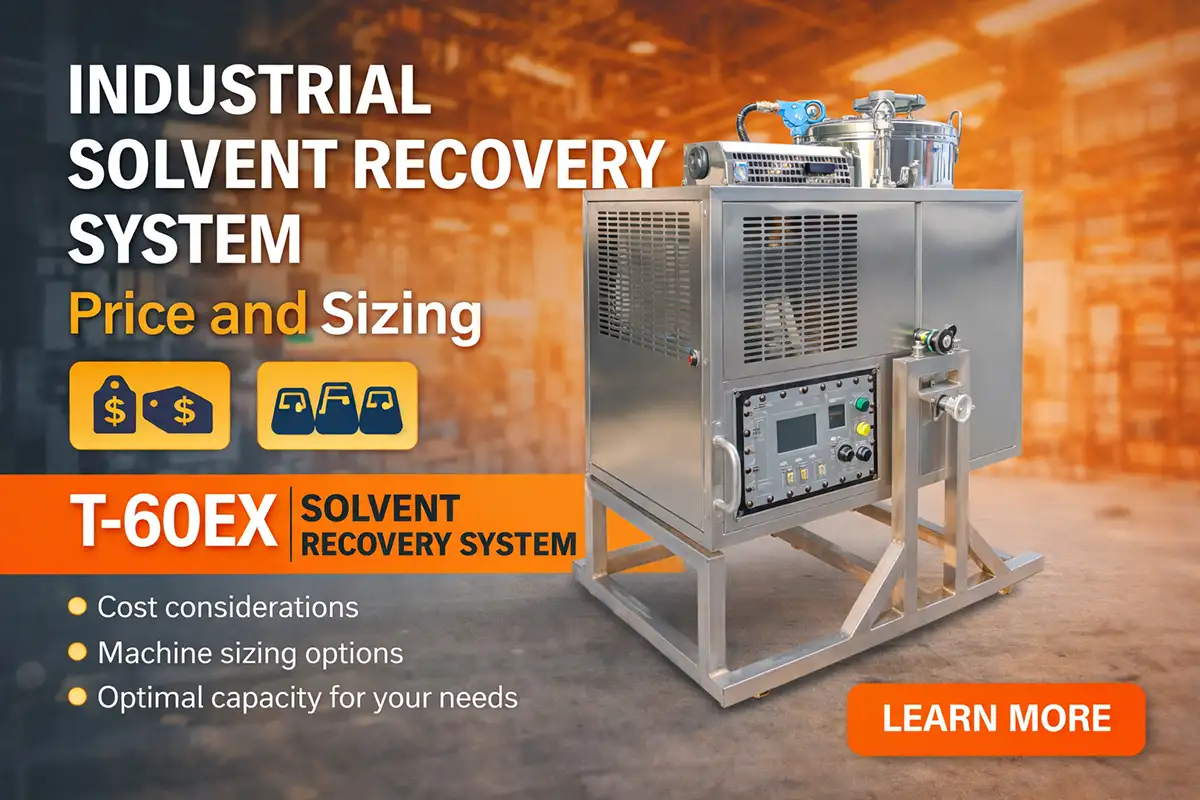
If daily waste is around 60 L, a 60 L batch unit (like T‑60Ex) with 150 minutes per cycle can usually process all waste in one standard shift. If waste grows to 120–150 L/day, either a 125 L unit or running two batches may be more economical.
4.2 When to choose a smaller model
A lower‑priced, smaller unit can be sufficient when:
Total waste volume is below 20–30 L/day
Space is very limited (e.g., laboratory environments)
Solvent has very high value, but volume is modest (pharmaceutical R&D labs)
For example, a 20 L explosion‑proof unit with 120‑minute cycle time can handle several batches per day and is often enough for a small paint shop or maintenance workshop.
4.3 When a larger system is more economical
Choosing a larger unit makes sense if:
Waste volume exceeds 200–300 L/day
Labor is expensive, making fewer, larger batches more attractive
Multiple production lines can share one central recovery system
Future expansion is planned within 1–2 years
For high‑volume users, it is worth looking at how a solvent recovery system works in detail, including options for continuous or semi‑continuous operation.
5. Hidden Cost Factors Often Overlooked
Looking only at the purchase price can be misleading. Several “hidden” factors influence total cost of ownership more than the initial invoice.
5.1 Energy consumption
Heating power in the models above ranges from 2 kW to 32 kW. While higher power shortens cycle time, it also increases electricity demand. Fortunately, distillation is relatively efficient, and the cost per recovered liter is usually far below the savings on fresh solvent.
As a rough rule from industry case studies, energy cost per liter of recovered solvent is often below 5–10% of the cost of buying fresh solvent, especially for high‑volume users.
5.2 Maintenance and downtime
Batch solvent recyclers are mechanically simple, but operating conditions (high temperature, aggressive chemicals) require good seals and corrosion‑resistant materials. Key points that affect ongoing cost include:
Quality of gaskets and seals (cheap materials fail faster)
Cleaning access: easy‑to‑open lids reduce labor time
Availability of spare parts and local service
5.3 Compliance and documentation
Agencies in North America, the EU, and many Asian countries increasingly require documentation of solvent use, waste volumes, and treatment methods. According to a 2023 report from a US environmental compliance consultancy, companies implementing on‑site recycling and better tracking reduced solvent‑related inspection findings by more than 40%.
Buying a system with proper documentation, certificates, and clear operating procedures often saves money indirectly by reducing fines, delays, and consulting fees later.
6. Practical Checklist Before Comparing Quotes
When requesting quotations, having a structured checklist speeds up the process and results in more comparable offers. The following items are particularly useful:
Solvent types and contaminants (e.g., paint, oil, resins, water)
Daily / monthly waste volume and maximum peaks
Required explosion‑proof zone classification (ATEX, NEC, etc.)
Target recovery rate and desired purity of recovered solvent
Available space and utilities (electricity, cooling water, ventilation)
Labor constraints (how many operator hours can be devoted per shift)
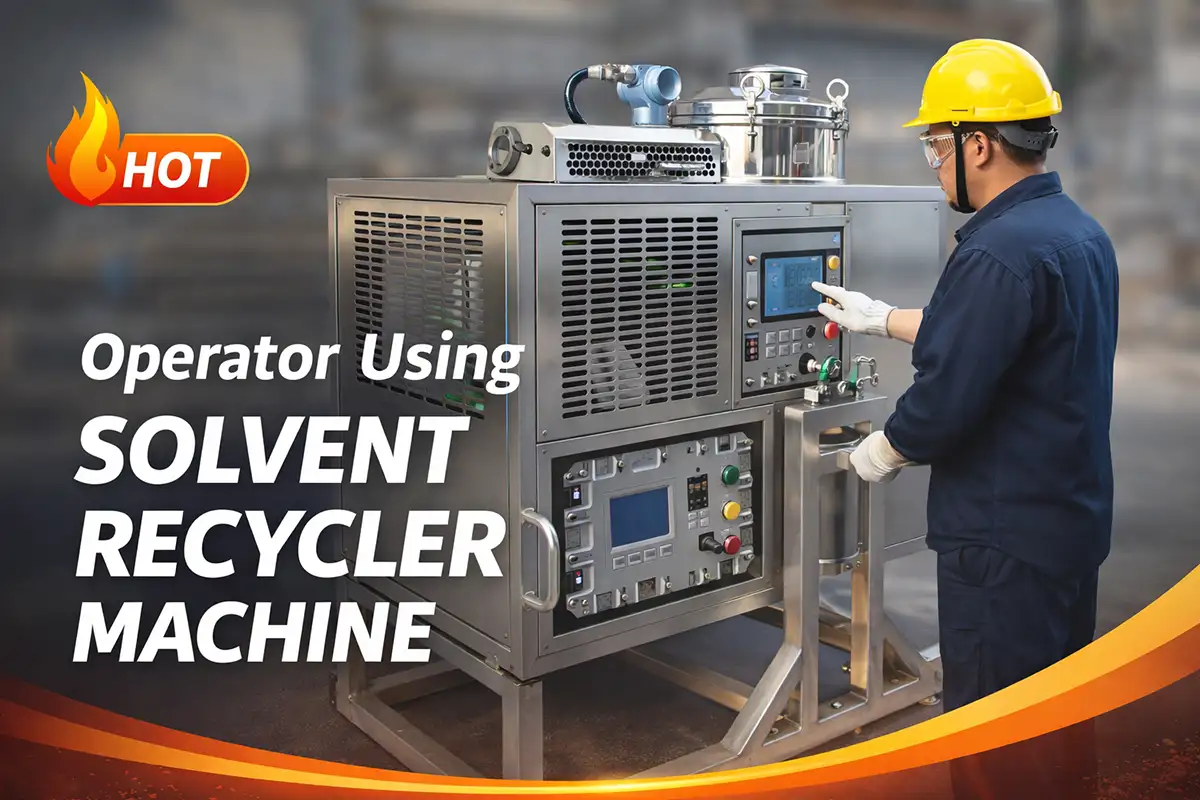
With this data, suppliers can select between models similar to the T‑20Ex, T‑60Ex, T‑80Ex, and up to T‑400Ex, balancing solvent recovery system price with the required throughput and safety level.
7. Summary: How to Think About Solvent Recovery System Price
Solvent recovery system price cannot be reduced to a single number. Instead, it is the result of capacity, safety design, automation, and the complexity of the plant’s solvent mix. Yet, the economics are often surprisingly favorable.
Small systems may start around US$4,000–8,000, mid‑size around US$8,000–20,000, and large central units can exceed US$60,000.
Explosion‑proof components and automation significantly increase price but also reduce risk and labor cost.
Payback below 1–3 years is common where solvent consumption and disposal costs are moderate to high.
Right‑sizing the machine to daily waste volume is key to balancing capex and efficiency.
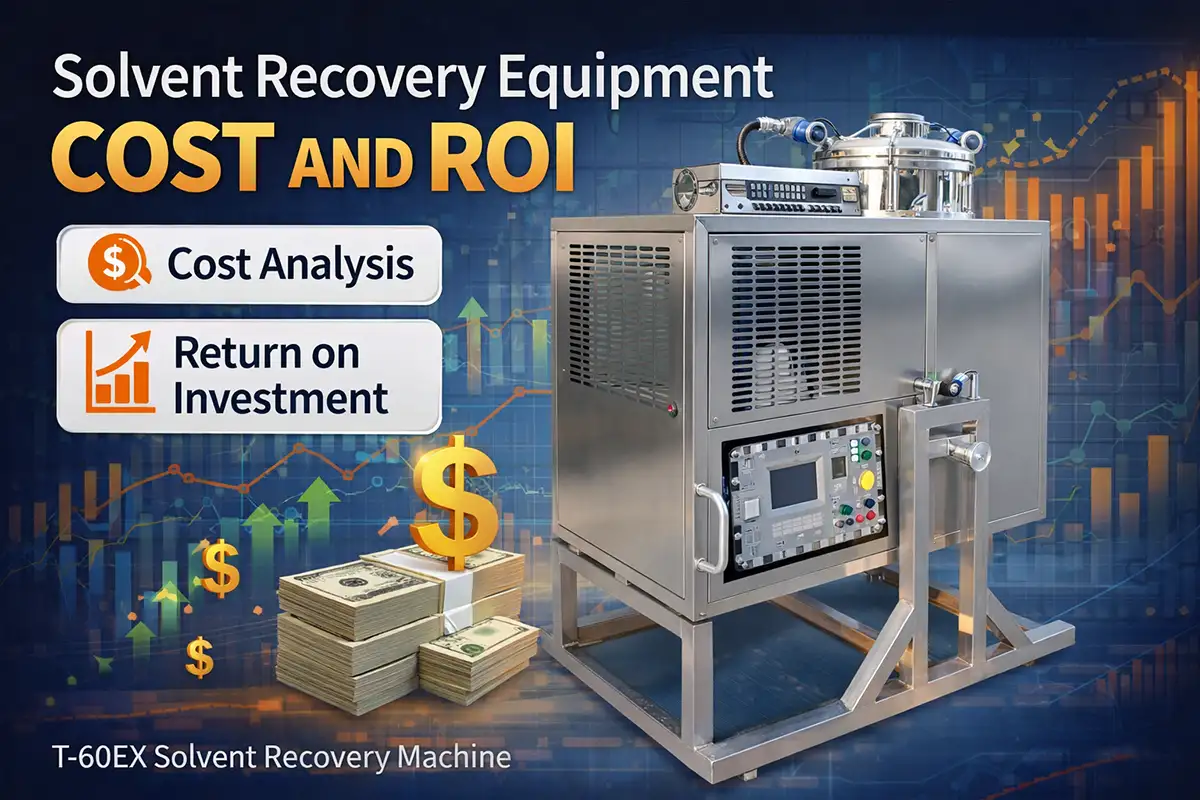
For deeper technical understanding before investing, it is helpful to review what solvent recovery is and how distillation works in practice. A good starting point is an educational overview such as what is solvent recovery, then combine that with real cost figures from your own plant.
With accurate data on current solvent use and a clear view of total savings, the question usually shifts from “Can a solvent recovery system be afforded?” to “How quickly can installation start?”.