
MIBK Recovery: How to Reduce Odor and Residual Impurities
Methyl isobutyl ketone (MIBK) is widely used for coatings, inks, resins, and precision cleaning. But when MIBK is reused, two complaints appear again and again: strong odor andmysterious residue that affects product quality.
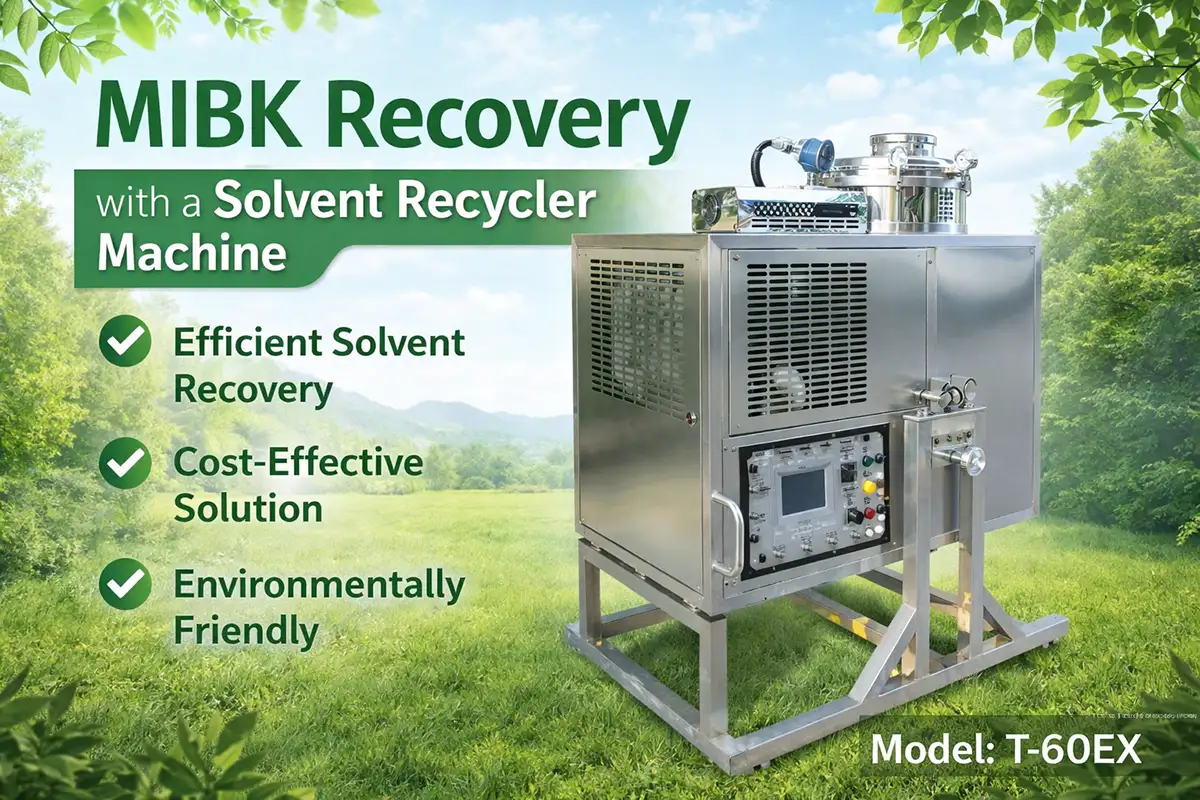
1) What causes odor during MIBK recovery?
“Odor” is not just a comfort issue—smell often hints that something volatile besides MIBKis being collected in the receiver. In real production waste streams, MIBK is rarely alone. It can be mixed with cleaning additives, low-boiling co-solvents, reaction by-products, or decomposition products formed when solvent contacts heat, oxygen, acids/alkalis, or certain metals.
In my experience, odor complaints usually come from one of three process conditions:
Too-fast heating, causing unstable boiling and “bumping” that carries contaminants upward.
Mixed solvents (including light ends) recovered into the same drum with no fraction strategy.
Overheating residues, which can generate additional odor compounds late in the run.
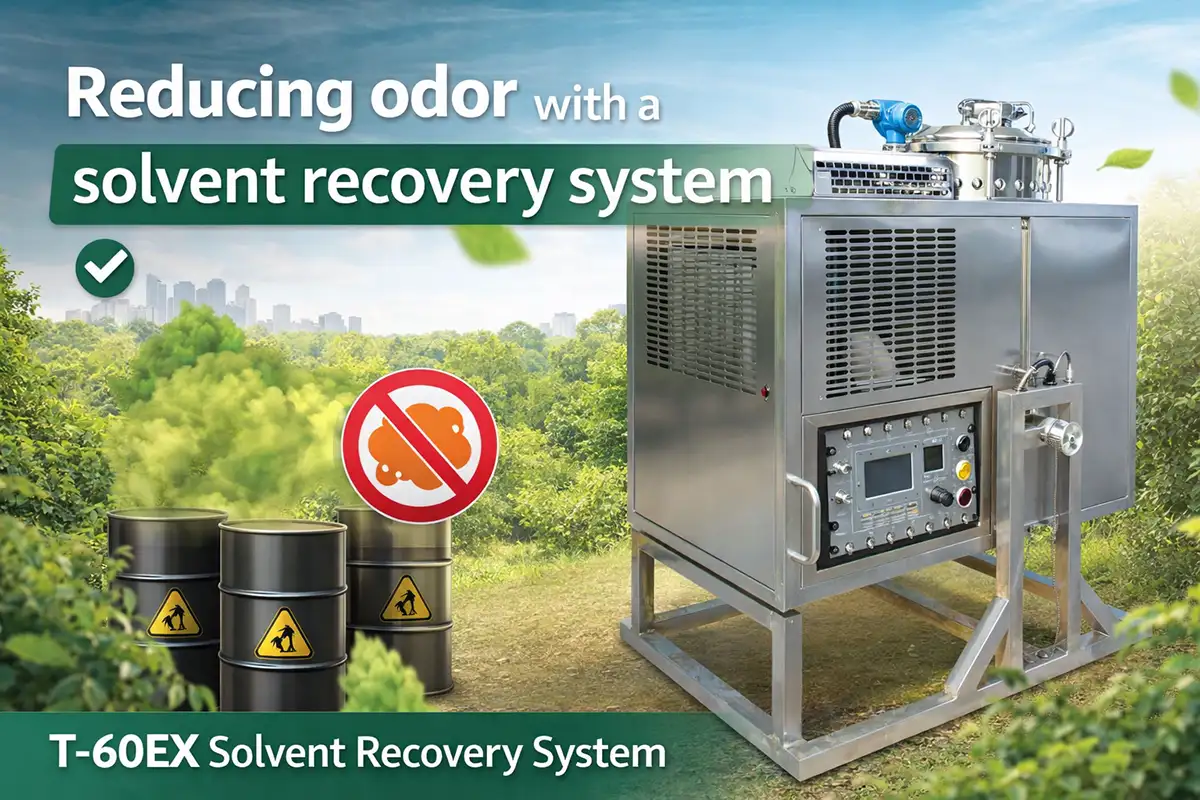
2) What “residual impurities” really are
When operators say “residual impurities,” it typically means one (or more) of the following:
Non-volatile solids: pigments, fillers, dust, metal fines, polishing compounds.
High-boiling organics: resins, plasticizers, oils, surfactants, greases.
Water: even small amounts can change odor perception and solvent performance in cleaning.
Unexpected co-solvents: a different ketone/ester/alcohol that partially co-distills.
Distillation is excellent at separating volatile solvent from non-volatile residue, but only if the process prevents carryover. That is why recovery quality depends less on “high temperature” and more on stable evaporation + good condensation + correct end-point control.
3) Steps that reduce smell & residue (practical workflow)
Below are the process steps that most consistently improve reclaimed MIBK. Each step answers the real question:how to make recovered MIBK smell cleaner and leave fewer deposits in downstream use.
Step A — Pre-filter the feed (simple but high impact)
If the waste MIBK contains visible particles, pre-filtration (bag filter, cartridge, or settling) reduces foaming, reduces bumping, and reduces carryover into the condenser. Less carryover = less odor and fewer “mystery residues” in the recovered solvent.
Step B — Avoid “one-drum recovery” for mixed solvent waste
If MIBK is mixed with lighter solvents, collecting everything together can amplify odor. A better approach is to segregate waste streams or use a procedure that discards a small “heads” cut (the earliest condensate) if it contains the strongest-smelling light ends.
Step C — Control heating rate to prevent entrainment
Many odor and impurity problems are not chemical—they are mechanical. When boiling is unstable, droplets of dirty liquid can be carried into the vapor path. The cure is a controlled heating profile and enough processing time for steady evaporation.
Step D — Stop at the right end-point (don’t “cook the sludge”)
Late in a run, the residue becomes concentrated. If heating continues too aggressively, thermal stress can form new odorous by-products, and viscosity increases can promote carryover. A good practice is to define an end-point based on: temperature behavior, recovered volume, or residue condition, and then stop before overheating.
Step E — Verify quality with quick checks
Fast checks like appearance (clarity), odor comparison, and a simple evaporation residue test help confirm whether the process is improving. For stricter applications, water content (Karl Fischer) and GC purity are common.
4) What to look for in a solvent recovery machine (for cleaner MIBK)
When odor and residual impurities are the main pain points, equipment details matter. A well-designedsolvent recycling machinesupports stable distillation instead of “boil-and-hope.”
Stable temperature control across a wide range (e.g., room temperature up to ~200°C), enabling gentle ramps.
Reliable condensation capacity to prevent vapor loss and reduce smell in the workspace.
Process repeatability: consistent treatment time, consistent recovery rate, consistent end-point.
Explosion-proof design (Ex) for flammable solvent environments, where required.
For readers who want the fundamentals, this internal guide explains the principle clearly:how a solvent recovery system works.
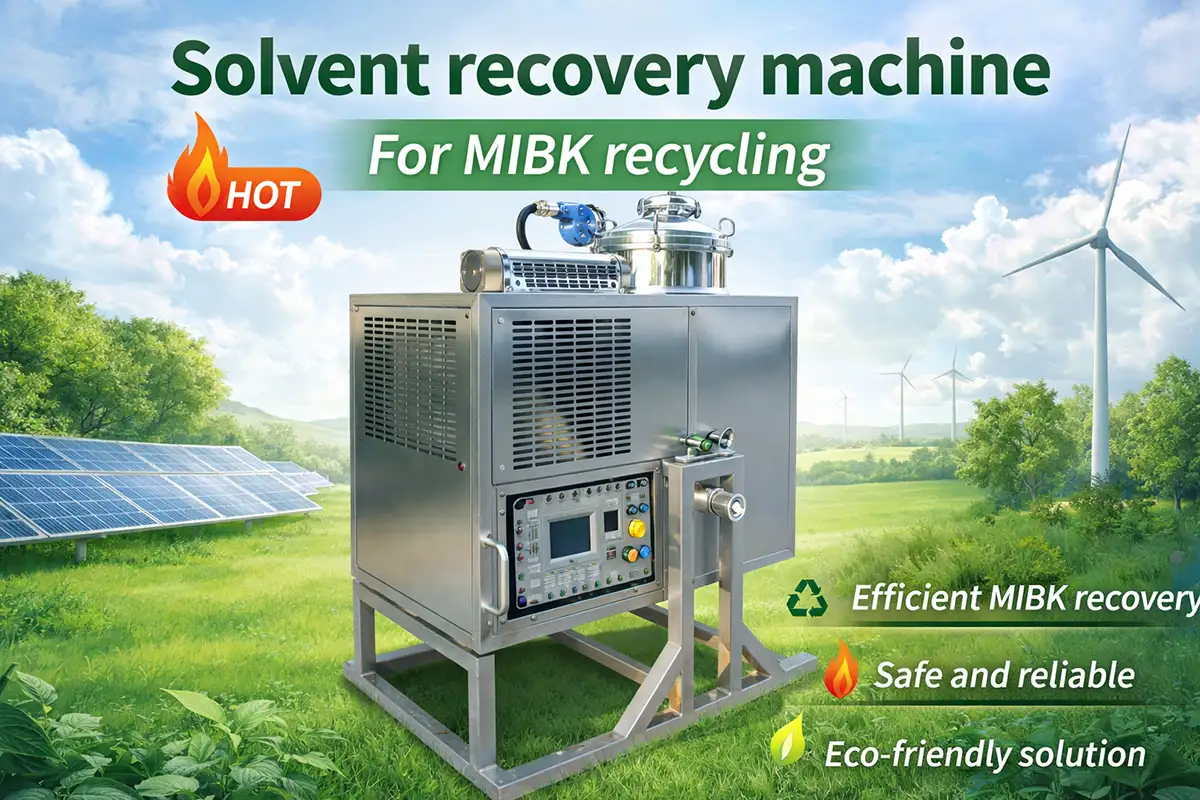
5) Example equipment capacities (from common Ex models)
Capacity and cycle time affect odor control because they influence heating stability and how often residues are overheated. Below is a clear, user-friendly table of typical configurations.
| Model | Feed Capacity (L) | Heating Power (kW) | Treatment Time (min) | Recovery (%) | Size (mm) |
|---|---|---|---|---|---|
| T-20Ex | 20 | 2 | 120 | 95 | 860×760×1190 |
| T-60Ex | 60 | 4 | 150 | 95 | 1160×870×1260 |
| T-80Ex | 80 | 5 | 180 | 95 | 1180×850×1290 |
| T-125Ex | 125 | 6 | 210 | 95 | 1250×920×1450 |
| T-250Ex | 250 | 16 | 240 | 95 | 2600×1200×1950 |
| T-400Ex | 400 | 32 | 270 | 95 | 1990×1850×2090 |
Note: The “best” model depends on daily solvent waste volume, shift pattern, and how sensitive the application is to odor and residue.