
Methanol Recovery Safety Essentials: Explosion Protection, Ventilation & Static Control
Methanol is a valuable solvent, but it is also highly flammable—meaning recovery must be designed around preventing ignition and controlling vapor. This guide focuses on the three topics people most often want clarified: what “explosion-proof” really means, how to ventilate correctly, and how to prevent static sparks. It also shows where an industrial solvent recycling machinefits into a safer, more compliant workflow.
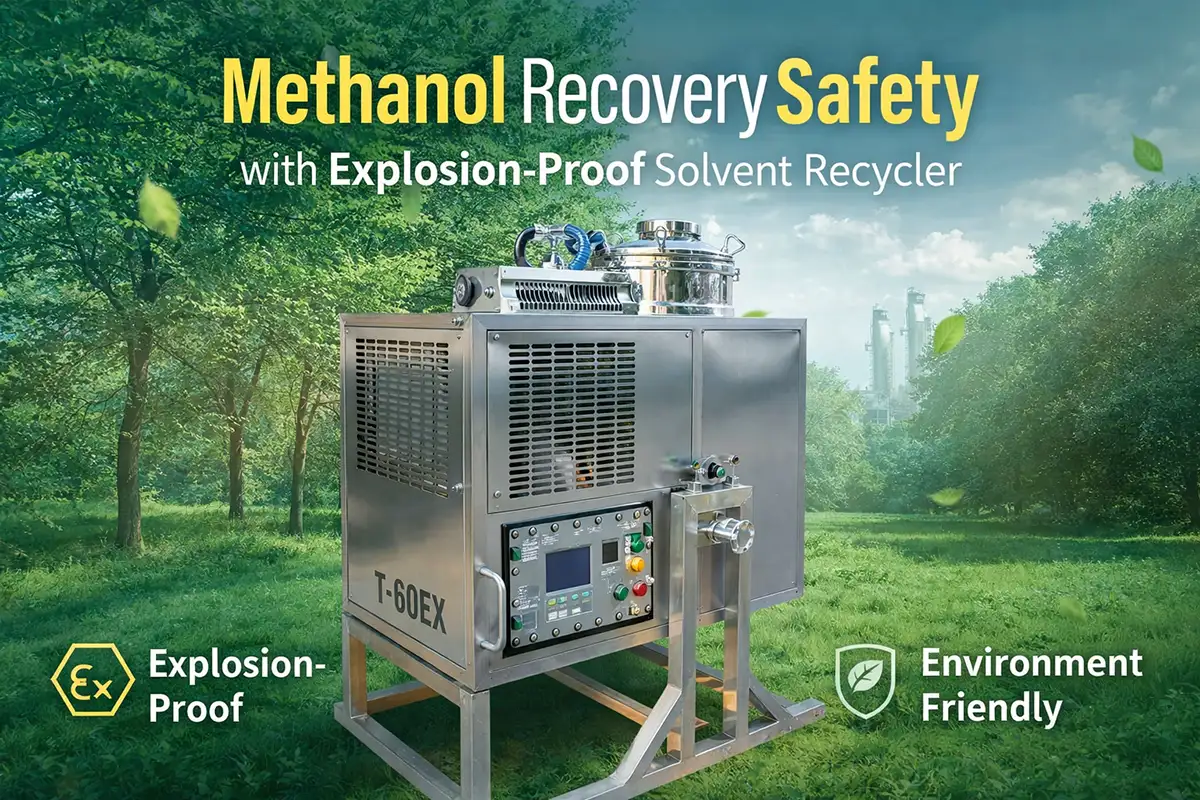
1) Explosion Protection: What “Explosion-Proof” Actually Covers
The phrase explosion-proof is often misunderstood. It does not mean “impossible to ignite.” It means the equipment is designed so that if flammable vapor reaches an electrical component, the device is built to avoid becoming an ignition source (or contain an internal ignition, depending on the protection concept and certification standard).
Why this matters for methanol: methanol vapor can ignite easily when mixed with air in the right range. The U.S. National Institute for Occupational Safety and Health (NIOSH) lists the methanollower explosive limit (LEL) as 6% by volume in air and the upper explosive limit (UEL) as 36.5%. Those numbers make a simple point: if vapor is allowed to build up, the “flammable zone” is not a narrow edge case—it’s a real operating possibility.
Is an explosion-proof solvent recycler enough by itself?
No. Explosion-proof design reduces ignition risk from the machine, but safety still depends onvapor management (ventilation) and charge management (static control). From the author’s perspective, treating “Ex-rated” as a complete solution is the fastest way to miss the real hazards.
When evaluating a methanol recovery setup, focus on practical checkpoints:
Ex-rated core components (controls, wiring, switches) suitable for flammable atmospheres.
Closed-loop handling to limit vapor escape during loading, distillation, and discharge.
Temperature discipline: stable control reduces unexpected boiling and vapor surges.
Related reading: solvent recovery system working principle.
2) Ventilation: The Simplest Way to Keep Vapor Below Risk Levels
Ventilation is often treated as a “facility detail,” but in methanol recovery it’s a frontline control. The goal is simple: prevent vapor accumulation, especially near potential ignition sources and around operators.
A useful reference point comes from the U.S. Occupational Safety and Health Administration (OSHA): methanol’s permissible exposure limit (PEL) is 200 ppm (8-hour time-weighted average). Even when far below explosive limits, high ppm exposure can still be a serious health issue—so ventilation protects bothfire safety and worker exposure.
What good ventilation looks like in practice
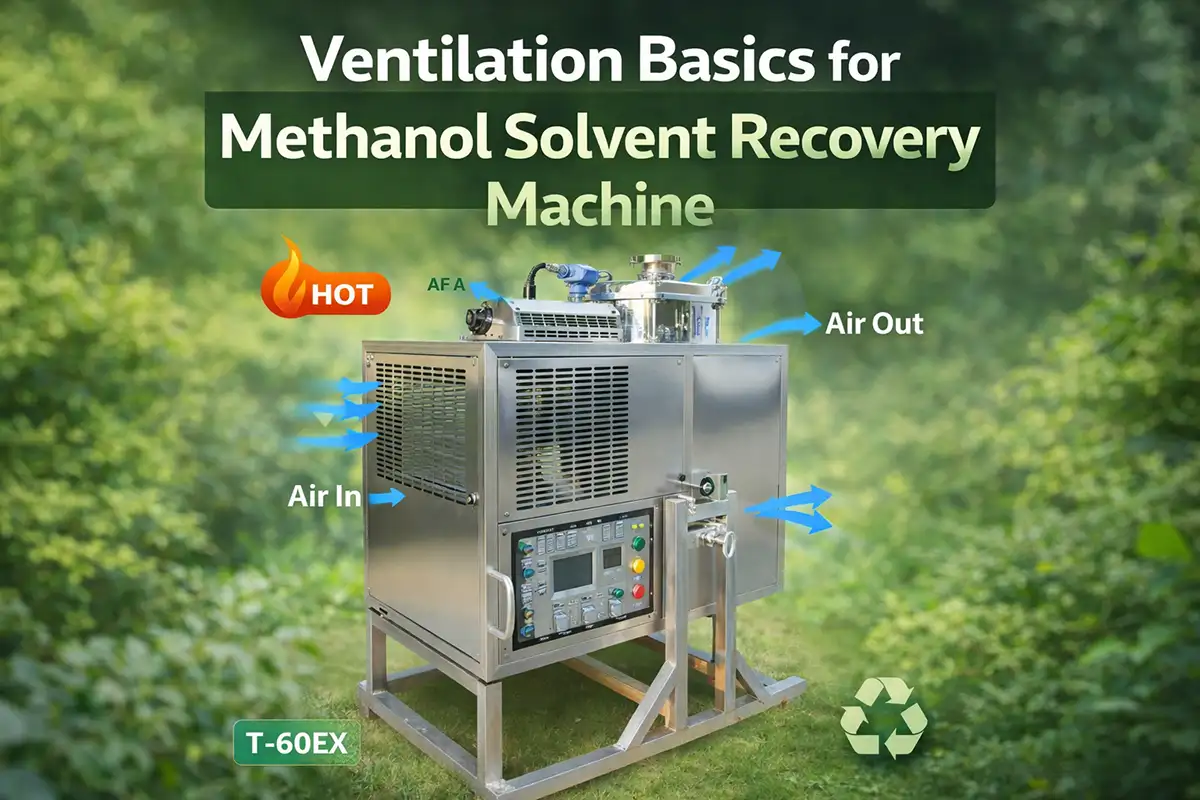
Local exhaust near vapor release points (loading door, waste tank opening, discharge).
Airflow direction that carries vapors away from operators—not across breathing zones.
Fresh-air makeup so exhaust does not create negative pressure that pulls vapors into offices or corridors.
How to tell if ventilation is “good enough” without guessing?
Use measurement. From the author’s point of view, the most reliable approach is combiningLEL monitoring (for fire risk) with ppm monitoring (for exposure), then adjusting exhaust or enclosure until readings stay consistently low during warm-up, steady-state operation, and unloading.
One more practical point: ventilation should match the operating rhythm. The highest vapor release often happens duringloading and hot start, not only during steady distillation. That’s why a consistent procedure (open/close timing, sealed transfers, and staged cooldown) matters as much as fan size.
3) Static Electricity Control: The “Invisible Spark” Problem
Static is deceptive because it is easy to ignore—until it becomes an ignition source. Methanol recovery includes actions that can generate charge: pouring, pumping, splashing, and flowing through hoses or filters.
Three controls that work in real facilities
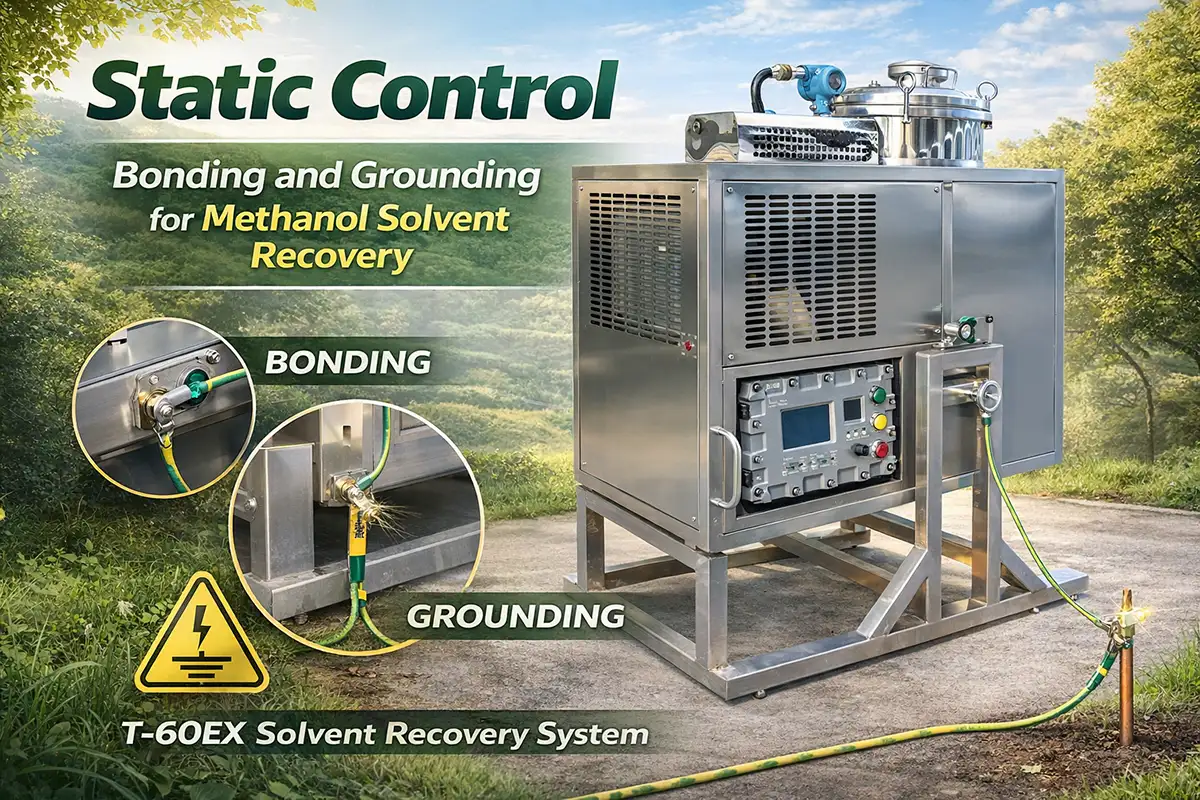
Bonding and grounding for tanks, drums, and the recovery unit so all metal parts share the same electrical potential.
Anti-static hoses and conductive fittings for transfers—especially if “temporary hoses” are used during busy shifts.
Flow discipline: avoid high-velocity filling that creates turbulence and charge separation.
Does grounding matter if the equipment is already explosion-proof?
Yes. Explosion-proof design addresses electrical ignition inside the machine; static can ignite vaporsoutside the enclosure—at the drum, hose, or operator interface. In the author’s experience, static control is one of the fastest, lowest-cost risk reductions available.
A well-designed solvent recycler machinesupports static control by enabling more closed transfers and reducing the number of times waste solvent must be poured or handled manually.
Explosion-Proof Methanol Recovery Machines: Practical Model Sizing (Examples)
People commonly ask: “What capacity is suitable?” The safest answer starts with operations: batch size per shift, frequency of solvent change, and how much contaminated methanol is generated. Below is a simple model lineup (Ex-type) showing typical feed capacities and operating ranges.
| Model | Feed Capacity (L) | Heating Power (kW) | Treatment Time (min) | Recovery (%) | Weight (kg) | Size (mm) |
|---|---|---|---|---|---|---|
| T-20Ex | 20 | 2 | 120 | 95 | 153 | 860×760×1190 |
| T-60Ex | 60 | 4 | 150 | 95 | 170 | 1160×870×1260 |
| T-80Ex | 80 | 5 | 180 | 95 | 200 | 1180×850×1290 |
| T-125Ex | 125 | 6 | 210 | 95 | 280 | 1250×920×1450 |
| T-250Ex | 250 | 16 | 240 | 95 | 520 | 2600×1200×1950 |
| T-400Ex | 400 | 32 | 270 | 95 | 1200 | 1990×1850×2090 |
Looking for broader system options? See solvent recycling system.
Can methanol be recovered safely on-site? Yes—when the unit is explosion-proof and the site controls vapor (ventilation) and ignition (static and electrical sources).
What are the three non-negotiables? Ex-rated equipment, measured ventilation performance (LEL/ppm), and verified grounding/bonding of every transfer point.
Does a recovery machine reduce disposal pressure? In most operations, yes—recovering reusable methanol reduces the amount classified as waste, and cuts transport and storage of flammable waste drums.
Safety reminder: always follow local regulations, facility EHS procedures, and the solvent’s SDS. This article is educational and does not replace a professional hazard assessment.