
Cyclohexanone Recovery: Process Choices for High-Boiling Ketone Solvent Recycling
Cyclohexanone is a workhorse solvent in coatings, inks, adhesives, and specialty chemical production—but reclaiming it is not as “plug-and-play” as acetone or IPA. This guide explains the practical process choices that matter for high-boiling ketone recovery, using clear rules of thumb and real equipment specs.
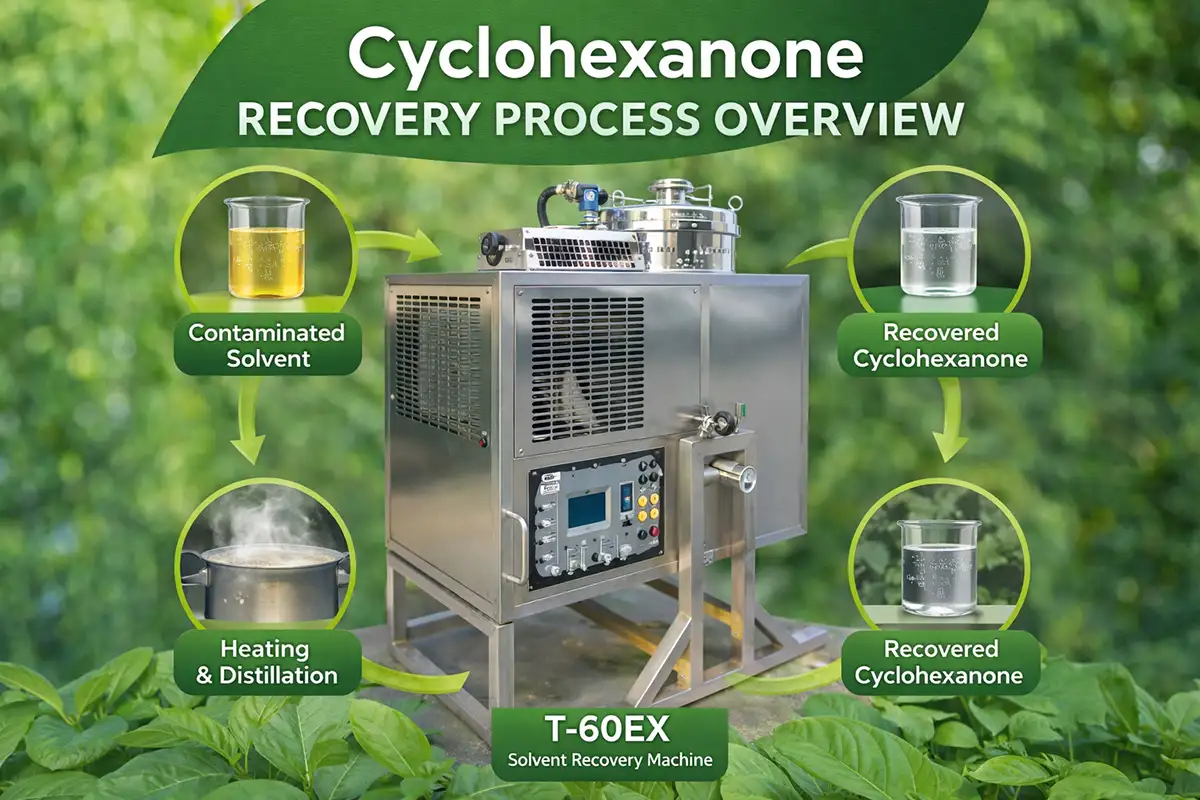
1) Why cyclohexanone is harder to recycle than low-boiling solvents
Cyclohexanone is a high-boiling ketone (boiling point around 155–156 °C). In plain terms: compared with solvents like acetone (56 °C), it needs more heating time and tighter control to separate it from oils, resins, pigments, and polymer residues.
Another challenge is that real-world “cyclohexanone waste” is rarely pure. It often contains:resins & bindersplasticizersink pigmentswater pickupmixed solventsThese contaminants don’t evaporate evenly. Some stay behind as residue, while others can co-distill and lower recovered solvent quality.
With high-boiling ketones, the “wrong” recovery method often looks fine on day one—but creates chronic problems later: slow cycles, dark distillate, frequent cleaning, or high residue loss.
Is cyclohexanone recovery always worth it?
It depends on three numbers: solvent purchase price, waste disposal cost, and achievable recovery rate. In many production lines, recycling becomes attractive when waste volumes are steady and the recovered solvent can replace a significant portion of fresh solvent without rework.
2) Process choices that actually work for high-boiling ketones
For cyclohexanone and similar ketones, most factories end up choosing among three practical routes:
Option A: Batch distillation (solvent recycling machine / solvent distiller)
This is the most common choice for plants that generate mixed solvent waste with solids(paint sludge, ink residue, adhesive gels). The concept is simple: heat the waste in a closed vessel, condense the vapor, and collect the recovered solvent—leaving non-volatile residue behind.
In the equipment parameters provided for explosion-proof models, a typical recovery target is~95% across multiple capacities. That “95%” is a realistic planning figure for many cyclohexanone-like applications, assuming the waste is distillable and not dominated by heavy non-volatiles.
Option B: Fractional distillation (when mixtures must be split)
If cyclohexanone is mixed with other solvents that boil close together, a basic batch still may recover “usable solvent,” but not a tight spec. Fractionation (more theoretical plates / better reflux control) becomes important when the recovered solvent must match a strict formulation.
Option C: Outsourced disposal/incineration (when recovery is not feasible)
When waste is extremely contaminated (e.g., high polymer content, reactive contaminants, or low solvent fraction), disposal may be the only practical route. In that case, it still helps to understandwhat solvent recovery isand where the cutoff point typically lies—so the decision is based on process reality, not guesswork.
For a beginner-friendly overview of system flow (heating → vapor → condensation → collection), seehow a solvent recovery system works.
What usually causes “dark” recovered cyclohexanone?
Most often it is thermal stress (overheating), plus co-distillation of trace high-boiling organics from resins or inks. The practical fix is to optimize temperature control, keep heating surfaces clean, and avoid running a still “too dry” at the end of a batch.
3) When a solvent recycling machine is the right tool
A solvent recycling machine is a strong fit when the goal is to:
Reduce solvent purchase by reusing recovered cyclohexanone in cleaning or production steps.
Cut hazardous waste volume by concentrating contaminants into a smaller residue stream.
Control risk with a closed, engineered process instead of open handling.
According to the U.S. EPA, “solvent recovery (e.g., distillation)” is listed as a common recycling method for many used solvents under hazardous waste management guidance (resource conservation and recovery framework). In practice, that means distillation is widely recognized as a legitimate recycling route—when performed safely and in compliance with local rules.
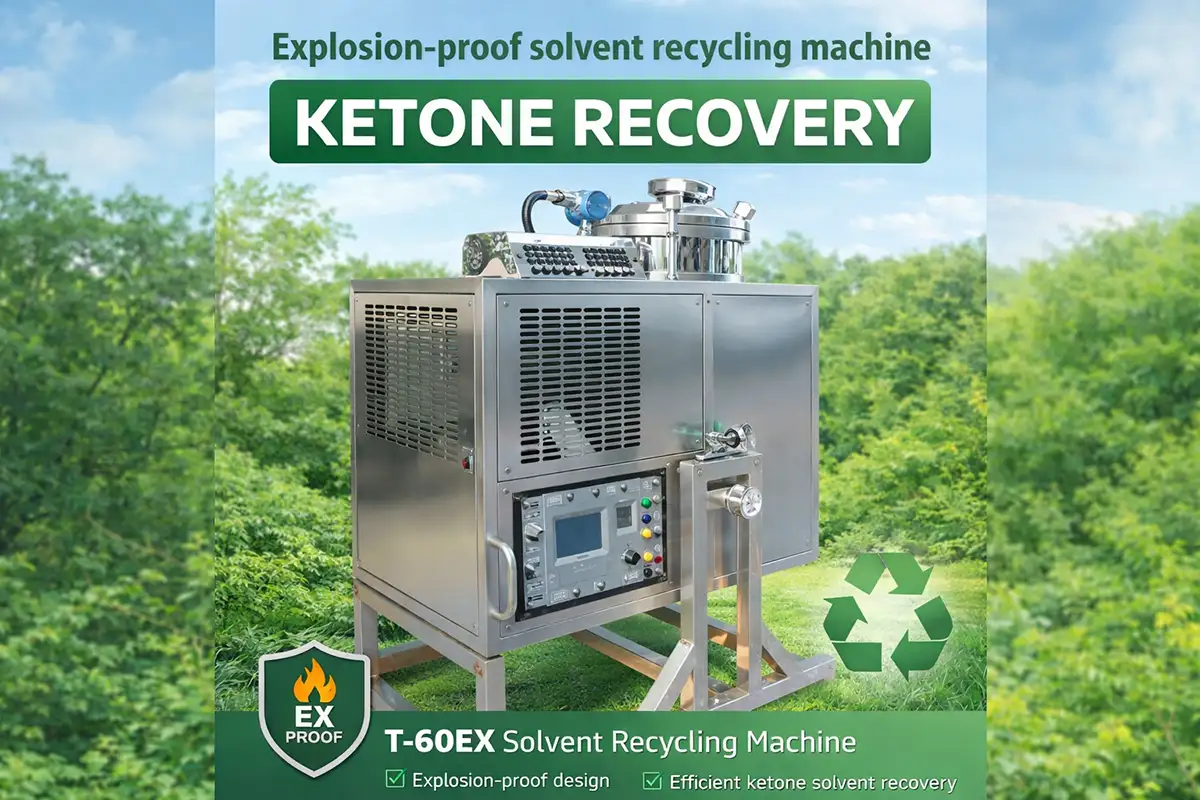
4) Typical equipment specs (from explosion-proof models)
The following table summarizes example explosion-proof units suitable for ketone recovery workflows. Key points for cyclohexanone: temperature range up to 200 °C and typical~95% recovery.
| Model | Feed Capacity (L) | Heating Power (kW) | Treatment Time (min) | Recovery (%) | Weight (kg) | Machine Size (mm) |
|---|---|---|---|---|---|---|
| T-20Ex | 20 | 2 | 120 | 95 | 153 | 860×760×1190 |
| T-60Ex | 60 | 4 | 150 | 95 | 170 | 1160×870×1260 |
| T-80Ex | 80 | 5 | 180 | 95 | 200 | 1180×850×1290 |
| T-125Ex | 125 | 6 | 210 | 95 | 280 | 1250×920×1450 |
| T-250Ex | 250 | 16 | 240 | 95 | 520 | 2600×1200×1950 |
| T-400Ex | 400 | 32 | 270 | 95 | 1200 | 1990×1850×2090 |
For product-level information on selecting a solvent recycler machine, see:Solvent Recycling Machine.
5) Purity, water, and contamination: what to check before reusing
Most teams evaluating cyclohexanone recovery want answers to a few practical questions:
Will the recovered solvent work for cleaning? Often yes, even if it is not “lab-grade,” as long as it dissolves target soils and does not leave problematic residues.
Will the recovered solvent work back in production? Sometimes—this depends on color, odor, non-volatile content, and water level tolerances for the formulation.
How to verify quickly? Simple checks include density, refractive index (if available), water screening (Karl Fischer or quick test kits), and a small trial batch.
Does “95% recovery” mean 95% purity?
No. Recovery rate refers to how much solvent is reclaimed from the waste stream by volume or mass. Purity depends on how cleanly cyclohexanone separates from other volatile components and how well the process avoids carryover and thermal degradation.
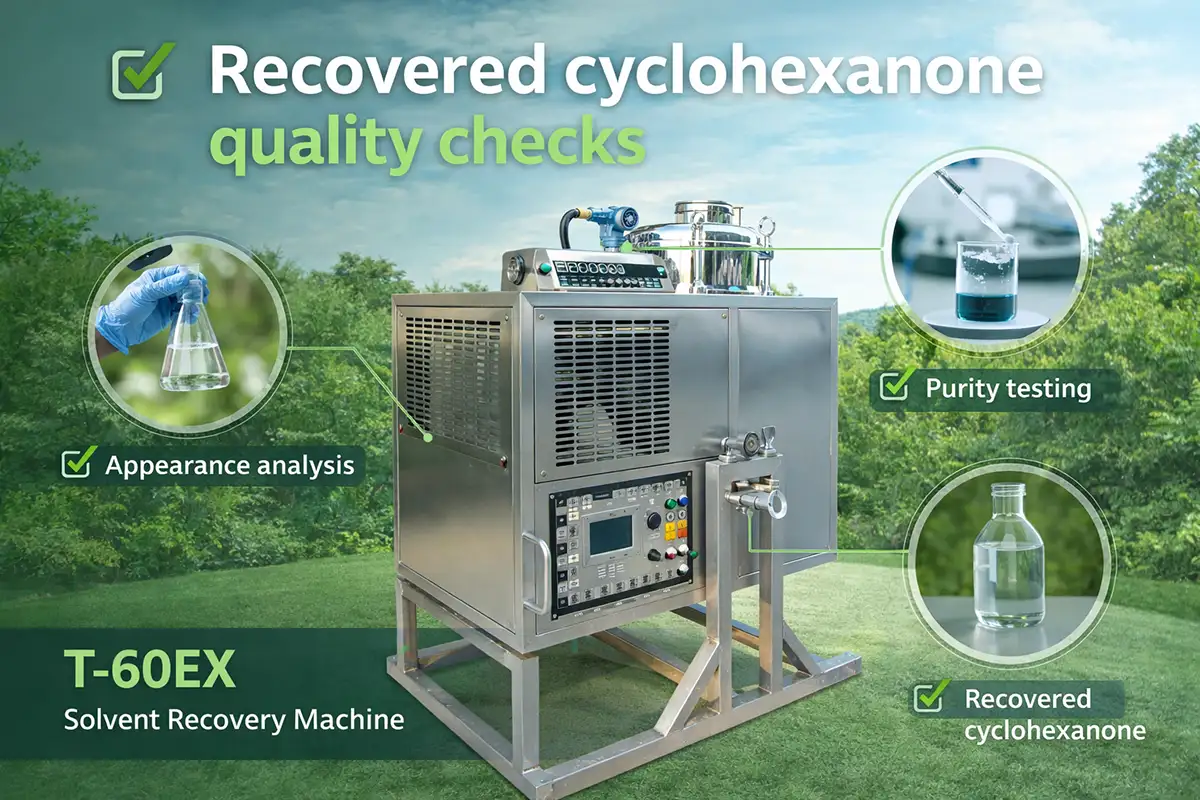
6) Safety & compliance checklist (high-level, not legal advice)
Explosion-proof selection: Many ketone environments require compliant electrical design and vapor control.
Ventilation and condenser performance: Stable condensation reduces vapor losses and odors.
Residue management: Plan how hot residue is discharged, cooled, and contained.
Documentation: Keep waste profiles, distillation logs, and lab checks to support audits.
In the U.S., solvent waste often falls under hazardous waste rules. The U.S. EPA emphasizes generator responsibility and proper determination/management of hazardous waste streams—so recovery projects should be implemented with EHS input from day one.
7) Recommended selection path (simple and practical)
Define the reuse goal: cleaning-grade reuse or formulation-grade reuse.
Confirm the waste is distillable: solvent fraction high enough; contamination not reactive.
Choose the right capacity: match daily waste volume to batch size and cycle time.
Start with a pilot batch: check recovered solvent against the minimum usable spec.