Toluene Recovery: How to Balance VOCs Control and Solvent Reuse
Toluene is a workhorse solvent in coatings, inks, electronics cleaning, and many industrial processes. The catch is that toluene is also a VOC (volatile organic compound): it evaporates easily, contributes to air pollution, and becomes expensive hazardous waste when it’s contaminated. This article explains—in plain English—how toluene recoverycan support VOCs治理 (VOCs control) while turning “waste solvent” back into usable material.
Why “waste toluene” becomes both an air problem and a cost problem
In many factories, toluene ends up in rags, wipes, cleaning tanks, printing systems, or paint mixing lines. When it evaporates, it becomes a VOC emission. When it’s contaminated (resins, pigments, oils, water), it becomes hazardous waste that must be stored, labeled, transported, and treated by licensed vendors.
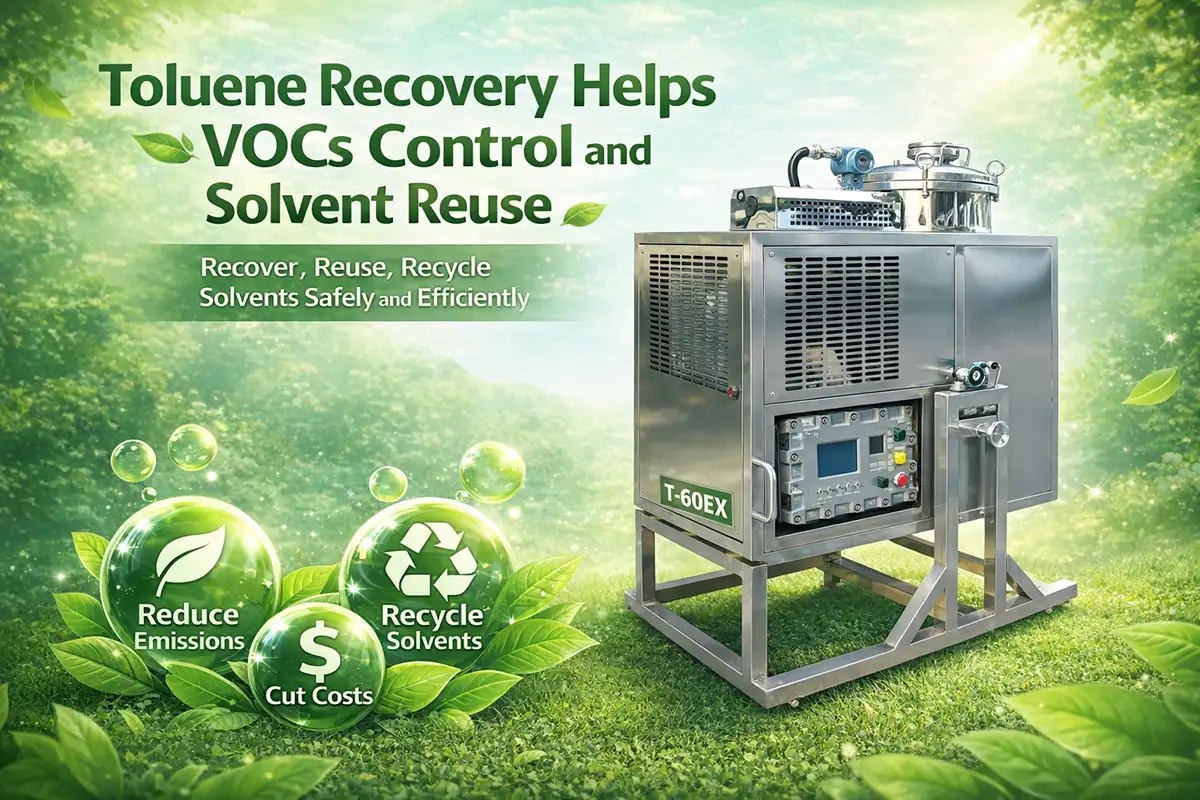
This creates a familiar tension: tight VOCs requirements push facilities to reduce emissions, while purchasing teams still need fresh solvent to keep production stable. The good news is that the two goals are not mutually exclusive. A properly selected solvent recycling systemcan turn that tension into a loop: use → collect → recover → reuse.
Not automatically. Recovery reduces the amount of solvent that becomes unmanaged evaporation or off-site waste, but VOC performance still depends on closed collection, good housekeeping, sealed containers, and correct operation of the recovery unit (condensation and vent handling). In practice, recovery is best viewed as a strong “source reduction + reuse” measure that supports VOC compliance strategies.
How a solvent recovery machine reclaims toluene (plain-English version)
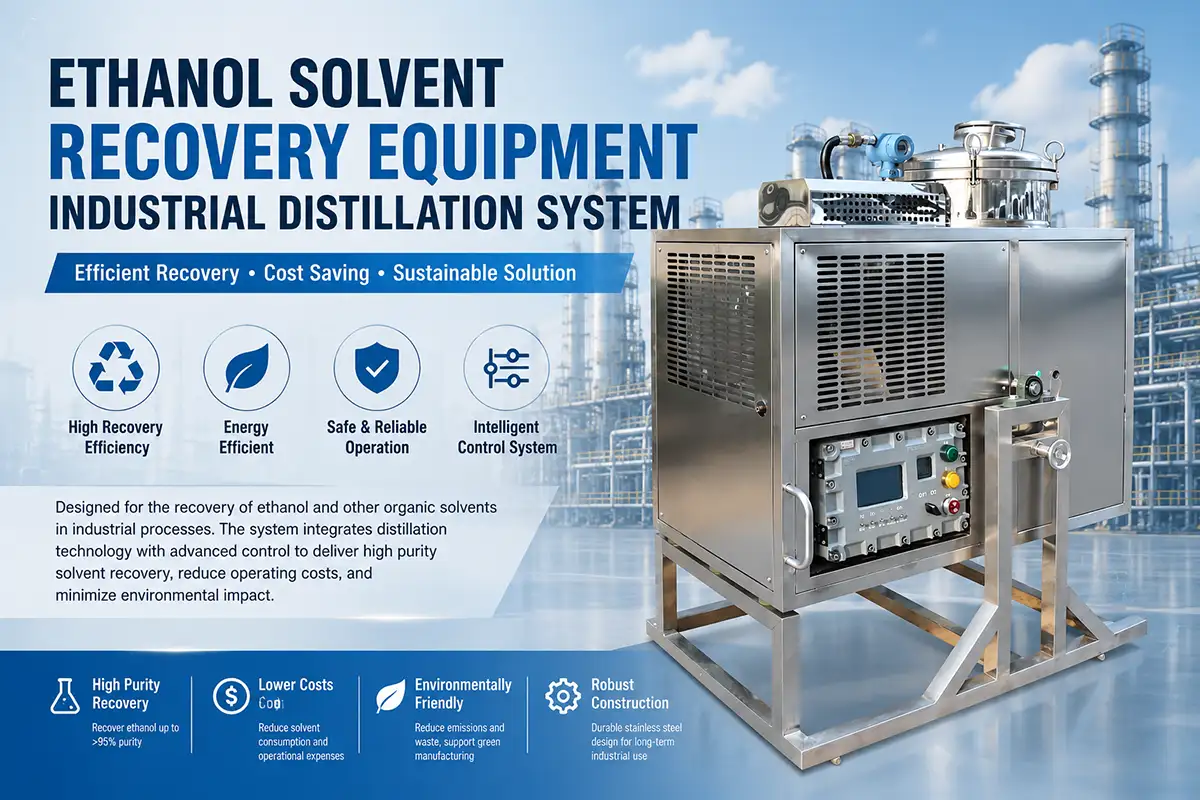
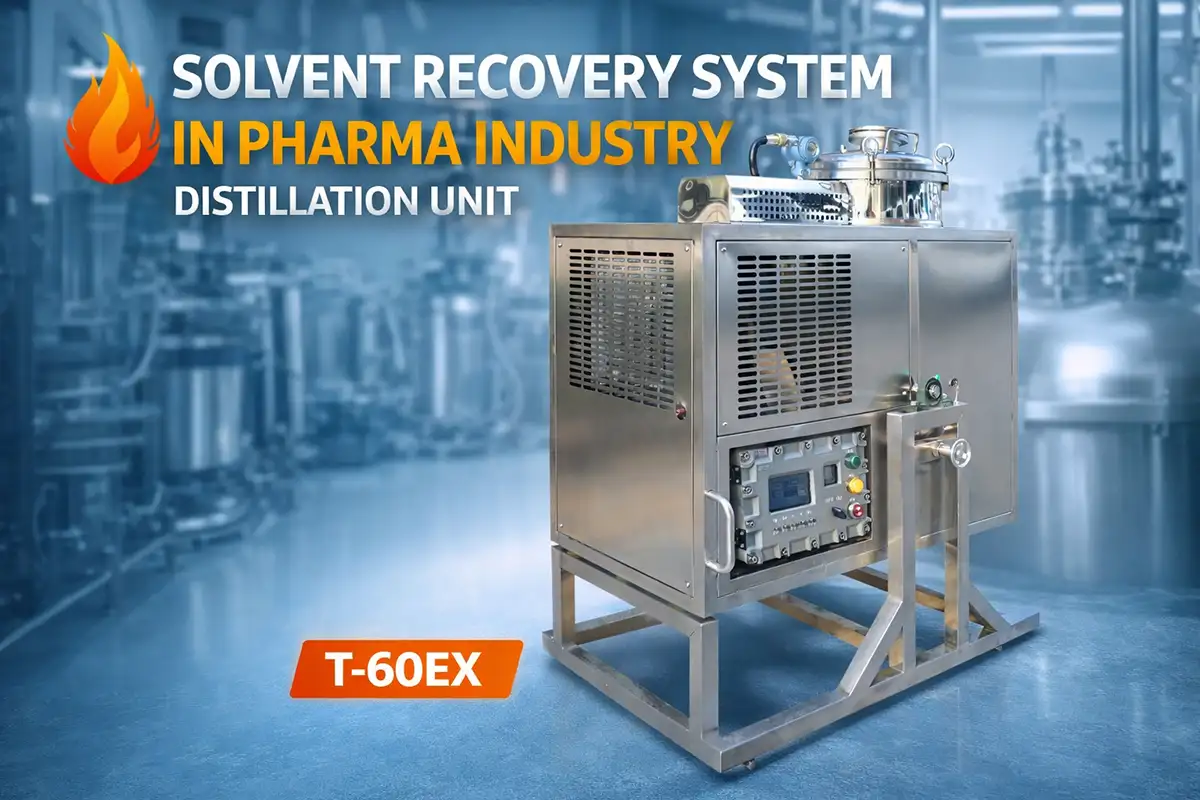
Most industrial solvent recovery equipment for toluene is based on distillation. The idea is simple: toluene boils and turns into vapor at a predictable temperature range, while heavier contaminants (resins, inks, oils, solids) do not evaporate as easily. The machine heats the waste solvent in a sealed vessel, routes the vapor through a condenser, and collects a cleaner liquid as “recovered toluene.”
What gets separated—and what does not
Often separated well: many high-boiling residues such as binders, pigments, and oils.
Needs attention: water or other low-boiling solvents in the mix can change the recovered composition.
Not a miracle: if the waste is a complex blend, the output may be “usable recycled solvent” rather than “lab-grade toluene.”
If the process can tolerate “cleaned toluene for washing/first-stage cleaning,” recovery tends to deliver fast savings. If the process requires ultra-pure toluene every time, recovery may still be used for non-critical steps.
Key numbers that matter: recovery rate, cycle time, and capacity
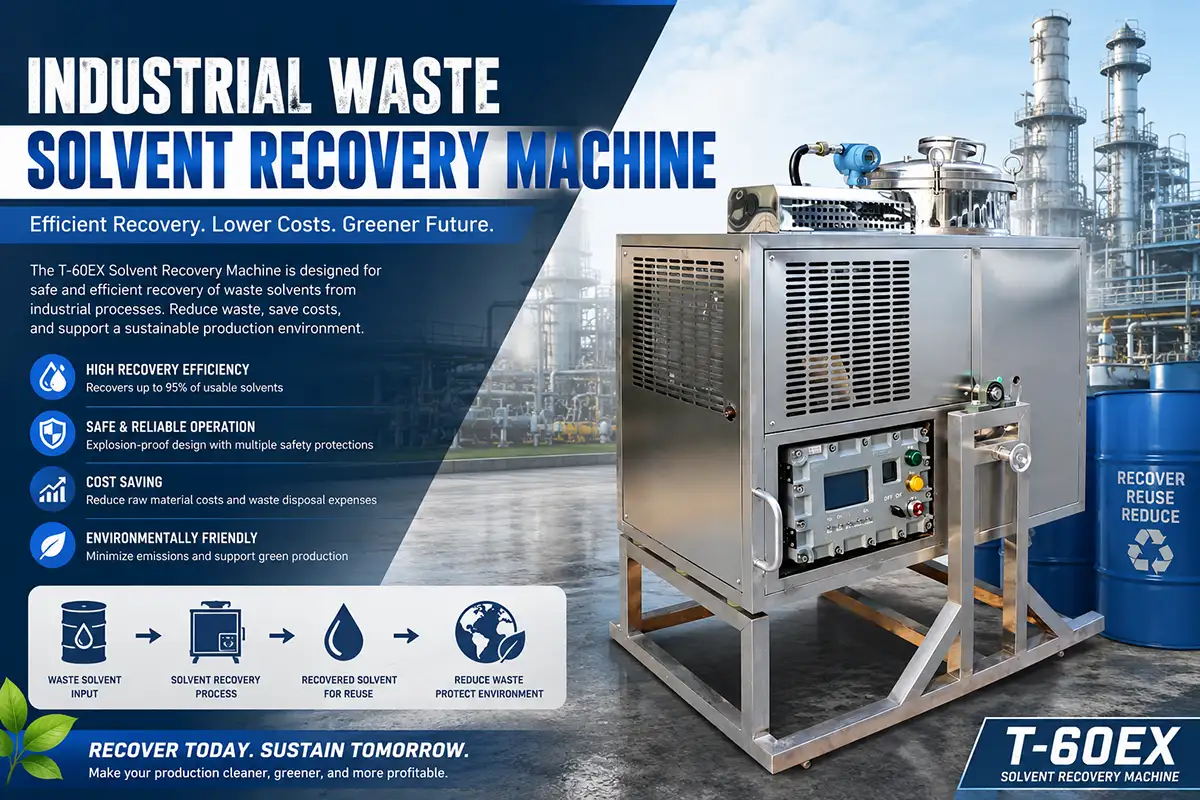
Buyers usually ask three questions: “How much can be processed per batch?”, “How long does it take?”, and “How much solvent can be recovered?” Based on the provided equipment parameters, these explosion-proof models target a 95% recovery rate with a temperature range up to RT–200°C, depending on solvent and contamination.
It is realistic as a design target when the waste stream is suitable (mainly toluene with higher-boiling residues) and the unit is operated correctly. In real plants, the achieved percentage can vary with contamination type, water content, and how the “last portion” is handled to avoid pulling heavy residues into the distillate.
↔| Model | Feed Capacity (L) | Heating (kW) | Cycle Time (min) | Recovery (%) | Weight (kg) | Size (mm) |
|---|---|---|---|---|---|---|
| T-20Ex | 20 | 2 | 120 | 95 | 153 | 860×760×1190 |
| T-60Ex | 60 | 4 | 150 | 95 | 170 | 1160×870×1260 |
| T-80Ex | 80 | 5 | 180 | 95 | 200 | 1180×850×1290 |
| T-125Ex | 125 | 6 | 210 | 95 | 280 | 1250×920×1450 |
| T-250Ex | 250 | 16 | 240 | 95 | 520 | 2600×1200×1950 |
| T-400Ex | 400 | 32 | 270 | 95 | 1200 | 1990×1850×2090 |
Selection is usually easier than it looks: estimate weekly waste toluene volume, decide how many batches per day are realistic, then size the unit so it works with production rhythm rather than against it. When the unit is too small, solvent piles up and operators bypass the system. When it’s too large, capital cost and footprint rise unnecessarily.
How recovery supports VOCs in day-to-day operations
VOC management is not just a paperwork issue—it’s operational. The cleanest compliance plans reduce emissions at the source: less open solvent, fewer transfers, fewer drums, and tighter control of waste handling.
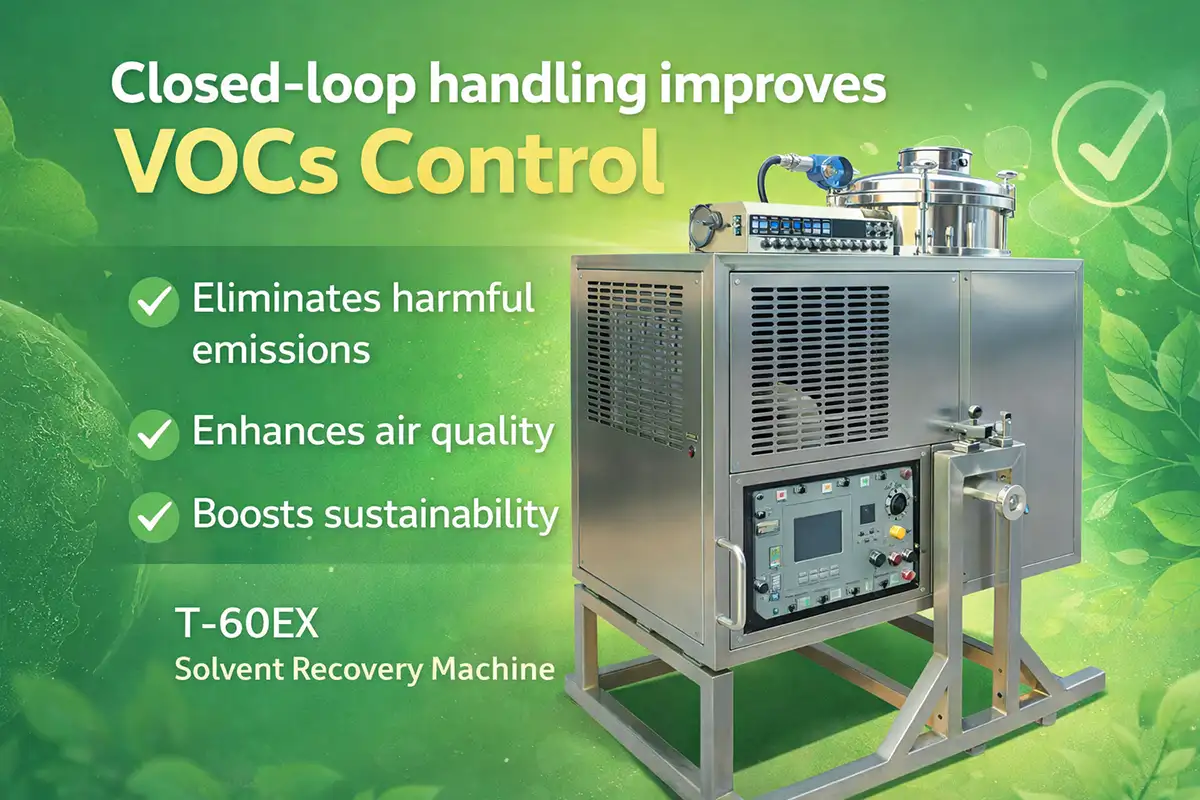
Closed-loop thinking: collect solvent in sealed containers and recover on-site.
Fewer shipments: less hazardous waste volume going off-site.
Less purchasing: recovered toluene replaces part of virgin solvent demand.
More predictable audits: documented recovery cycles and waste residue handling.
The World Health Organization (WHO) highlights air pollution as a major global health risk and estimates that millions of premature deaths are associated with exposure to ambient and household air pollution. VOC reduction is one of the practical steps industries use to support broader air-quality improvement goals. (Reference: WHO air pollution fact sheets and global estimates.)
In many plants, yes—especially for cleaning, flushing, and first-pass wash steps where slight variability is acceptable. The best way to confirm is to define a simple internal spec (appearance, odor, water check, or a basic lab test) and match it to the intended reuse point. Recovery works best when reuse targets are chosen deliberately.
What to check before installing a toluene solvent recovery unit
Toluene is flammable, so equipment selection is never only about throughput. An explosion-proof unit is a strong start, but a complete plan also includes ventilation, grounding/bonding practices, operator training, and correct residue disposal. If solvent waste contains unexpected chemicals (e.g., strong oxidizers or acids), it must be separated and handled under the right procedure.
Keep waste streams consistent (label “toluene-only” vs “mixed”).
Plan a residue handling routine (drain, cool, dispose).
Choose capacity that matches real shift patterns.
Track savings: solvent purchase avoided + waste disposal reduced.
Open buckets or open-top tanks (VOC loss + safety risk).
Mixing unknown chemicals into solvent waste.
Overshooting purity expectations without testing.
Buying by “largest capacity” instead of workflow.
For readers comparing terms: “solvent recycling,” “solvent recovery,” and “solvent distillation” are often used interchangeably. If a buying team is still building fundamentals, reading what solvent recovery iscan help align engineering, EHS, and procurement on the same definition.
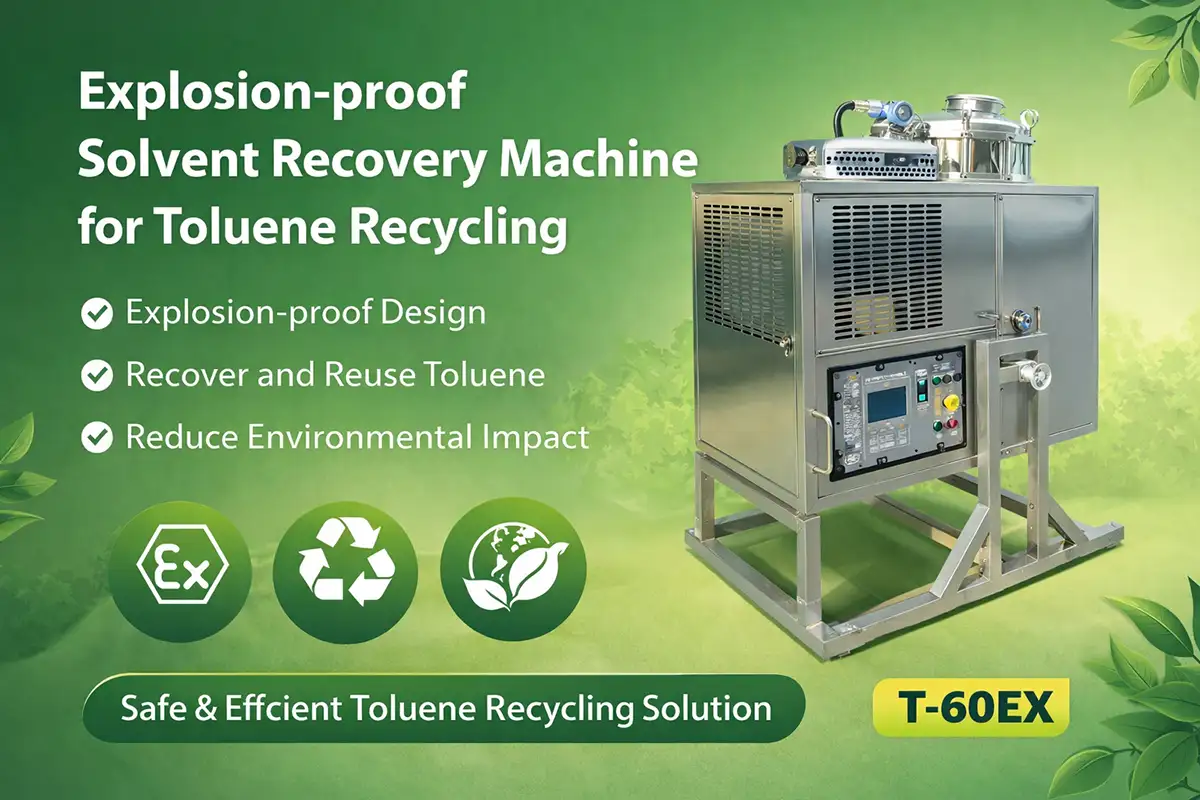
Toluene recovery is one of the few measures that can improve environmental performance and reduce operating cost at the same time. When implemented as a closed-loop practice (not just a standalone machine), it supports VOCs治理, reduces hazardous waste volume, and keeps solvent value inside the plant.
Choosing the right unit
The fastest sizing method is to start from weekly waste solvent volume and decide how many recovery batches fit naturally into operations.
Small batches (maintenance/repair lines): 20–60 L
Regular production (daily solvent use): 80–125 L
High throughput (central solvent room): 250–400 L
Tip: If the waste stream is a mix (toluene + other solvents), define the “dominant solvent” first—this improves stability of recovered solvent quality.