Ethanol Recovery: An Application Guide for Pharmaceutical & Laboratory Settings
Ethanol is one of the most common solvents in extraction, cleaning, synthesis, and sample preparation. Yet in many facilities it is still treated as “single-use”—purchased, used, stored as waste, then shipped out for disposal. This guide explains (in plain English) how ethanol recovery works, when it makes sense in pharma and lab workflows, and how to pick the right solvent recycling machine.
1) Why ethanol recovery matters (beyond “saving money”)
In pharmaceutical and laboratory environments, ethanol is valued because it is effective, relatively easy to evaporate, and compatible with many processes. The downside is that it becomes contaminated quickly—water, oils, resins, dissolved organics, salts, buffers, and pigments can all accumulate in spent solvent.
Recovering ethanol on-site is mainly about three practical outcomes:
Stable supply: fewer emergency purchases and fewer delays from solvent deliveries.
Lower waste volume: less hazardous waste storage and fewer pickups.
More consistent operations: recycled ethanol can be standardized for non-critical steps (like pre-cleaning).
Not necessarily. In my experience, the tipping point is not the size of the organization, but theconsistency of solvent waste generation. A small lab that creates a predictable stream of ethanol waste (e.g., daily cleaning or routine extraction) can benefit just as much—especially when storage space and disposal logistics are tight.
2) How an ethanol recovery (solvent recycling) machine works
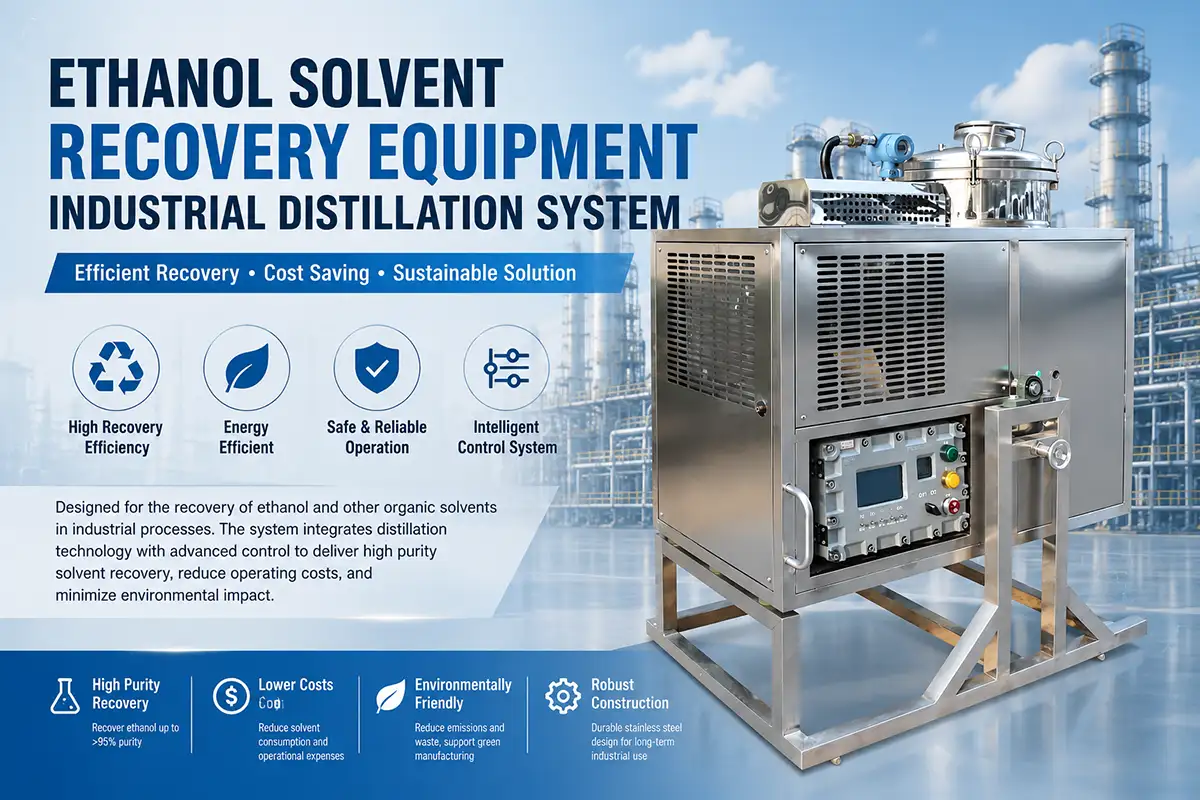
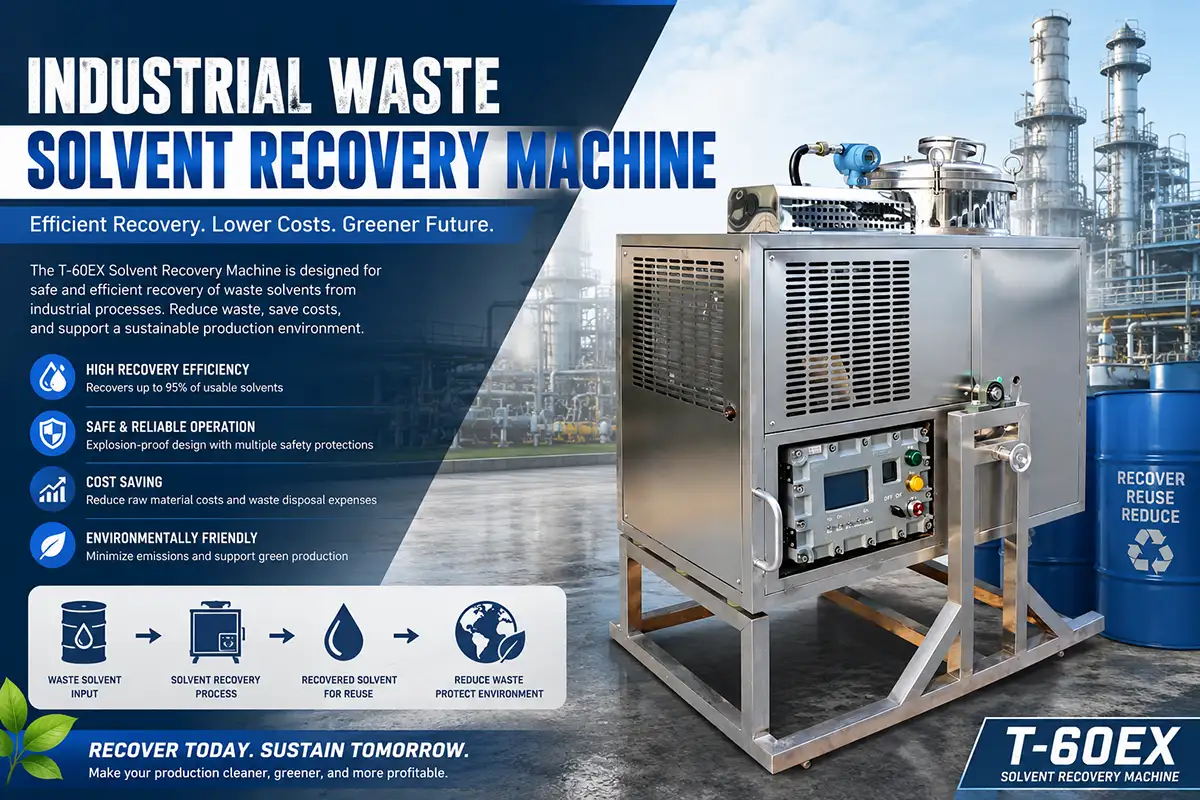
Most ethanol solvent recovery units used in labs and pharma support areas are essentially controlled distillation systems. The principle is simple: ethanol vaporizes at a lower temperature than many contaminants. The machine heats the waste mixture, condenses ethanol vapor back into liquid, and leaves heavier residues behind.
Key steps in plain terms
Fill: spent ethanol is loaded into a feed tank.
Heat and separate: the system heats the mixture so ethanol evaporates first.
Condense: vapor is cooled into recovered ethanol.
Residue handling: concentrated contaminants remain for safer disposal.
For a deeper, step-by-step explanation, see:How does a solvent recovery system work?
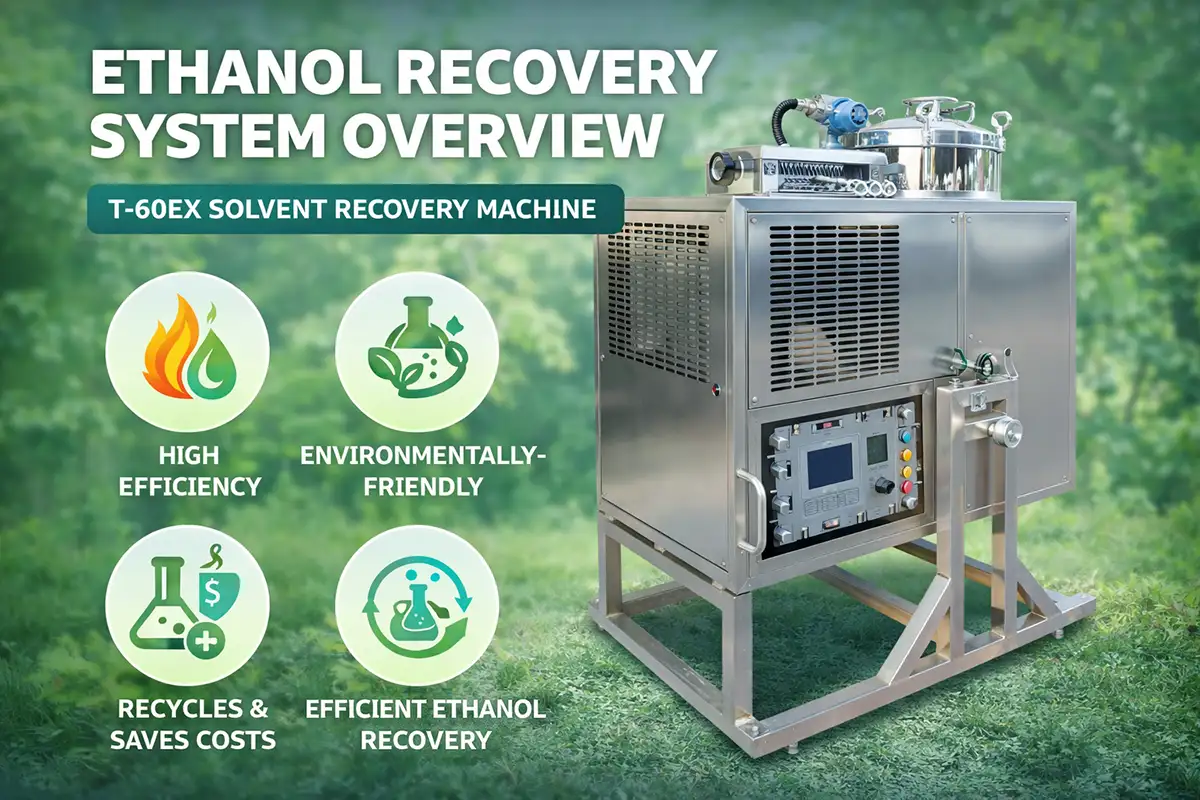
It depends on the required purity and the contamination profile. Distillation can return ethanol close to its original performance for many process tasks (cleaning, rinsing, rough extraction, parts washing). For highly sensitive analytical work, I recommend treating recovered ethanol as a separate grade unless validated by internal QC (e.g., water content checks, GC/HPLC baseline suitability, or conductivity where relevant).
3) Where ethanol recovery fits in pharma and lab scenarios
A) Cleaning and equipment wipe-down
Many facilities use ethanol in large quantities for surface cleaning and equipment wipe-down. This is often the easiest place to introduce recycled ethanol, because the acceptable purity window is wider than in analytical testing.
B) Botanical or API-adjacent extraction support
Ethanol is widely used for extraction and precipitation steps. When the ethanol stream becomes dark, oily, or water-laden, recovery helps bring it back into a usable range and reduces drum accumulation. A well-sized solvent recycler can turn “waste solvent management” into a repeatable internal utility.
C) Sample prep and general lab workflows
Labs often generate mixed ethanol waste from rinsing glassware, cleaning tools, or non-critical sample preparation steps. A recovery unit can consolidate these streams (when compatible) and reduce disposal frequency.
4) What recovery rate and cycle time should be expected?
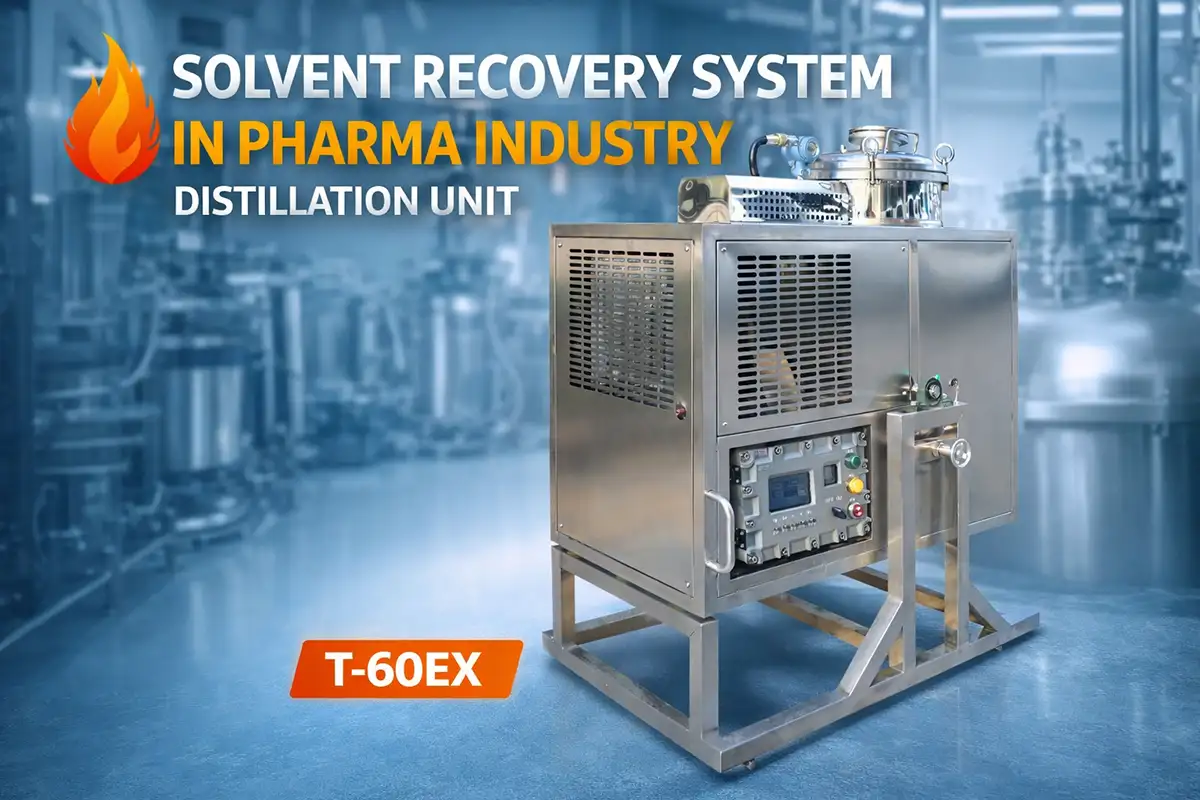
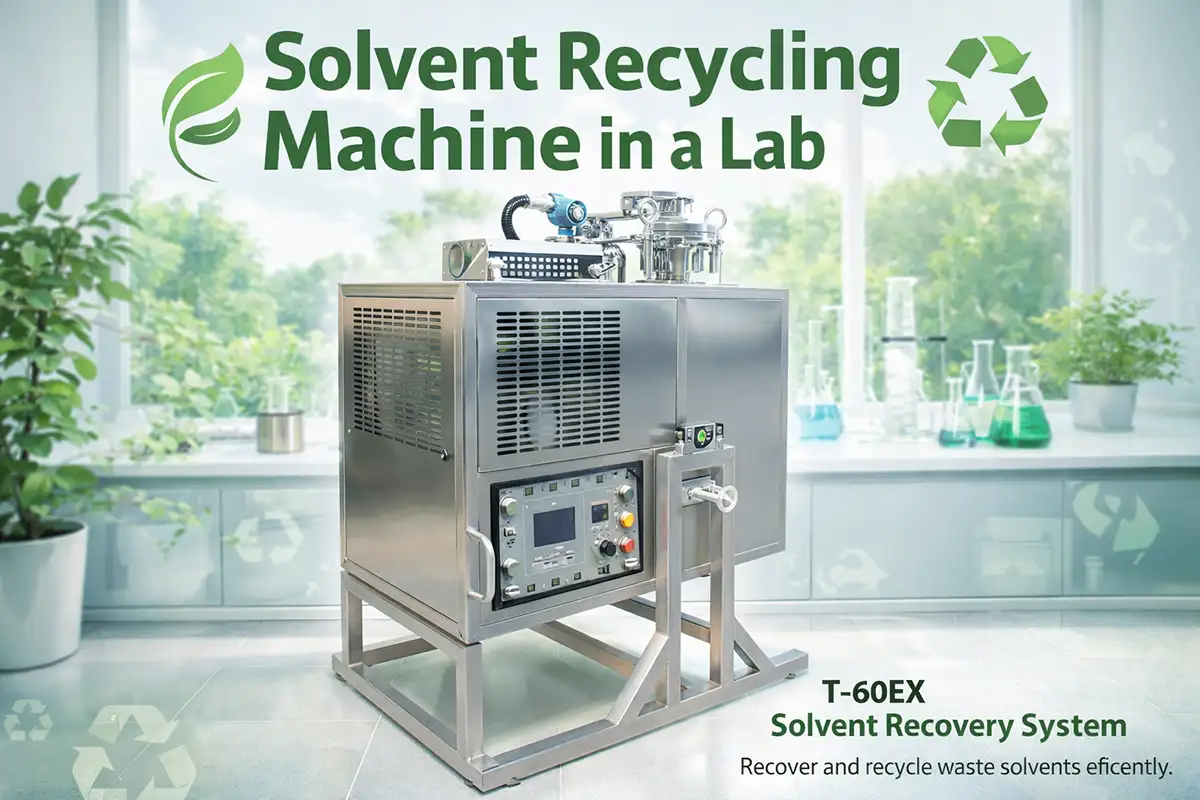
The practical questions usually sound like this: How much ethanol can be recovered per batch, and how long does it take? Equipment specifications vary, but many purpose-built solvent recyclers for ethanol target high recovery for compatible mixtures. The models below are examples of typical batch capacities and operating ranges used in solvent recovery equipment.
| Model | Feed Capacity (L) | Heating Power (kW) | Treatment Time (min) | Recovery (%) | Weight (kg) | Size (mm) |
|---|---|---|---|---|---|---|
| T-20Ex | 20 | 2 | 120 | 95 | 153 | 860×760×1190 |
| T-60Ex | 60 | 4 | 150 | 95 | 170 | 1160×870×1260 |
| T-80Ex | 80 | 5 | 180 | 95 | 200 | 1180×850×1290 |
| T-125Ex | 125 | 6 | 210 | 95 | 280 | 1250×920×1450 |
| T-250Ex | 250 | 16 | 240 | 95 | 520 | 2600×1200×1950 |
| T-400Ex | 400 | 32 | 270 | 95 | 1200 | 1990×1850×2090 |
A useful rule for planning: if the process generates solvent waste every day, match machine capacity to a single shift’s waste volume (or a predictable batch size) so recovery does not become a bottleneck.
5) Safety and compliance: the questions that matter
Ethanol vapors are flammable, and “lab scale” does not automatically mean “low risk.” A solvent recovery setup should be treated like any other controlled process: ventilation, grounding/bonding, compatible containers, and clear operating procedures. If solvent mixtures are unknown or may include reactive chemicals, separation is not just a quality issue—it becomes a safety issue.
For regulated environments, the safe answer is usually “no,” unless a facility’s EHS rules explicitly permit it for a specific stream. Drain disposal can create fire risk, harm plumbing systems, and violate local wastewater rules. That’s why recovery (when feasible) and proper waste handling are preferred routes—less volume, fewer pickups, and clearer compliance documentation.
If the workflow includes other solvents (IPA, methanol, acetone), waste segregation and disposal guidance should be documented. (Example internal resource for alcohol waste: how to dispose of isopropyl alcohol.)
7) How to choose a solvent recycler machine for ethanol (fast checklist)
Buyers usually want straightforward selection criteria. Here are the questions that actually decide success:
What is the daily/weekly ethanol waste volume? Choose capacity so recovery keeps up with generation.
What contaminants are present? Water, oils, and dissolved solids change achievable purity and residue handling.
What purity is needed for reuse? Cleaning-grade reuse is easier than analytical-grade reuse.
Where will the unit sit? Space, ventilation, and safe container logistics matter as much as kW.
Is hazardous-area protection required? Choose appropriate explosion-proof configurations where applicable.
When a facility wants a single “starting point,” I typically recommend matching one batch to a standard container size already used on-site (for example, 20 L / 60 L / 80 L), then scaling up only after real waste data confirms the need.
Takeaway
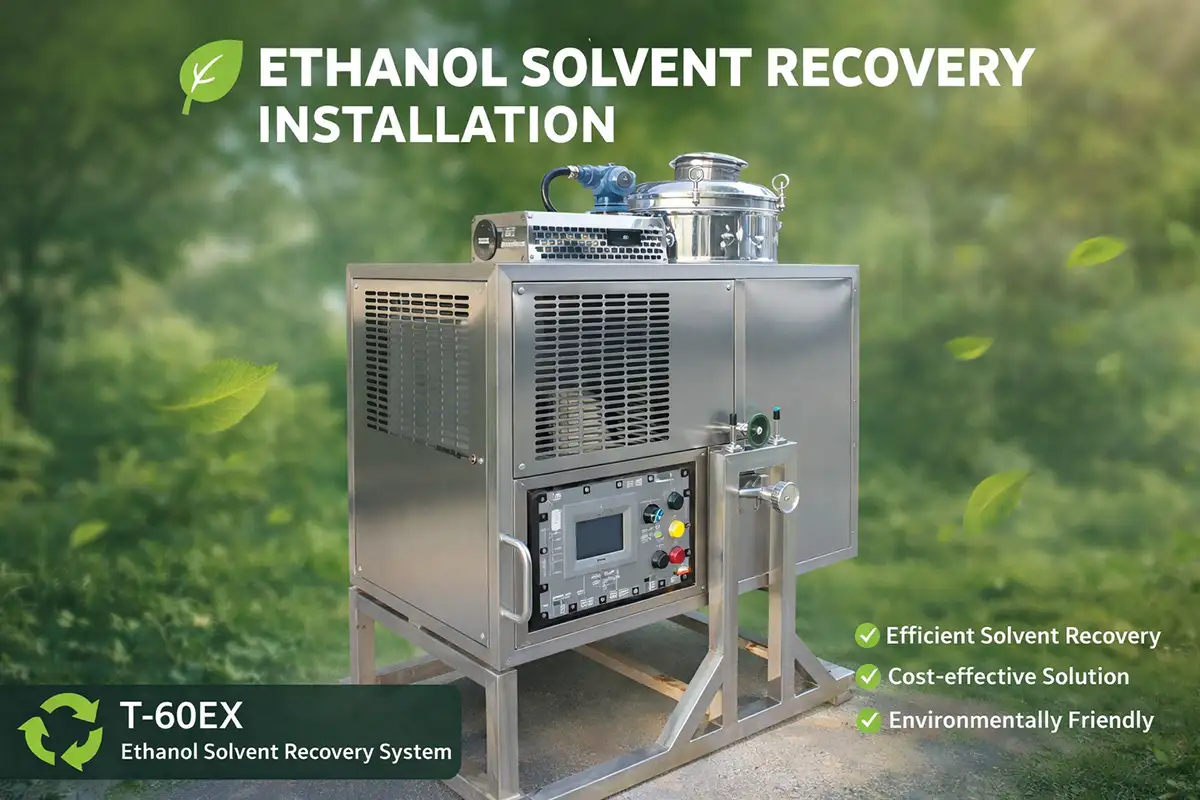
Ethanol recovery is not a “nice-to-have gadget.” In pharma support areas and laboratories, it can be a practical utility that reduces waste volume, smooths solvent supply, and makes day-to-day operations more predictable. The most successful deployments start with clear reuse goals (what recovered ethanol will be used for), realistic throughput planning, and safe handling procedures.
If a next step is comparing equipment, start here:solvent recycling machine(typical configurations and selection considerations).