Ethyl Acetate Recovery: The Cost-Saving Key for Printing & Coating
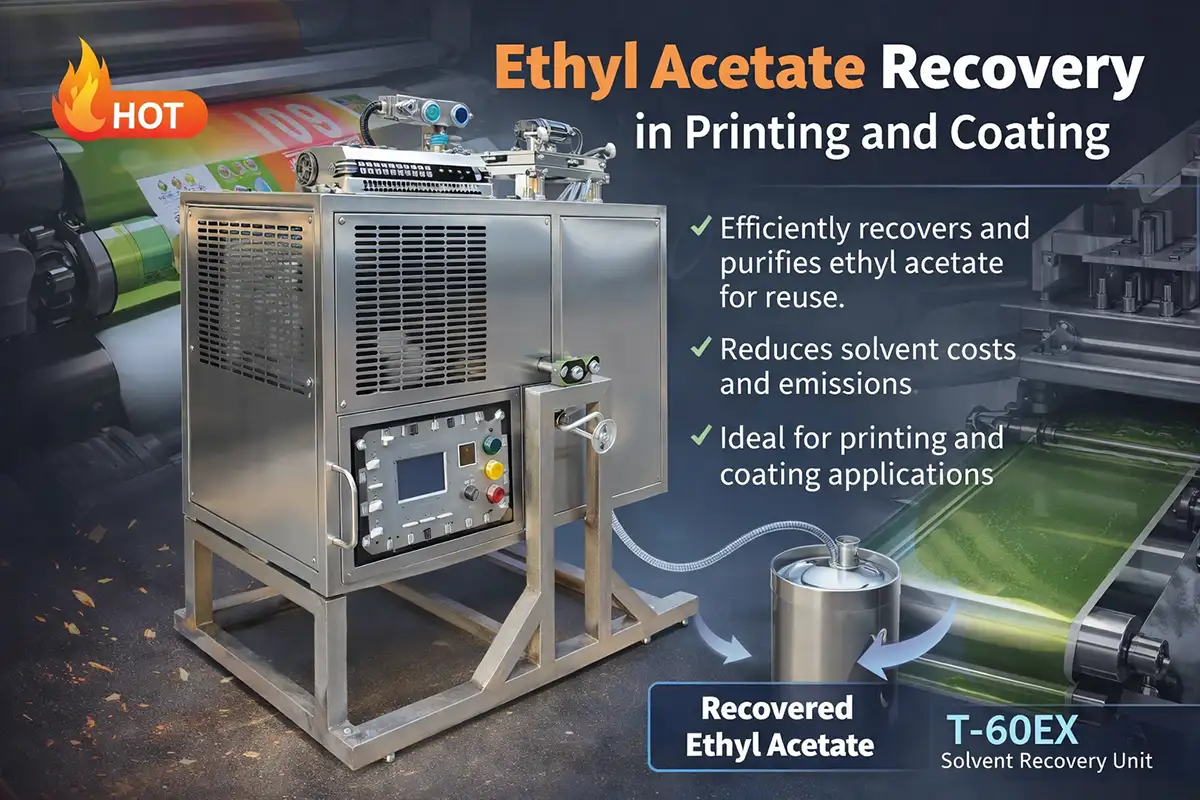
Ethyl acetate (EA) is a workhorse solvent in gravure/flexo inks, laminating adhesives, and coating lines. It also becomes one of the fastest-growing operating costs when it leaves the plant as waste. This article explains—without jargon—how EA recovery works and when a solvent recycling machine pays off.
Aligned with common industrial solvent recycler performance for EA-type mixtures.
Lower hazardous waste volumes and fewer solvent purchases.
In printing and coating plants, ethyl acetate is everywhere: ink dilution, plate/cylinder cleaning, adhesive and coating viscosity control, and periodic line wash-up. The problem is not that EA is “used”—the problem is that it is often paid for twice: first when it is purchased, and again when the spent solvent is shipped out as hazardous waste.
1) Why ethyl acetate becomes a “silent cost”
Most teams track raw material cost and production yield, but solvent loss hides in day-to-day operations: cleaning rags, dirty wash solvent, and mixed residues. Over time, the plant ends up purchasing fresh EA while also paying for disposal of spent EA mixtures.
Yes—because the total cost is not only purchase price. In practice, the combined cost of replacement solvent + storage/handling + hazardous waste pickup (and the administrative burden) can make recovery worthwhile even when unit price looks low. Recovery also stabilizes supply during price swings and reduces downtime caused by waiting for solvent deliveries.
2) How ethyl acetate recovery works (a simple view)
A solvent recycling machine is essentially a controlled distillation unit designed for dirty production solvents. For ethyl acetate mixtures (common in printing inks and coating/laminating adhesives), the process is usually:
Load spent solvent (EA mixed with ink resin, pigments, oils, small amounts of other solvents).
Heat and evaporate the solvent portion.
Condense the vapor back into liquid—this becomes the recovered ethyl acetate (or an EA-rich blend).
Leave solids/residue in the boiling tank for safe removal and disposal.
The practical outcome: instead of “buy → use once → dispose,” the workflow becomes “buy → use → recover → reuse,” while only a smaller residue stream leaves the site. For readers who want the technical step-by-step, see:how a solvent recovery system works.
3) What results to expect (and what to measure)
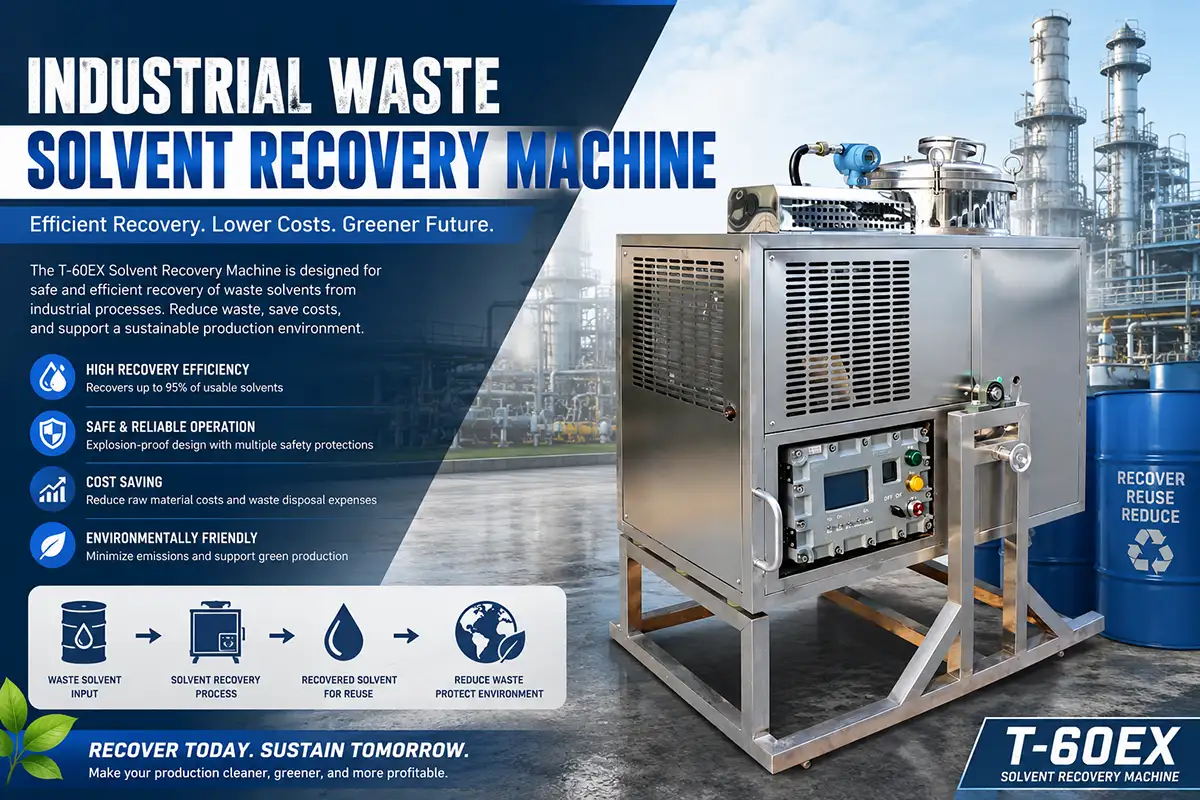
For many EA wash streams, a well-matched distillation unit can deliver a high recovery rate. The equipment parameters provided for Ex models in this article list a typical recovery of 95%. In real operation, actual performance depends on contamination level and whether the spent solvent is a single solvent or a blend.
Recovery rate: target % of solvent reclaimed per batch (often ~95% for suitable streams).
Recovered solvent clarity/odor: quick checks for obvious contamination.
Reuse point: decide where recovered EA is acceptable (e.g., first-pass cleaning vs. final wipe).
Residue handling: measure residue weight/volume to understand true disposal reduction.
Sometimes—but not always. In many plants, recovered EA is first reused for equipment cleaning and “rough wash” steps because these tolerate minor impurities. When the goal is to reuse in critical formulations, the recommendation is to verify quality with simple lab checks (water content, non-volatiles, and any plant-specific criteria). This staged reuse approach is one of the fastest ways to capture savings without risking print/coating quality.
For broader background terminology (what “solvent recovery” means and why it’s used), this primer helps:what is solvent recovery.
4) How to size a solvent recycler for printing/coating EA
Sizing is where projects succeed or fail. Rather than starting with machine size, start with one number:how many liters of spent solvent are generated per day (or per shift).
Practical sizing logic used in many plants:
If the line produces 20–80 L of spent solvent per collection cycle, a smaller batch unit is easier to integrate.
If collection is 125–400 L at a time (central waste room, multiple lines), larger batch units reduce operator handling.
Consider the treatment time: batch cycles in the provided models range roughly from 120 to 270 minutes, so plan how many batches fit in a shift.
Use three inputs: monthly EA purchase volume, monthly hazardous waste volume/cost tied to EA mixtures, and a conservative recovery rate (for example, 80–95% depending on the stream). In many cases, savings come from both reduced purchases and reduced disposal—so payback can be faster than expected when disposal fees are high.
5) Equipment examples (Ex models) for ethyl acetate recovery
Below is a plain view of representative batch capacities and typical cycle times. These are useful reference points when matching a unit to daily solvent generation.
| Model | Feed Capacity (L) | Heating Power (kW) | Treatment Time (min) | Recovery (%) |
|---|---|---|---|---|
| T-20Ex | 20 | 2 | 120 | 95 |
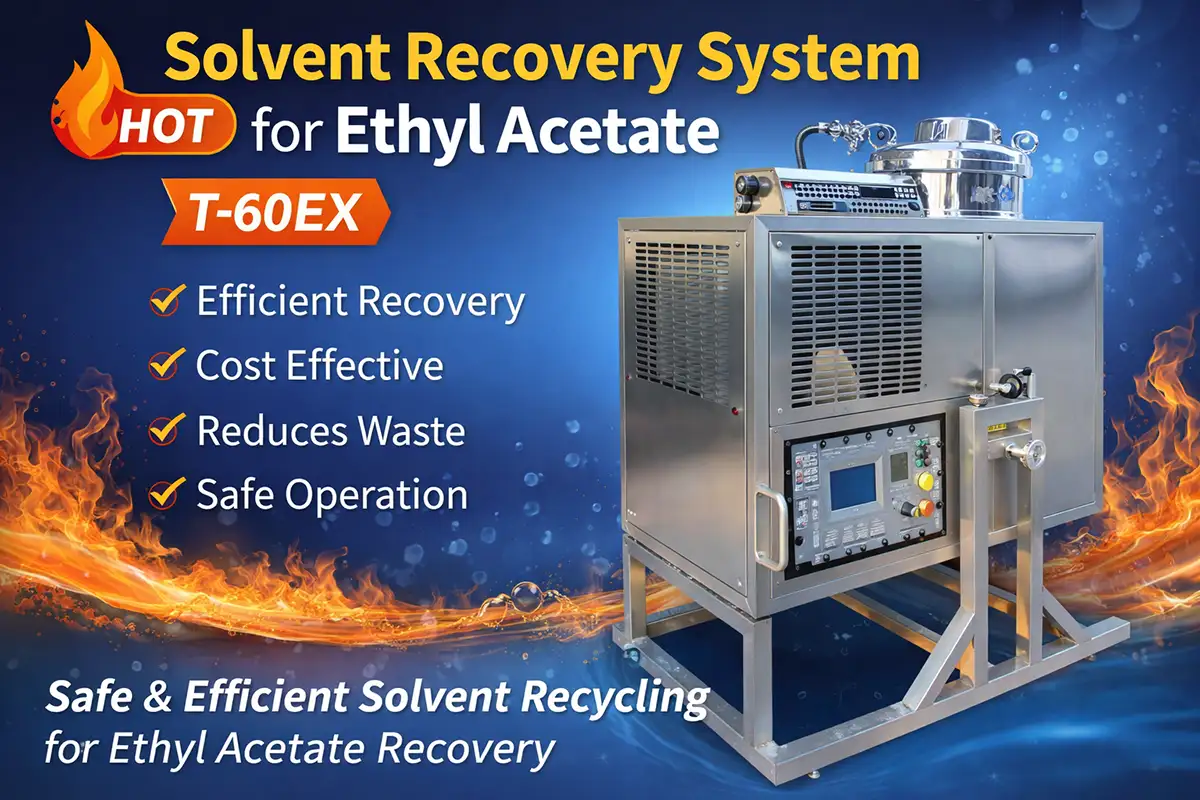
| T-60Ex | 60 | 4 | 150 | 95 |
| T-80Ex | 80 | 5 | 180 | 95 |
| T-125Ex | 125 | 6 | 210 | 95 |
| T-250Ex | 250 | 16 | 240 | 95 |
| T-400Ex | 400 | 32 | 270 | 95 |
When comparing models, it’s tempting to focus only on liters per batch. In printing/coating, it is often smarter to match the machine tocollection habits (drums, IBCs, shift schedules) and the mix stability of the waste solvent. If the waste stream varies heavily day to day, a slightly larger buffer capacity can smooth operations.
6) Safety & compliance basics (no fluff)
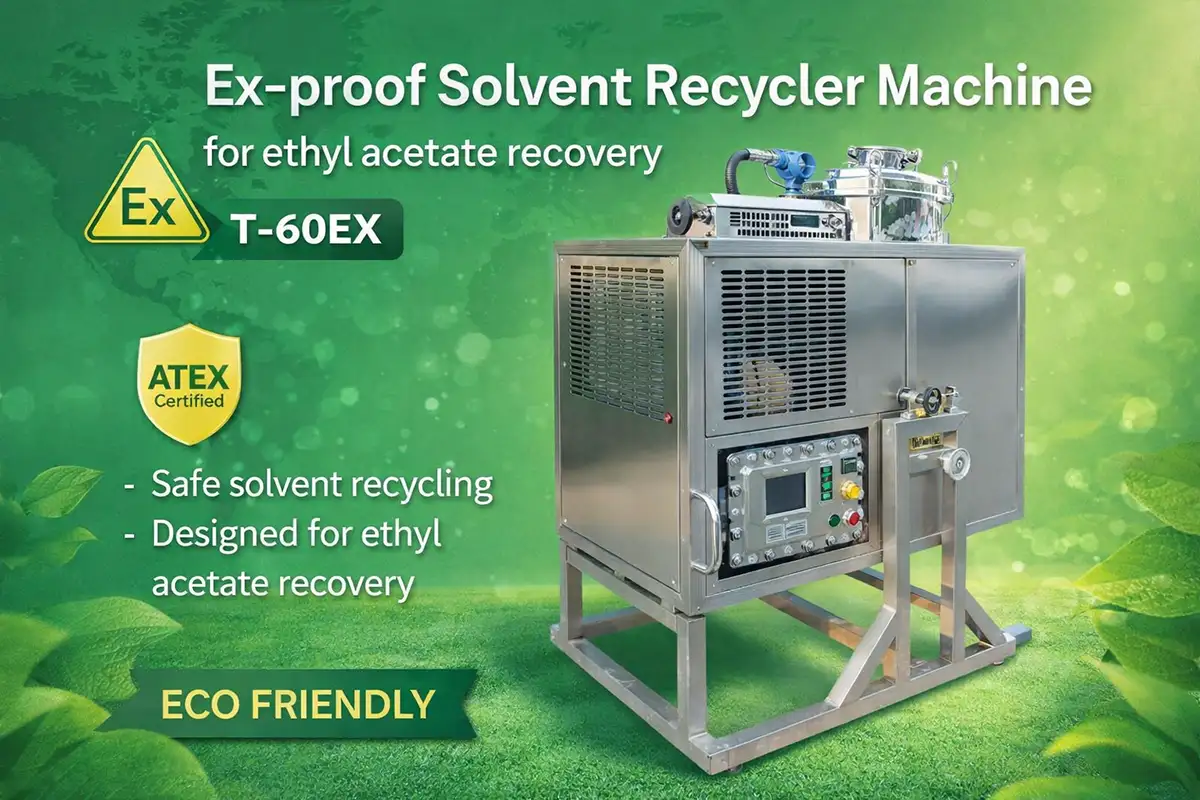
Ethyl acetate is flammable, so recovery equipment selection and installation must treat safety as a design requirement, not an afterthought. In practice, the key topics are:
Explosion-proof (Ex) configuration where required by site classification.
Ventilation and VOC control aligned with local rules and your EHS plan.
Temperature control and stable operation to avoid overheating contaminated mixtures.
Residue management (hot residue, sticky resins/pigments) with a repeatable SOP.
7) Practical takeaway: what the buyer really wants to know
For printing and coating plants, ethyl acetate recovery is usually a cost project first—and a sustainability project second. The decision becomes clearer when these questions have concrete answers:
How much spent EA mixture is generated per day? (This sets capacity.)
Where can recovered solvent be reused safely? (Cleaning steps are often the easiest win.)
What is the true all-in cost of “dispose and replace”? (Purchasing + disposal + handling time.)
If the goal is to reduce solvent purchases and hazardous waste quickly, a batch solvent recycling machine is one of the most direct tools available. For product options, see the internal page:solvent recycling machine.