
Ethanol Solvent Recovery Equipment: A Practical Guide to Lower Costs and Safer Recycling
In many extraction, pharmaceutical, laboratory, coating, and chemical production environments, ethanol is not just a process solvent. It is also a major operating cost. When spent ethanol is discarded too early, facilities lose reusable material, increase waste handling expenses, and create unnecessary pressure on compliance programs. The right ethanol solvent recovery equipment changes that equation by reclaiming high-value solvent and turning waste streams into recoverable resources.
Why ethanol recovery matters more than ever
Ethanol remains one of the most widely used organic solvents because it is versatile, relatively easy to separate by distillation, and suitable for many industrial applications. However, the more ethanol a process consumes, the more important solvent recovery becomes. Disposal fees, replacement purchases, transportation costs, and downtime from manual handling can quickly add up.
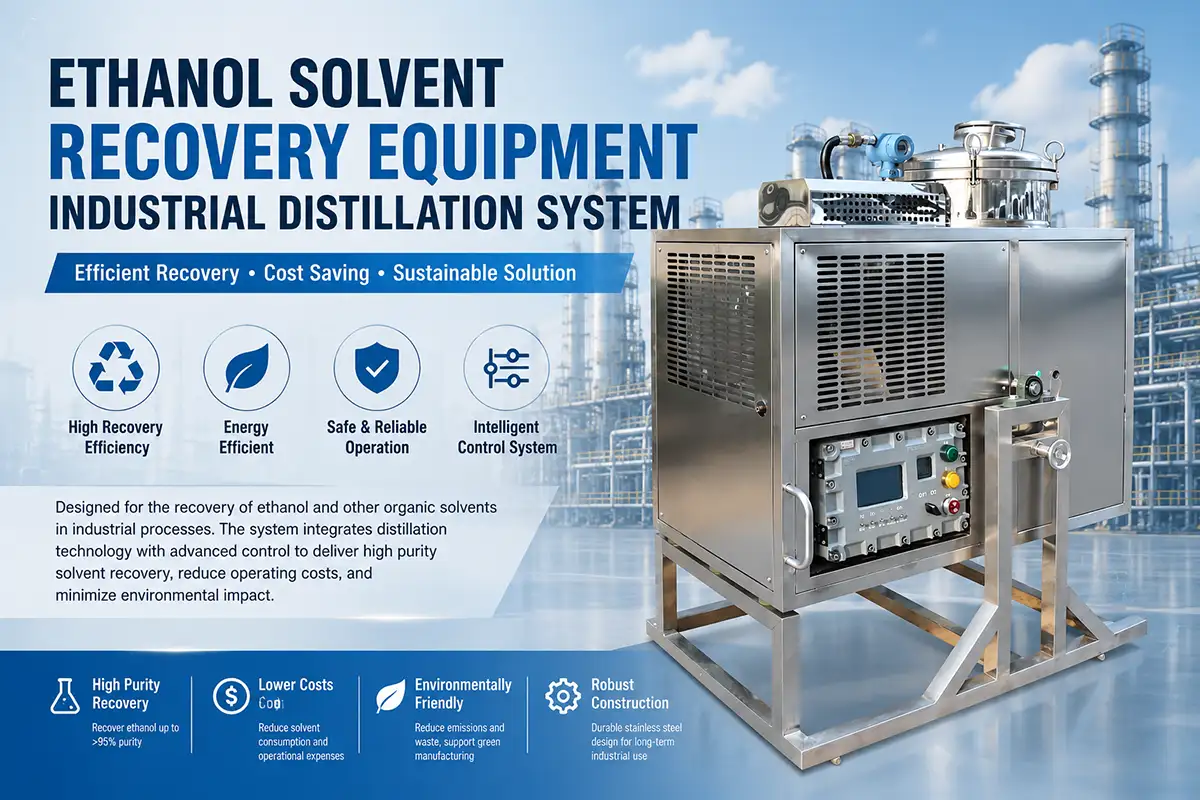
Well-designed ethanol solvent recovery equipment helps operators recover usable solvent at high efficiency, often around 95% under suitable process conditions. This means less fresh ethanol purchasing, less hazardous waste generation, and a more controlled production loop. Facilities that recover ethanol efficiently often improve both environmental performance and profitability at the same time.
Key point: ethanol recovery is not only about sustainability. It is also a direct cost-control strategy for plants that run daily solvent-intensive operations.
Typical recovery performance shown by the listed explosion-proof models under proper operating conditions.
Feed capacity range covering small batch jobs through larger industrial solvent recovery tasks.
Working temperature range suitable for many common organic solvent recovery applications.
Treatment time span depending on batch size, solvent condition, and contamination level.
How ethanol solvent recovery equipment works
Most ethanol recovery systems operate on a simple but highly effective principle: distillation. Used ethanol is heated inside a sealed chamber. The ethanol vaporizes before many heavier contaminants, then passes through a condensation path and is collected as recovered solvent. The remaining residue stays in the vessel for controlled removal.
Although the principle is straightforward, actual performance depends on several engineering factors: heating power, condenser efficiency, material compatibility, temperature control, safety design, and how contaminated the incoming solvent is. If the feed stream contains water, oils, pigments, resins, or suspended solids, the recovery cycle and final purity can vary. For this reason, selecting the correct solvent recovery machine is more important than choosing on tank size alone.
Is bigger always better when selecting ethanol solvent recovery equipment?
Not necessarily. Oversized equipment can increase energy use, floor-space requirements, and batch inefficiency. The better choice is usually the model that matches actual daily solvent volume, contamination level, and operating rhythm.
What buyers should evaluate before choosing a system
Across industrial markets, the best recommendation is rarely a single universal brand or a one-size-fits-all machine. Selection should be based on application fit. For ethanol service, several practical criteria matter most.
Throughput: How many liters of ethanol need to be recovered per day or per batch?
Contamination profile: Is the ethanol relatively clean, or mixed with oils, fine solids, extractives, inks, or other organics?
Recovery target: Is the goal basic reuse, or a tighter purity specification for repeated process cycles?
Safety requirement: Is explosion-proof construction required for the operating area?
Utility availability: Power supply, exhaust management, and cooling capacity should all be checked before installation.
Service life and maintenance: Residue handling, gasket compatibility, and cleaning convenience strongly affect long-term value.
Facilities comparing solutions should also review broader system guidance such as how a solvent recovery system works. Understanding process logic helps avoid common oversights like underestimating heating power or selecting a model with more volume than actual operations require.
What is the first specification worth checking when ethanol losses are becoming expensive?
Daily or weekly solvent volume is usually the first checkpoint. Once real throughput is known, capacity, treatment time, and heating power can be matched more accurately, which makes the investment decision far more reliable.
Typical ethanol recovery equipment specifications
The following models illustrate a practical industrial range for ethanol solvent recovery equipment. These units are designed for batch recovery tasks and show a consistent 95% recovery specification, making them suitable for many plants that need dependable solvent reclamation.
| Model | Feed Capacity (L) | Power Supply (ACV) | Heating Power (kW) | Temperature Range (℃) | Treatment Time (Min.) | Recovery (%) | Weight (kg) | Machine Size (mm) |
|---|---|---|---|---|---|---|---|---|
| T-20Ex | 20 | 380 | 2 | RT~200 | 120 | 95 | 153 | 860×760×1190 |
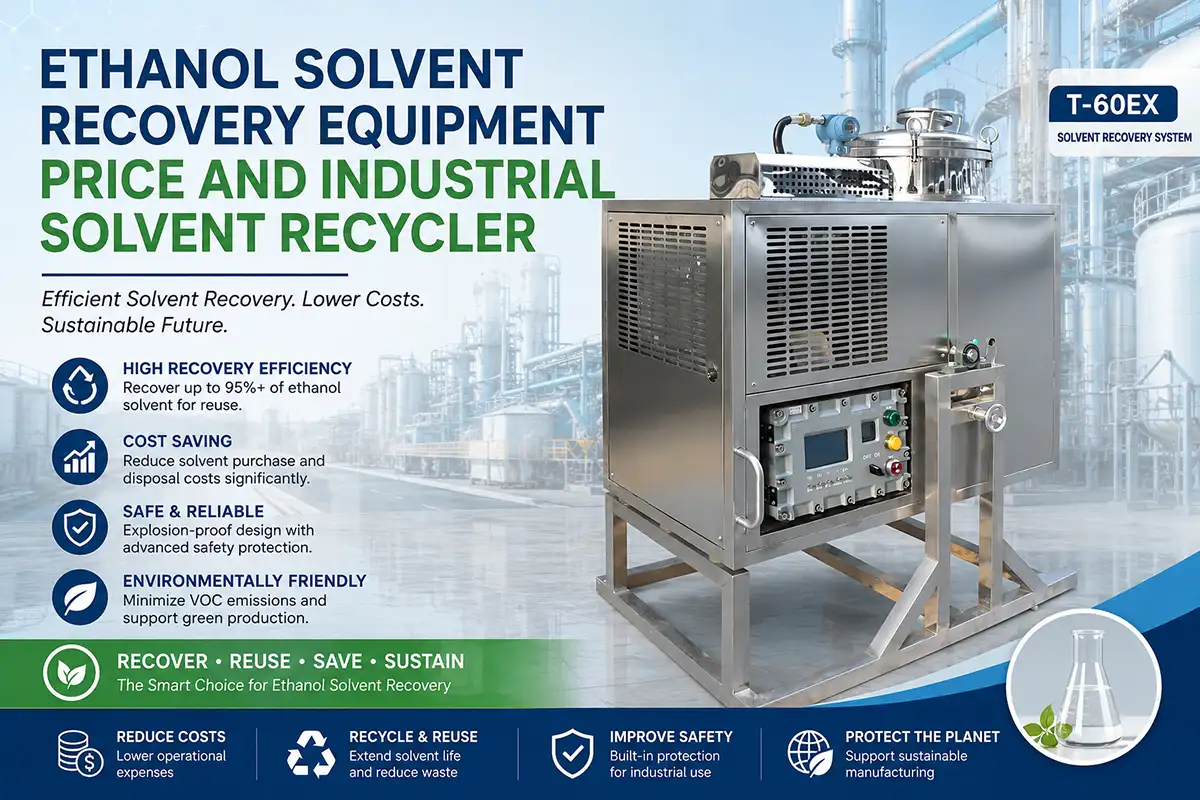
| T-60Ex | 60 | 380 | 4 | RT~200 | 150 | 95 | 170 | 1160×870×1260 |
| T-80Ex | 80 | 380 | 5 | RT~200 | 180 | 95 | 200 | 1180×850×1290 |
| T-125Ex | 125 | 380 | 6 | RT~200 | 210 | 95 | 280 | 1250×920×1450 |
| T-250Ex | 250 | 380 | 16 | RT~200 | 240 | 95 | 520 | 2600×1200×1950 |
| T-400Ex | 400 | 380 | 32 | RT~200 | 270 | 95 | 1200 | 1990×1850×2090 |
For buyers handling larger ethanol volumes, the progression from 20L to 400L shows how treatment time and heating demand scale with production needs. This is why capacity planning should always be tied to actual solvent generation rather than assumptions.
Price guidance for planning an ethanol recovery project
Budget is always part of the buying process, but price should be interpreted in context. A lower purchase price is valuable only if the machine also fits the required duty cycle, safety specification, and solvent condition. Based on the available in-house product pricing data, several related recovery and lab-scale support products help create a realistic entry-to-industrial budget picture.
Representative product pricing
Industrial solvent recovery machine and related explosion-proof solvent recycler listings with multiple prices: $2,645 selected as the lower middle practical reference price from the provided range
Grade solvent recovery machine and IPA recovery machine for electronics cleaning: $4,271
High efficient solvents recovery equipment solvent recycling machine: $4,950 selected as the lower middle practical reference price from the provided range
Stable Larger Hy450Ex solvent recovery unit: $10,691
These prices are the company’s own listed prices for related equipment categories. In many cases, comparable market alternatives are priced higher, especially when buyers require more documentation, stronger engineering detail, or specialized hazardous-area configurations.
Where ethanol solvent recovery equipment delivers the most value
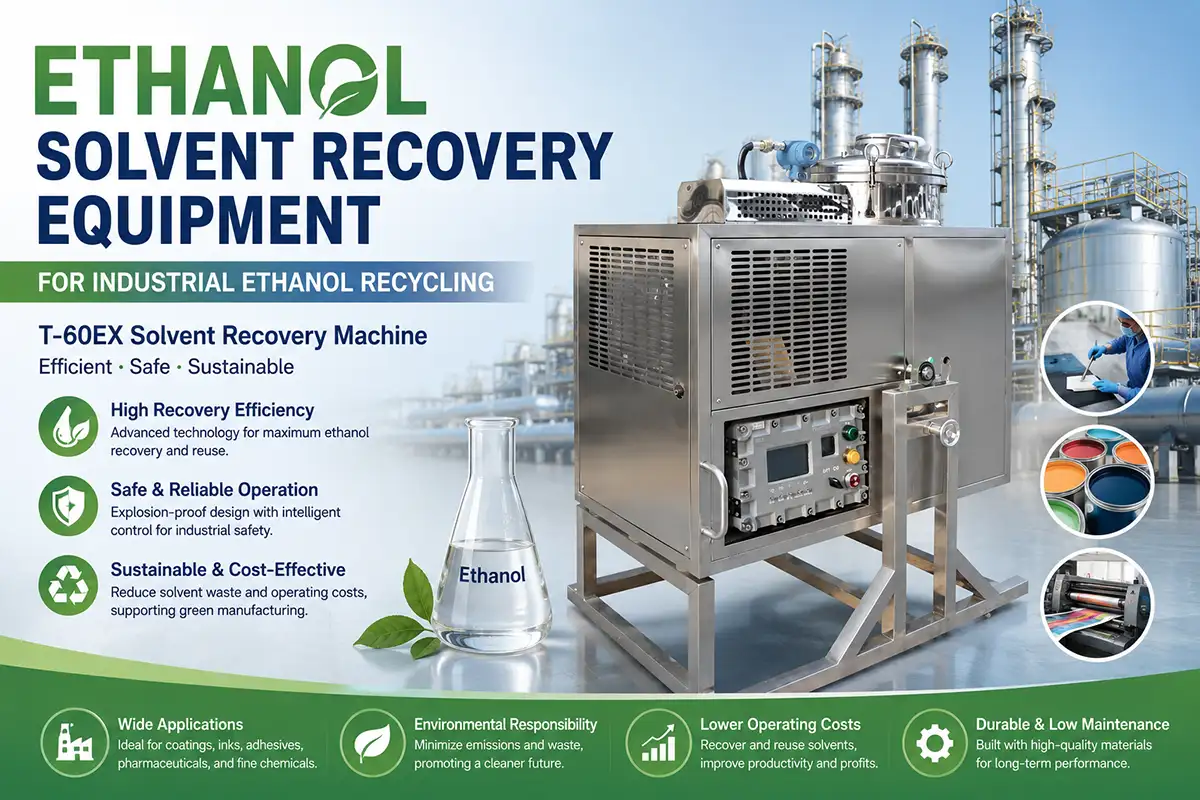
The strongest return usually appears in operations that consume ethanol continuously and generate a repeatable waste stream. Typical examples include extraction processing, pharmaceutical intermediate production, cleaning operations, coatings, chemical manufacturing, and laboratory scale-up environments. In these settings, solvent losses are not random. They are systematic. That makes recovery measurable and financially attractive.
For companies evaluating recovery economics, content around ethanol recovery systems can help connect process design with expected savings. When the same solvent is being bought, used, discarded, and replaced week after week, reclamation often becomes one of the fastest operational improvements available.
Can ethanol recovery equipment improve compliance as well as cost control?
Yes. When less spent ethanol leaves the site as waste, handling complexity is reduced. That often helps facilities improve waste minimization performance, storage discipline, and overall process consistency.
Final thoughts on selecting the right equipment
The best ethanol solvent recovery equipment is the one that fits the solvent, the throughput, the operating area, and the expected maintenance rhythm. For some facilities, a compact system is enough to recover moderate daily volumes efficiently. For others, larger explosion-proof equipment with stronger heating power and longer batch capability is the better long-term solution.
Rather than focusing only on brand familiarity, buyers should prioritize technical clarity: supported solvent types, batch size, recovery rate, heating range, treatment time, safety configuration, and serviceability. That is the framework that consistently leads to better purchasing decisions and stronger real-world performance.
As ethanol costs, waste costs, and compliance demands continue to rise, solvent recovery is becoming less of an optional upgrade and more of a practical requirement. The right system helps recover value that would otherwise be lost every day.
Quick selection checklist
Identify the actual liters of ethanol generated per shift or per day.
Check contamination level and expected recovered ethanol reuse standard.
Match tank capacity with treatment time and plant production rhythm.
Confirm power supply, ventilation, and installation area requirements.
Review explosion-proof or special safety needs before purchase.
Compare equipment price with annual solvent savings, not with purchase price alone.