
Solvent Recovery System in Pharma Industry: Cost, Compliance, and Efficiency Guide
A modern solvent recovery system in pharma industry is no longer just a waste-reduction tool. It has become a practical way to improve solvent utilization, stabilize production costs, support GMP-oriented operations, and reduce hazardous disposal pressure in pharmaceutical manufacturing environments.
Why Solvent Recovery Matters in Pharmaceutical Manufacturing
Pharmaceutical plants frequently use valuable organic solvents during synthesis, extraction, cleaning, crystallization, and formulation support steps. Ethanol, acetone, isopropyl alcohol, ethyl acetate, toluene, xylene, and other process solvents can represent a substantial ongoing operating expense. When these solvents are discarded after a single use, manufacturers face a double burden: fresh solvent purchasing costs and hazardous waste treatment costs.
This is exactly where a solvent recovery system creates measurable value. By separating reusable solvent from contaminated streams through controlled heating and condensation, a recovery unit can help a facility reclaim a large percentage of solvent for reuse in suitable process steps. In many cases, the recovery rate can reach 95%, depending on solvent characteristics, contamination profile, and process configuration.
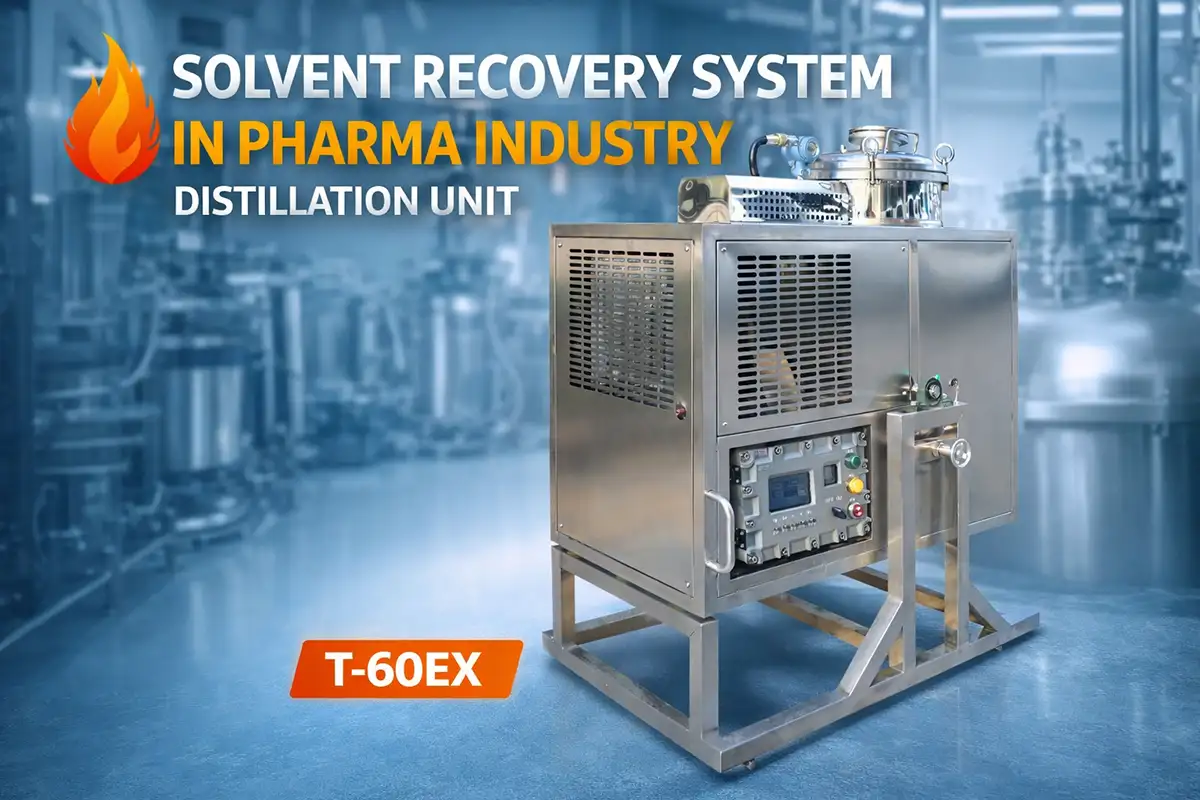
What Does a Solvent Recovery System in Pharma Industry Actually Do?
The basic working principle is straightforward: waste solvent is collected into the recovery chamber, heated within a defined temperature range, vaporized, condensed, and separated into purified recovered solvent and residue. Yet in pharmaceutical production, the practical requirements are much higher than in general industry. Process reliability, material compatibility, temperature control, operator safety, and documentation all matter.
Solvent Cost Control
Recovered solvent can reduce repeated purchases of high-volume consumables, especially in batch-intensive production lines.
Waste Reduction
Less spent solvent sent for disposal means lower off-site treatment frequency and lower storage pressure.
Safer Handling
Explosion-proof designs and controlled operation are especially important when dealing with flammable pharmaceutical solvents.
Operational Sustainability
Recycling aligns with ESG goals while supporting more efficient internal resource management.
Can recovered solvent always be reused directly in a pharma process?
Not always. The answer depends on purity requirements, contamination type, and the intended reuse point. In the author’s view, recovered solvent is most valuable when a plant clearly defines whether the solvent is suitable for cleaning, intermediate steps, or further purification before critical use.
For readers comparing operating principles, this overview on how a solvent recovery system works is also useful as supporting background.
Key Selection Factors for Pharmaceutical Solvent Recovery
Choosing the right system is always context-dependent. In pharma, a general recommendation is rarely enough because the best-fit solution depends on the solvent profile, daily throughput, safety classification, and validation expectations. Several factors deserve special attention:
Solvent compatibility: Ethanol, IPA, acetone, ethyl acetate, toluene, and mixed streams behave differently during recovery.
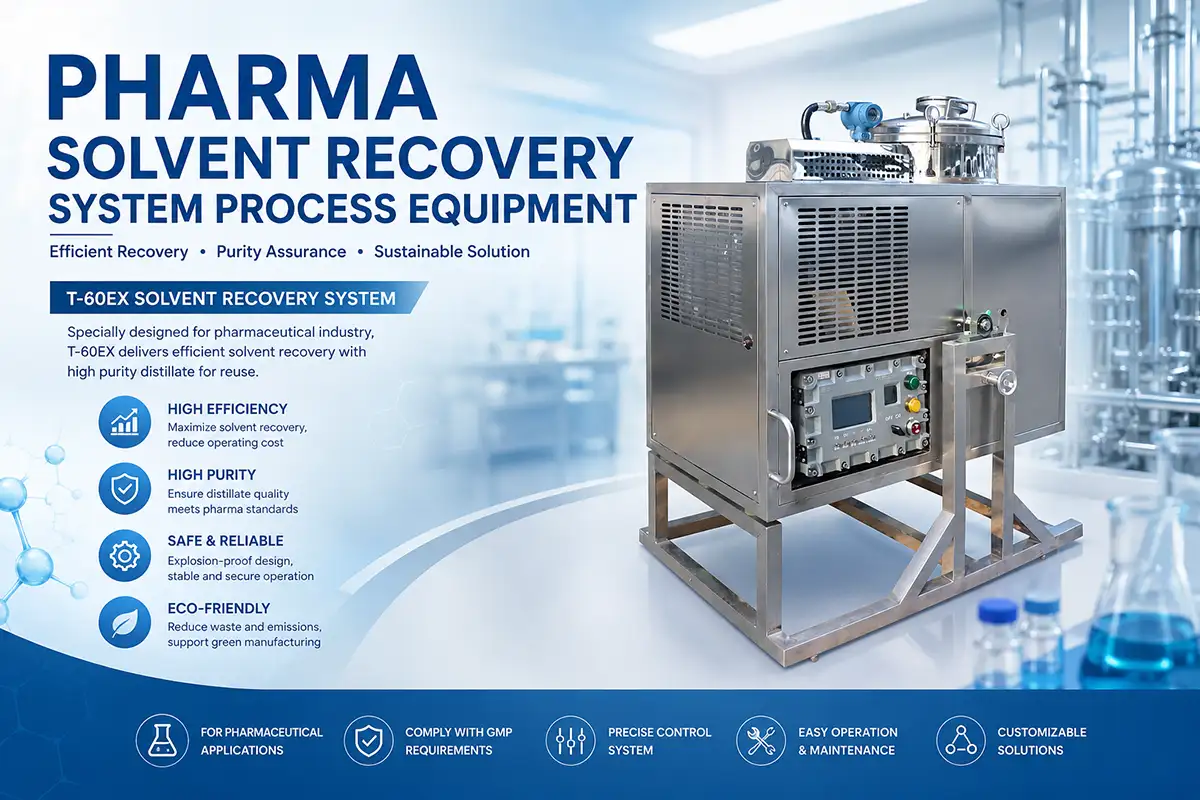
Throughput requirement: A small R&D or pilot lab may need 20–60 L per batch, while production support operations may require 125–400 L or more.
Temperature control: Stable operation across an RT~200℃ range supports broader solvent handling flexibility.
Recovery target: If the process target is around 95% solvent recovery, equipment and operating conditions must be matched accordingly.
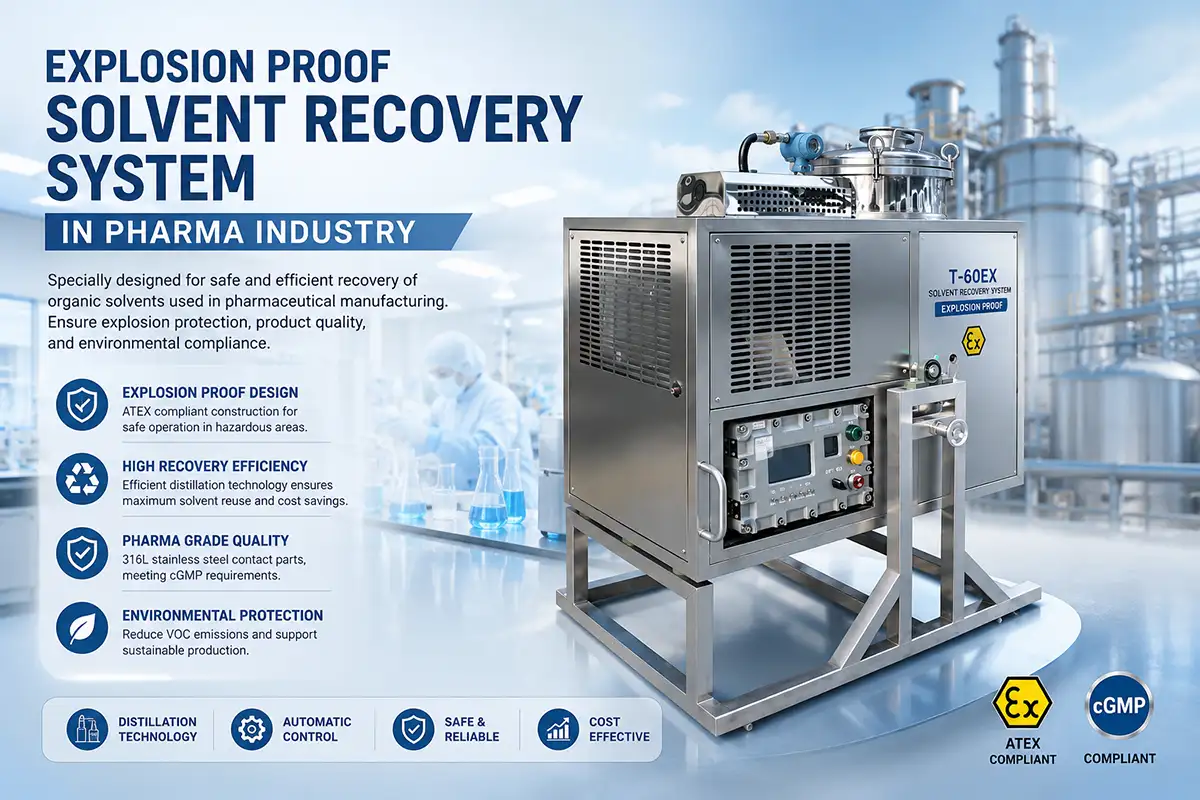
Safety features: Explosion-proof construction is essential where flammable solvent vapor is present.
Maintenance practicality: Residue removal, chamber cleaning, and routine inspection should be efficient enough for real production schedules.
Another important point is the relationship between solvent recovery and waste minimization. For facilities currently paying high disposal fees, combining recycling strategy with better waste handling can bring a major operating improvement. Related reading on what solvent recovery means in practice can strengthen internal decision-making.
Is larger equipment always the better choice for a pharmaceutical plant?
No. Oversizing can increase footprint, power demand, and idle capacity. From the author’s perspective, the best system size is the one aligned with actual solvent generation per shift or per batch, leaving only a reasonable operational margin.
Representative Model Parameters for Pharma-Oriented Solvent Recovery
Below is a practical specification reference for explosion-proof solvent recovery units suitable for different scales of pharmaceutical solvent handling. These models cover feed capacities from 20 L to 400 L, making them relevant for laboratory support, pilot production, and industrial process recovery.
| Model | Feed Capacity (L) | Power Supply (ACV) | Heating Power (kW) | Temperature Range (℃) | Treatment Time (Min.) | Recovery (%) | Weight (kg) | Machine Size (mm) |
|---|---|---|---|---|---|---|---|---|
| T-20Ex | 20 | 380 | 2 | RT~200 | 120 | 95 | 153 | 860×760×1190 |
| T-60Ex | 60 | 380 | 4 | RT~200 | 150 | 95 | 170 | 1160×870×1260 |
| T-80Ex | 80 | 380 | 5 | RT~200 | 180 | 95 | 200 | 1180×850×1290 |
| T-125Ex | 125 | 380 | 6 | RT~200 | 210 | 95 | 280 | 1250×920×1450 |
| T-250Ex | 250 | 380 | 16 | RT~200 | 240 | 95 | 520 | 2600×1200×1950 |
| T-400Ex | 400 | 380 | 32 | RT~200 | 270 | 95 | 1200 | 1990×1850×2090 |
This range makes it easier for pharmaceutical buyers to match a system to real process volume instead of guessing. A smaller batch unit may suit R&D solvent reclaiming, while larger systems are more relevant for centralized production waste streams.
Price Perspective and Return on Investment
In equipment sourcing, price should be evaluated against compliance, recovery performance, durability, and expected solvent savings. For example, several of the company’s industrial solvent recovery product listings show a price range of $2,645–$9,690. Using the requested pricing rule, the mid-range but lower-side reference value is approximately $5,990.
This reference helps position an entry-to-mid industrial solvent recovery solution for facilities that need cost-effective recycling without stepping into much higher market pricing often seen elsewhere. For pharmaceutical operations, return on investment can be attractive when solvent purchase volume is high and hazardous waste treatment costs are significant.
Facilities comparing options may also want to review a broader explanation of what drives solvent recovery system price, especially when evaluating operating cost against capital cost.
What usually creates the fastest payback in a solvent recovery project?
In the author’s view, fast payback usually comes from a combination of high solvent consumption, expensive disposal fees, and a solvent stream that can be recovered repeatedly with stable quality. The more predictable the waste stream, the easier it is to realize savings.
Compliance, Safety, and Process Confidence
Pharma buyers rarely choose equipment only by nominal capacity. They also evaluate safety design, explosion-proof configuration, material contact surfaces, sealing reliability, and process control stability. In solvent recovery applications involving flammable vapors, an explosion-proof model can support safer operation and help align with plant engineering requirements.
It is also wise to consider how the recovered solvent will be documented and managed internally. A well-designed solvent recovery workflow supports traceability, batch planning, and more disciplined waste segregation. All of these factors can improve process confidence even before cost savings are fully realized.
Where solvent streams vary greatly, pre-assessment of boiling range, residue type, and impurity profile remains essential. Good equipment performance starts with a clear understanding of the solvent mixture.
Conclusion: Building a Smarter Solvent Recovery Strategy for Pharma
A reliable solvent recovery system in pharma industry can help manufacturers reduce solvent purchasing costs, lower hazardous waste output, improve operational efficiency, and support a more sustainable production framework. The best solution is not selected by brand name alone. It is selected by fit: solvent type, batch size, throughput, recovery target, safety classification, and long-term operating value.
For pharmaceutical facilities handling ethanol, IPA, acetone, ethyl acetate, xylene, toluene, or mixed solvent waste, an appropriately sized explosion-proof recovery unit can become an important part of process optimization. With feed capacities from 20 L to 400 L, a recovery rate up to 95%, and practical pricing that starts from accessible levels within the company’s own range, solvent recycling is increasingly a strategic manufacturing decision rather than just an environmental one.
Final Thought
When pharmaceutical solvent use is continuous, solvent loss should not be treated as unavoidable. A properly configured recovery system turns recurring waste into reusable value, and that shift can improve both compliance confidence and production economics over time.