
Solvent Recycling Equipment for Small Factories: How to Cut Waste, Cost, and Downtime
For workshops, printing rooms, electronics cleaning lines, coating facilities, parts-wash stations, and extraction labs, the right solvent recycler turns contaminated liquid into reusable solvent instead of recurring disposal cost.
Why small factories are adopting solvent recycling
Solvent recycling equipment for small factories is no longer a luxury purchase reserved for large chemical plants. Many smaller production sites now use IPA, acetone, ethanol, ethyl acetate, xylene, toluene, thinner, hydrocarbon cleaning solvent, or mixed organic solvent every week. When that solvent becomes loaded with oil, ink, resin, coating residue, pigment, dust, or extraction impurities, the old approach is simple but expensive: buy new solvent, store waste solvent, pay for disposal, and repeat.
A compact solvent recovery machine changes that loop. Through controlled distillation, the machine heats the waste solvent, evaporates the reusable fraction, condenses it, and separates residues into a much smaller waste volume. For many suitable solvents and applications, recovery can reach about 95%, which means a small factory can reduce solvent purchasing, lower hazardous waste volume, and improve daily material control.
Is solvent recycling practical when daily solvent waste is not very high?
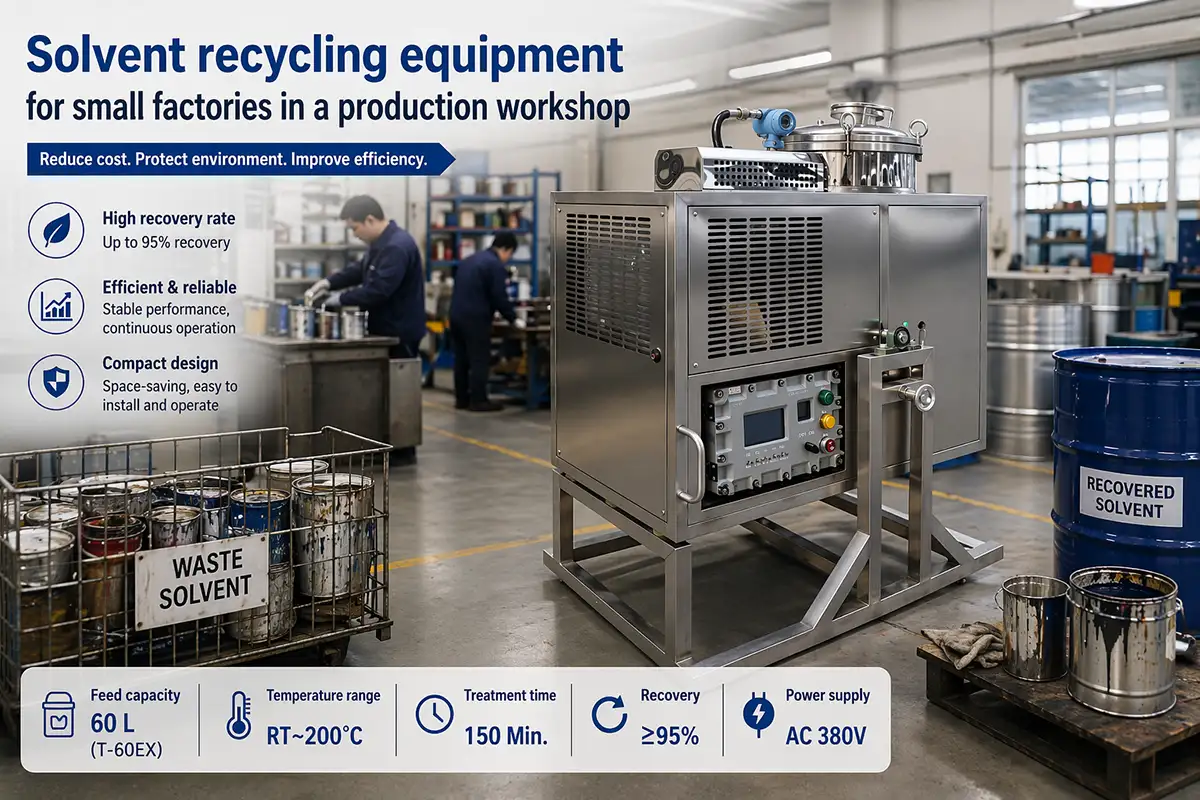
Yes. From the author’s point of view, small factories often benefit faster because they feel every drum of solvent cost directly. A 20L, 60L, or 80L unit can match modest daily waste volumes without forcing the factory to install a large industrial recovery plant.
Common applications: IPA, acetone, ethanol, thinner, paint, and ink
Small factories usually need a practical machine rather than a complicated chemical recovery line. Typical use cases include parts-wash solvent recycling, IPA cleaning solvent recovery, acetone recycling for surface cleaning, ethanol solvent recovery for extraction or formulation, and paint or ink thinner recovery. If the operation involves isopropyl alcohol, the safety and disposal background can also be reviewed in this related guide on how to dispose of isopropyl alcohol.
For coating, printing, auto repair, packaging, and furniture finishing workshops, dirty thinner and ink-wash solvent can quickly become a high-cost waste stream. A dedicated thinner recycler machine can help reclaim usable solvent for cleaning and pre-wash steps, while reducing waste shipments. For factories comparing equipment categories, the general solvent recycling equipment page is a useful internal reference.
Printing and packaging: reclaim ink wash solvent, thinner, ethyl acetate blends, and cleaning solvent where compatible.
Electronics and precision cleaning: recover IPA or acetone used for degreasing, wiping, and cleaning fixtures.
Paint and coating workshops: reduce dirty thinner waste and reuse recovered solvent for washing spray guns, tanks, and tools.
Extraction and laboratory support: recycle ethanol or other suitable solvent streams after process validation.
Model selection for small and growing factories
The best equipment size depends on liters per day, solvent boiling range, contamination level, required recovery purity, available power supply, and site safety classification. The model table below provides a clear starting point. All listed models use AC 380V power supply, operate from room temperature to 200℃, and are designed for about 95% recovery under suitable conditions.
| Model | Feed Capacity (L) | Power Supply (ACV) | Heating Power (kW) | Temperature Range | Treatment Time | Recovery | Weight | Machine Size (mm) |
|---|---|---|---|---|---|---|---|---|
| T-20Ex | 20 | 380 | 2 | RT~200℃ | 120 min | 95% | 153 kg | 860×760×1190 |
| T-60Ex | 60 | 380 | 4 | RT~200℃ | 150 min | 95% | 170 kg | 1160×870×1260 |
| T-80Ex | 80 | 380 | 5 | RT~200℃ | 180 min | 95% | 200 kg | 1180×850×1290 |
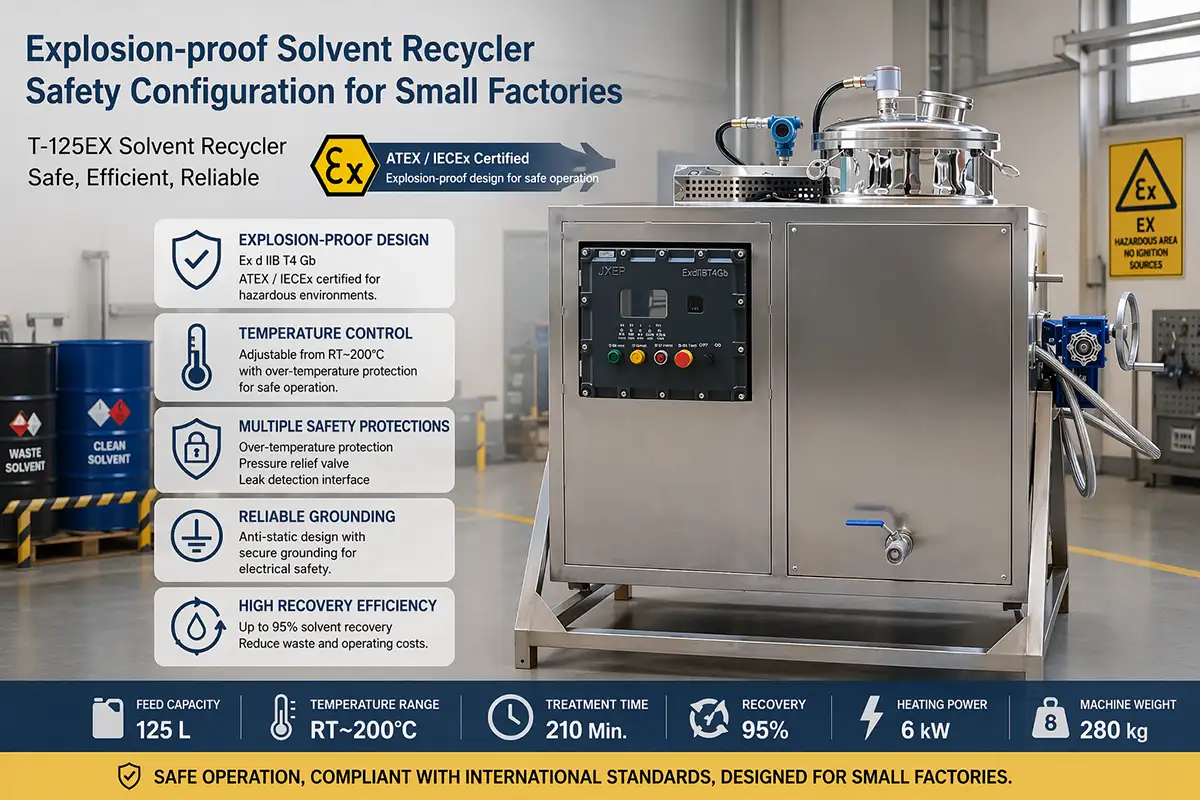
| T-125Ex | 125 | 380 | 6 | RT~200℃ | 210 min | 95% | 280 kg | 1250×920×1450 |
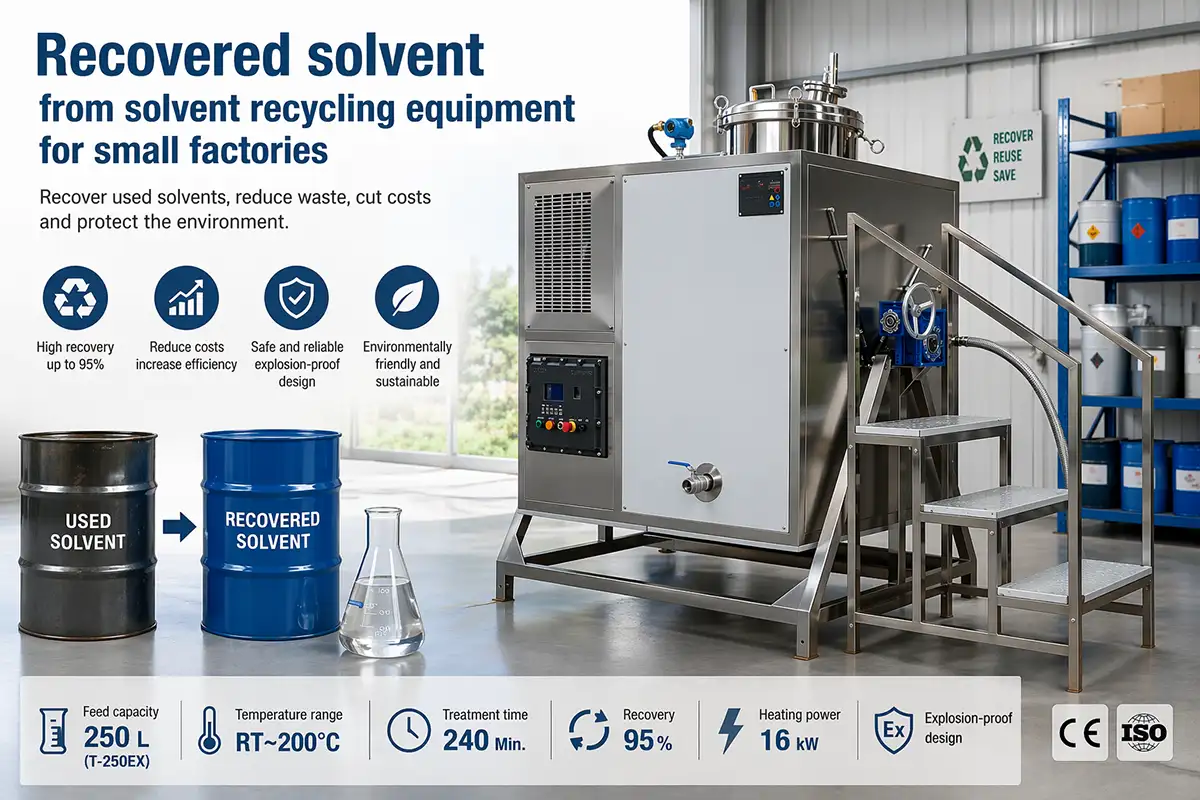
| T-250Ex | 250 | 380 | 16 | RT~200℃ | 240 min | 95% | 520 kg | 2600×1200×1950 |
| T-400Ex | 400 | 380 | 32 | RT~200℃ | 270 min | 95% | 1200 kg | 1990×1850×2090 |
Which capacity is most suitable for a small factory starting solvent recycling?
In the author’s experience, a factory should size the unit around actual waste generation instead of choosing the biggest tank. A T-20Ex can suit trial or low-volume operations, while T-60Ex and T-80Ex are often more practical for steady workshop use. The T-125Ex becomes attractive when one batch per shift must handle a larger mixed cleaning load.
Safety points that should be specified before purchase
Solvents are valuable because they are chemically active, but that also means safety must be clearly specified. A small factory should not buy a solvent recycler based only on tank volume. Before ordering, confirm the solvent flash point, boiling point, water content, residue type, and whether the installation area requires explosion-proof electrical design. Grounding, ventilation, lid sealing, temperature control, condenser performance, relief protection, and operator training all matter.
For flammable solvents, the equipment configuration should match the real operating environment. Explosion-proof solvent recycler options are important when recycling IPA, acetone, ethanol, thinner, xylene, toluene, ethyl acetate, or similar organic solvents. If a site has hazardous location requirements, documentation should state what model and configuration are being supplied and what local compliance checks are still required by the user.
Author’s recommendation: create a simple solvent profile before selecting equipment: solvent name, liters per day, contamination type, expected reuse purpose, installation region, electrical supply, and hazardous area classification. This prevents oversizing and reduces the risk of choosing an unsuitable recovery system.
Price expectation and return on investment
For small factories, purchase price is important, but the better question is how much solvent can be reused each month. If a factory buys solvent frequently and pays for waste liquid disposal, the payback can be driven by both purchasing reduction and waste minimization. The company price for many solvent recovery machine configurations is listed in the range of $2,645–$9,690; when presenting a practical mid-lower selection from this range, a useful company reference price is $4,950. Larger high-capacity systems such as an HY450Ex solvent recovery unit may be quoted at $10,691, depending on configuration.
Practical company reference price for selected small-factory configurations
Final price depends on capacity, explosion-proof configuration, condenser requirements, scraper design, control system, and project documentation.
Should price be the first filter when comparing solvent recycling equipment?
Price matters, but it should follow solvent compatibility and safety. A low-priced machine that cannot safely recover the factory’s solvent is not economical. The author would first confirm solvent type, daily volume, recovery target, explosion-proof needs, and maintenance access, then compare price.
How to build an efficient solvent recovery workflow
A small factory can improve recovery results by organizing waste solvent before it enters the machine. Separate water-heavy waste from cleaner solvent streams, avoid mixing unknown chemicals, filter large solids when appropriate, and label each container. The recovered solvent should be tested for reuse quality before being returned to production. In many workshops, recovered solvent is used first for pre-cleaning, rough washing, or non-critical cleaning, while fresh solvent remains reserved for final rinsing or high-purity steps.
Maintenance is also part of the economics. Residue should be removed on schedule, seals should be inspected, condenser surfaces should remain efficient, and operators should record batch time, recovered volume, and residue behavior. These records help determine whether the factory needs a 20L, 60L, 80L, 125L, or larger model as solvent use grows.
Match the machine capacity to actual liters per day, not only to future projections.
Confirm temperature range and boiling characteristics before purchase.
Specify explosion-proof requirements early when handling flammable solvents.
Use recovered solvent according to quality testing and the factory’s process tolerance.
Track recovery percentage, treatment time, and residue volume to calculate real savings.
Final takeaway
Solvent recycling equipment for small factories offers a practical path to lower solvent purchases, reduced waste disposal, cleaner workshop management, and stronger environmental performance. The best result comes from matching the model to solvent type, waste volume, recovery purpose, and safety classification. With 20L to 400L feed capacity options, up to 95% recovery under suitable conditions, and company pricing references such as $4,950 for selected configurations, small factories can start with a realistic system and scale as production grows.
Explore Solvent Recycling EquipmentSpecifications and recovery performance should be confirmed according to actual solvent composition and site conditions.