Isopropyl Alcohol Recycling: Contamination Control and Reuse Tests
Successful isopropyl alcohol recycling depends on more than collecting a clear distillate. Water, mixed solvents, and process residues must be assessed before recovered IPA can be released for cleaning or manufacturing reuse.
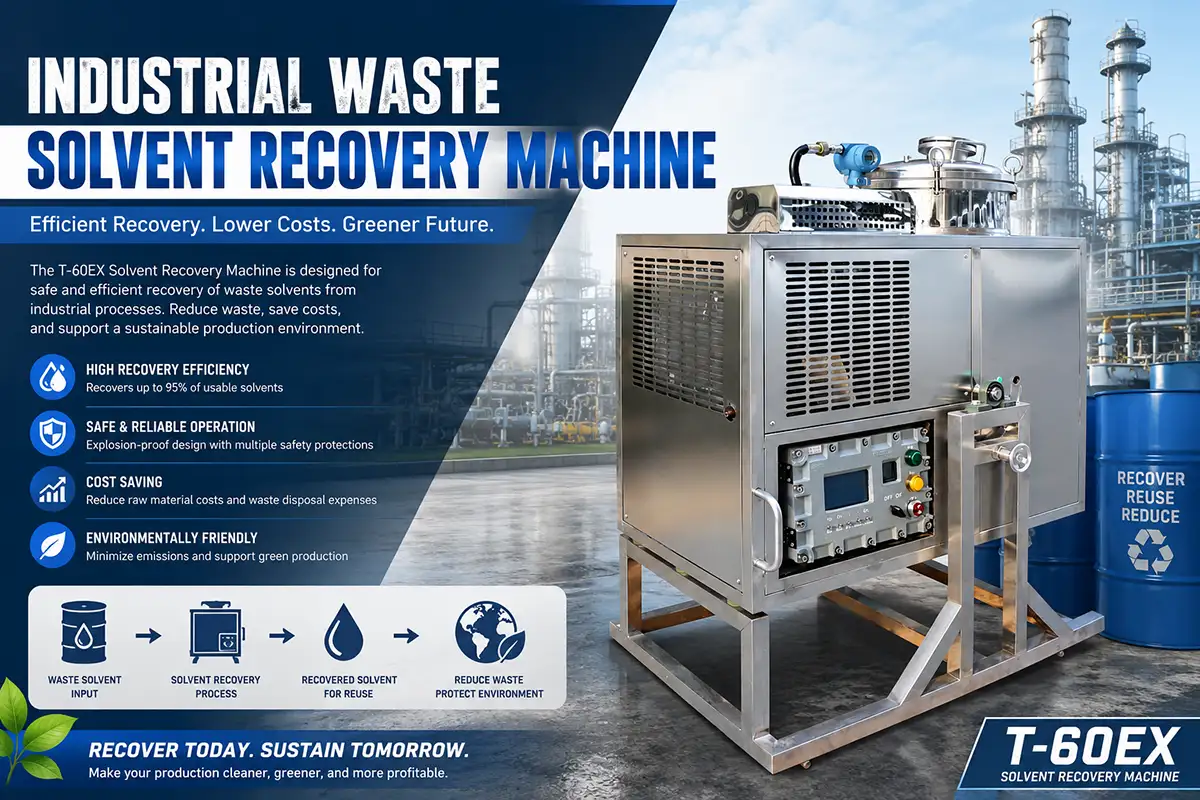
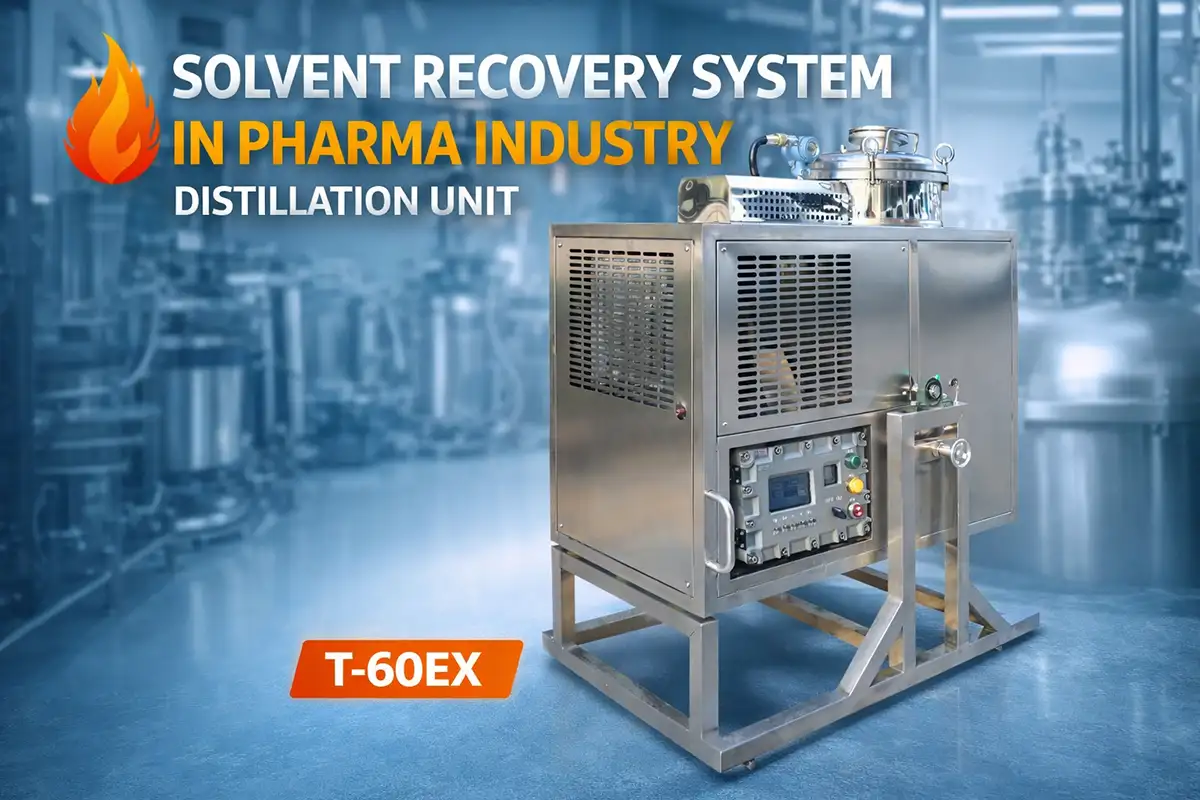
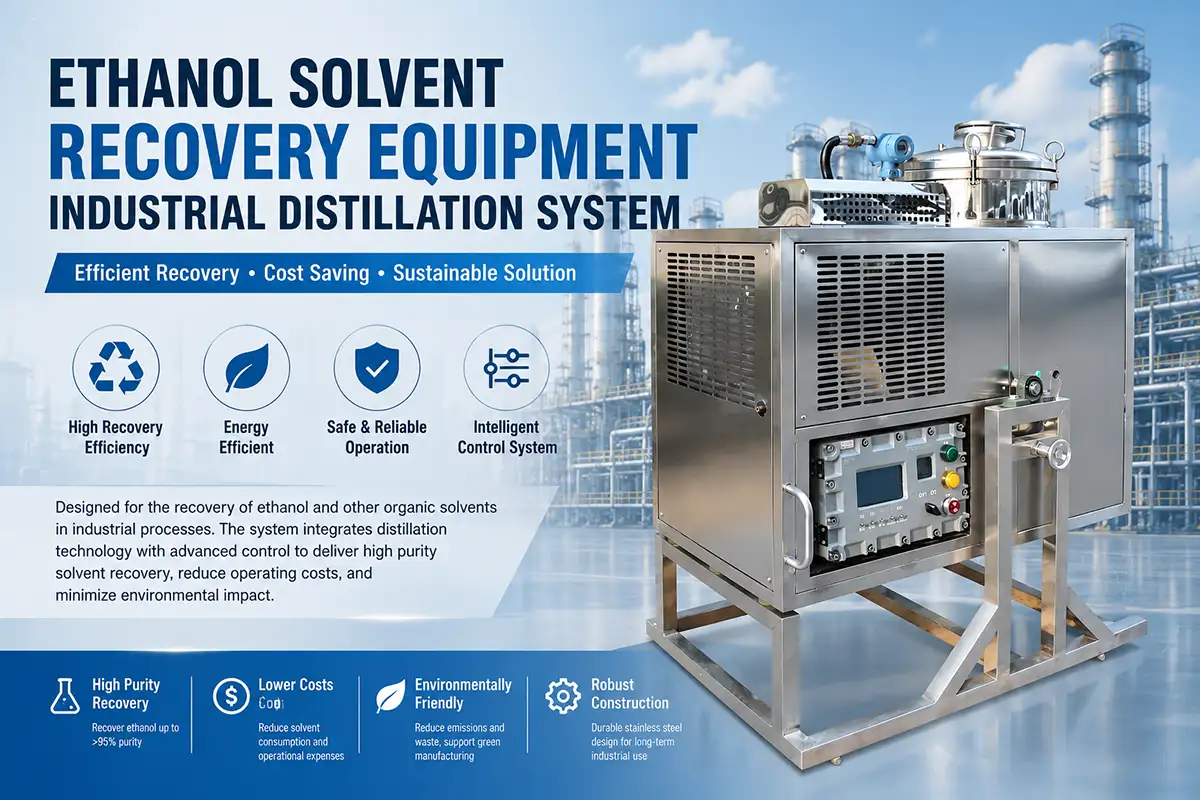
A Solvent Recovery Machine can support an industrial recovery program, but equipment specifications alone do not establish solvent quality. The practical approach is to characterize the waste stream, confirm the selected machine configuration, and validate recovered material against the requirements of its intended application.
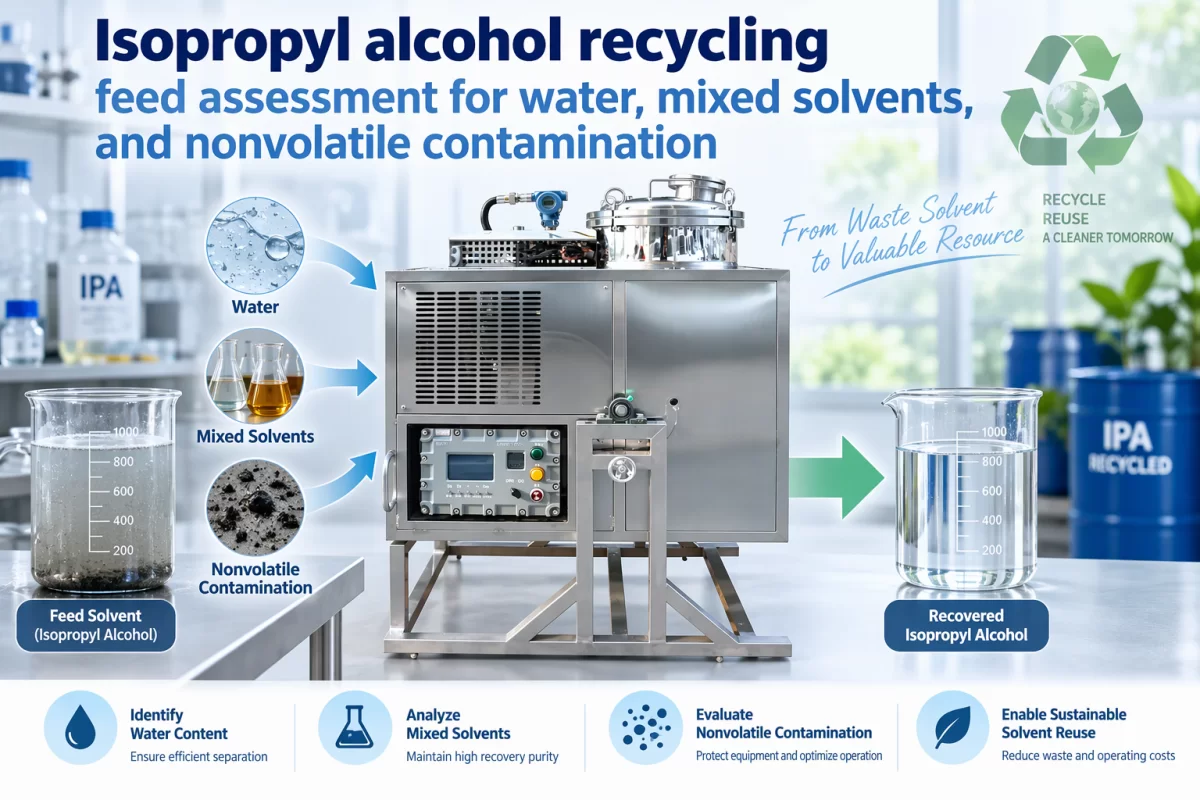
Start isopropyl alcohol recycling with feed characterization
Used IPA may contain moisture from rinsing operations, dissolved cleaning agents, oils, resins, particles, or other solvents introduced during production. These contaminants behave differently during distillation. Separate waste streams by source whenever practical, and obtain representative samples using a documented sampling procedure that accounts for settling or phase separation.
Water: measure it rather than infer it
Establish feed water content with a validated method appropriate to the matrix, such as Karl Fischer titration. IPA and water form an azeotropic mixture, so ordinary distillation does not automatically produce anhydrous IPA. If the receiving process requires very low moisture, confirm whether additional dehydration or a different separation arrangement is needed. Neither visual clarity nor a nominal recovery percentage demonstrates acceptable water content.
Mixed solvents: identify what may travel with the IPA
Review process chemical inventories and safety data sheets, then use a suitable chromatographic method to identify and quantify relevant volatile components. Other solvents may co-distill or change the composition of collected fractions. An IPA assay should use appropriate calibration and a clearly stated reporting basis; chromatographic area percentage is not automatically equivalent to mass percentage.
Nonvolatile contamination: check residue and carryover risk
Oils, polymers, salts, and suspended solids can influence fouling, foaming, and residue handling. A process-relevant nonvolatile residue test, together with solids or particle testing where needed, helps characterize the feed. Distillation can separate many nonvolatile materials, but entrainment can still contaminate collected solvent. Establish operating controls through supplier review and qualification, rather than assuming complete impurity removal.
Does a clear recovered solvent prove that IPA is suitable for reuse?
I would treat clarity as an observation, not a release criterion. Dissolved water and volatile contaminants may be invisible. I recommend comparing analytical results with the receiving process specification before approving any batch.
Unknown, incompatible, or unsuitable waste should remain segregated pending a documented handling decision. The guidance on isopropyl alcohol waste disposal provides relevant handling context; recovery residues and rejected batches still require an appropriate waste route under applicable local requirements.
Evaluate the T-125Ex Solvent Recovery Machine accurately
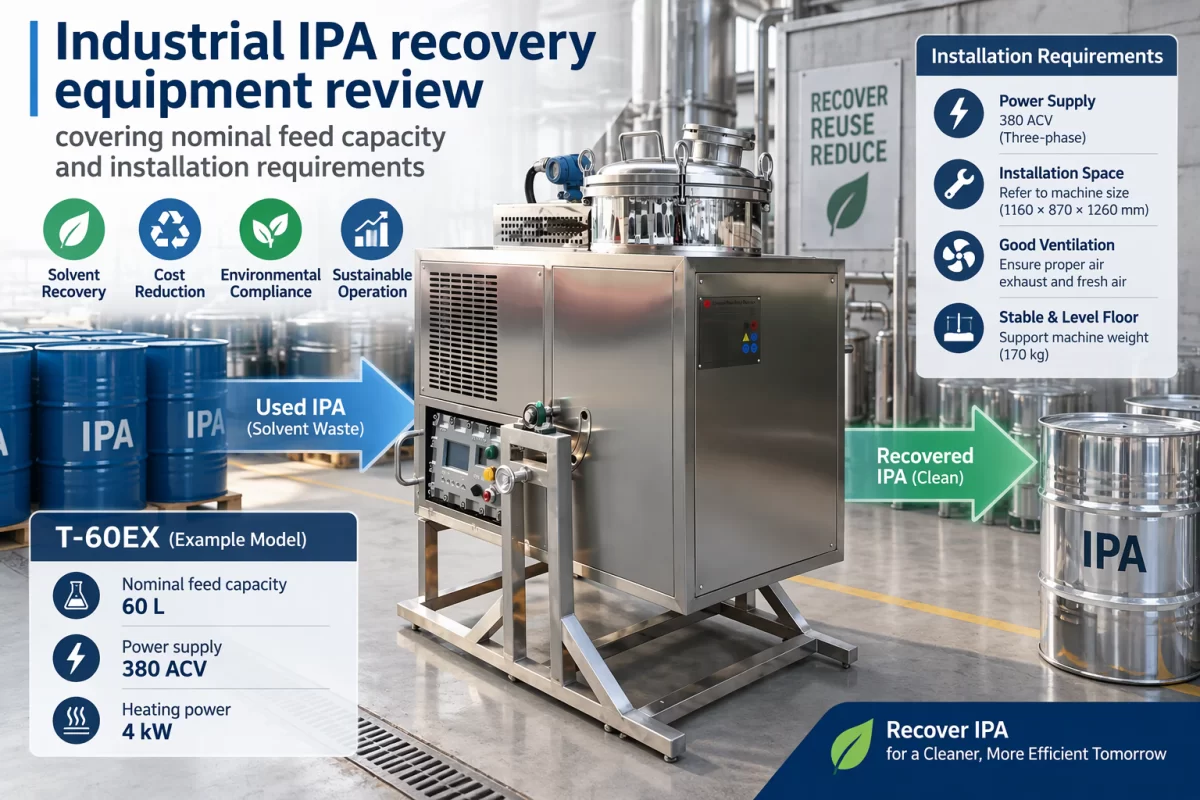
The supplied specification table identifies the T-125Ex as a nominal 125 L feed-class Solvent Recycler Machine with 6 kW heating power. These figures are useful for an initial equipment discussion, but they do not independently establish effective working volume, hourly throughput, daily production, or recovered IPA purity.
| Parameter | Listed value | Interpretation for IPA evaluation |
|---|---|---|
| Nominal feed capacity | 125 L | Feed class; permitted working charge requires confirmation. |
| AC power supply | 380 V | Confirm electrical installation requirements. |
| Heating power | 6 kW | Not a measured energy-consumption figure per batch. |
| Temperature range | Room temperature–200 °C | Not an IPA operating-temperature recommendation. |
| Treatment time | 210 min | Listed value; feed conditions and cycle scope are unspecified. |
| Recovery | 95% | Listed nominal figure; basis and test conditions require confirmation. |
| Machine weight | 280 kg | Use for preliminary handling and installation planning. |
| Machine dimensions | 1250 × 920 × 1450 mm | Confirm dimension orientation and service clearances. |
When comparing industrial solvent recycling equipment, request a model-specific review of material compatibility, cooling requirements, residue handling, safeguards, and intended installation conditions. The “Ex” model suffix and certification wording in other product listings do not, by themselves, verify a particular hazardous-area approval or certification for this configuration.
Keep recovery rate, IPA content, and reusable proportion separate
These three measures answer different questions. Reporting them separately prevents a high collection yield from being mistaken for high solvent purity or full reuse eligibility.
- Recovery rate describes material recovered relative to a defined input. State whether the calculation concerns total collected liquid or IPA itself, and use a consistent mass or volume basis.
- IPA content describes the concentration of IPA in the tested recovered liquid. Specify the analytical method and whether the result is reported by mass, volume, or another validated basis.
- Reusable proportion describes how much recovered material meets the intended process requirements. Define its denominator explicitly, such as released recovered liquid divided by total collected liquid.
Does the listed 95% recovery figure establish 99% IPA purity?
No. I read the 95% entry as a nominal recovery figure, not a composition result. I would require separate IPA and water measurements before accepting a 99% purity statement. The supplied data do not establish that purity for all waste streams.
No batch-specific yield, energy use, or reusable volume is calculated here because the necessary measurements and operating conditions have not been supplied. In particular, dividing nominal feed capacity by listed treatment time would not establish validated production throughput.
Design recovered IPA tests around the receiving process
Set acceptance criteria before running qualification batches. Electronics cleaning may need moisture, ionic contamination, and particle controls, while another cleaning application may prioritize residue, drying behavior, and surface appearance. There is no single test panel or fixed purity level that proves suitability for every industrial use.
- Test the incoming waste: record its source, water content, relevant solvent composition, nonvolatile residue, and any application-specific hazards.
- Test the recovered batch: repeat relevant composition and moisture measurements, and evaluate residue, particles, or specific contaminants as required.
- Run a controlled reuse trial: compare recovered IPA with the approved fresh-solvent control under the same process conditions. Check cleaning effectiveness, drying, residue, and downstream product quality.
- Approve or reject through documented review: hold collected solvent until required results are accepted. Treat blending or reassignment to a less demanding use as a separately validated decision.
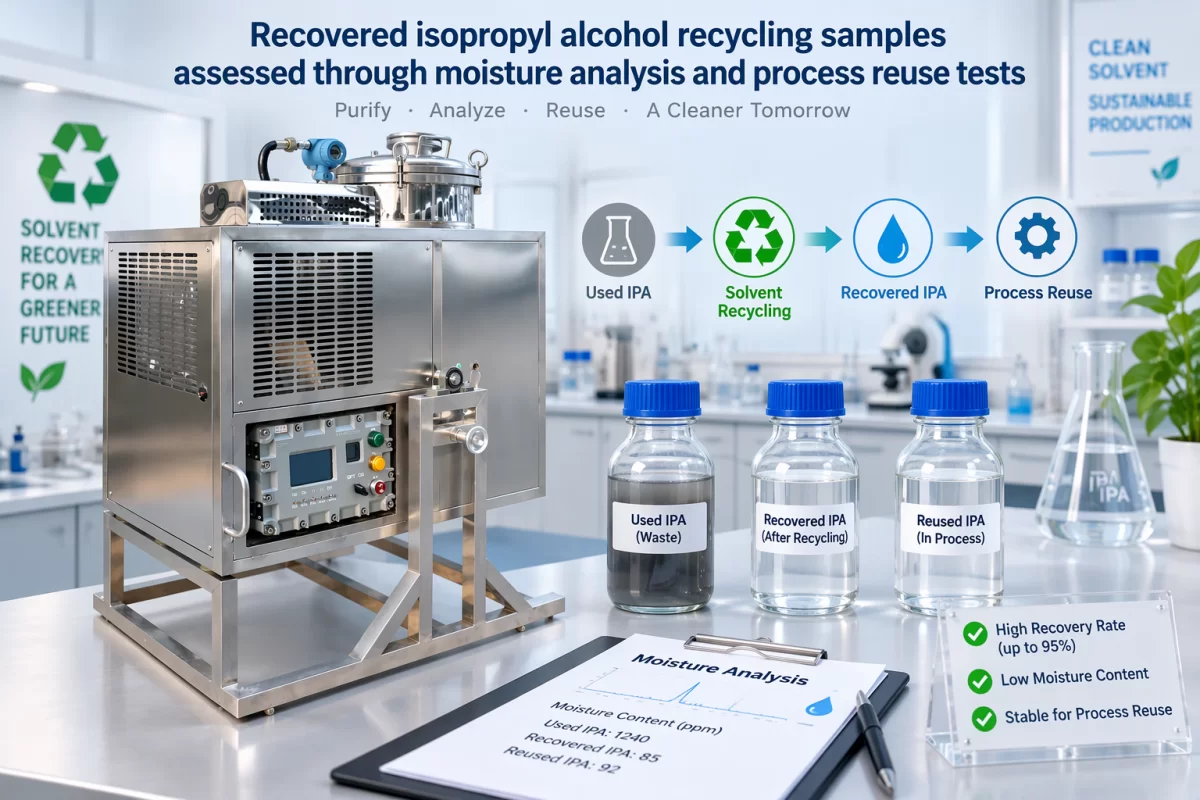
For further operational context, review safe reuse of recovered solvents. General guidance supports planning but does not replace the receiving process specification or model-specific qualification evidence.
What evidence demonstrates stable performance across batches?
I look for traceable records linking feed characteristics, actual charge, operating settings, collection results, laboratory data, and reuse outcomes. Consistency across representative batches is more persuasive than one successful sample, especially when the waste source changes.
Maintain batch IDs, sampling details, test methods, collection quantities, residue quantities, deviations, and release decisions. Trend moisture, IPA content, and reusable proportion over time. Establish the qualification batch count and acceptance limits through the site's quality and risk review; no universal count is established by the supplied product data.
Reference pricing and quotation scope
Our company reference price
US$2,645–9,690
This is the median listed price band in the supplied company price table, not a confirmed T-125Ex quotation. The table contains repeated price ranges rather than a single fixed price for each configuration.
Actual pricing is subject to configuration and the inquiry quotation. Submit the waste composition, intended reuse specification, required working charge, utilities, and installation requirements so the proposal can define equipment scope and qualification needs. No payback or operating-cost result is claimed without site-specific purchase, disposal, energy, labor, and validated reuse data.
Build an IPA recovery program on verified reuse
Isopropyl alcohol recycling is best evaluated as a controlled process: characterize water and impurities, confirm the Solvent Recovery Machine configuration, test the recovered liquid, and validate its intended reuse. The T-125Ex nominal specifications provide a starting point for selection—not a universal purity or throughput guarantee.
Prepare a representative feed analysis and receiving-process acceptance criteria before requesting a configuration review and quotation. That evidence makes the equipment discussion more useful and the eventual reuse decision more defensible.