How to Calculate Solvent Recovery Capacity per Shift
Reliable solvent recovery capacity per shift starts with a complete batch record—not the number printed beside “feed capacity.” A useful calculation combines available operating minutes, the effective volume charged into each batch, the time needed to finish the entire cycle, and a liquid yield verified with representative waste solvent.
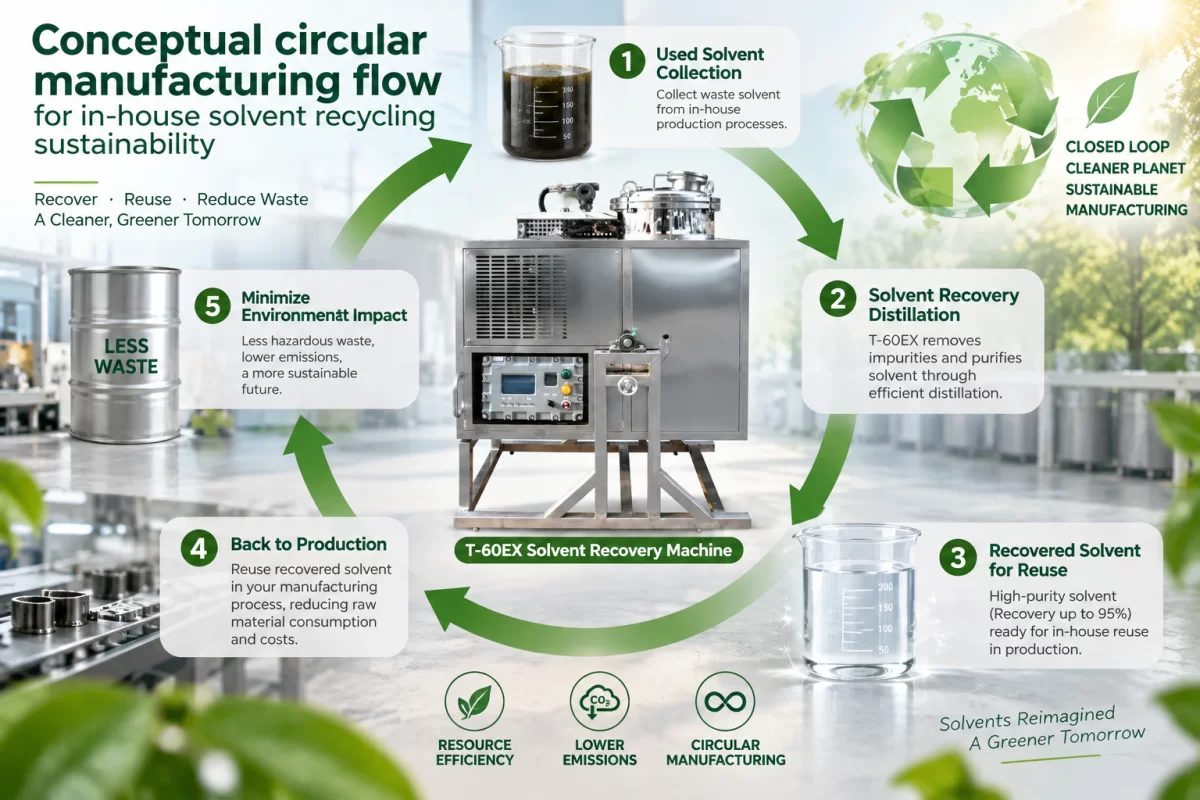
This guide uses the 60 L T-60Ex and 125 L T-125Ex as nominal batch-size examples. It provides fields for actual operating data rather than claiming an untested shift output. The central distinction is simple: nominal feed volume is neither recovered liters per hour nor a guaranteed quantity of reusable solvent.
Start with nominal parameters, then confirm operating data
The supplied model sheet lists the following values. These are reference specifications, not sample-specific performance results. The product information also identifies the T-60EX with a nominal 60 L feed capacity and 4 kW power; the parameter sheet labels this power as heating power.
| Parameter | T-60Ex | T-125Ex |
|---|---|---|
| Feed capacity (L) | 60 | 125 |
| Heating power (kW) | 4 | 6 |
| Power supply (AC V) | 380 | 380 |
| Listed treatment time (min) | 150 | 210 |
| Listed recovery (%) | 95 | 95 |
| Measured complete cycle (min) | To confirm | To confirm |
| Sample-verified liquid yield (%) | To confirm | To confirm |
For equipment details, the 60 L batch solvent reclaimer page is a relevant starting point. Confirm the supplied configuration, permitted charge volume, and solvent compatibility before building a production schedule.
Does a 60 L feed rating mean 60 liters of recovered solvent per hour?
No. I treat 60 L as the nominal feed quantity, not an hourly production rate. Actual recovered output depends on the approved working charge, complete cycle duration, and measured liquid yield. Dividing the nominal volume by the listed treatment time would omit unconfirmed stages and would still not establish recovered-liquid output.
Measure the complete 60 L and 125 L batch cycles
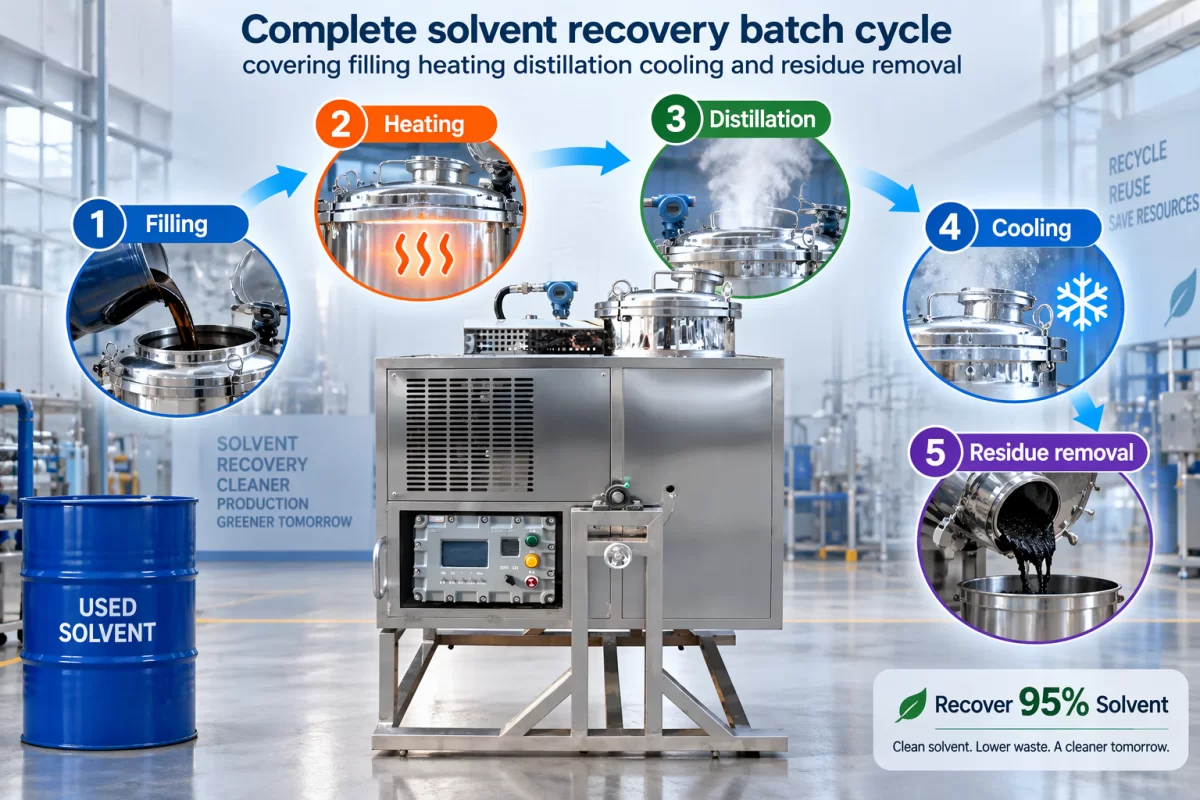
Run representative sample trials under the intended operating configuration and log each stage with start and finish times. Record actual feed volume, waste composition, cooling conditions, operating settings, recovered volume, and interruptions alongside the time log. These details help explain differences between runs.
Use the same cycle boundary for both machines: filling starts the batch, and safe residue removal plus any required within-cycle cleaning ends it. Count separately any additional preparation needed between batches. If stages overlap, use elapsed clock time rather than adding overlapping durations twice.
| Stage | 60 L example (min) | 125 L example (min) |
|---|---|---|
| Filling / feed transfer | ||
| Heat-up | ||
| Distillation / collection | ||
| Cooling to approved handling condition | ||
| Residue removal / within-cycle cleaning | ||
| Complete elapsed cycle, C |
Follow the approved operating procedure throughout testing. Cooling and residue handling should not be shortened merely to make another batch fit. Neither a model suffix nor a marketplace listing title establishes certification or suitability for a particular hazardous waste stream.
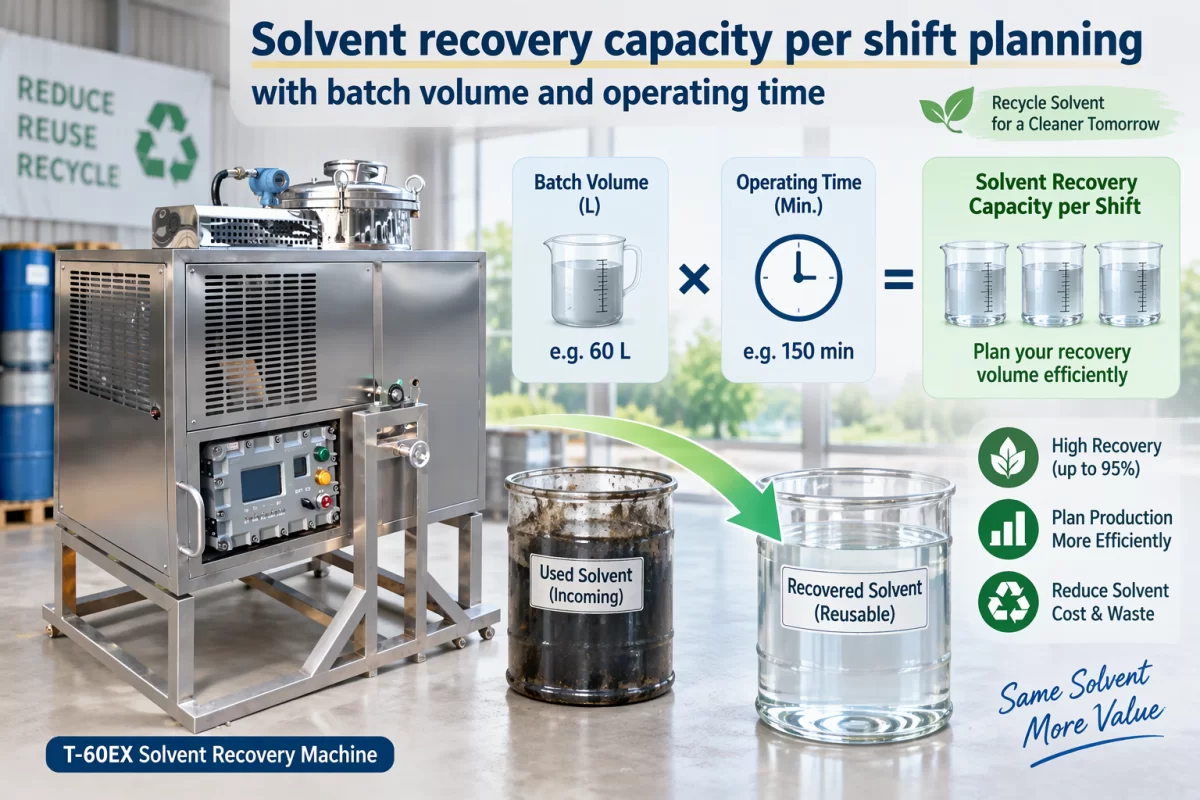
Calculate solvent recovery capacity per shift
First determine the minutes genuinely available to finish batches. Subtract initial preparation, final shutdown, planned maintenance, and any breaks or other downtime that actually stop equipment operation. Do not deduct a break if the approved process continues through it; conversely, do not assume unattended operation is permitted.
A = S − D S is scheduled shift length in minutes. D is fixed non-batch downtime, including required initial preparation and final shutdown. A is available batch-operating time.
N × C + max(N − 1, 0) × B ≤ A C is the complete measured cycle. B is additional changeover time between consecutive batches, excluding work already included in C or D. N is the largest nonnegative whole number satisfying the inequality.
N = max(0, floor((A + B) / (C + B))) The closed-form equation applies when C is positive, A and B are nonnegative, and batch and changeover durations are constant. It counts changeovers only between completed batches.
If cleaning is required after the final batch, include it in the complete cycle or fixed end-of-shift allowance. Avoid counting the same task twice. Where durations differ from batch to batch, build the actual chronological schedule instead of relying on the constant-cycle equation.
Can a batch that finishes after the shift be counted as a completed cycle?
No. I count only cycles that reach the defined completion point within the available shift window. A partly completed batch is work in progress. Liquid collected from it can be logged separately, but it should not be presented as output from a completed shift cycle.
y = measured recovered liquid volume / measured effective feed volume Recovered liquid per shift (L) = N × V × y V is the verified effective feed volume per batch in liters, and y is the sample-verified volumetric liquid yield expressed as a decimal. Measure feed and recovered volumes on a consistent basis, including comparable temperature conditions.
Report processed feed as N × V separately from recovered liquid. If charges or yields differ, sum Vi × yi over the completed batches. Reusable solvent volume may be lower than total collected liquid if some fractions fail the intended reuse specification.
Fillable shift-capacity worksheet
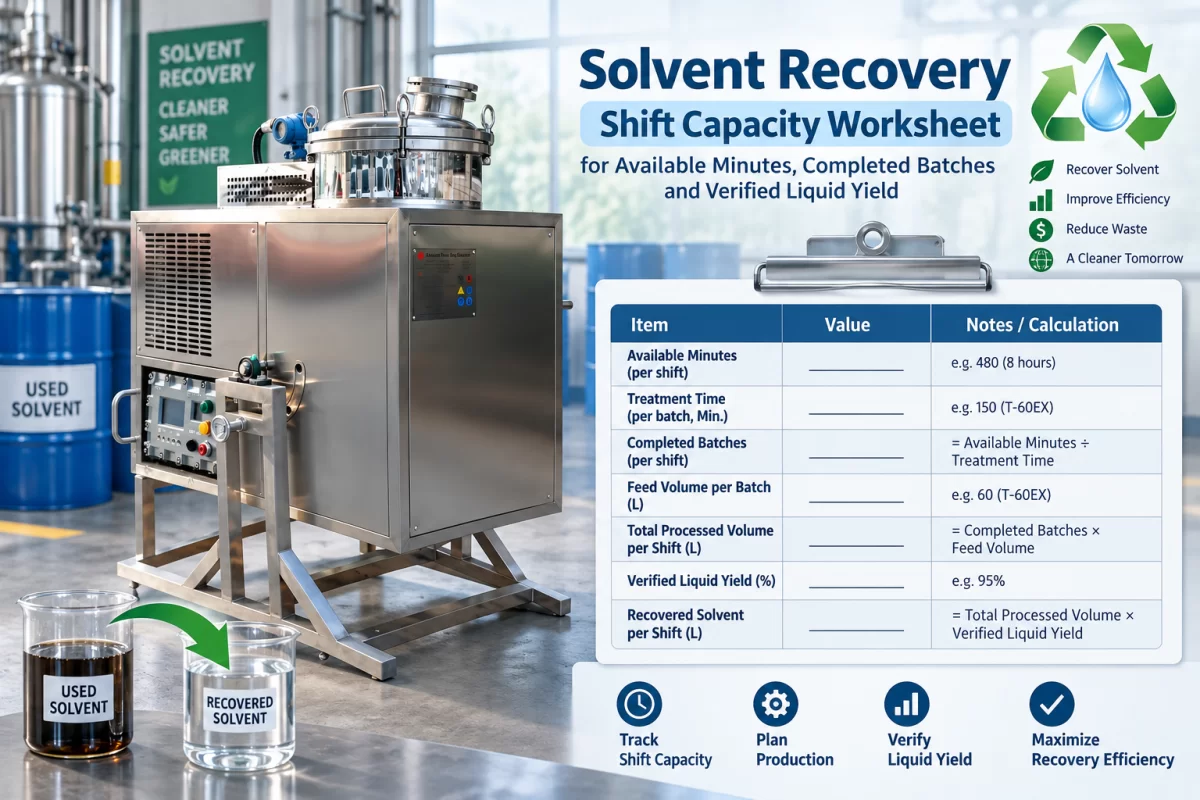
Complete one column for each model using the same waste stream and comparable operating conditions. Leave output fields unconfirmed until effective feed volume, complete cycle time, and liquid yield have been established. The fields below are for manual entry and do not automatically calculate or save results.
| Planning field / unit | T-60Ex | T-125Ex |
|---|---|---|
| Scheduled shift, S (min) | ||
| Preparation, shutdown, breaks, other fixed downtime (min) | ||
| Planned shift maintenance (min) | ||
| Available minutes, A = S − total fixed downtime (min) | ||
| Effective feed per batch, V (L) | ||
| Complete cycle, C (min) | ||
| Additional between-batch changeover, B (min) | ||
| Sample-verified liquid yield (%) | ||
| Completed cycles, N (whole batches) | ||
| Processed feed per shift (L) | ||
| Recovered liquid per shift (L) |
Convert the entered yield percentage to a decimal before multiplication. Attach the trial record, sample identification, configuration, and reuse-quality test results to the completed worksheet.
Use verified shift output to guide equipment selection
A larger nominal batch does not automatically produce more reusable liquid in a particular shift. Longer cooling, residue removal, or preparation can reduce the number of completed cycles. The supplied heating-power values alone also do not establish heat-up time or actual energy consumption.
Does continuous operation remove the need for a shift calculation?
No. I would evaluate a continuous configuration using verified operating throughput, startup and shutdown time, availability, and sample-specific yield. Its scheduling basis differs from counting batch cycles, but its collected-liquid output still needs evidence.
If the operating requirement involves continuous feeding and discharge, confirm that functionality for the quoted model. The link is background reading, not evidence that either batch model listed here includes continuous operation.
Company reference pricing
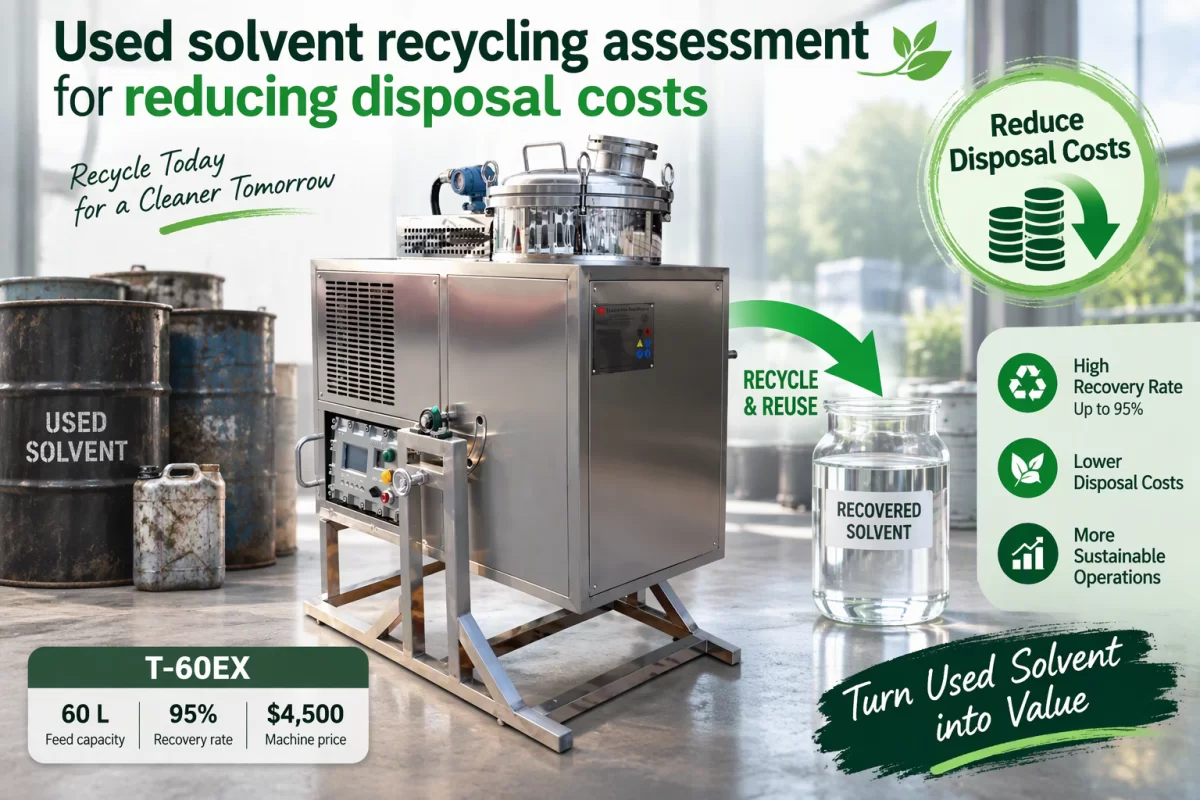
The supplied company price list contains both single prices and price ranges. Ordering the listed entries by their lower price, then their upper price, gives a median listed entry of US$2,645–9,690. This is our company’s reference price range, retained as a range rather than converted into an unsupported single price.
It is not a confirmed quotation for the T-60Ex or T-125Ex. Actual pricing is subject to configuration and the inquiry result. Request a model-specific quotation together with sample-trial data; marketplace product titles do not independently verify throughput, purity, certification, or installed features.
Base solvent recovery capacity per shift on completed work
A defensible shift figure follows four steps: confirm effective feed volume, measure the full batch cycle, fit only complete cycles into available minutes, and multiply their feed volume by sample-verified liquid yield. Keep purity and reuse acceptance separate from volume recovery.
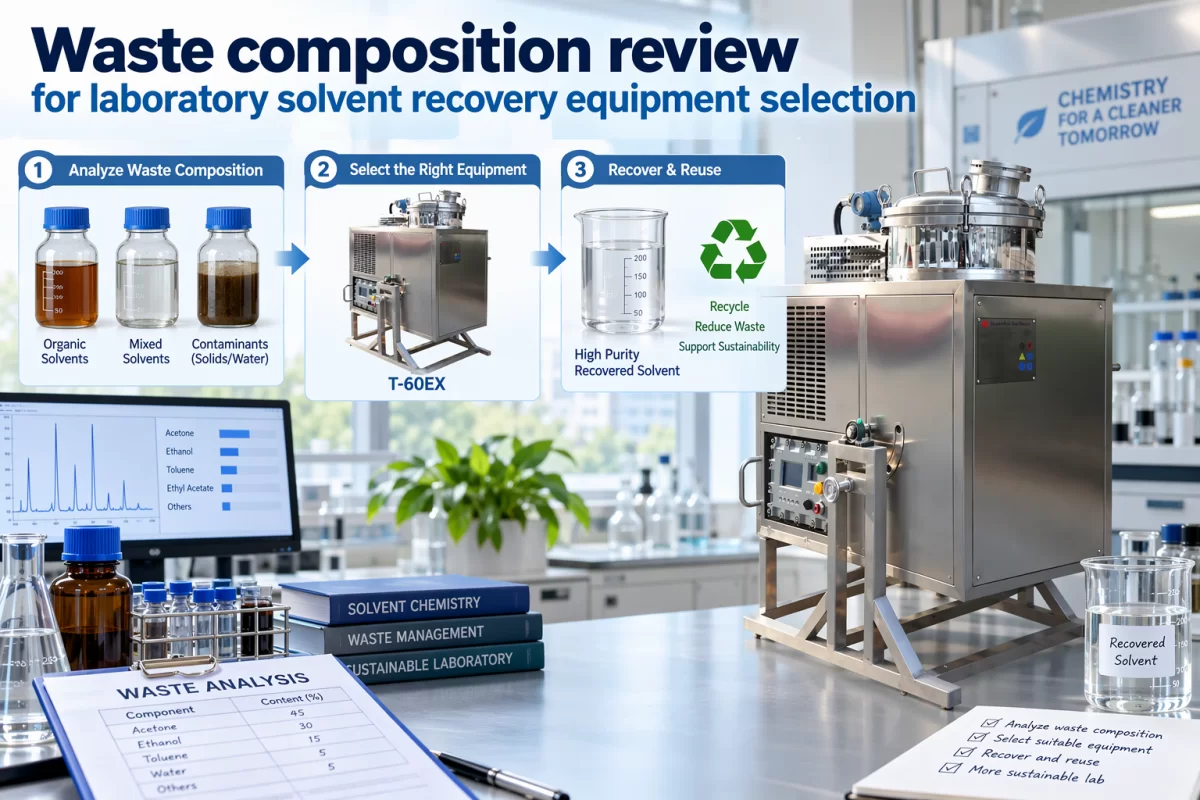
For the nominal 60 L and 125 L examples, actual shift totals remain unconfirmed because complete-cycle measurements and tested volumetric yields have not been supplied. To select a Solvent Recovery Machine, provide the waste-solvent composition, required shift schedule, reuse criteria, and intended configuration, then request trial results and a matching quotation.