How to Choose Explosion-Proof Solvent Recycling Equipment for Factories?
Factories that use thinner, acetone, IPA, ethanol, xylene, toluene, ethyl acetate, or other volatile organic solvents face the same daily challenge: used solvent cannot simply be treated as ordinary liquid waste, yet buying fresh solvent again and again quietly eats into production margins. The right explosion-proof solvent recycling equipment can reduce waste volume, recover reusable solvent, improve workshop housekeeping, and support safer hazardous-liquid management.
Start with the Solvent and the Risk Level
Explosion-proof solvent recycling equipment is mainly used for flammable or combustible solvent waste. In most factories, this waste comes from printing, coating, paint spraying, electronics cleaning, precision parts washing, adhesive production, chemical blending, pharmaceutical extraction, or laboratory-scale pilot production. Because solvent vapor can form an explosive atmosphere when mixed with air, the machine should be designed around ignition prevention, sealed distillation, controlled heating, stable condensation, and reliable electrical protection.
The first selection step is to identify the solvent composition. Single solvents such as acetone, ethanol, isopropyl alcohol, methanol, or xylene are usually easier to recover than mixed solvents with resins, inks, pigments, oils, or high-boiling contaminants. If the waste contains many solids, the factory may need a scraper-type or residue-friendly distillation structure. If the solvent contains water or multiple components with close boiling points, recovery purity should be checked through a sample test before choosing the final model.
From my experience, most common industrial organic solvents are good candidates, but not every waste liquid should be treated in the same way. A solvent with heavy sludge, high polymer content, or reactive impurities needs extra review. The safer approach is to confirm the SDS, boiling range, flash point, and residue behavior before selecting equipment.
Choose Capacity by Daily Waste Volume
The machine capacity should follow actual waste generation, not only the size of the workshop. A small factory producing 30 to 50 liters of dirty solvent per day may not need an oversized system. A coating or printing facility with continuous cleaning operations may need a larger batch unit, or multiple machines, to prevent waste barrels from accumulating.
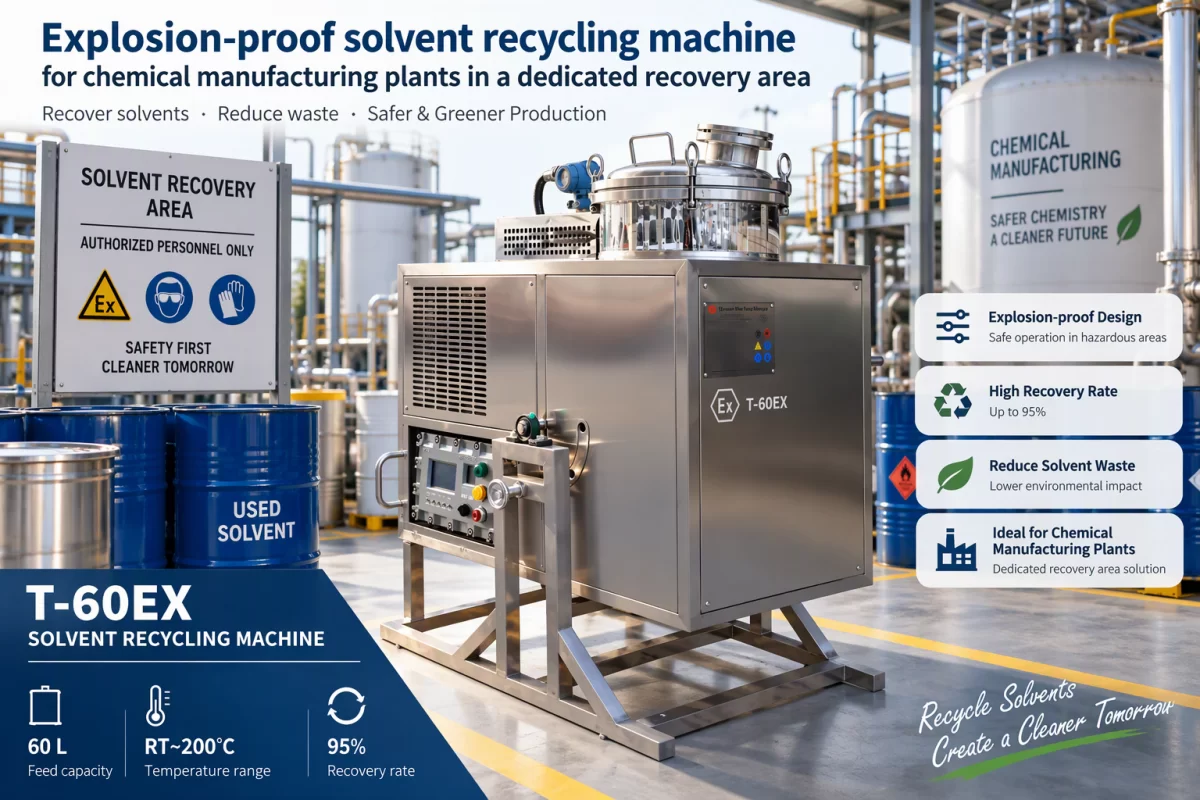
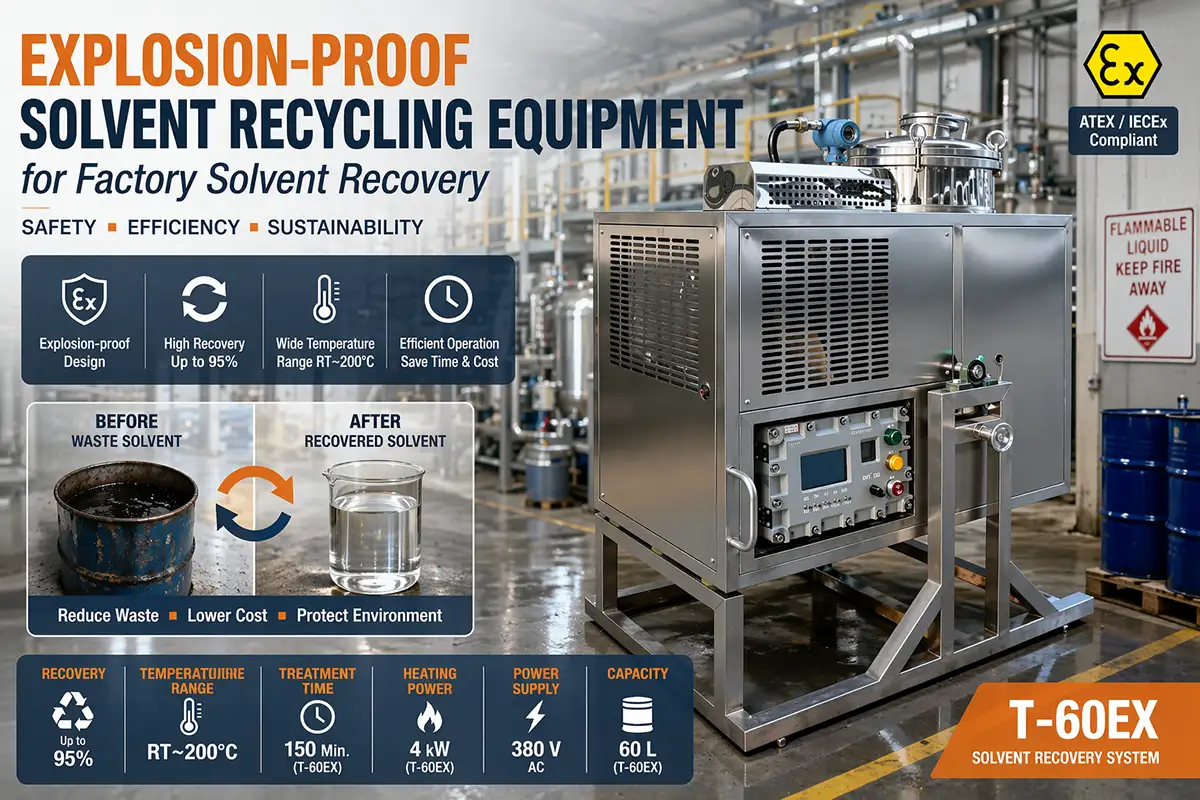
Our explosion-proof models cover a practical range from 20 L to 400 L feed capacity, with a recovery rate of about 95% under suitable solvent conditions. Treatment time increases with capacity and solvent characteristics. The T-20Ex is suitable for small-batch recovery and testing. The T-60Ex and T-80Ex are often more practical for routine workshop cleaning solvent. The T-125Ex provides more buffer for medium factories. The T-250Ex and T-400Ex are better for higher-volume production lines where waste solvent is generated every shift.
For factories comparing equipment categories, the dedicated solvent recovery machine page is a useful reference because it focuses on equipment built for reclaiming usable solvent from contaminated waste streams.
| Model | Feed Capacity | Power Supply | Heating Power | Temperature Range | Treatment Time | Recovery | Machine Weight |
|---|---|---|---|---|---|---|---|
| T-20Ex | 20 L | 380 ACV | 2 kW | RT-200℃ | 120 min | 95% | 153 kg |
| T-60Ex | 60 L | 380 ACV | 4 kW | RT-200℃ | 150 min | 95% | 170 kg |
| T-80Ex | 80 L | 380 ACV | 5 kW | RT-200℃ | 180 min | 95% | 200 kg |
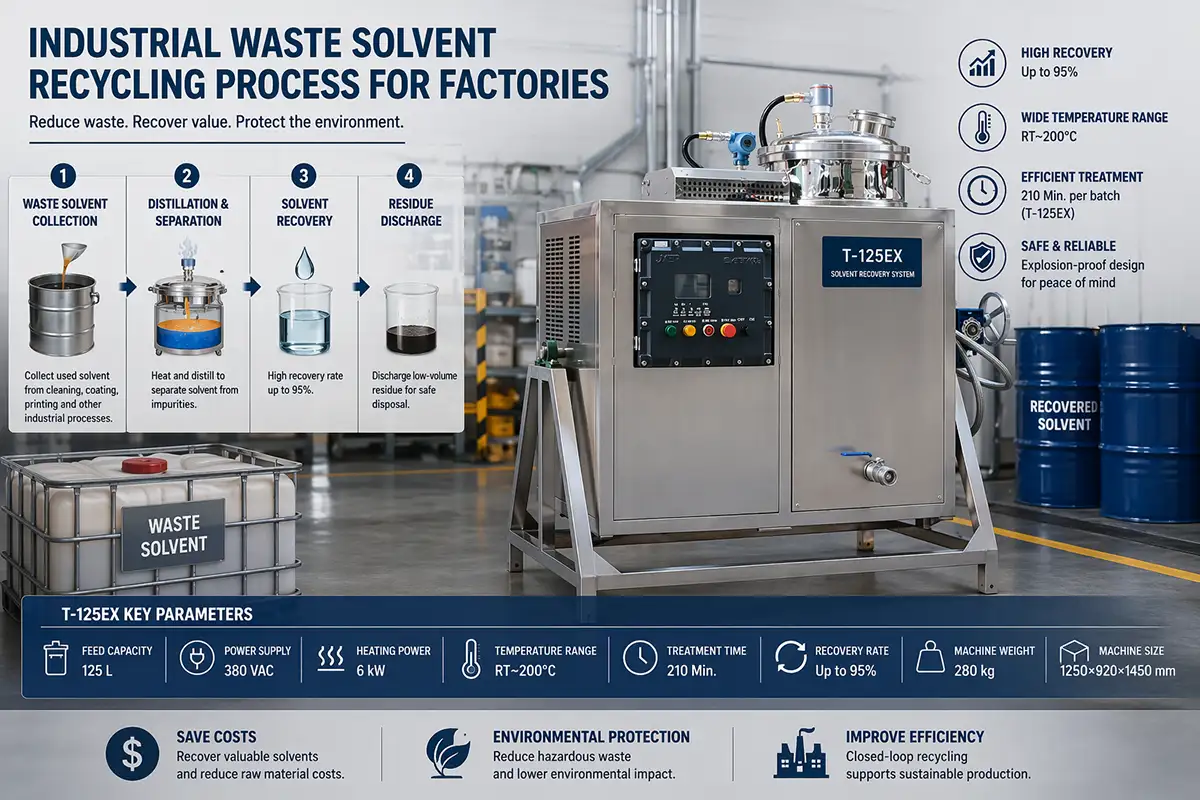
| T-125Ex | 125 L | 380 ACV | 6 kW | RT-200℃ | 210 min | 95% | 280 kg |
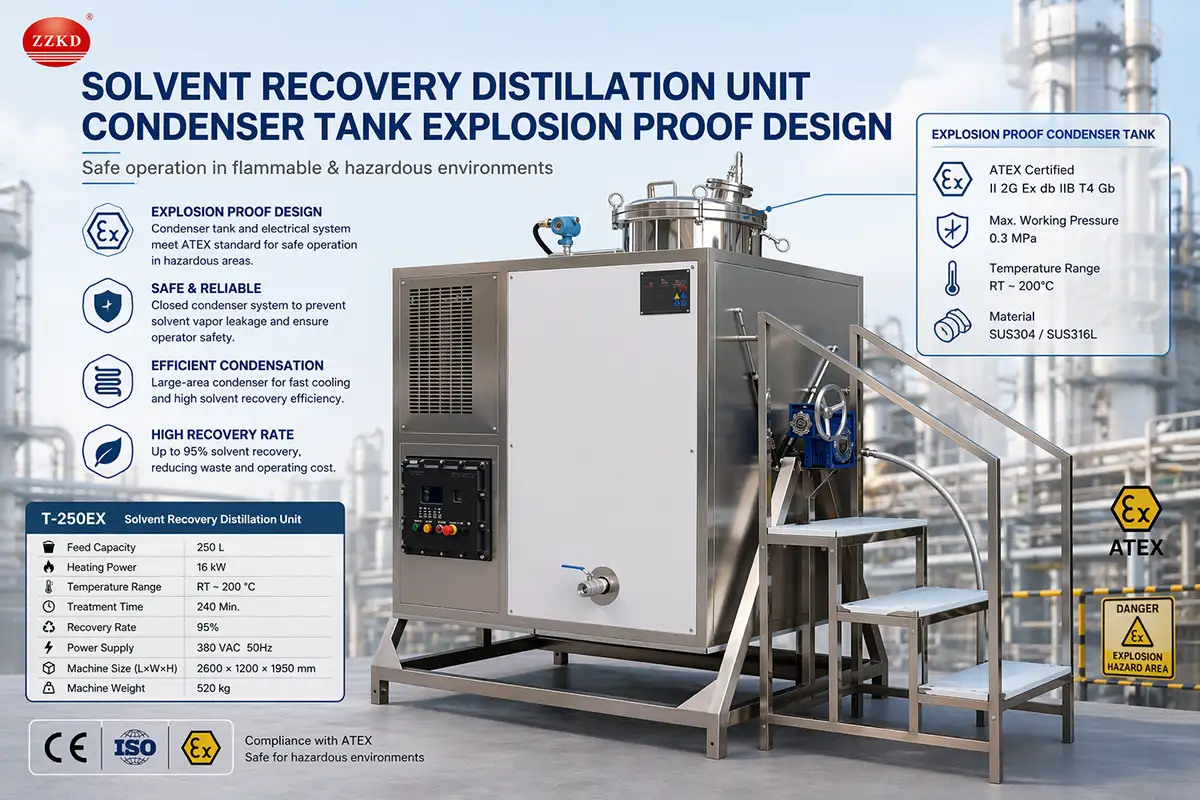
| T-250Ex | 250 L | 380 ACV | 16 kW | RT-200℃ | 240 min | 95% | 520 kg |
| T-400Ex | 400 L | 380 ACV | 32 kW | RT-200℃ | 270 min | 95% | 1200 kg |
Check Safety Design Before Price
Price matters, but for explosion-proof equipment it should never be the first filter. A solvent recycler handles heat, vapor, liquid waste, and recovered solvent in one process. The machine should support stable temperature control, vapor condensation, sealed operation, pressure awareness, grounding, anti-static management, and electrical components appropriate for the intended working environment. The installation area should also be ventilated and managed according to local safety rules.
Factories should ask how the heating system controls temperature rise, how vapor is condensed, how residue is discharged, and how operators are protected during loading and unloading. It is also important to confirm whether the recovered solvent will be reused for cleaning, dilution, washing, or a more sensitive process. A factory that only needs recovered thinner for rough cleaning has different purity expectations from an electronics plant recovering IPA for precision cleaning.
I would not automatically recommend that. Oversizing can increase energy use, footprint, and batch waiting time. A better decision is to calculate daily waste volume, number of shifts, expected growth, and storage limits. If production is growing quickly, choosing one level above the current need can be sensible, but jumping too far may reduce efficiency.
When the process depends on distillation, it helps to understand the recovery principle. This guide to a solvent recovery distillation unit explains how heating, evaporation, condensation, and residue separation work together to cut solvent cost and waste.
Use Price as a Practical Budget Reference
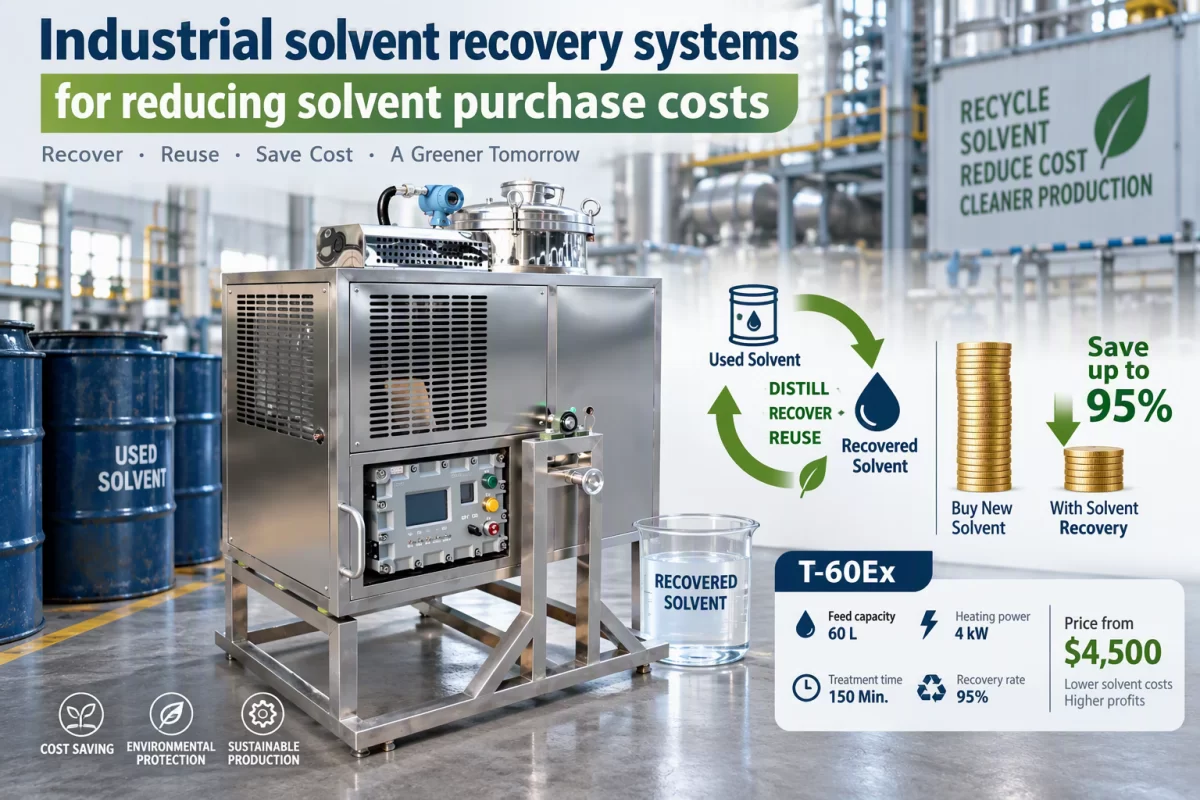
For budget planning, our company price references show that many industrial solvent recovery and explosion-proof solvent recycler configurations fall in the range of $2,645 to $9,690. When a product has a price range, a practical middle but still economical reference is about $5,900 for a mid-low configuration. This is useful for early project planning, although the final quotation should follow the exact model, capacity, material requirements, condenser configuration, residue handling, and optional functions.
For larger operations, the T-450Ex 450-liter waste solvent distillation recovery system is listed at $10,691. A continuous solvent recovery machine for electronics cleaning and IPA recovery is listed at $4,271. These figures are company price references, so the right way to use them is to match the process first, then compare the model and configuration.
Match the Machine to the Industry
Different industries create different solvent waste patterns. Printing factories often handle ink-contaminated thinner, ethyl acetate, toluene, or mixed cleaning solvents. Paint and coating factories may generate thinner, xylene, acetone, and resin-heavy residue. Electronics factories often care about IPA recovery, cleanliness, and controlled contamination. Chemical and extraction facilities may focus on ethanol or other recoverable solvents with larger batch volumes.
For paint shops and printing plants, thinner recovery is one of the most common applications. A factory that repeatedly buys fresh thinner for gun washing, roller cleaning, or equipment flushing can often reduce purchasing and disposal pressure by installing a thinner recycler matched to daily use. The recovered thinner may be reused for cleaning processes, while the concentrated residue is easier to manage as waste.
In my view, residue behavior is often underestimated. Two factories may use similar solvents, but one has light contamination while the other has thick paint sludge or adhesive solids. Residue affects heating time, cleaning workload, discharge convenience, and long-term maintenance. Choosing by liters alone can miss this important detail.
Evaluate Operating Convenience and Maintenance
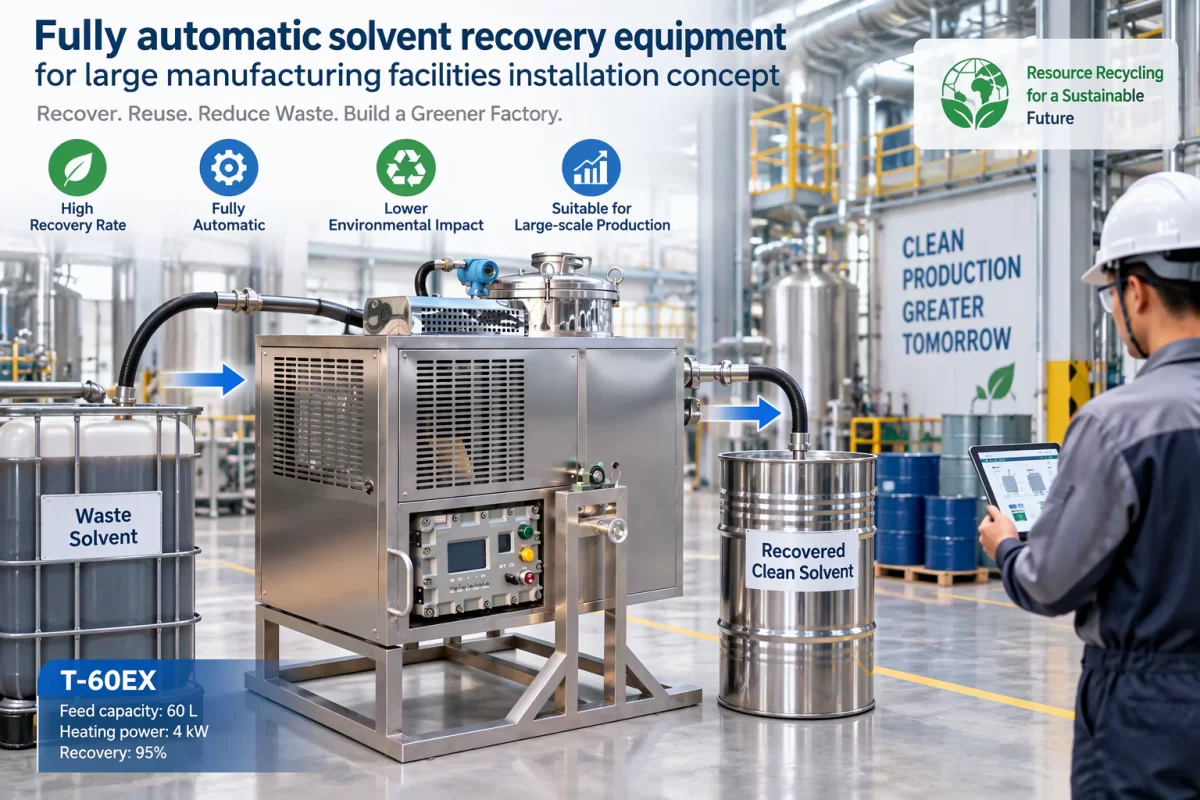
Good explosion-proof solvent recycling equipment should make daily operation simple. Operators should be able to load dirty solvent, set the recovery temperature, collect clean solvent, and remove residue with minimal disruption to the production line. Maintenance should focus on keeping the distillation tank clean, checking seals, cleaning condenser paths when needed, and ensuring electrical and grounding systems remain in good condition.
Factories should also consider where recovered solvent will be stored. Clean solvent containers should be clearly labeled, sealed, and separated from dirty solvent barrels. If the recovered solvent will be used directly in production, a quality check routine should be created. If it will be used for pre-cleaning, the purity requirement may be more flexible. Either way, a simple operating standard helps the equipment deliver stable value instead of becoming a rarely used machine in the corner of the workshop.
A Simple Selection Checklist
Confirm solvent identity: review SDS, flash point, boiling range, water content, and whether the solvent is single or mixed.
Measure real waste volume: calculate liters per day, peak production periods, and how often the machine should run.
Check contamination: note resin, pigment, oil, adhesive, ink, metal particles, or sludge content.
Select capacity: match T-20Ex to T-400Ex class models according to batch volume and operating schedule.
Review safety needs: consider explosion-proof electrical design, ventilation, grounding, sealed operation, and operator workflow.
Plan reuse quality: decide whether recovered solvent is for cleaning, dilution, washing, or a more controlled process.
Use price after technical matching: compare the company price reference only after the correct process and model range are clear.
Final Recommendation
Choosing explosion-proof solvent recycling equipment for a factory should begin with safety, solvent behavior, and real production data. Capacity, recovery rate, treatment time, power, and price are important, but they only become meaningful after the waste solvent is understood. For most factories, the best equipment is the model that can safely process the daily waste volume, recover solvent at a practical purity, reduce fresh solvent purchases, and fit naturally into the existing workshop workflow.
With models from 20 L to 400 L, a temperature range of RT-200℃, and about 95% recovery under suitable conditions, explosion-proof solvent recyclers can become a direct cost-control tool for factories using volatile organic solvents. The smartest purchase is not always the biggest machine or the lowest initial price. It is the equipment that turns hazardous solvent waste into a manageable, repeatable, and economically valuable recovery process.