
How to Compare Batch Versus Continuous Solvent Recovery Units?
Choosing between batch and continuous solvent recovery units is not only a question of machine size. The better choice depends on solvent volume, contamination pattern, operator rhythm, safety requirements, and how quickly recovered solvent needs to return to production.
Start With the Recovery Pattern
A batch solvent recovery unit works in cycles. Waste solvent is loaded into the distillation tank, heated, evaporated, condensed, and collected as clean solvent. After the cycle is complete, residues are removed and the next batch begins. This structure is straightforward, which is why many workshops, coating plants, printing facilities, laboratories, electronics cleaning lines, and maintenance departments choose a batch solvent recovery machine as their first recycling system.
A continuous solvent recovery unit is designed for a more constant input and output. Instead of waiting for a full cycle to finish, contaminated solvent can be fed more regularly while recovered solvent is discharged in a controlled manner. This design is attractive when the plant produces solvent waste every shift and wants recovery to become part of the production line rather than a separate end-of-day task.
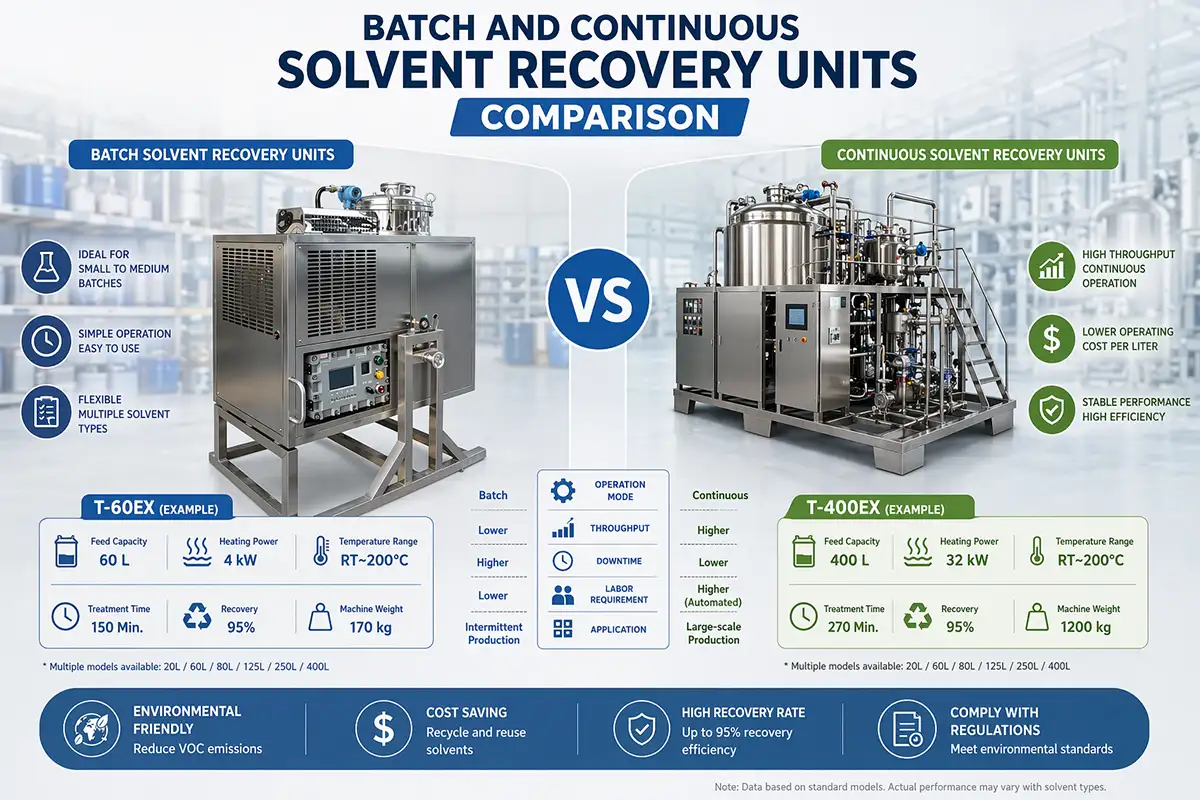
Compare equipment layout, loading style, and recovered solvent output.
Compare Capacity, Time, and Recovery Rate
The practical comparison starts with volume. Available batch models can cover a wide feed capacity range, including 20L, 60L, 80L, 125L, 250L, and 400L configurations. These models use 380V power supply, heating power from 2 kW to 32 kW, an RT-200°C temperature range, and a typical recovery rate of about 95%. Treatment time increases with capacity, from about 120 minutes for smaller units to about 270 minutes for large units.
Is a larger batch unit always better than a smaller continuous unit?
Not always. From an equipment selection perspective, the better unit is the one that matches the waste generation rhythm. If waste solvent arrives in separate drums or varies by solvent type, a larger batch unit may be easier to manage. If waste is produced steadily and the same solvent is processed repeatedly, a continuous unit can reduce waiting time and keep recovered solvent moving back into use.
| Comparison Point | Batch Solvent Recovery Unit | Continuous Solvent Recovery Unit |
|---|---|---|
| Best workflow | Scheduled recovery cycles, drum-by-drum processing, flexible solvent changes. | Stable production lines with frequent or constant solvent waste output. |
| Typical advantage | Simple operation, easier residue cleaning, lower complexity, adaptable to varied waste streams. | Higher operating continuity, less idle time, better for large repeated solvent streams. |
| Capacity planning | Choose feed capacity by daily waste volume and acceptable cycle count. | Choose throughput by hourly waste generation and required recovered solvent return rate. |
| Operator attention | Requires loading, cycle checking, discharge, and residue removal after each run. | Requires process monitoring, steady feed control, and stable operating conditions. |
| Ideal solvent condition | Variable solvent waste, pigment sludge, resin residue, and mixed operating schedules. | Consistent solvent chemistry with predictable contamination level. |
Check the Solvent Type and Residue Load
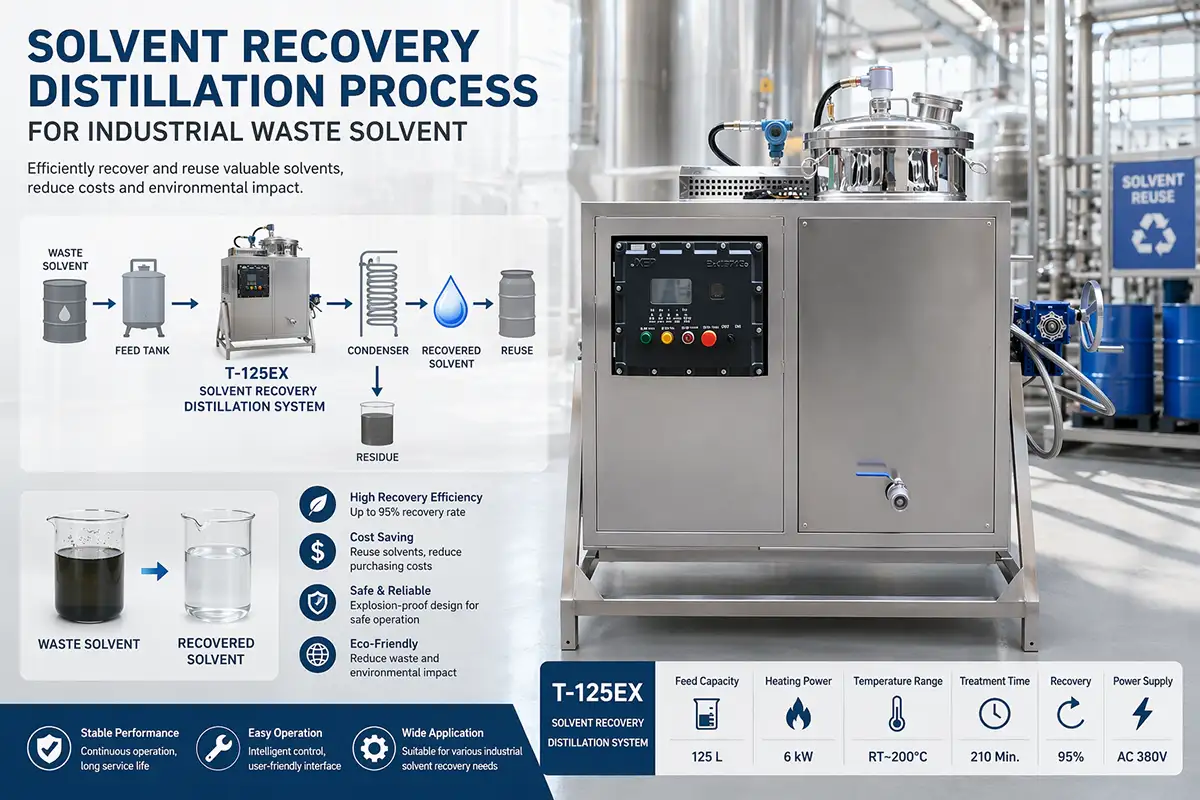
Solvent recovery is usually based on distillation. The contaminated solvent is heated until the useful solvent evaporates, then the vapor is condensed back into liquid form. Heavy contaminants, paint sludge, ink residue, oil, resin, and solids remain in the boiling tank. This is why residue behavior matters. A plant processing paint thinner, for example, may value easy tank cleaning and scraper options. In that case, a dedicated thinner recycler may be a more relevant reference than a general purpose unit.
Batch equipment often gives operators more control when residue changes from batch to batch. Continuous equipment can still handle demanding solvents, but the feed should be more consistent. If residue concentration suddenly rises, continuous operation may need closer monitoring to avoid fouling, overheating, or unstable distillation.
Different departments may generate different solvent blends. Batch processing lets each stream be separated, tested, recovered, and cleaned without mixing every waste source together.
Printing, coating, extraction, and cleaning lines with predictable solvent use can benefit from steady recovery, especially when solvent reuse is needed during the same production shift.
Evaluate Safety and Installation Requirements
Industrial solvent recovery equipment must be selected with flammable vapor control in mind. Explosion-proof design, temperature control, condenser performance, sealing quality, and proper ventilation are not optional details. When comparing a batch unit with a continuous unit, safety should be judged by the actual solvent, flash point, operating temperature, vapor generation rate, and installation environment.
Batch units are often easier to isolate because each cycle has a clear start and stop. Continuous units require more attention to steady-state control because feeding, heating, vaporization, condensation, and discharge may happen at the same time. For both designs, the equipment should be matched with trained operators, clear maintenance routines, and proper grounding.
Which unit is safer for flammable solvents?
Safety depends less on the label "batch" or "continuous" and more on the design standard. From the author's point of view, an explosion-proof configuration, correct temperature range, reliable condenser, and disciplined operating procedure matter most. For changing waste streams, batch control can be simpler. For steady production, a well-designed continuous system can also be safe and efficient.
Review Model Specifications Before Budgeting
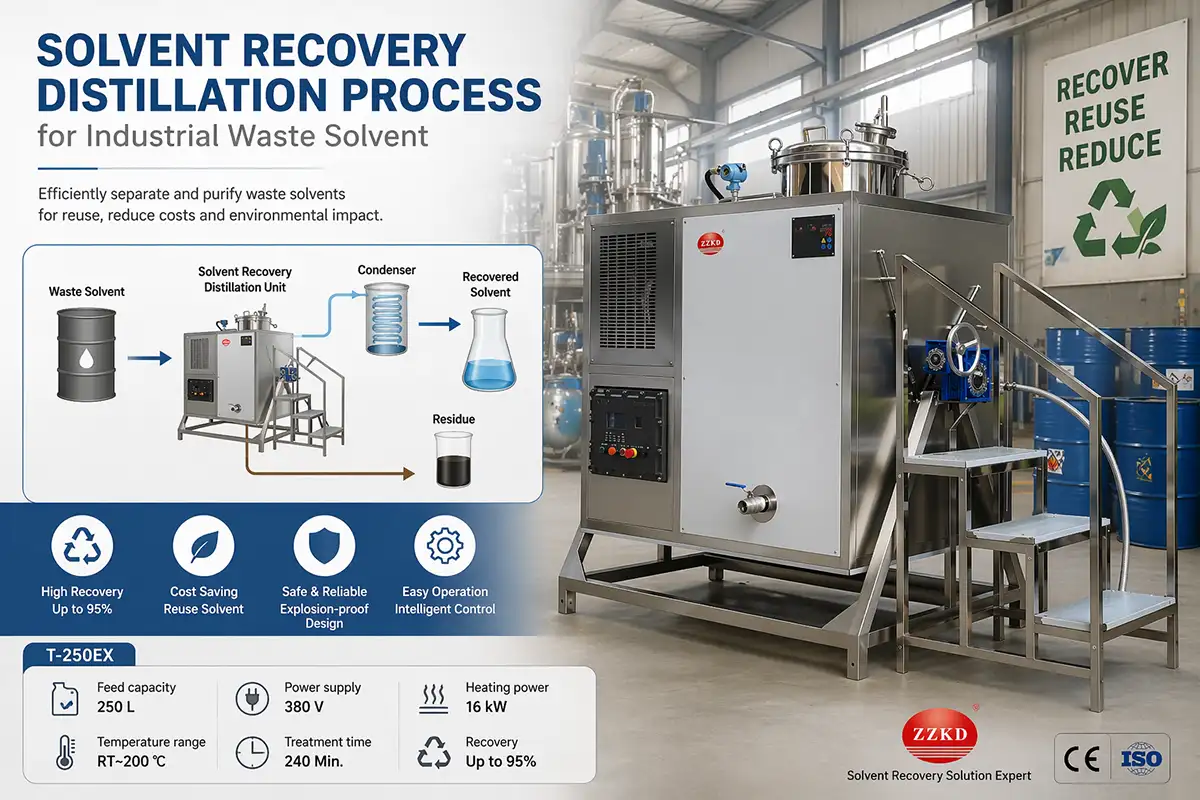
A careful buyer should compare specifications before comparing price. The T-series batch models provide a useful reference for common recovery needs. Feed capacity ranges from 20L to 400L, recovery can reach about 95%, and the temperature range supports many organic solvent recovery applications up to RT-200°C. Smaller units are easier to place in compact workshops, while larger units suit higher daily solvent waste volumes.
Calculate Labor, Downtime, and Solvent Reuse Value
The purchase price is only the first part of the decision. A batch unit may cost less and be easier to maintain, but it may require more operator handling if the facility generates solvent waste continuously. A continuous unit may require a higher level of process planning, yet it can reduce handling time and support more immediate reuse of recovered solvent.
Solvent savings should be calculated from three directions: reduced new solvent purchases, reduced hazardous waste disposal, and reduced storage pressure. A solvent recovery distillation unit can also improve internal waste management because contaminated solvent does not have to wait as long for off-site disposal.
When does continuous recovery usually become worth considering?
Continuous recovery becomes attractive when solvent waste is generated every day, the solvent type is stable, and production benefits from quick reuse. From the author's view, if operators are running several batch cycles per shift and still cannot keep up, continuous recovery should be reviewed seriously.
A Practical Selection Checklist
Before choosing between batch and continuous solvent recovery units, it helps to answer the following operating questions with real plant data rather than estimates.
Measure average and peak waste solvent volume per day, then compare it with realistic cycle time or hourly throughput.
Separate solvent streams by type, boiling point, contamination level, water content, and residue behavior.
Confirm whether recovered solvent must return to production immediately or can be stored after each batch.
Review available floor space, ventilation, operator skill, residue removal method, and maintenance schedule.
Check whether the equipment temperature range, condenser capacity, heating power, and explosion-proof design match the solvent application.
Final Recommendation
Choose a batch solvent recovery unit when flexibility, simple operation, mixed waste streams, and controlled cycle processing are most important. Choose a continuous solvent recovery unit when the plant has stable solvent waste, higher daily volume, and a need to keep recovered solvent flowing back into production. The smartest comparison is not batch versus continuous in theory. It is the actual match between solvent chemistry, daily workload, safety requirements, labor cost, and the value of fast solvent reuse.