Solvent Recovery Methods: A Practical Guide to Cutting Costs and Improving Sustainability
In many industries, solvents are essential for cleaning, extraction, coating, printing, electronics manufacturing, pharmaceuticals, and chemical processing. Yet fresh solvent purchasing and hazardous waste disposal can quietly become two of the largest hidden operating costs in a plant. That is why solvent recovery methods are no longer a niche topic. They are now central to production efficiency, compliance, and sustainable manufacturing strategy.
From the author’s perspective, the most effective solvent recovery program is never based on equipment alone. It begins with understanding the solvent type, contamination profile, daily throughput, recovery target, and safety classification. Once those factors are clear, the right method becomes easier to select and the return on investment becomes much easier to justify.
Why solvent recovery matters more than ever
When waste solvent is handled as a disposable byproduct, a facility pays twice: first when buying virgin solvent and second when paying to transport and treat hazardous waste. By contrast, well-designed solvent recovery methods help reclaim reusable solvent, reduce waste volume, stabilize production quality, and improve environmental performance. In sectors using ethanol, acetone, IPA, xylene, toluene, ethyl acetate, or mixed cleaning solvents, the savings can be significant.
Facilities that are evaluating a solvent recovery machine often discover that the economics improve further when recovery is integrated with waste reduction and process control. Less storage of spent solvent, fewer waste pickups, and more predictable solvent purity create a measurable operational advantage.
Main solvent recovery methods used in industry
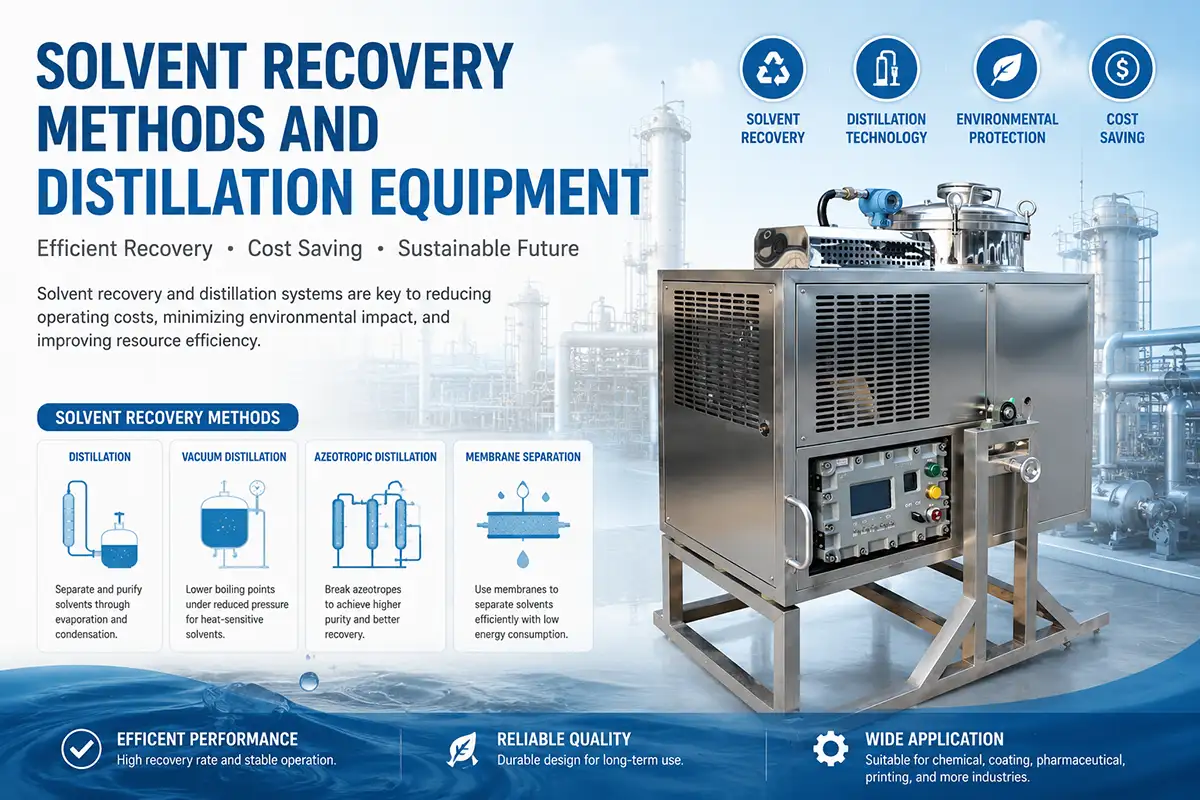
The phrase solvent recovery methods can cover several technologies. However, not every method fits every application. The correct choice depends on boiling point differences, contamination level, required purity, and whether the process is batch or continuous.
1. Distillation recovery
Distillation is the most widely used method for reclaiming organic solvents. It works by heating spent solvent so the usable fraction evaporates, then condensing the vapor into liquid form for reuse. This method is highly effective for many common industrial solvents and is often the best balance of simplicity, performance, and cost.
For example, many facilities recovering acetone, IPA, thinner, ethanol, or xylene choose distillation because it can handle contaminated solvent streams with paint residue, oil, resin, ink, or dissolved solids. For readers comparing configurations, this guide on how a solvent recovery system works provides a useful technical overview.
Could distillation be too simple for mixed solvents?
In the author’s view, distillation remains the first method to evaluate, but mixed solvents with close boiling points may require tighter process control or staged separation. If the reuse target is basic cleaning performance rather than ultra-high purity, standard solvent distillation is often still the most practical option.
2. Filtration and pre-treatment
Filtration is usually not a complete recovery method by itself, but it can greatly improve system performance. Removing suspended solids before heating can reduce fouling, improve heat transfer, and extend equipment life. In applications involving sludge, coatings, or fine particles, pre-treatment is often the difference between stable recovery and frequent maintenance.
3. Vacuum-assisted recovery
Vacuum operation lowers the boiling point of the solvent, which can help protect heat-sensitive compounds and reduce energy consumption in selected applications. It is especially useful when oxidation, thermal degradation, or high-temperature exposure must be limited.
4. Membrane and specialty separation methods
Membrane, adsorption, and other specialty methods can be useful in narrow process windows, but they are generally more application-specific. For many manufacturers, these are secondary methods rather than the main recovery route.
How to select the right equipment for solvent recovery
Choosing equipment is not about picking the largest machine. It is about matching capacity to actual production demand, contamination load, and operating schedule. A plant with intermittent waste generation may prefer a batch unit, while a line with steady solvent consumption may need a more robust configuration.
Check solvent type and compatibility with seals, gaskets, and tank materials.
Confirm throughput in liters per batch or per day.
Review heating power, recovery rate, and cycle time.
Verify safety features and hazardous-area suitability.
Consider maintenance access and residue removal.
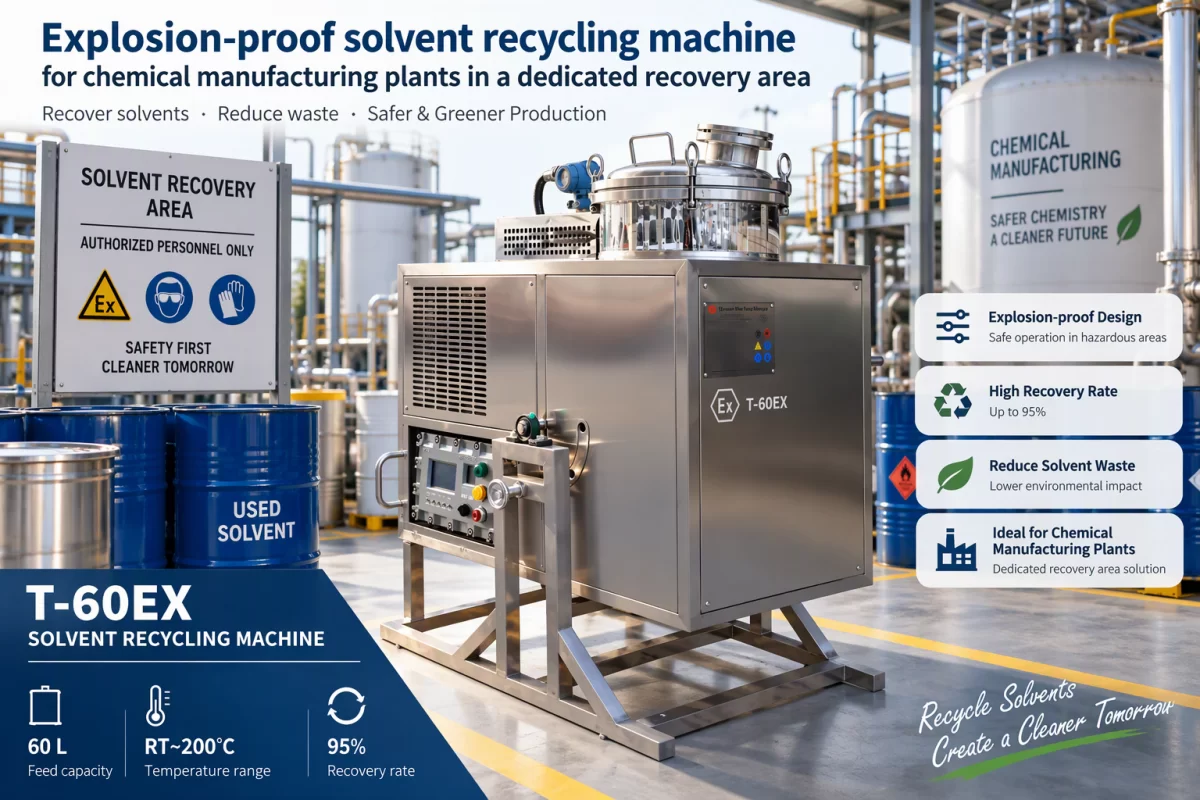
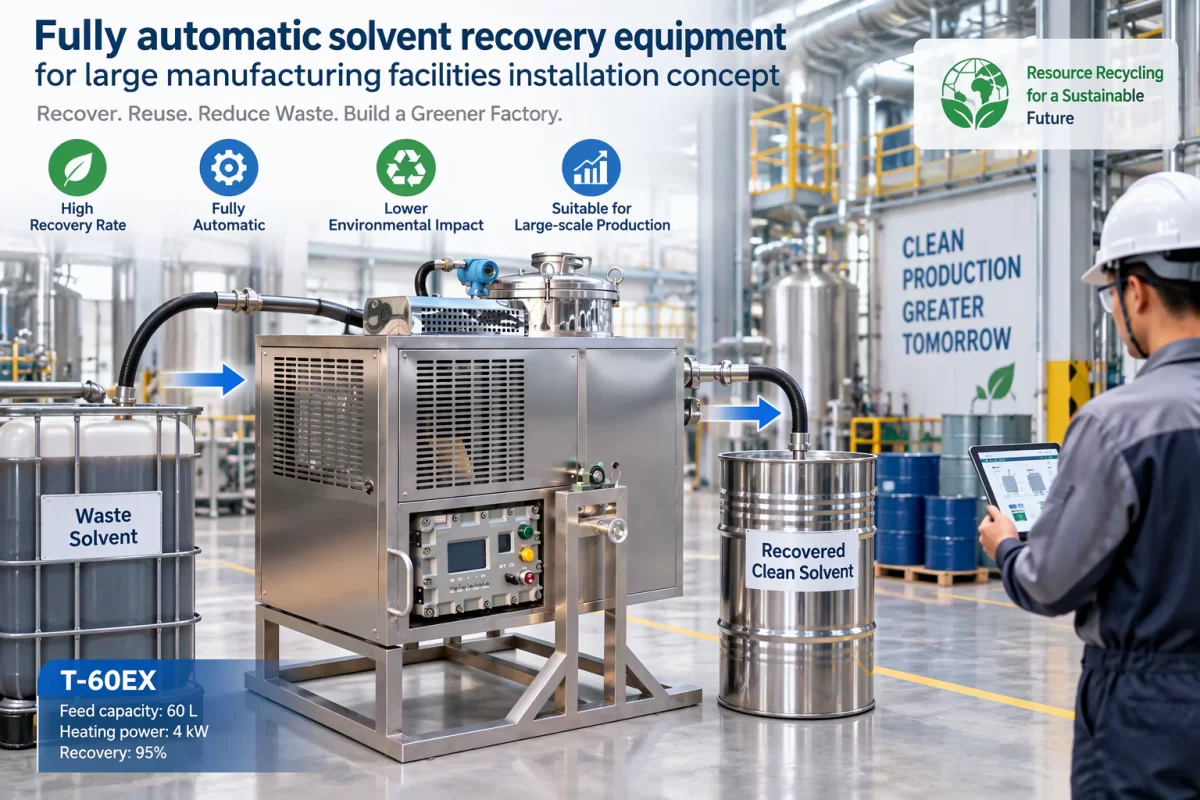
In the current product range, explosion-proof models are available from 20L to 400L. This capacity range supports laboratory-scale, pilot-scale, and industrial recycling needs with recovery performance up to 95% under suitable conditions.
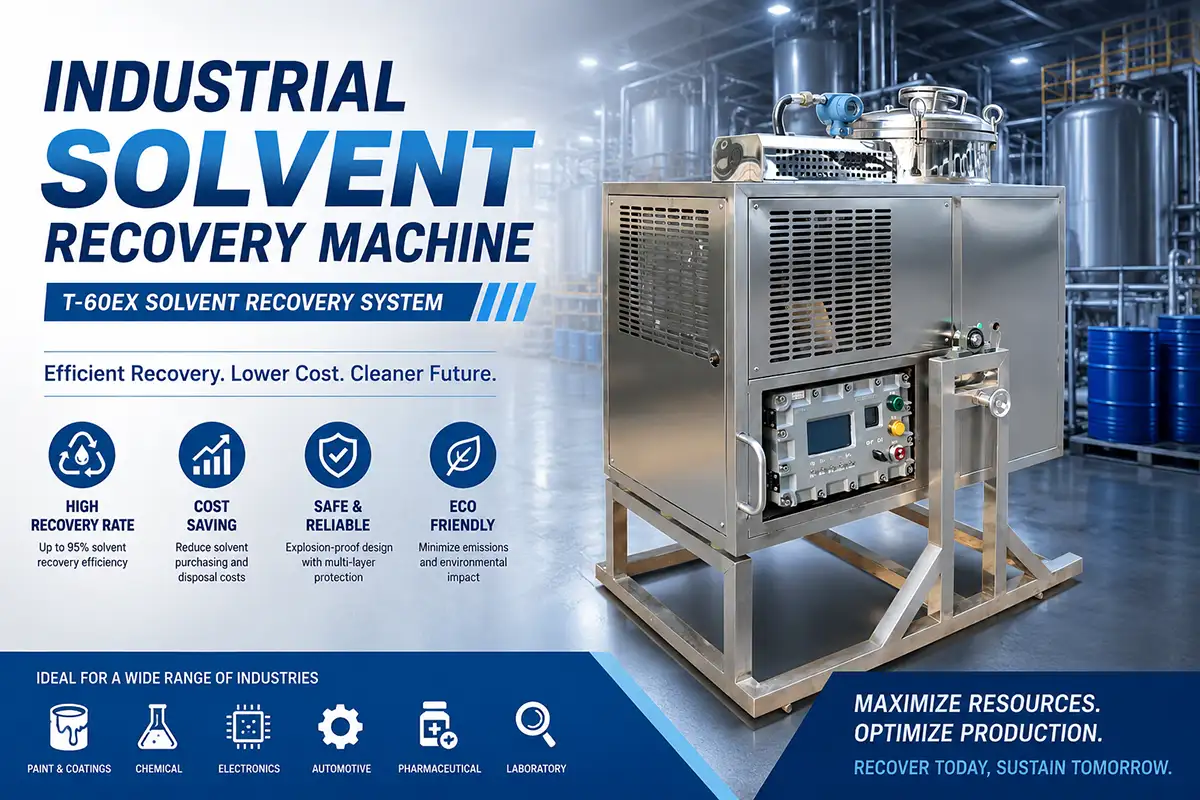
Reference specifications for common recovery units
The following table summarizes key parameters for several explosion-proof solvent recovery units. On mobile devices, the table can be scrolled horizontally for easier viewing.
| Model | Feed Capacity (L) | Power Supply (ACV) | Heating Power (kW) | Temperature Range (℃) | Treatment Time (Min.) | Recovery (%) | Weight (kg) | Machine Size (mm) |
|---|---|---|---|---|---|---|---|---|
| T-20Ex | 20 | 380 | 2 | RT~200 | 120 | 95 | 153 | 860×760×1190 |
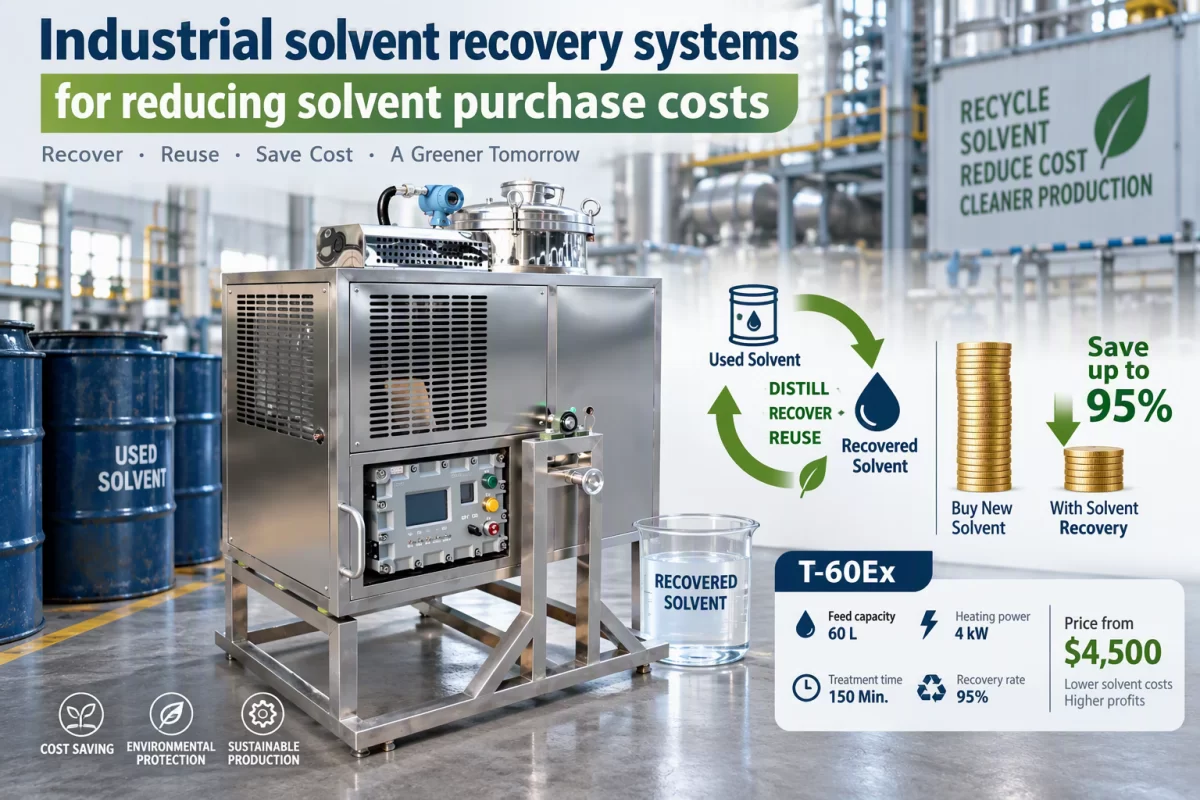
| T-60Ex | 60 | 380 | 4 | RT~200 | 150 | 95 | 170 | 1160×870×1260 |
| T-80Ex | 80 | 380 | 5 | RT~200 | 180 | 95 | 200 | 1180×850×1290 |
| T-125Ex | 125 | 380 | 6 | RT~200 | 210 | 95 | 280 | 1250×920×1450 |
| T-250Ex | 250 | 380 | 16 | RT~200 | 240 | 95 | 520 | 2600×1200×1950 |
| T-400Ex | 400 | 380 | 32 | RT~200 | 270 | 95 | 1200 | 1990×1850×2090 |
Cost considerations and practical pricing reference
Price is always part of the decision, but it should be evaluated in the context of solvent consumption, waste disposal cost, and achievable reuse rate. A lower-cost unit that cannot support the required solvent load may become more expensive over time. Conversely, a properly sized machine can pay back quickly through reclaimed solvent and reduced waste hauling.
For entry-level industrial solvent recovery configurations in the current range, a representative company price is approximately US$2,645. For larger 450L-class recovery equipment, one available company reference price is US$10,691. Market alternatives from other suppliers are often priced higher, especially when similar safety and industrial build features are required.
Is the cheapest machine always the most economical?
The author’s answer is no. True economy comes from matching equipment size, safety level, and recovery target to the actual production process. An undersized system can create bottlenecks, while an oversized one may add unnecessary energy and capital cost.
Safety and compliance should guide the method selection
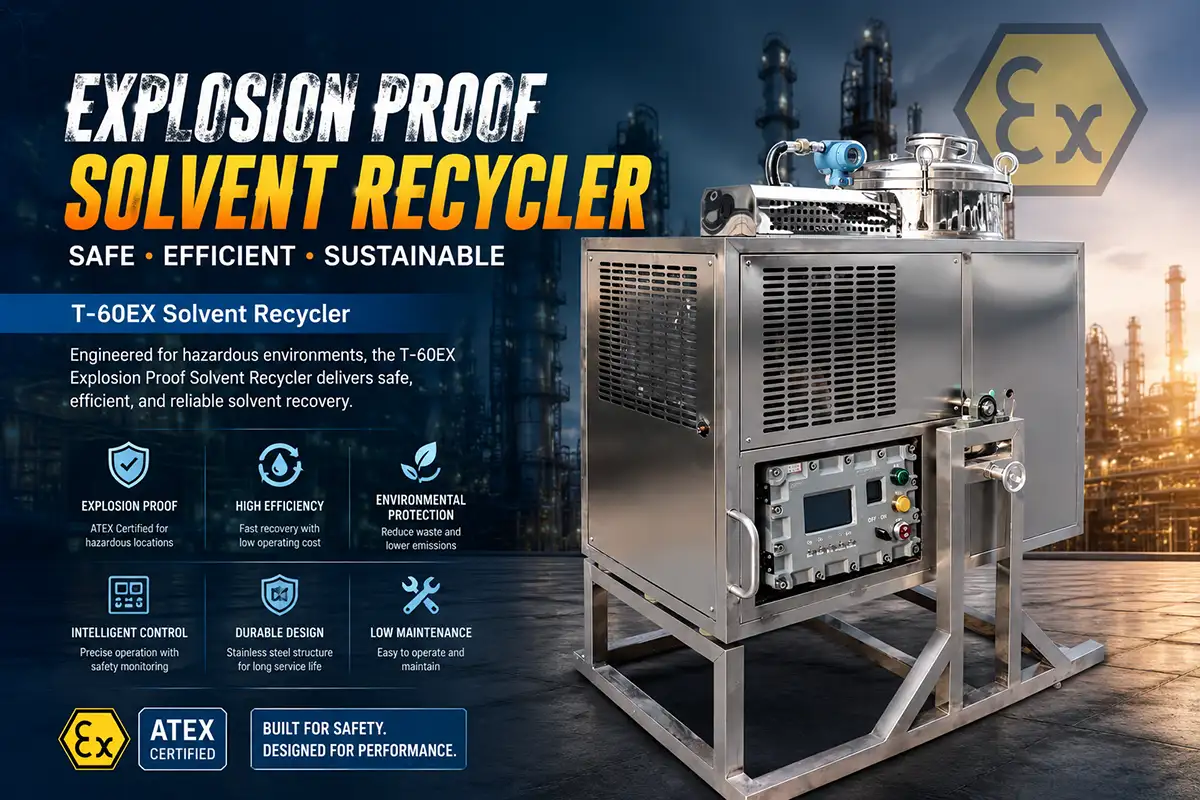
Any discussion of solvent recovery methods must include safety. Many solvents are flammable, and some are toxic, highly volatile, or regulated under strict workplace and environmental rules. That means the best method is not simply the one with the highest theoretical recovery rate. It is the one that also supports safe handling, grounding, temperature control, residue management, and, where required, explosion-proof operation.
In practical terms, users should evaluate hazardous-area requirements, ventilation, static protection, relief design, and the compatibility of wetted materials with the solvent stream. For businesses handling alcohol recovery, this article on ethanol recovery systems is also relevant because it shows how solvent-specific conditions affect equipment choice.
Best use cases for modern solvent recovery systems
Different industries apply solvent recovery methods in different ways:
Printing and painting: recovery of thinner, xylene, and mixed cleaning solvents contaminated with pigments and resins.
Electronics cleaning: reclaiming IPA and precision cleaning solvents where cost control is essential.
Extraction processes: ethanol recovery for reuse in production workflows.
Chemical manufacturing: distillation of spent process solvents for internal recycle.
Laboratories and pilot plants: smaller batch recovery for research and controlled production environments.
Which recovery method fits most plants starting a recycling program?
From the author’s perspective, batch distillation with proper pre-filtration remains the strongest starting point for many facilities because it is flexible, proven, and easier to scale from 20L systems to much larger industrial units.
Conclusion: solvent recovery methods should be chosen for fit, not hype
The most successful solvent recovery methods are those aligned with the real process: solvent chemistry, contamination level, target purity, throughput, and safety requirements. In many industrial settings, distillation remains the core method because it offers a practical route to high recovery, strong cost control, and repeatable solvent reuse.
For facilities seeking a dependable path forward, the next step is to compare waste solvent characteristics with available equipment sizes, cycle times, and safety configurations. When that evaluation is done correctly, solvent recovery becomes more than a waste-reduction measure. It becomes a direct productivity tool.