
Solvent Recovery Unit: Complete Guide to Cutting Solvent Costs and Improving Safe Reuse
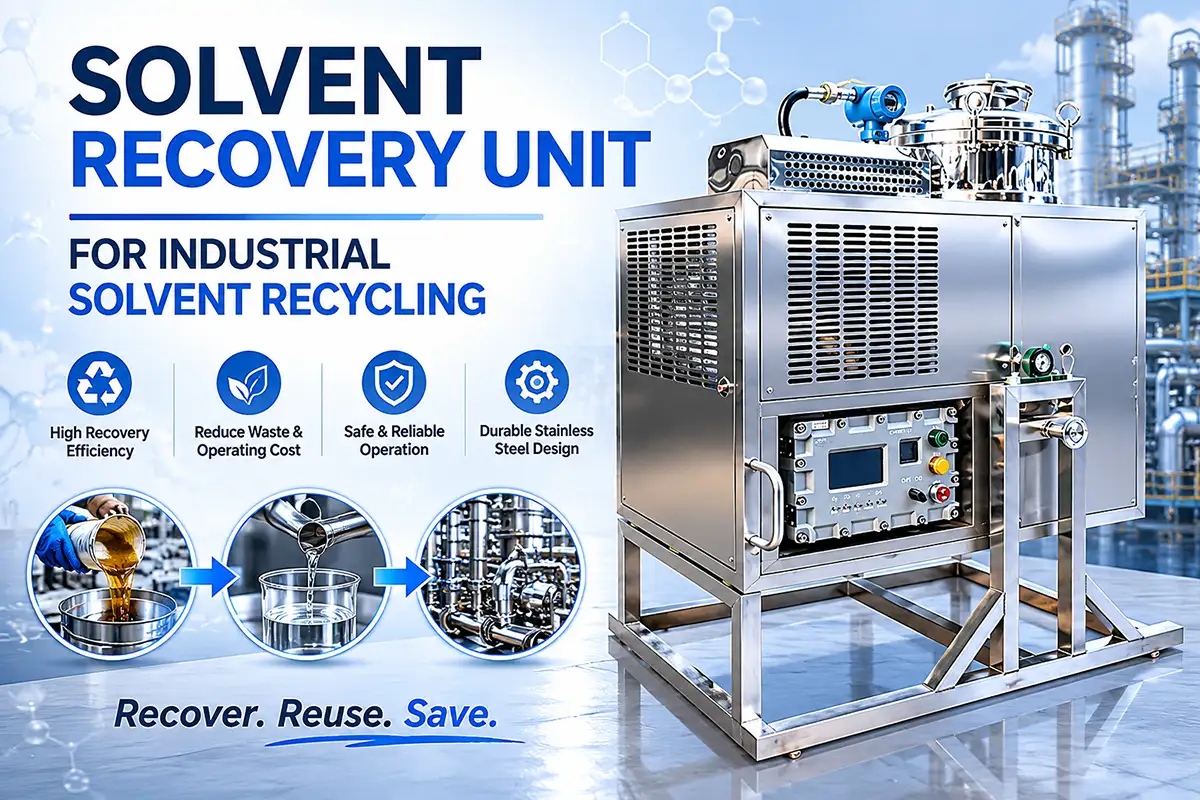
A modern solvent recovery unit is no longer viewed as a niche piece of equipment. In many manufacturing, cleaning, coating, printing, electronics, pharmaceutical, and extraction environments, it has become a practical tool for lowering disposal volume, reclaiming valuable solvent, and building a cleaner closed-loop process.
Quick Navigation
Why a Solvent Recovery Unit MattersHow the Process WorksHow to Choose the Right UnitTypical Technical SpecificationsTypical Price RangeFinal ThoughtsWhy a Solvent Recovery Unit Matters in Real Production
Many facilities still treat used solvent as unavoidable waste. That approach often creates two growing costs at the same time: fresh solvent purchasing and spent solvent disposal. A properly selected solvent recovery unit changes that equation by distilling contaminated solvent and returning a reusable fraction back into production. For operations using acetone, IPA, ethanol, xylene, paint thinner, or mixed organic solvents, the savings can become meaningful very quickly.
From an SEO and market perspective, the strongest equipment pages are the ones that clearly connect a machine to a use case. That is why buyers often search not only for a solvent recycler, but also for terms such as solvent recovery machine, solvent recycling system, acetone recycler, ethanol recovery system, or thinner recycler machine. A strong page should answer the commercial question behind the keyword: what solvent can be recovered, at what throughput, under which safety conditions, and at what approximate return on investment?
Key value created by recovery equipment
Reduces fresh solvent purchasing frequency
Decreases hazardous waste volume and handling cost
Supports cleaner production and sustainability targets
Improves reuse of valuable solvents with recovery rates up to 95% in suitable applications
Creates better process consistency when contamination profiles are stable
Could a recovery system really make sense for a medium-volume plant?
Yes. From the author’s perspective, the answer is often yes when solvent consumption is repetitive and contamination is predictable. Even a medium-volume plant can justify a solvent recovery unit if it buys the same solvent continuously and pays recurring disposal fees. The more stable the feed solvent and the more regular the operating schedule, the easier the payback calculation becomes.
How a Solvent Recovery Unit Works
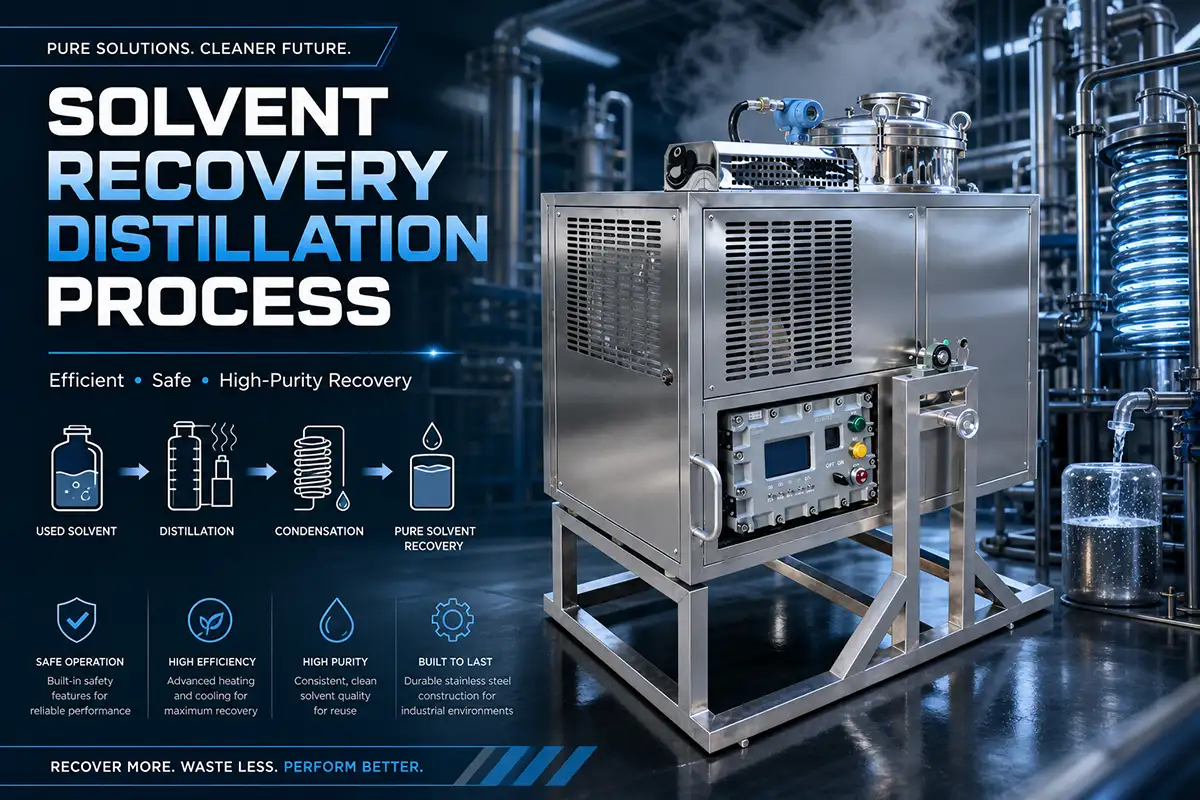
The basic process is simple: contaminated solvent is heated inside a distillation chamber, the solvent fraction evaporates, vapor moves through a condenser, and the condensed liquid is collected for reuse. Non-volatile residues, oils, pigments, resins, inks, or solids remain behind in the boiling tank. This method is especially useful where the recovered solvent does not need ultra-high purity but must be clean enough for washing, extraction, dilution, or reprocessing.
Facilities comparing system layouts can also review broader process explanations in resources such as how a solvent recovery system works. In practice, however, the selection decision is rarely about distillation theory alone. It is more about fit: solvent type, daily volume, required recovery percentage, heating power, treatment time, and explosion-proof configuration.
For operators handling ethanol applications, a more targeted reference like ethanol recovery system selection can also help clarify process differences between general-purpose solvent recycling and dedicated alcohol recovery use cases.
What should be checked before installation?
From the author’s standpoint, the first checks should always be solvent compatibility, local electrical requirements, ventilation, hazardous-area classification, and expected residue behavior. A unit may look suitable on paper, but residue viscosity, solids loading, and boiling-point spread often decide whether the process will stay efficient over time.
How to Choose the Right Solvent Recovery Unit
The best model is rarely defined by brand name alone. It is defined by application fit. In the current equipment market, buyers repeatedly compare solutions based on these factors:
1. Solvent compatibility: IPA, acetone, ethanol, ethyl acetate, toluene, xylene, and hydrocarbon-related streams all behave differently. The boiling range and contaminant profile determine whether a simple recycling approach is enough or a more engineered separation step is required.
2. Throughput and duty cycle: A laboratory or pilot user may only need a small batch machine, while a coating, printing, or electronics plant may need repeated daily batches or larger continuous operation logic.
3. Safety and compliance: For flammable solvents, explosion-proof execution is essential. Buyers regularly look for ATEX, Class I Div, CE, grounding design, temperature control, and protective interlocks.
4. Recovery quality: If recovered solvent returns to rough cleaning, standard purification may be enough. If it returns to a more sensitive process, tighter control of vapor path, temperature, and contamination carryover becomes more important.
5. Support and spare parts: Even a cost-effective machine becomes expensive if downtime is long and service support is unclear.
Is the lowest equipment price usually the best choice?
No. The author’s answer is that initial price matters, but installed value matters more. If a lower-priced solvent recovery unit has weaker safety configuration, slower treatment time, harder residue cleaning, or limited spare-parts support, the lifecycle cost can quickly exceed the apparent savings.
Typical Technical Specifications for Explosion-Proof Models
The following examples illustrate how different capacities scale across a practical range of explosion-proof solvent recovery equipment. These data points help buyers estimate floor space, power demand, cycle length, and likely application fit.
| Model | Feed Capacity (L) | Power Supply (ACV) | Heating Power (kW) | Temperature Range (℃) | Treatment Time (Min.) | Recovery (%) | Weight (kg) | Machine Size (mm) |
|---|---|---|---|---|---|---|---|---|
| T-20Ex | 20 | 380 | 2 | RT~200 | 120 | 95 | 153 | 860 × 760 × 1190 |
| T-60Ex | 60 | 380 | 4 | RT~200 | 150 | 95 | 170 | 1160 × 870 × 1260 |
| T-80Ex | 80 | 380 | 5 | RT~200 | 180 | 95 | 200 | 1180 × 850 × 1290 |
| T-125Ex | 125 | 380 | 6 | RT~200 | 210 | 95 | 280 | 1250 × 920 × 1450 |
| T-250Ex | 250 | 380 | 16 | RT~200 | 240 | 95 | 520 | 2600 × 1200 × 1950 |
| T-400Ex | 400 | 380 | 32 | RT~200 | 270 | 95 | 1200 | 1990 × 1850 × 2090 |
These figures show a clear pattern: as feed capacity rises, heating demand, treatment time, equipment weight, and installation footprint all increase. That is why sizing should always begin with actual liters per day instead of a vague preference for a “larger” machine.
Typical Price Range and Budget Expectations
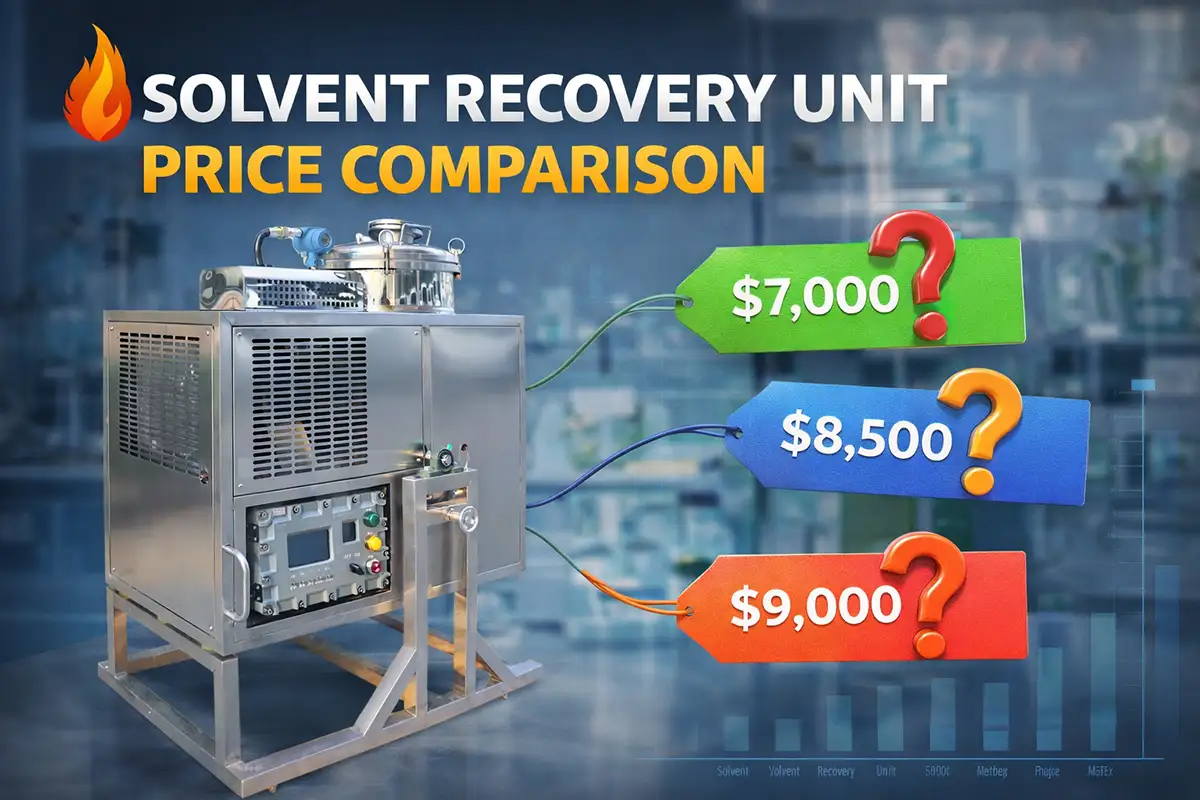
Price is one of the most searched topics in this market, but it should be treated carefully because many listings bundle different configurations under one range. Industrial or explosion-proof solvent recovery unit listings often appear in broader ranges such as $2,645–$9,690. Following the rule of taking the middle, relatively lower option when multiple prices exist, a practical reference figure for many standard industrial listings is approximately $6,168.
At the higher end, some larger or more specialized systems can exceed $10,691, while certain heavy-duty recovery equipment listings stretch much further depending on size, automation, and solvent-specific engineering. This is also why searchers interested in budgeting often look for broader guidance on what drives cost in a system, not just a catalog number.
What usually changes the final quotation?
The author’s answer is straightforward: safety rating, batch size, condenser design, control level, residue discharge method, and the solvent itself. A standard acetone or IPA recovery project may price very differently from a mixed-solvent or high-residue process. Shipping, installation, and compliance documentation can also materially affect total cost.
Common Applications for Solvent Recovery Equipment
A versatile solvent recovery unit is typically used across multiple industries. Printing plants recover ink-related solvents. Electronics manufacturers reclaim cleaning solvents such as IPA. Paint and coating operations recycle thinner blends. Extraction and chemical processing plants often reclaim ethanol or other organic carriers. In each case, the most effective content and product positioning are the ones that speak directly to the application, not just the machine category.
Paint, coating, and thinner recycling
Acetone and IPA recovery in cleaning processes
Ethanol reuse in extraction and liquid handling systems
Xylene and toluene recovery in chemical applications
Waste solvent minimization in general industrial production
Final Thoughts
Choosing the right solvent recovery unit is less about chasing a single “best” brand and more about matching the machine to solvent type, throughput, compliance requirements, and target reuse quality. For SEO and conversion, the most persuasive equipment content is precise, application-led, and rich in operational detail. Buyers want proof of fit: supported solvents, liters per batch, recovery percentage, treatment time, electrical requirements, safety configuration, and expected price band.
When those details are clearly presented, a solvent recovery page does more than rank for keywords. It becomes a decision-support asset. That is exactly what the market responds to, and exactly what helps transform a search for a solvent recovery unit into a qualified inquiry.