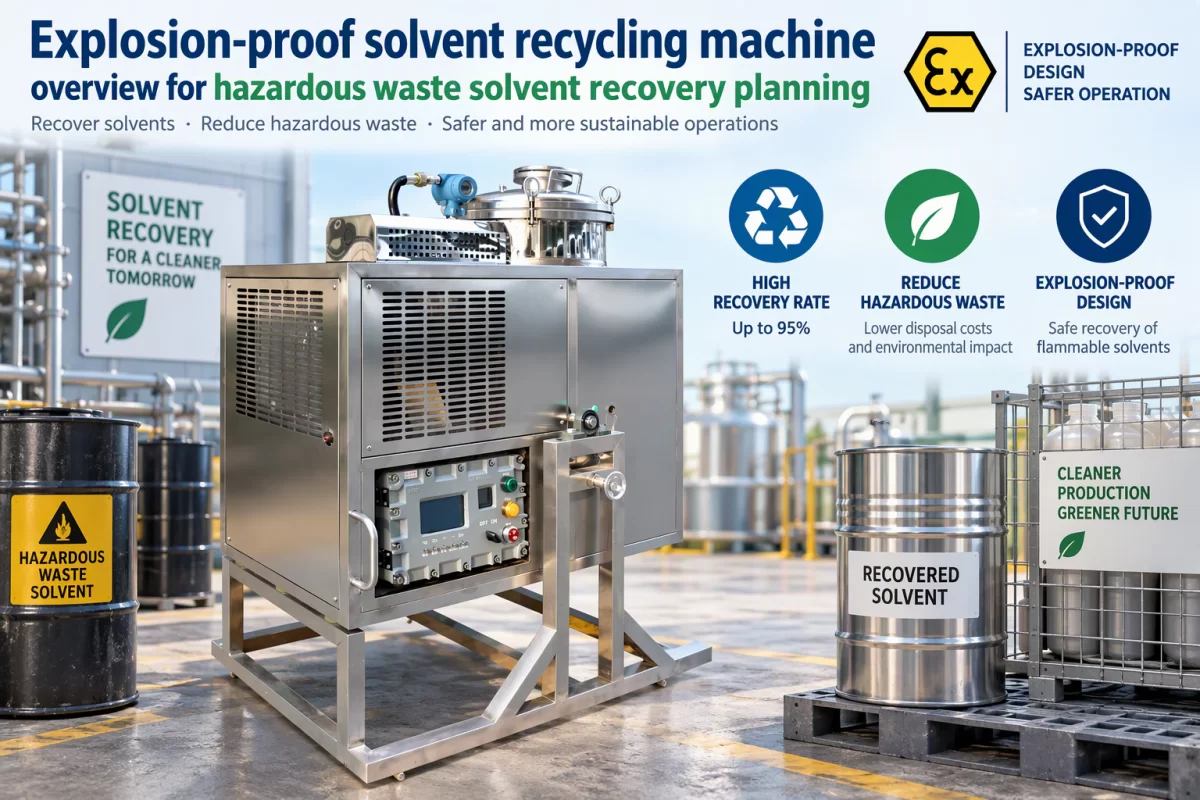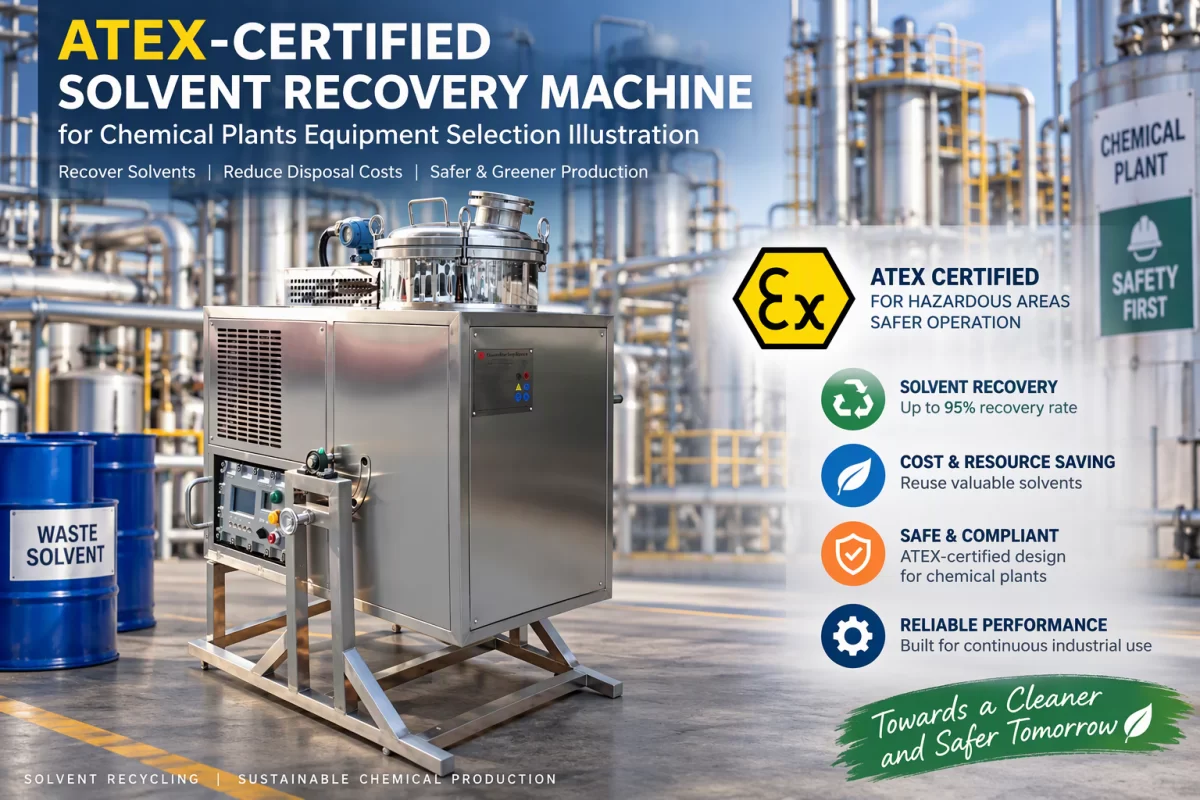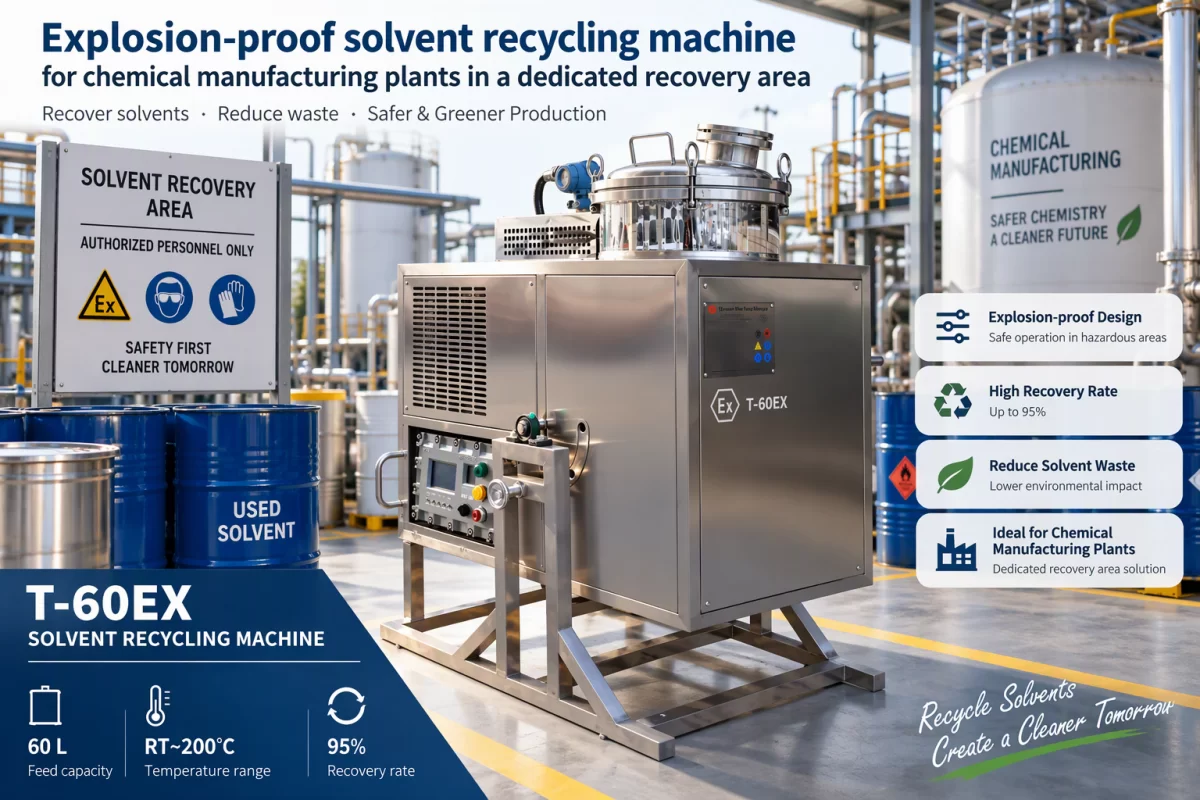
What is the best industrial solvent recovery system for factories?
The best industrial solvent recovery system is not simply the largest machine or the lowest-cost unit. For factories, the right solution is the one that matches solvent type, daily waste volume, safety classification, recovery target, and operating cost. A well-chosen solvent recovery machine can cut raw solvent purchases, reduce hazardous waste disposal, and create a more predictable production process.
Why factories are investing in solvent recovery systems
Factories in printing, electronics cleaning, coatings, metal parts washing, chemical manufacturing, and extraction increasingly rely on solvent recovery systems because solvent waste is expensive in two ways. First, used solvent must be replaced with fresh solvent. Second, contaminated solvent must often be stored, transported, and treated as regulated waste. An industrial solvent recovery system helps solve both problems by separating reusable solvent from contaminants through controlled distillation.
In practical terms, this means a factory can recover a high percentage of valuable solvents such as ethanol, IPA, acetone, xylene, thinner, or ethyl acetate, then return the recovered solvent to cleaning, washing, extraction, or blending operations. For many plants, the result is lower solvent purchasing frequency, lower disposal volume, and better sustainability reporting.
What actually makes one system “the best” for a factory?
The answer depends on throughput, solvent characteristics, and safety requirements. A factory handling 20 liters per batch has a very different need from a production line processing 250 to 400 liters of contaminated solvent. The best system is the one that safely achieves the required recovery rate, fits the workflow, and delivers a reasonable payback period.
Core features to evaluate in an industrial solvent recovery system
When comparing industrial solvent recovery systems, several technical factors should be reviewed carefully rather than relying on marketing claims alone.
Supported solvent types: Different factories work with alcohols, ketones, esters, aromatics, or mixed waste solvents. The machine must be suitable for the target solvent family and contamination load.
Feed capacity: Batch size affects productivity. Undersized equipment creates bottlenecks, while oversized equipment can increase capital cost without adding value.
Recovery rate: A strong benchmark for many factory applications is around 95% solvent recovery under proper operating conditions.
Heating power and treatment time: These directly affect batch cycle efficiency and production planning.
Construction materials: Durable contact materials such as 316L stainless steel and compatible seals help improve reliability in harsh solvent environments.
Explosion-proof design and controls: This is critical for flammable solvents and hazardous areas.
Maintenance simplicity: Residue removal, tank cleaning, and routine inspection should be straightforward.
Factories evaluating a solvent recovery machine should also confirm condenser performance, power supply compatibility, operating temperature range, and whether the equipment is better suited to batch or continuous-style production logic.
Recommended factory models and technical comparison
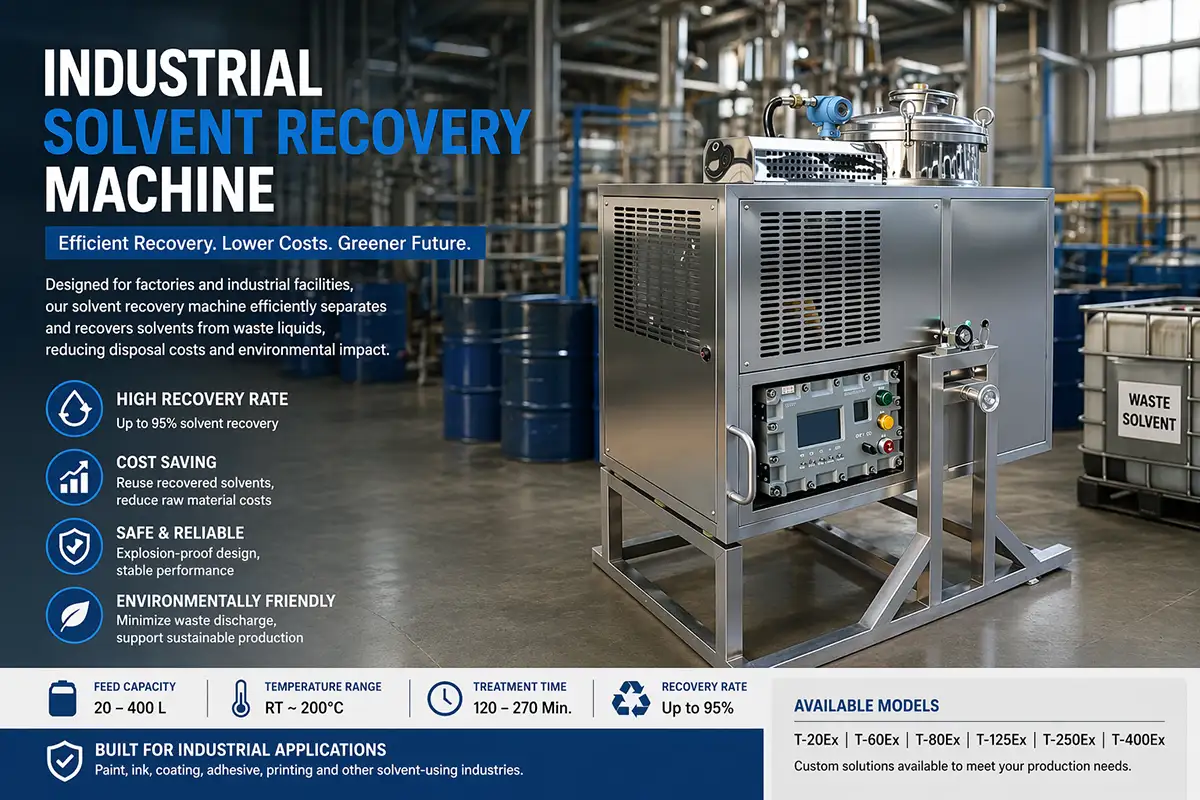
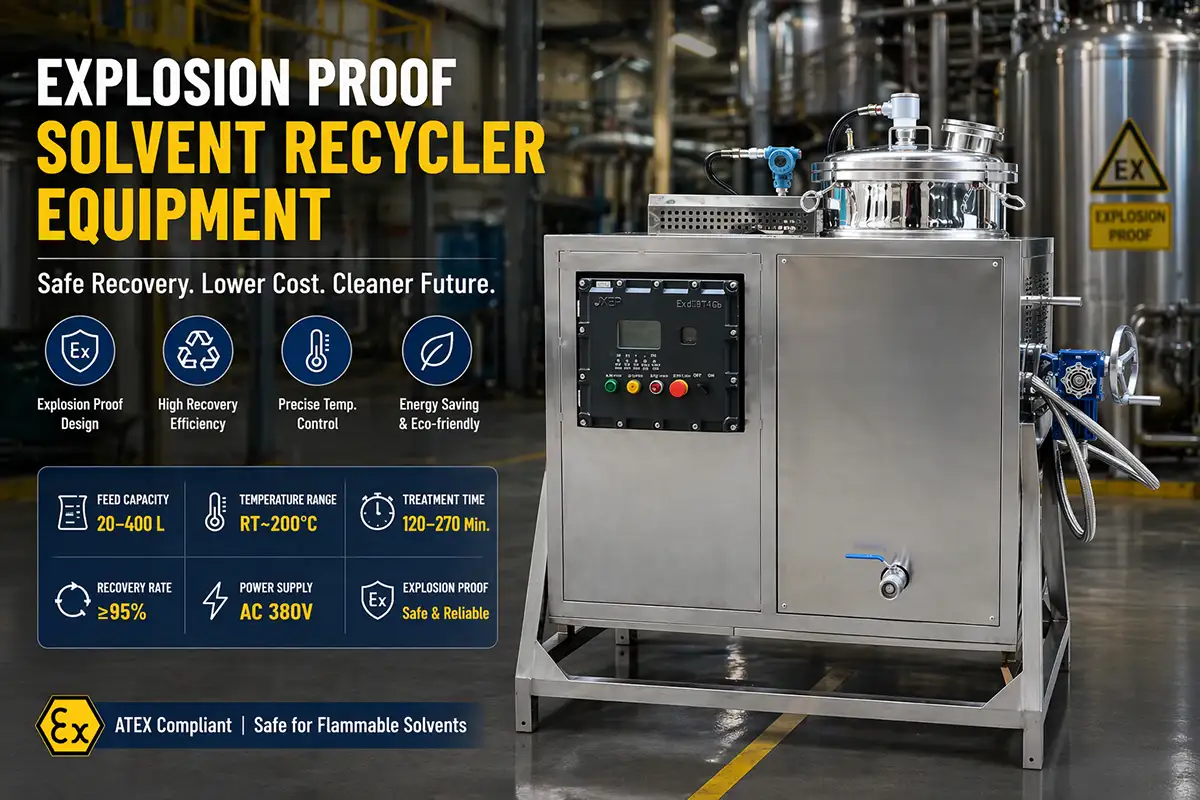
For industrial users needing practical batch solvent recycling, the following explosion-proof models provide a clear progression from compact production support to larger factory-scale solvent recovery. All listed models operate at 380V AC, support a temperature range from room temperature to 200℃, and target a recovery rate of 95%.
| Model | Feed Capacity (L) | Heating Power (kW) | Treatment Time (Min.) | Recovery (%) | Weight (kg) | Machine Size (mm) |
|---|---|---|---|---|---|---|
| T-20Ex | 20 | 2 | 120 | 95 | 153 | 860 × 760 × 1190 |
| T-60Ex | 60 | 4 | 150 | 95 | 170 | 1160 × 870 × 1260 |
| T-80Ex | 80 | 5 | 180 | 95 | 200 | 1180 × 850 × 1290 |
| T-125Ex | 125 | 6 | 210 | 95 | 280 | 1250 × 920 × 1450 |
| T-250Ex | 250 | 16 | 240 | 95 | 520 | 2600 × 1200 × 1950 |
| T-400Ex | 400 | 32 | 270 | 95 | 1200 | 1990 × 1850 × 2090 |
This model range is especially useful for factories that need to scale from pilot recovery to routine production solvent recycling. Smaller units such as the T-20Ex and T-60Ex are practical for controlled batch operations, while the T-125Ex, T-250Ex, and T-400Ex better serve plants with higher solvent waste generation.
Which industries benefit the most?
The best industrial solvent recovery system usually depends on the use case. In factory settings, three major application groups appear repeatedly:
Ethanol recovery for extraction and processing
Where ethanol is used for extraction or formulation, recovery reduces solvent replacement cost and can improve process consistency. For readers comparing alcohol applications, this guide on ethanol recovery system selection offers additional application context.
IPA and acetone recovery for electronics and parts cleaning
Electronics manufacturers and parts-wash operations often handle IPA and acetone waste streams. A properly matched system can recover reusable solvent while reducing off-site disposal. For acetone-specific workflows, see acetone recycling guidance.
Paint, ink, and thinner recycling
Printing shops, coating lines, and paint-related factories often generate contaminated thinner and mixed solvents. In these cases, a dedicated distillation-based recycler can sharply reduce waste drum volume and improve solvent reuse economics.
Can one machine handle every waste solvent stream in a factory?
Usually, no single setup is ideal for every stream. Solvent composition, solids content, boiling behavior, and safety classification can vary widely. In many factories, the best approach is to group similar solvent streams and match the machine configuration to those specific recovery tasks.
Safety is not optional in solvent recovery
For flammable solvents, safety specifications are often more important than headline capacity. A factory should confirm grounding, temperature control, sealed system integrity, pressure relief strategy, compatible electrical design, and the suitability of the machine for hazardous operating conditions. Clear documentation matters. Ambiguous safety language can delay purchasing decisions and make technical approval difficult.
An effective industrial solvent recovery system should present model-specific information about explosion-proof design, electrical classification, operating limits, and recommended accessories such as chillers, condensers, and ventilation support. This helps engineering, EHS, and procurement teams evaluate the equipment on facts rather than assumptions.
For plants comparing broader solvent recycling equipment options, safety documentation should be reviewed alongside throughput and cost.
What about price and return on investment?
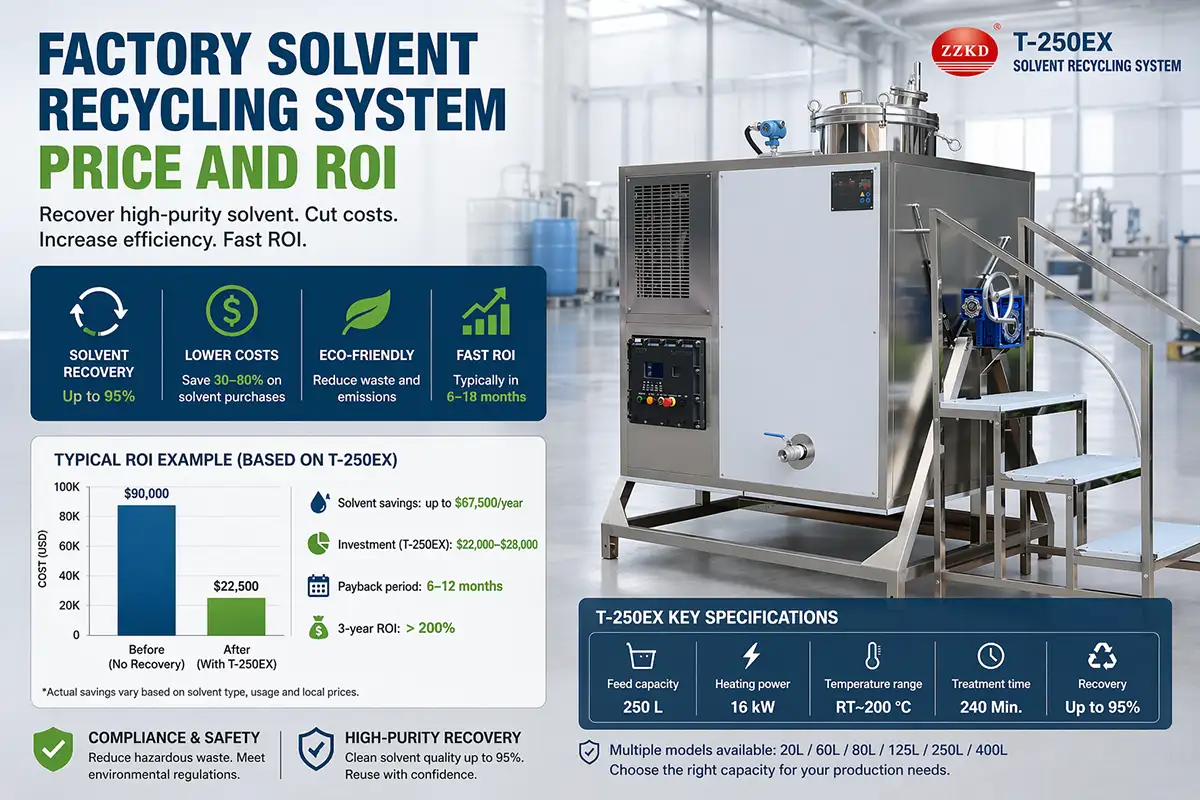
Price always matters, but the initial machine price is only part of the financial picture. The real value of a solvent recycler comes from recovered solvent volume, reduced purchase frequency, lower hazardous waste handling cost, and shorter payback time.
For reference, one of the company’s industrial solvent recovery machine listings shows a price range of $2,645–$9,690. Using the requested pricing rule, the mid-range lower reference point can be presented as $6,168. This is a company price reference and may still be lower than many comparable products available in the market.
Higher-capacity systems and more advanced configurations will naturally cost more, especially when explosion-proof design, special condensers, or larger thermal systems are involved. Even so, for factories with regular solvent waste generation, payback can be attractive when solvent reuse becomes part of routine operations.
Is a cheaper machine always the better investment?
Not necessarily. If a low-cost machine is undersized, slow, or poorly matched to the solvent stream, the factory may lose more through downtime, poor recovery, and maintenance trouble. The better investment is the machine that balances safety, recovery performance, throughput, and lifecycle cost.
How to choose the best system for a specific factory
A simple selection framework can make solvent recovery decisions much easier:
Identify the solvent or mixed solvent stream. Ethanol, IPA, acetone, xylene, and thinner all behave differently in practice.
Measure liters per day or per batch. This determines whether a 20L, 60L, 125L, 250L, or 400L-class unit is more suitable.
Review contamination type. Solids, oils, resins, inks, or dissolved organics affect operating strategy and cleaning frequency.
Confirm plant utility conditions. Voltage, ventilation, condenser cooling, and floor space all matter.
Check safety classification and documentation. This is essential for flammable solvent duty.
Estimate solvent savings. Compare annual recovered solvent value against machine cost and operating expense.
Factories that complete these six steps usually make faster, more confident purchase decisions and avoid sizing errors that reduce efficiency later.
Final answer: what is the best industrial solvent recovery system for factories?
The best industrial solvent recovery system for factories is a properly sized, safety-focused, high-recovery distillation unit designed for the actual solvent stream and operating environment. For many industrial users, an explosion-proof batch solvent recycler with approximately 95% recovery, room temperature to 200℃ capability, durable materials, and models ranging from 20L to 400L provides a practical and scalable answer.
Instead of choosing based on price alone, factories should evaluate solvent type, batch size, required throughput, residue profile, and safety documentation. When these factors are aligned, a solvent recovery system becomes more than a waste-treatment device. It becomes a cost-control tool, a sustainability asset, and a more reliable part of the manufacturing process.