
What solvent recycling machine offers continuous operation and high recovery?
A solvent recycling machine designed for continuous operation should do more than boil dirty solvent. It should keep production moving, recover a high percentage of usable liquid, reduce hazardous waste volume, and make daily operation predictable for factories that clean parts, print, coat, paint, or process chemical materials.
The direct answer
The most suitable choice is an automatic, explosion-proof solvent recovery machine with continuous solvent recovery capability, stable distillation control, and a recovery rate around 95%. For manufacturers handling IPA, acetone, ethanol, ethyl acetate, xylene, toluene, paint thinner, or mixed organic solvents, this type of equipment offers the best balance between high recovery and practical day-to-day throughput.
In a production environment, continuous operation means dirty solvent can be fed and clean solvent can be collected with less interruption than a simple manual batch still. The result is easier scheduling, fewer idle periods, and better control of solvent waste management. A factory that uses solvent every day should look beyond the tank size alone and evaluate feeding mode, heating power, condensation performance, discharge convenience, explosion-proof design, and maintenance access.
For readers comparing equipment categories, the solvent recycler machine page is a useful internal reference because it connects the general machine type with the practical recycling purpose: turning used solvent into reusable solvent inside the facility.
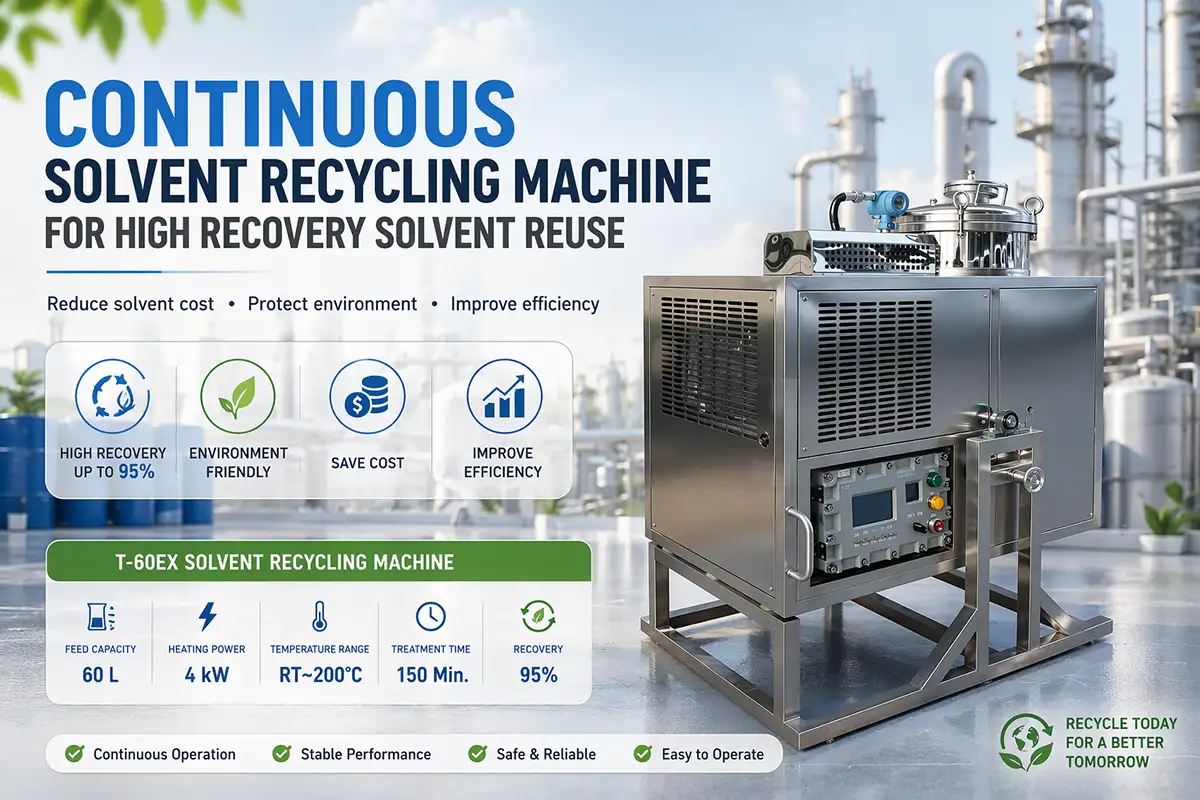
Why continuous operation matters
Solvent recycling becomes more valuable when it matches the rhythm of production. In paint shops, printing plants, electronics cleaning, coating lines, and chemical processing workshops, waste solvent is not generated once a week in a neat container. It often appears throughout the shift. A machine that supports continuous or semi-continuous workflow can reduce waiting time, avoid waste buildup, and keep recovered solvent available for reuse sooner.
Is continuous operation always better than batch recovery?
From a practical engineering view, continuous operation is better when solvent waste is generated steadily and the plant needs repeated reuse during long shifts. Batch recovery can still be economical for small workshops, laboratories, or low-volume users, but higher-volume factories usually gain more stability from continuous feeding capability.
A well-selected solvent recovery machine can also improve housekeeping and compliance. Instead of storing large volumes of used solvent for off-site disposal, operators can separate contaminants, recover usable solvent, and reduce the volume that must be handled as waste. This is one of the clearest ways to reduce new solvent purchases while also lowering disposal pressure.
Key performance points to check
The best solvent recycling machine for continuous operation is not selected by one specification alone. High recovery, stable heating, explosion-proof safety, and ease of residue discharge must work together. A machine may advertise a large tank, but if the condenser is weak or cleaning is difficult, real production efficiency will suffer.
High recovery rate: The listed Ex models show 95% recovery, making them suitable for plants focused on reducing solvent purchasing costs.
Controlled heating: A temperature range of RT-200℃ supports many common organic solvents with different boiling points.
Explosion-proof construction: Solvents can be flammable, so explosion-proof design is essential for paint, coating, printing, and chemical plants.
Capacity matching: Feed capacities from 20 L to 400 L allow the machine to fit small workshops, medium factories, and larger production facilities.
Residue handling: Sticky paint sludge, inks, resins, oils, and pigments should be removed safely and conveniently after distillation.
When the solvent contains heavy sludge or resin, a scraper-type or residue-friendly configuration may be preferred. When solvent value is high or the plant uses solvent daily, automation becomes more important because it reduces manual handling and improves consistency.
Model parameters for high-recovery solvent recycling
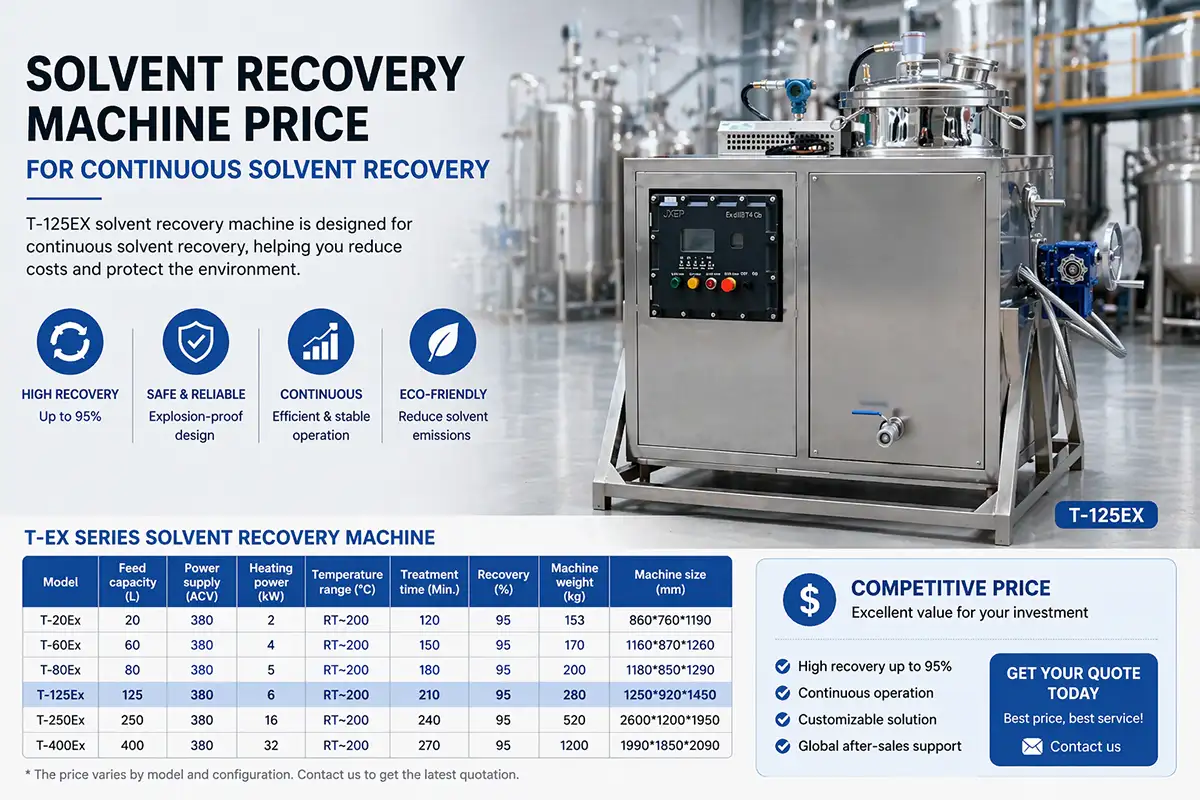
The following technical data helps match equipment size to solvent waste volume. All listed models show a 95% recovery rate, with treatment time increasing as feed capacity rises. On mobile screens, the table can scroll horizontally for comfortable reading.
| Model | Feed Capacity | Power Supply | Heating Power | Temperature Range | Treatment Time | Recovery | Machine Size |
|---|---|---|---|---|---|---|---|
| T-20Ex | 20 L | 380 ACV | 2 kW | RT-200℃ | 120 min | 95% | 860*760*1190 mm |
| T-60Ex | 60 L | 380 ACV | 4 kW | RT-200℃ | 150 min | 95% | 1160*870*1260 mm |
| T-80Ex | 80 L | 380 ACV | 5 kW | RT-200℃ | 180 min | 95% | 1180*850*1290 mm |
| T-125Ex | 125 L | 380 ACV | 6 kW | RT-200℃ | 210 min | 95% | 1250*920*1450 mm |
| T-250Ex | 250 L | 380 ACV | 16 kW | RT-200℃ | 240 min | 95% | 2600*1200*1950 mm |
| T-400Ex | 400 L | 380 ACV | 32 kW | RT-200℃ | 270 min | 95% | 1990*1850*2090 mm |
Price reference for continuous solvent recovery
This reference applies to the listed continuous solvent recovery product. For standard automatic solvent recovery models shown with a price range, the more accessible company reference starts from $2,645. Market alternatives are often higher, so the article uses only the company price information provided.
Price should be evaluated together with solvent consumption. If a plant buys new solvent frequently and pays for waste disposal, recovery equipment can return value from two directions: less new solvent purchasing and less hazardous waste volume. The payback is usually stronger when the recovered solvent can be reused directly for cleaning, washing, dilution, extraction, or process support.
What solvent types are most suitable for recovery?
In this evaluation, common recyclable solvents include IPA, acetone, ethanol, ethyl acetate, xylene, toluene, MEK, and many paint thinners. The important check is boiling point, contamination type, water content, residue behavior, and whether the recovered purity meets the factory's reuse standard.
How to choose the right capacity
Capacity selection should start with daily waste solvent volume, not with the largest available model. A 20 L or 60 L unit can be enough for a small workshop with intermittent solvent waste. A 125 L or 250 L model is better for medium production where solvent waste is collected every shift. A 400 L machine is more appropriate when the factory has large cleaning tanks, coating lines, or multiple solvent-using stations.
Continuous operation becomes especially attractive when the machine must support production rather than occasional cleanup. If dirty solvent arrives every day, an automatic solvent recycling system can help build a repeatable closed-loop process: collect used solvent, distill it, condense clean solvent, discharge residues, and return recovered solvent to approved uses.
Which specification has the biggest impact on real recovery performance?
The recovery percentage is important, but real performance depends on the whole system. Heating control, condenser efficiency, solvent composition, residue loading, operator settings, and maintenance condition all affect how much clean solvent is collected during normal operation.
Recommended application scenarios
A continuous solvent recycling machine with high recovery is recommended for factories where solvent waste is predictable, solvent purchasing is a major cost, and recovered solvent can be reused without compromising product quality. Paint and coatings manufacturers can recover thinner and cleaning solvents. Printing plants can recycle wash solvents contaminated with ink. Electronics and precision cleaning facilities can recover IPA or acetone when purity requirements are suitable. Chemical manufacturers can reduce waste volume from production or cleaning operations.
The equipment is also useful for sustainability programs. Recovering solvent in-house reduces the volume of fresh solvent transported to the plant and waste solvent transported away from it. That does not remove the need for proper safety management, but it creates a cleaner, more controlled process than simply storing used solvent until disposal.
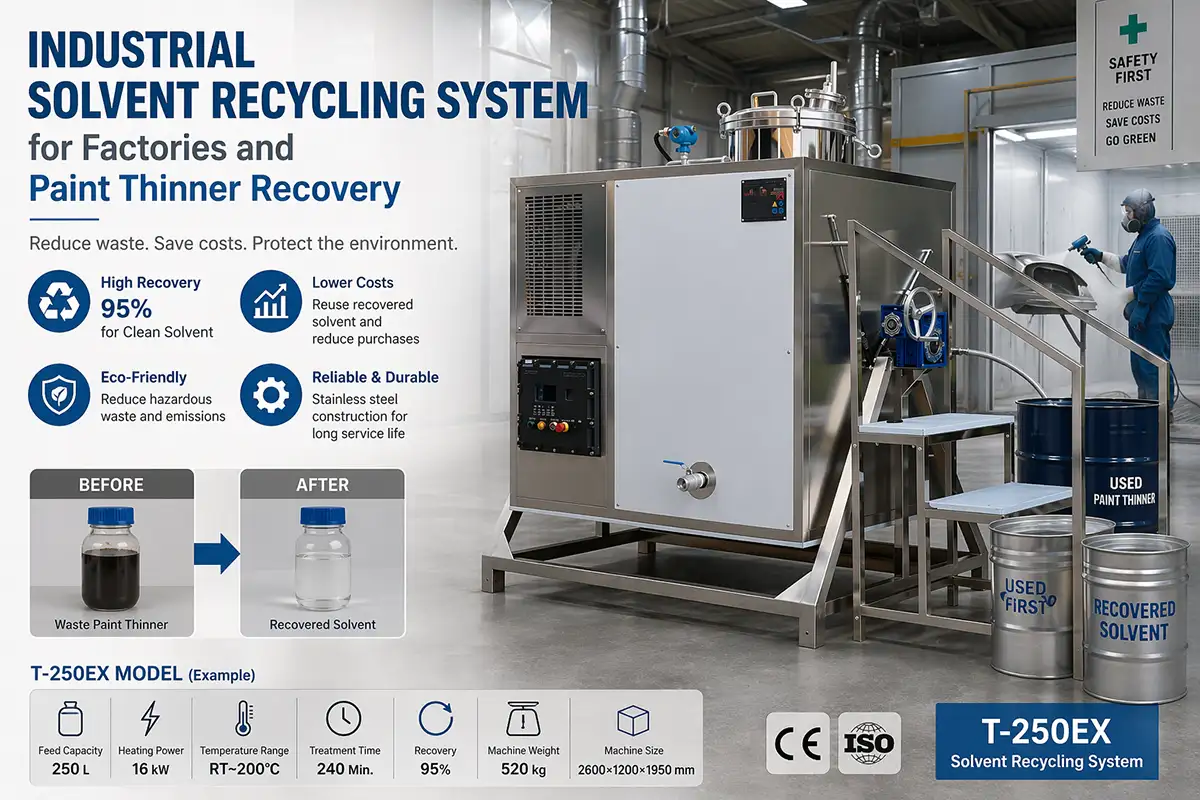
Final recommendation
For continuous operation and high recovery, choose an automatic explosion-proof solvent recycling machine with continuous recovery capability, RT-200℃ temperature control, matched feed capacity, and a proven recovery rate around 95%. For many factories, the $4,271 continuous solvent recovery option is a strong starting point because it combines practical automation, high solvent recovery, and a company price level designed to stay competitive against higher market alternatives.