Why Solvent Recovery Matters for Modern Manufacturing and Lab Operations
Solvent use remains essential in coating, cleaning, pharmaceutical processing, extraction, printing, electronics, and chemical manufacturing. Yet rising disposal costs, stricter safety standards, and sustainability goals have changed the conversation. Instead of treating used solvent as pure waste, more facilities now view it as a recoverable resource. That is exactly where a well-designed solvent recovery system creates value.
What Is Solvent Recovery?
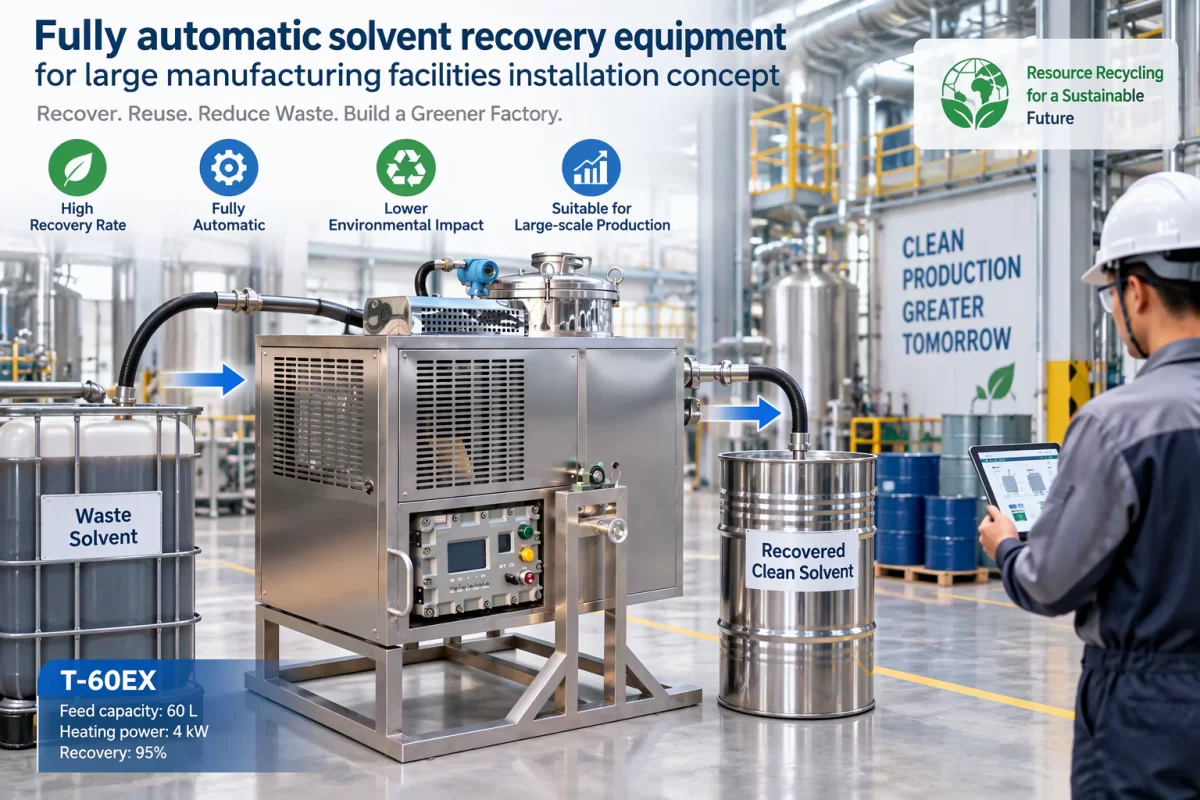
Solvent recovery is the process of separating reusable solvent from contaminated liquid streams so that the solvent can return to production instead of being discarded immediately. In most cases, the principle is straightforward: the used solvent is heated, vaporized, condensed, and collected, while heavy contaminants such as oils, resins, inks, pigments, waxes, or solids remain behind as residue.
From an operational perspective, this means a facility can reduce fresh solvent purchases, lower hazardous waste volume, and stabilize process costs. A modern solvent recycling system is not just a tank with heat. It is part of a broader process strategy involving temperature control, recovery rate, safety interlocks, compatible materials, and throughput planning.
Why More Facilities Are Choosing Solvent Recovery Systems
The business case for a solvent recycler usually rests on five practical benefits:
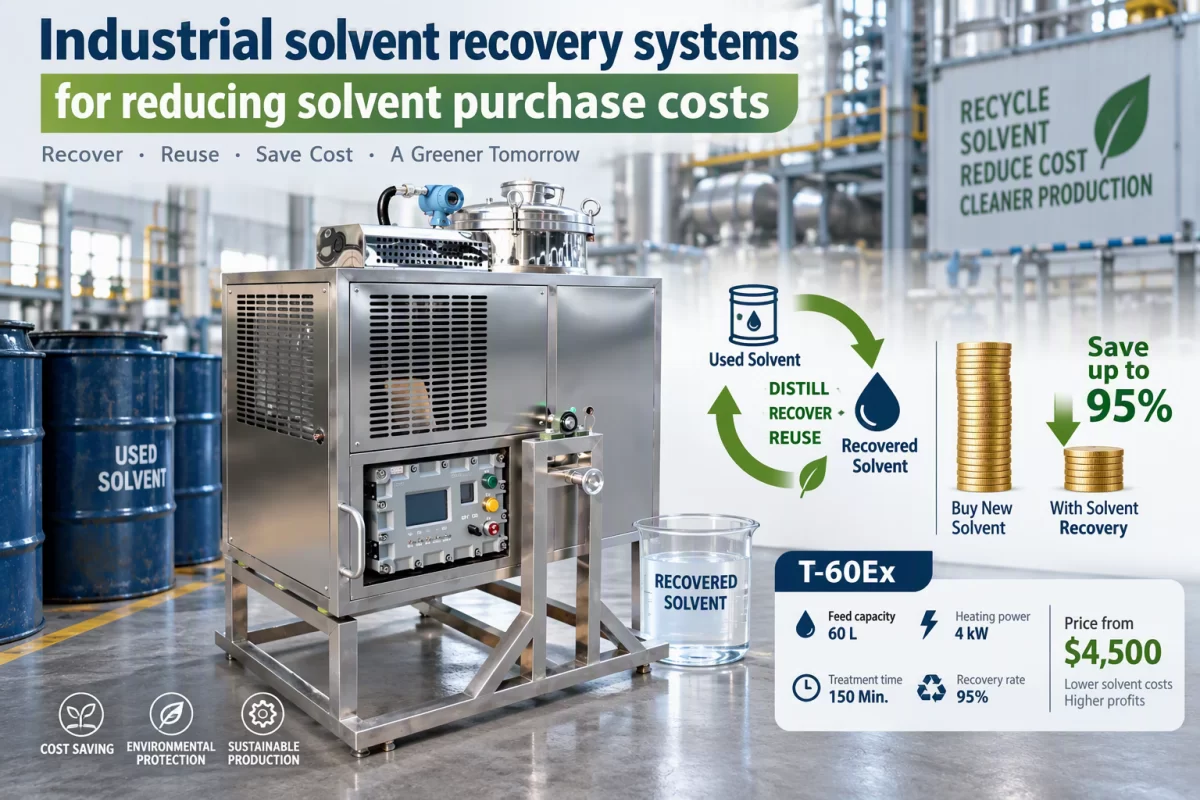
Lower solvent purchasing costs: recovered solvent can often be reused for pre-cleaning, intermediate cleaning, or even primary production depending on purity requirements.
Reduced waste handling: smaller waste volumes often mean lower transport, storage, and disposal fees.
Improved environmental performance: solvent recycling supports waste minimization and resource efficiency goals.
Better process control: consistent recovery procedures reduce the randomness of manual disposal practices.
Safer compliance planning: properly selected equipment helps align operations with hazardous-area and electrical safety requirements.
Could disposal still be cheaper than recycling in some cases?
Yes, but usually only when solvent volumes are very small, contamination is extreme, or local disposal costs remain unusually low. In most industrial settings where solvents are used repeatedly, recovery becomes increasingly attractive as volume and frequency rise.
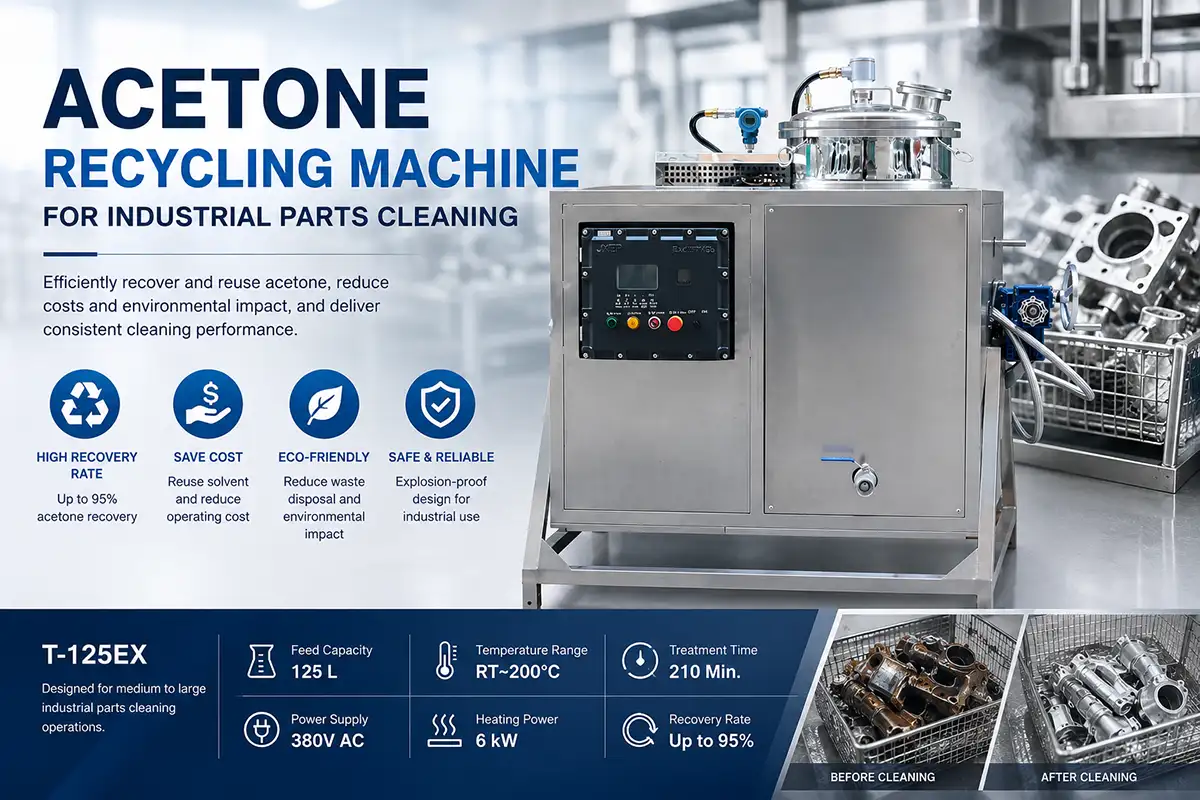
This is especially true for operations using acetone, IPA, ethanol, thinner blends, and cleaning solvents on a routine basis. Facilities comparing waste hauling bills against capital equipment often discover that an acetone recycling machine or multi-solvent recovery unit can create long-term savings while improving process consistency.
How to Select the Right Solvent Recovery Machine
One of the biggest mistakes in this market is asking for the “best brand” or “best machine” without defining the application. In real projects, equipment selection is always context-dependent. The following factors matter most.
1. Solvent Type and Contaminant Profile
Different solvents behave differently under heat and vacuum. Ethanol recovery, for example, may have very different purity goals from paint thinner recycling or acetone cleaning recovery. The residue composition matters too. Sticky resins, polymer solids, oils, or high-boiling contaminants can change cycle time and cleaning difficulty.
2. Throughput and Duty Cycle
Some users need a compact batch unit for periodic cleanup. Others need an industrial solvent recovery unit operating every shift. Daily volume, batch size, and turnaround time should be calculated before choosing feed capacity. Oversizing wastes capital, while undersizing creates bottlenecks.
Does a larger machine always deliver better value?
Not necessarily. A larger machine can process more per cycle, but it also requires more floor space, power, and supporting utilities. The best value usually comes from matching the machine to actual liters per day, solvent loading pattern, and production rhythm.
3. Safety and Hazardous-Area Classification
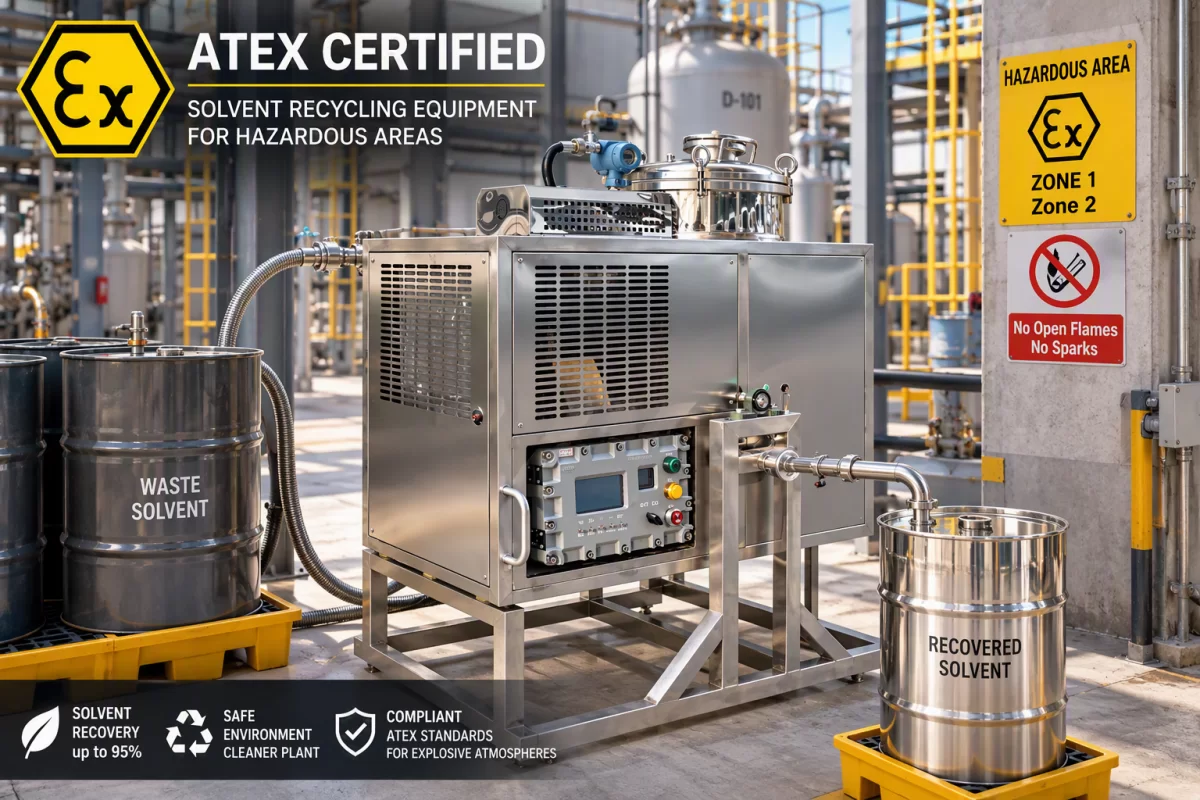
For flammable solvents, safety is not optional. Buyers should verify whether the installation requires explosion-proof or hazardous-area configurations such as ATEX, IECEx, or Class I Division ratings. Grounding, over-temperature protection, sealed electrical design, pressure relief, and operator interlocks all deserve close review.
4. Recovery Rate and Solvent Quality
A recovery percentage near 95% is attractive, but the purity target matters just as much. Some applications only need recovered solvent for rough cleaning. Others need higher-quality reclaimed solvent to re-enter production. The right solvent recovery system should be evaluated not only on recovery rate, but also on whether the recovered liquid matches the intended reuse step.
5. Materials, Utilities, and Serviceability
Good equipment selection also includes construction material, seal compatibility, heating efficiency, cleaning access, and spare-parts availability. Stainless-steel contact surfaces, durable seals, and a logical control layout can significantly improve long-term ownership experience.
Typical Explosion-Proof Solvent Recycling Machine Range
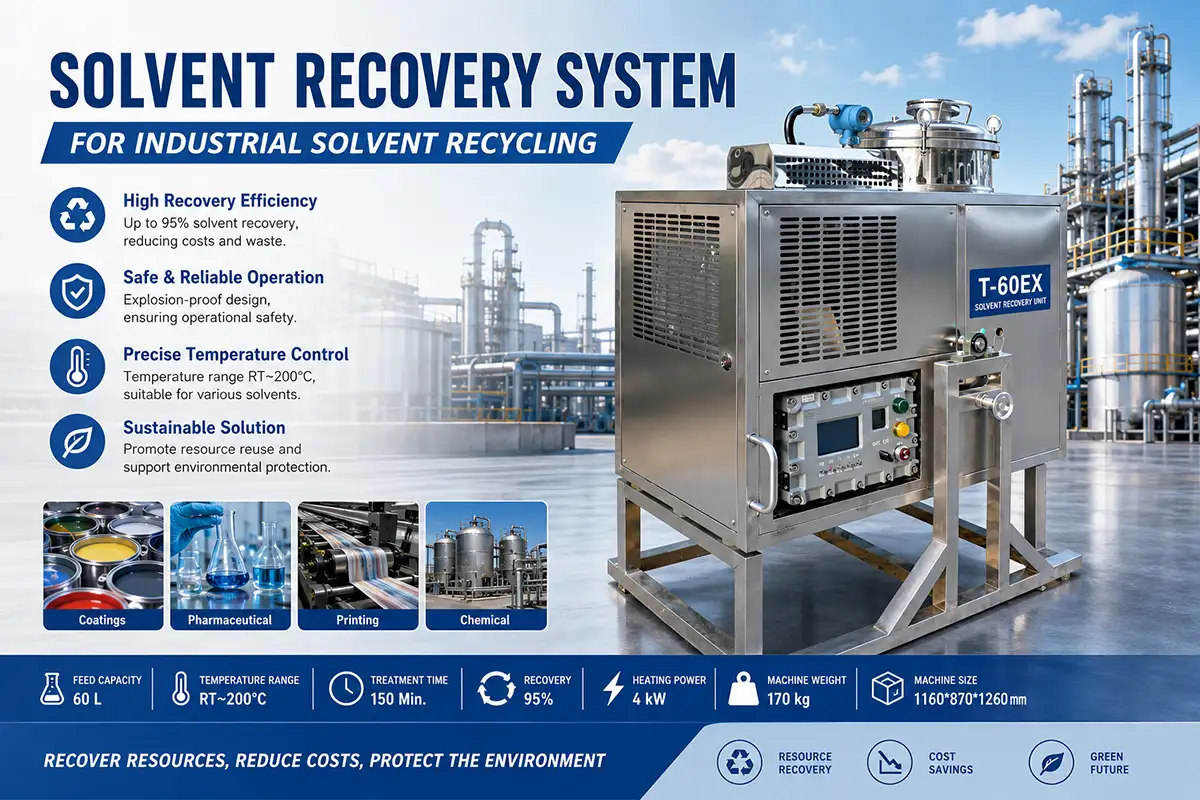
The following table shows a representative equipment range for batch solvent recovery applications. These specifications illustrate how capacity, power, treatment time, and machine dimensions change as throughput increases.
| Model | Feed Capacity (L) | Power Supply (ACV) | Heating Power (kW) | Temperature Range (℃) | Treatment Time (Min.) | Recovery (%) | Machine Weight (kg) | Machine Size (mm) |
|---|---|---|---|---|---|---|---|---|
| T-20Ex | 20 | 380 | 2 | RT~200 | 120 | 95 | 153 | 860 × 760 × 1190 |
| T-60Ex | 60 | 380 | 4 | RT~200 | 150 | 95 | 170 | 1160 × 870 × 1260 |
| T-80Ex | 80 | 380 | 5 | RT~200 | 180 | 95 | 200 | 1180 × 850 × 1290 |
| T-125Ex | 125 | 380 | 6 | RT~200 | 210 | 95 | 280 | 1250 × 920 × 1450 |
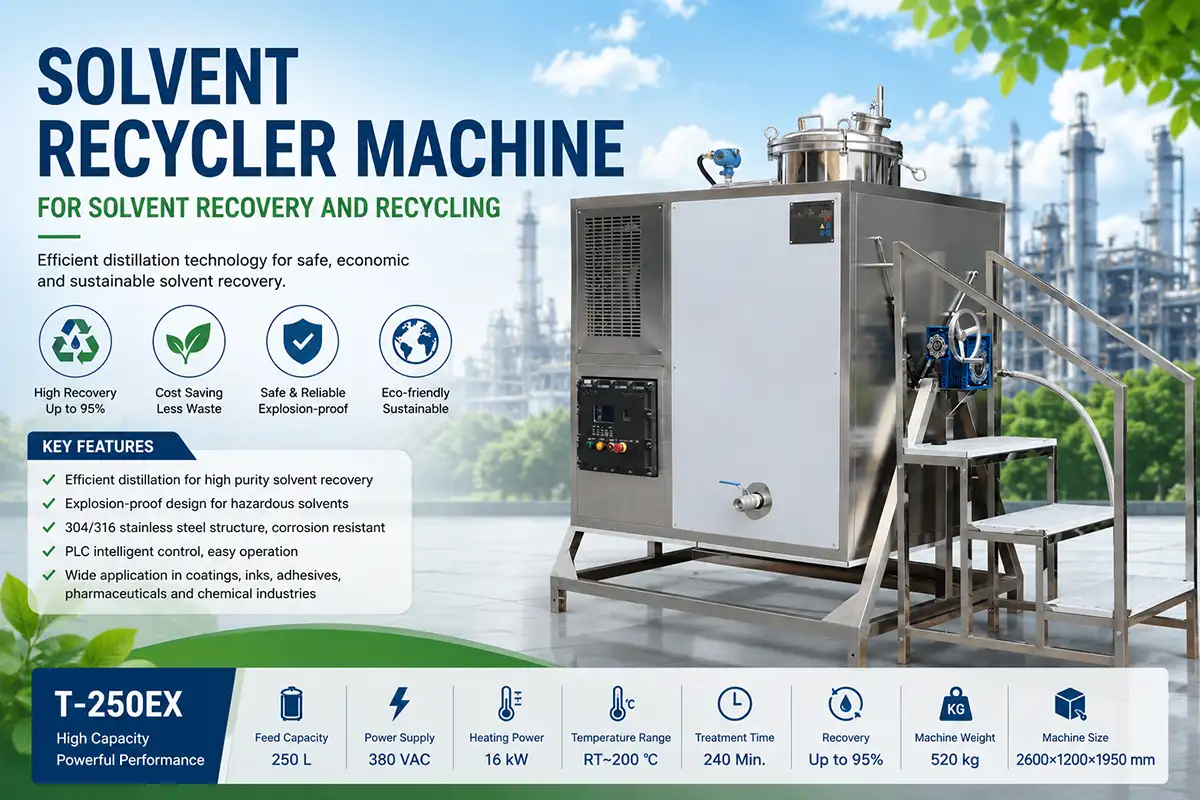
| T-250Ex | 250 | 380 | 16 | RT~200 | 240 | 95 | 520 | 2600 × 1200 × 1950 |
| T-400Ex | 400 | 380 | 32 | RT~200 | 270 | 95 | 1200 | 1990 × 1850 × 2090 |
Where Solvent Recovery Equipment Delivers the Most Value
Not every application needs the same machine design, but several industries consistently benefit from solvent recovery:
Paint & Ink Parts Cleaning Pharmaceutical Processing Electronics Cannabis & Botanical Extraction Chemical Manufacturing Printing
For example, in coating and printing environments, thinner and mixed cleaning solvents often contain pigments and resins that are ideal candidates for batch recovery. In extraction environments, ethanol recovery can improve solvent economy and reduce process waste. In industrial maintenance and parts washing, acetone and IPA streams can often be reclaimed for repeated cleaning cycles.
Is solvent recovery only relevant for very large factories?
No. Smaller labs and medium-sized workshops can also benefit, especially when solvent use is repetitive and disposal compliance is becoming expensive or difficult. The key is matching equipment size and configuration to the actual workflow.
Facilities that are still manually managing solvent waste may also benefit from reviewing compliant disposal practices for specific chemicals. For example, operations using IPA can also explore guidance on how to dispose of isopropyl alcohol when recovery is not the right path for every batch.
From Waste Problem to Recoverable Asset
In many plants, the shift toward solvent recycling equipment begins with cost pressure but quickly expands into something larger: cleaner workflow, safer handling, stronger compliance readiness, and more predictable production support. That is why the strongest equipment decisions are rarely brand-first decisions. They are application-first decisions.
If the solvent type, throughput, residue profile, hazardous-area requirement, and reuse target are all clearly defined, then choosing the right solvent recovery machine becomes much easier. Equipment can then be sized rationally, utilities can be planned correctly, and the return on investment becomes easier to defend.
Conclusion
A properly selected solvent recycler machine can help reduce waste, recover valuable solvent, improve operational discipline, and support safer production across many industries. Whether the application involves ethanol, IPA, acetone, thinner, or mixed cleaning solvents, the right solution depends on process details rather than generic rankings.
For buyers evaluating solvent recovery equipment, the most important questions remain practical: What solvent is being processed? How many liters per day need treatment? What recovery quality is required? Does the installation need explosion-proof compliance? Once these answers are clear, the path to selecting an effective solvent recovery system becomes much more precise.