
MEK (Methyl Ethyl Ketone) Recovery: Common Problems & Practical Solutions
MEK is widely used for cleaning, coatings, inks, and adhesives—but it becomes expensive and risky when it turns into waste. This article answers the questions that come up most often during MEK recovery and shows practical fixes that improve recovered-solvent quality, recovery rate, and day-to-day safety.
Topic focus: MEK recovery with a solvent recycling machine (distillation-based solvent recycler).
1) What “good MEK recovery” looks like (in plain English)
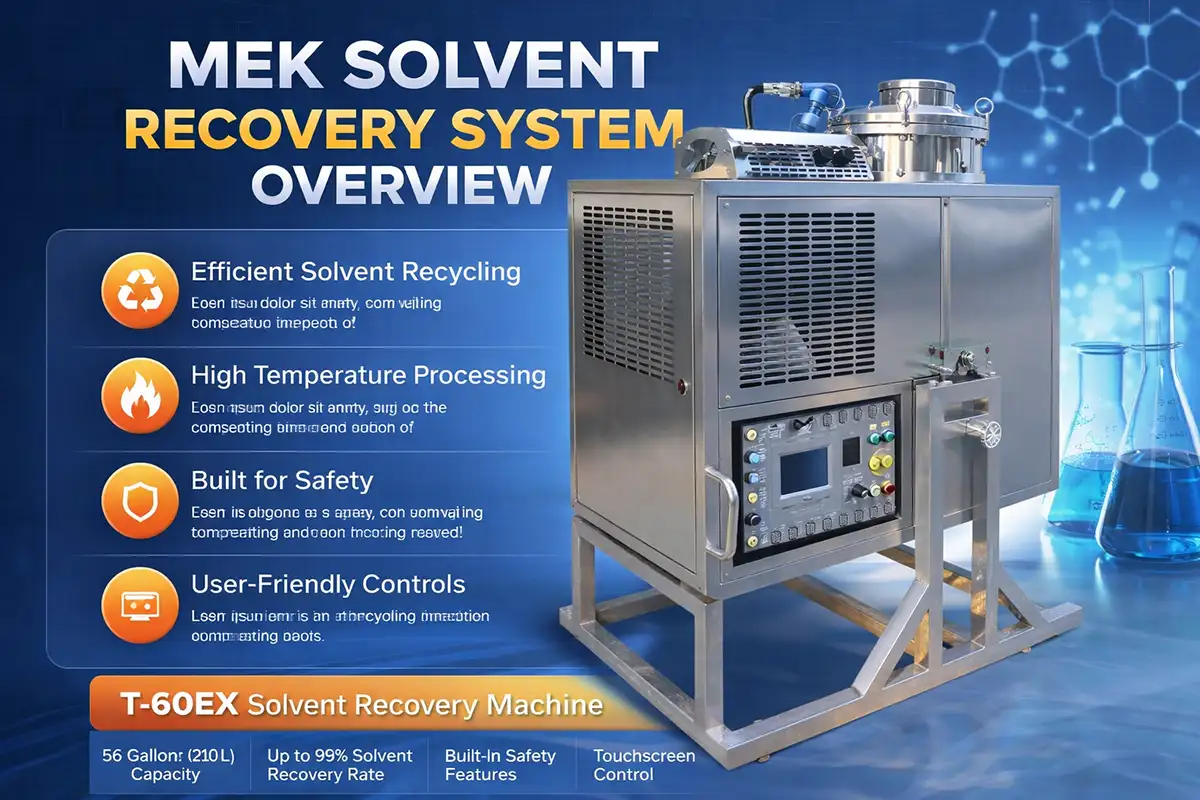
In a typical solvent recovery setup, “good” usually means three things: (1) recovered MEK is clean enough to reuse in the same process, (2) the recovery percentage is high enough to reduce purchasing costs, and (3) the residue (still bottoms) is minimized and stable. Many modern solvent recyclers are designed to reach high recovery under proper operating conditions. For example, common equipment configurations target around 95% recovery for compatible solvent streams (machine-dependent and waste-dependent).
A quick reality check
Recovered MEK is rarely “lab grade.” It is “fit-for-purpose” MEK. The right question is not “Is it perfect?” but “Is it stable and consistent enough to run the process without defects?” That is exactly where a properly configured solvent recycler and a consistent operating routine make the biggest difference.
2) Problem: Recovered MEK looks cloudy or smells “off”
Cloudiness and strong odor shifts usually point to contamination—most often water, resins, oils, dyes, or a mix of solvents (MEK blended with toluene/acetone/IPA, etc.). MEK can absorb some moisture from the environment, and water contamination can show up as haze or inconsistent evaporation.
Not necessarily. From the author’s experience, cloudiness is more often a feed quality and separation issue than a machine failure. The fix typically starts with characterizing the waste stream: is it mostly MEK, or a cocktail? If it is a mixture, separation temperatures and cycle time may need adjustment, and pre-filtration can help reduce carryover of fine solids or sticky binders.
Solutions that usually work
Stop mixing waste streams: keep “MEK-only” waste separate from mixed thinner waste. Mixing is the #1 reason recovered solvent quality becomes unpredictable.
Use proper filtration: strain inks/paints/adhesives before distillation to reduce entrainment and burnt odor.
Check cooling performance: poor condensation can allow vapors to escape and alter the balance of what actually gets recovered.
Control batch size: overfilling increases foaming and carryover of contaminants into the recovered MEK.
For a clearer explanation of the distillation principle behind this, see:How does a solvent recovery system work?
3) Problem: Recovery rate drops (more waste, less reusable MEK)
A falling recovery percentage usually happens for one of four reasons: (1) the waste contains less MEK than expected, (2) the process is ending early (short cycle), (3) MEK is being lost to leaks/venting due to condensation issues, or (4) the residue becomes too viscous and traps solvent.
| Model | Feed Capacity (L) | Heating Power (kW) | Temperature Range (°C) | Treatment Time (min) | Target Recovery (%) |
|---|---|---|---|---|---|
| T-20Ex | 20 | 2 | RT~200 | 120 | 95 |
| T-60Ex | 60 | 4 | RT~200 | 150 | 95 |
| T-80Ex | 80 | 5 | RT~200 | 180 | 95 |
| T-125Ex | 125 | 6 | RT~200 | 210 | 95 |
| T-250Ex | 250 | 16 | RT~200 | 240 | 95 |
| T-400Ex | 400 | 32 | RT~200 | 270 | 95 |
Because “recovery %” describes how much solvent can be reclaimed from the solvent portion—not how clean the original waste was. From the author’s point of view, heavy sludge is a sign that the waste contains a high load of non-volatile solids (resins, pigments, oils). In that case, the correct solution is usually operational: smaller batches, better pre-filtration, and a consistent end-point (don’t overcook the residue).
Solutions that raise recovery rate consistently
Standardize the waste input: keep a simple log (source line, material type, approximate solids %). Consistency improves results more than “tweaking temperatures” every batch.
Prevent vapor losses: verify condenser cooling and seals. MEK is volatile; small leaks can become large losses over weeks.
Don’t end the cycle too early: if treatment time is cut short, solvent remains trapped in the residue.
Right-size the machine: if daily MEK waste is high, a larger feed capacity reduces frequent small batches and stabilizes throughput.
4) Problem: Fast fouling, burned smell, or frequent cleaning shutdowns
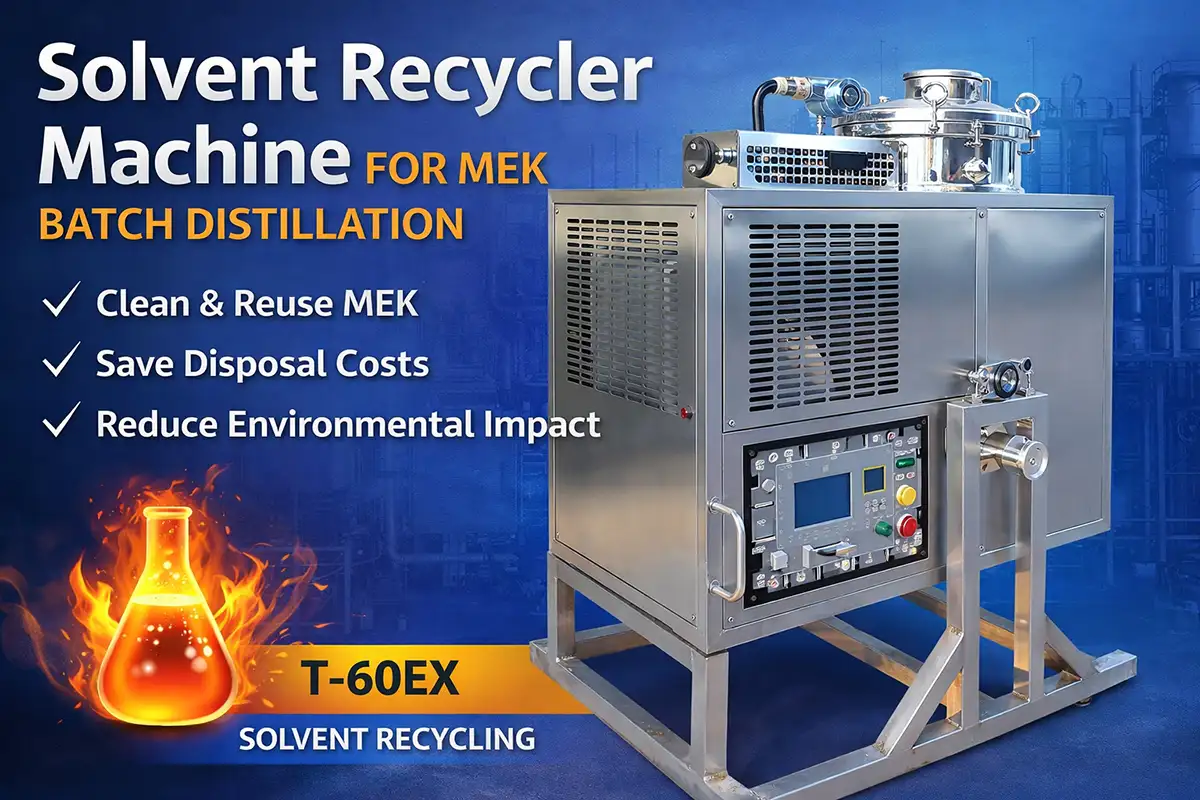
Burned odor is often mistaken for “bad MEK,” but it is commonly caused by overheating residues like inks, adhesives, or paint binders. When sticky components bake onto the tank, heat transfer worsens and cleaning frequency increases.
Operational tip that pays back quickly
The easiest way to reduce fouling is to treat MEK waste before it becomes “old.” Aged waste tends to thicken and form gels, especially when exposed to air or mixed with reactive contaminants. Regular recovery cycles usually produce cleaner distillate and less stubborn residue.
For broader waste-handling and compliance considerations (beyond MEK), this guide is helpful:How to dispose of solvent waste.
5) Problem: “Can MEK just be poured out or evaporated instead?”
In most industrial contexts, “pouring out” or uncontrolled evaporation is not a safe or compliant plan. MEK is flammable and volatile, and many jurisdictions regulate solvent disposal and air emissions. According to the U.S. National Institute for Occupational Safety and Health (NIOSH), MEK exposure can irritate eyes and respiratory tract, and controlling vapor levels is a core workplace-safety requirement.
Both, but the priority depends on the site. In the author’s experience, companies often start for cost reasons (less fresh MEK purchasing), and later appreciate the compliance and safety benefits: less hazardous waste volume, fewer drum pickups, and lower VOC handling in day-to-day operations.
6) Choosing the right MEK solvent recycler (simple checklist)
A “solvent recycler machine” is not one-size-fits-all. The best choice is based on daily waste volume, solvent type (MEK-only vs mixed), and whether the process produces high solids (ink/paint) or mostly clean solvent (parts washing). When equipment is properly sized, typical batch times can range from about 120 to 270 minutes depending on capacity and heating power, with a working temperature envelope up to RT–200°C for many industrial designs.
Capacity: match feed capacity to daily waste generation (avoid constant overfilling or nonstop small batches).
Explosion-proof design: MEK is flammable—use appropriate Ex-rated equipment in relevant environments.
Cooling and sealing quality: reduces solvent loss and odor.
Ease of residue removal: lowers downtime and improves consistency.
Conclusion: The most common MEK recovery “fix” is process discipline
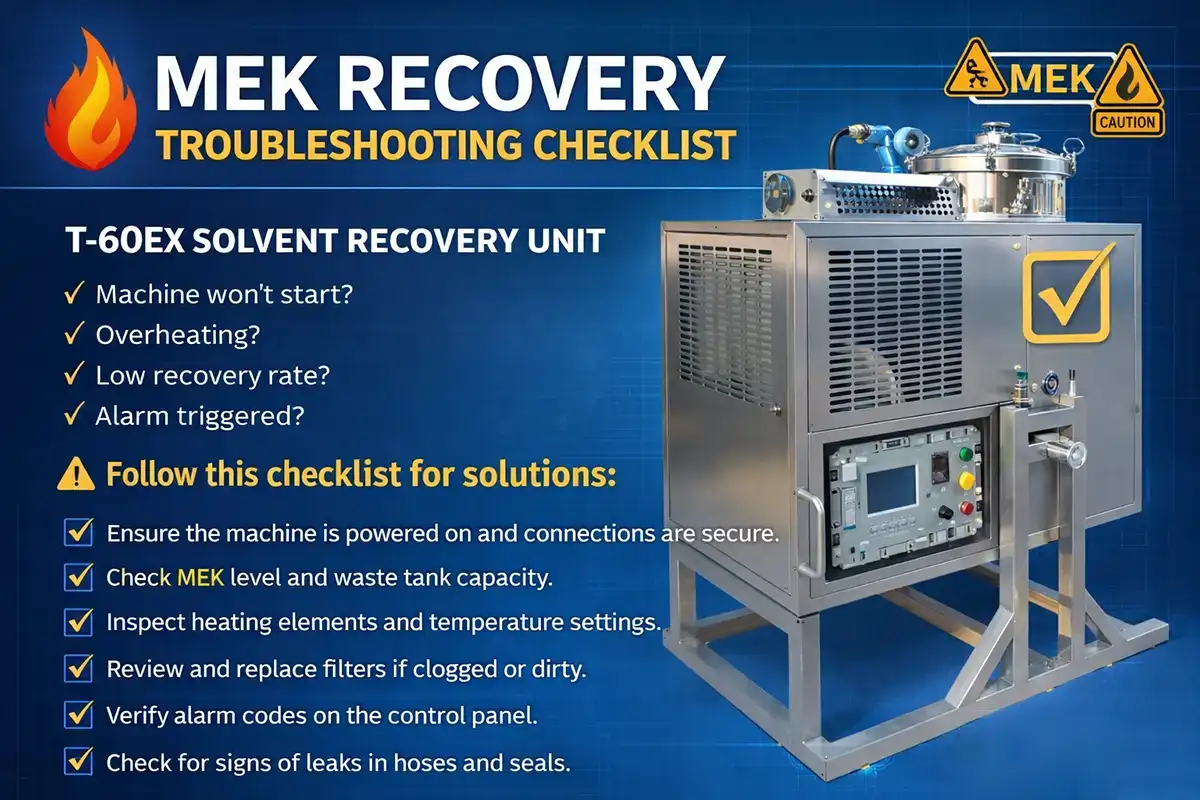
When MEK recovery underperforms, the cause is often not mysterious: mixed waste streams, inconsistent batch size, poor filtration, or preventable vapor loss. A well-matched solvent recycling system and a repeatable operating routine typically deliver stable recovered MEK quality and high recovery—often around the 95% target level for compatible solvent waste. The result is fewer solvent purchases, less hazardous waste handling, and a cleaner, more controllable workflow.
Looking for equipment options? Explore our solvent recycling machine page for typical configurations and capacity ranges.