
Solvent Recovery Distillation: A Practical Guide to Lower Costs and Cleaner Solvent Reuse
In many industries, solvent is not a small consumable expense. It is a recurring operating cost, a waste-management issue, a safety consideration, and often a hidden factor affecting production efficiency. That is why solvent recovery distillation has become an increasingly important solution for manufacturers, laboratories, electronics cleaning lines, coating plants, printing facilities, and extraction operations that want to recover valuable solvent instead of sending it out as waste.
Why Solvent Recovery Distillation Matters
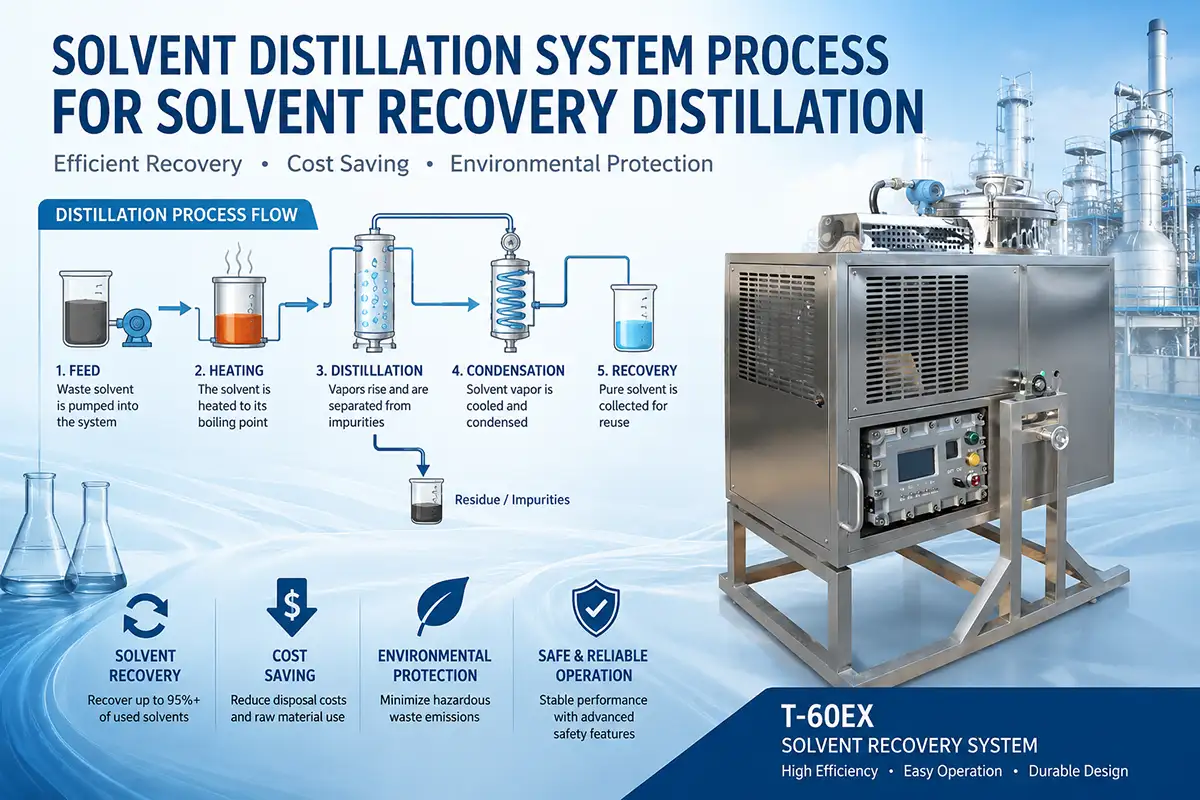
Solvent recovery distillation is the process of separating reusable solvent from contaminated liquid by heating the mixture, vaporizing the solvent, and then condensing it back into a cleaner form. In simple terms, it turns spent solvent into reusable solvent and leaves behind oils, inks, resins, pigments, solids, or other contaminants that are not meant to return to the process.
The value of this approach is easy to understand. A plant that buys fresh solvent every week and pays again to dispose of dirty solvent is paying twice. A properly selected recovery unit can help reduce fresh solvent purchases, lower hazardous waste volumes, and improve resource efficiency at the same time. For operations that use acetone, IPA, ethanol, toluene, xylene, ethyl acetate, or similar organic solvents, the savings potential can be significant.
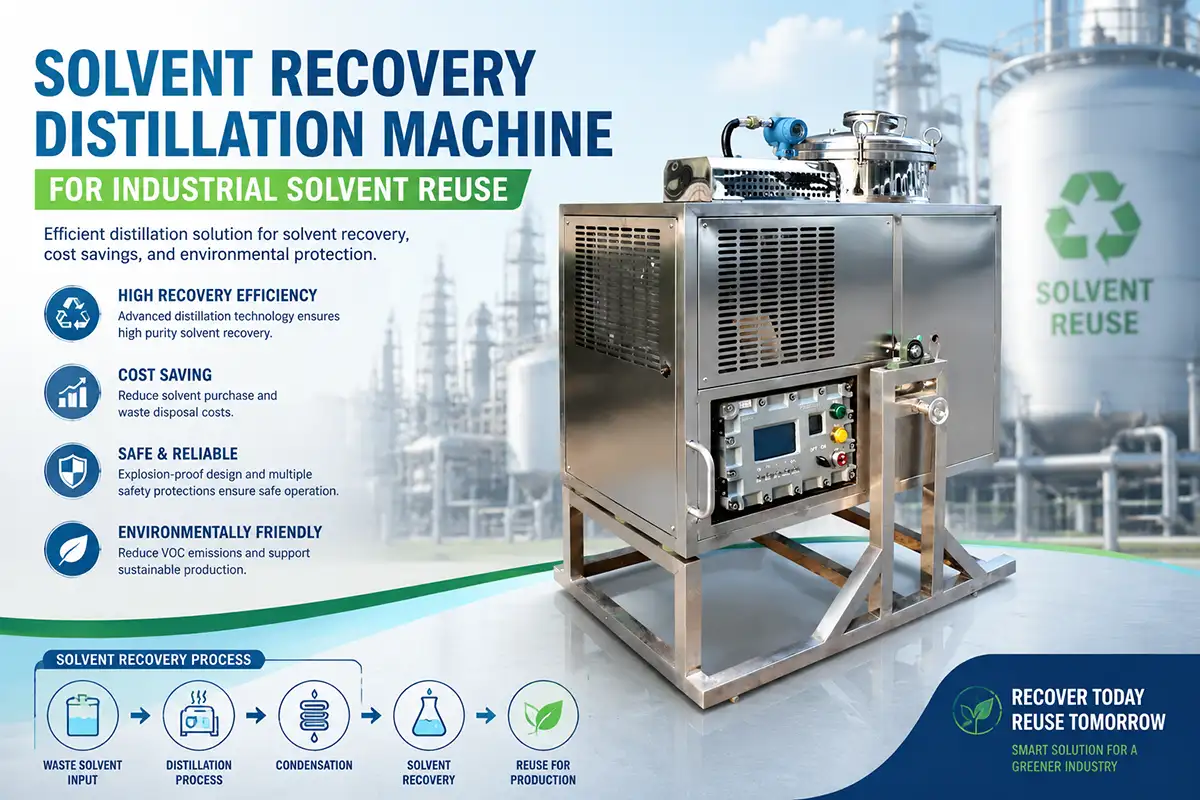
For readers exploring complete equipment options, the site also provides useful background on solvent recovery machine configurations and application-focused recovery solutions.
How the Process Works in Real Production Environments
In actual operation, solvent recovery distillation is less complicated than many buyers first assume. Contaminated solvent is charged into the still tank. The machine heats the liquid within a controlled temperature range, typically up to 200°C in the provided explosion-proof models. As the solvent reaches its boiling point, vapor rises and moves through a cooling section where it condenses into liquid for collection. The residue stays in the tank for later removal.
This basic principle makes the technology suitable for many sectors. Paint shops recover cleaning thinner. Electronics manufacturers reclaim IPA. Printing plants recover solvents used for ink and roller cleaning. Extraction and chemical processing facilities reclaim ethanol or other organic solvents when purity targets and process design allow.
Is solvent recovery distillation only useful for very large factories?
Answer from the author: Not at all. The equipment data shows feed capacities ranging from 20 L to 400 L, which means solvent recovery distillation can fit small batch operations, pilot lines, and larger industrial production environments. The key is not company size but solvent usage pattern, contamination level, and required throughput.
What Buyers Usually Evaluate Before Choosing a System
1. Solvent Type
Different solvents have different boiling points, flammability profiles, and material compatibility requirements. Acetone, IPA, ethanol, xylene, and mixed cleaning solvents do not all behave the same way in recovery distillation.
2. Throughput and Cycle Time
Batch size affects model selection. A plant handling 20 liters per batch has very different needs from a line processing 250 or 400 liters at a time.
3. Safety Requirements
Explosion-proof design, grounded operation, controlled heating, and hazardous-area suitability are essential in many solvent recovery applications.
4. Recovery Target
Not every process requires the same purity level. Some users want basic reuse for washing; others need cleaner recycled solvent for more sensitive production steps.
5. Footprint and Utilities
Machine size, power supply, heating power, ventilation, and site layout all matter when installing a solvent recovery distillation unit.
6. Service and Long-Term Value
Equipment should be evaluated not only by initial purchase price but also by durability, operating simplicity, and the ease of integrating it into daily production.
Buyers comparing different system types may also want to review broader solvent recycling system options to understand how configuration, automation, and application goals influence equipment selection.
Technical Parameters for Explosion-Proof Solvent Recovery Distillation Models
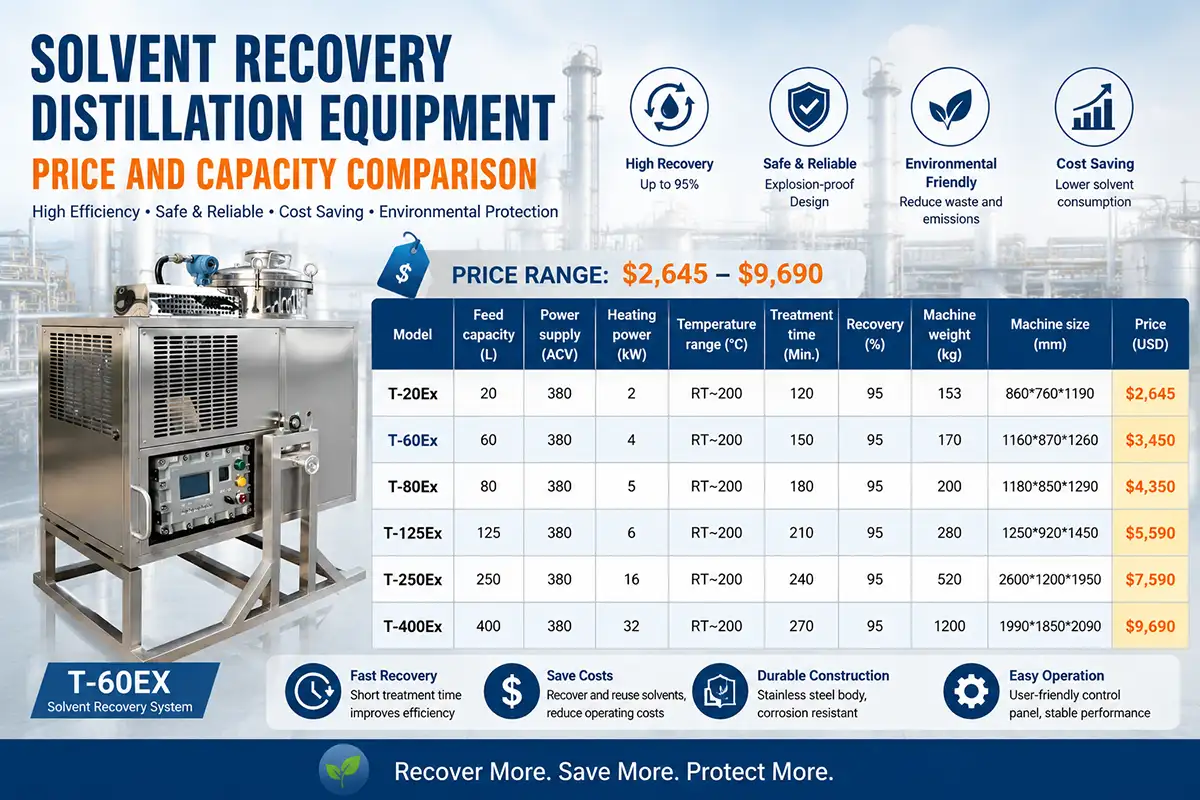
The following equipment range covers common industrial batch capacities. All listed models use a 380 ACV power supply, operate from room temperature to 200°C, and are designed for high recovery performance. This makes them suitable for buyers who need a structured way to compare treatment time, heating power, machine weight, and physical footprint.
| Model | Feed Capacity (L) | Power Supply (ACV) | Heating Power (kW) | Temperature Range (℃) | Treatment Time (Min.) | Recovery (%) | Machine Weight (kg) | Machine Size (mm) |
|---|---|---|---|---|---|---|---|---|
| T-20Ex | 20 | 380 | 2 | RT~200 | 120 | 95 | 153 | 860 × 760 × 1190 |
| T-60Ex | 60 | 380 | 4 | RT~200 | 150 | 95 | 170 | 1160 × 870 × 1260 |
| T-80Ex | 80 | 380 | 5 | RT~200 | 180 | 95 | 200 | 1180 × 850 × 1290 |
| T-125Ex | 125 | 380 | 6 | RT~200 | 210 | 95 | 280 | 1250 × 920 × 1450 |
| T-250Ex | 250 | 380 | 16 | RT~200 | 240 | 95 | 520 | 2600 × 1200 × 1950 |
| T-400Ex | 400 | 380 | 32 | RT~200 | 270 | 95 | 1200 | 1990 × 1850 × 2090 |
What does a higher-capacity machine usually change besides tank size?
Answer from the author: In practice, higher-capacity solvent recovery distillation units also involve stronger heating power, larger footprint, higher machine weight, and different treatment times. That is why model selection should be based on daily solvent volume and production rhythm, not only on a rough estimate of tank capacity.
Price Guidance for Common Solvent Recovery Equipment
Budget planning is often one of the first steps in equipment evaluation. Based on the provided company pricing data, entry-level laboratory and pilot-support equipment starts from relatively accessible levels, while industrial solvent recovery distillation systems scale according to capacity and configuration.
Industrial solvent recovery machine series and multiple related recovery units: $2,645
Grade solvent recovery machine and IPA recovery machine for electronics cleaning: $4,271
Stable larger T-450Ex solvent recovery unit: $10,691
For readers evaluating cost versus process value, this related guide on solvent recovery system price explains which specifications usually drive equipment investment.
Where Solvent Recovery Distillation Delivers the Most Value
The strongest return usually appears in facilities with repeat solvent consumption and stable contamination patterns. Examples include cleaning operations where dirty solvent contains oils and solids, coating lines using thinner or mixed wash solvents, electronics production using IPA, and extraction processes where ethanol recovery supports lower ongoing material costs.
Another major benefit is waste reduction. Instead of paying for the transport and treatment of large volumes of used solvent, a business can often cut waste volume substantially by recovering the reusable fraction onsite. That does not eliminate the need to handle residue correctly, but it can change the economics of waste management in a meaningful way.
Can solvent recovery distillation improve both sustainability and operating efficiency at the same time?
Answer from the author: Yes. That is exactly why the technology is attractive. The same equipment can reduce raw solvent demand, cut waste output, and support a more controlled internal reuse loop. In many production settings, environmental improvement is not separate from cost control; it is part of the same decision.
Application-specific content is also useful when matching equipment to solvent chemistry. For example, facilities focused on ketone reuse may benefit from reading acetone recycling guidance to better understand process considerations and recovery opportunities.
How to Choose the Right Model
A good purchasing decision usually begins with a few clear technical questions: What solvent or solvent mixture needs to be recovered? How many liters are generated per day or per shift? Is the process batch or continuous? What level of cleanliness is acceptable for reused solvent? Does the site require explosion-proof equipment? What utilities and floor space are available?
Once these questions are answered, model selection becomes much more logical. Small users may prefer compact systems such as the T-20Ex or T-60Ex. Mid-range industrial users may look at the T-80Ex or T-125Ex for balanced capacity and manageable footprint. Higher-throughput plants may need the T-250Ex or T-400Ex to align with production volume and reduce handling frequency.
It is also wise to think beyond immediate capacity. If solvent usage is expected to rise within the next 12 to 24 months, selecting a machine with some reserve capability may be more efficient than replacing undersized equipment too early.
Final Thoughts on Solvent Recovery Distillation
Solvent recovery distillation is not simply a waste-treatment accessory. It is a production-support technology that can improve solvent economics, reduce disposal pressure, and support more sustainable manufacturing practices. When the equipment is chosen according to solvent type, batch size, safety needs, and recovery goals, the result is often a cleaner process with stronger long-term value.
Whether the requirement is a compact laboratory setup, an explosion-proof industrial recycler, or a higher-capacity solvent distillation unit for continuous plant demand, the most successful projects start with clear process data and realistic recovery expectations.