
Solvent Waste Recovery: How to Cut Disposal Costs and Reuse Solvents Safely
In many factories, laboratories, coating lines, electronics plants, printing workshops, and chemical processing facilities, solvent consumption is not just a purchasing issue. It is also a waste management issue, a compliance issue, and a profit issue. A well-designed solvent waste recovery strategy can turn contaminated solvent streams into reusable resources, reduce hazardous waste output, and create a faster return on equipment investment.
Why solvent waste recovery matters now
Rising solvent prices, stricter environmental expectations, and higher waste hauling costs are pushing more companies to rethink traditional disposal practices. Instead of paying repeatedly to buy fresh solvent and remove used solvent, many operators are moving toward closed-loop or semi-closed-loop recovery. This is especially valuable for plants using ethanol, IPA, acetone, ethyl acetate, toluene, xylene, and similar organic solvents in high volumes.
The core idea is simple: contaminated solvent is collected, heated under controlled conditions, vaporized, condensed, and separated so that a large portion of the original solvent can be reclaimed for reuse. Depending on the solvent profile and contamination level, recovery rates can reach about 95%. That means less waste sent off-site and less new solvent purchased.
Is solvent waste recovery only useful for very large factories?
Not at all. From the author’s perspective, the biggest advantage appears wherever solvent is consumed frequently enough to create repeated disposal and repurchasing costs. Small and mid-sized users often benefit quickly because waste handling expenses are already significant relative to production volume.
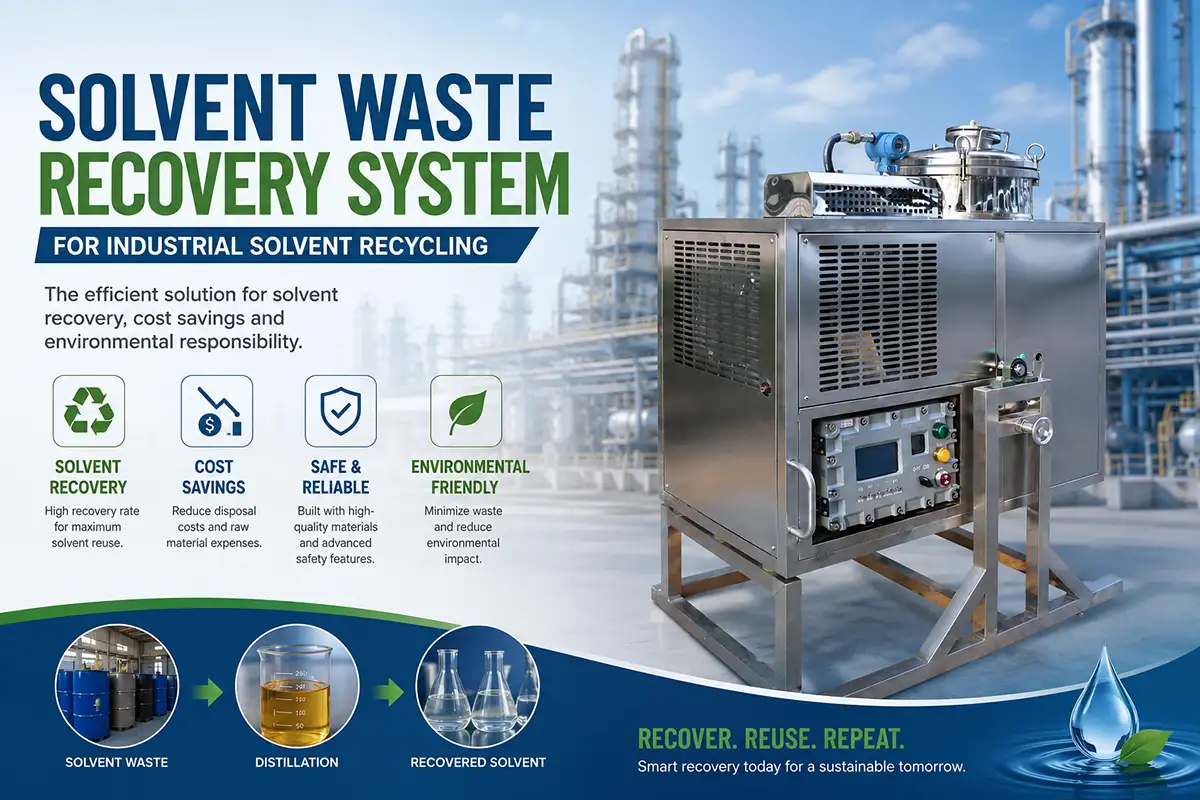
How the solvent recovery process works
Most industrial solvent waste recovery systems use distillation as the central mechanism. Waste solvent is introduced into a recovery chamber, where it is heated through a controlled temperature range. The clean solvent fraction vaporizes first, passes through a condensation section, and returns to liquid form in a receiving tank. Non-volatile residues such as oils, resins, inks, pigments, adhesives, or suspended solids remain behind for separate disposal.
Collection
Segregate spent solvent by chemistry as much as possible to improve purity and shorten treatment time.
Heating & Evaporation
The machine applies controlled heat so the reusable solvent fraction evaporates efficiently and safely.
Condensation
Vapor is condensed back into liquid solvent for storage, reuse, or further polishing if required.
Residue Handling
Boiling residues are reduced in volume, helping lower hazardous waste disposal costs.
For a deeper explanation of process flow, readers can also review how a solvent recovery system works. Facilities focused on solvent reclaim through thermal separation may also find this guide to solvent recovery distillation units useful.
Key factors when selecting a solvent waste recovery machine
The right machine is never chosen by brand name alone. It should match the solvent type, daily throughput, site power conditions, expected recovery target, and area safety classification. In practical terms, the following factors matter most:
Feed capacity: choose a batch size that aligns with the daily waste volume and shift rhythm.
Power supply: stable plant power helps keep heating cycles predictable.
Heating power: higher kW can support larger batches, but should still match process and safety requirements.
Temperature range: solvent boiling behavior and impurity profile determine needed operating flexibility.
Treatment time: a shorter cycle can improve throughput, but not if it sacrifices separation quality.
Recovery rate: around 95% recovery is an important benchmark for many common solvents.
Machine size and weight: floor loading, plant layout, and maintenance access all matter.
What is often overlooked during equipment selection?
The author’s answer is residue behavior. Many buyers focus on solvent boiling point and capacity, but sludge, resin, paint solids, or sticky contaminants often decide how smoothly the system operates over time. Good sizing should always consider the real composition of the waste stream, not only the solvent name on paper.
Representative technical parameters
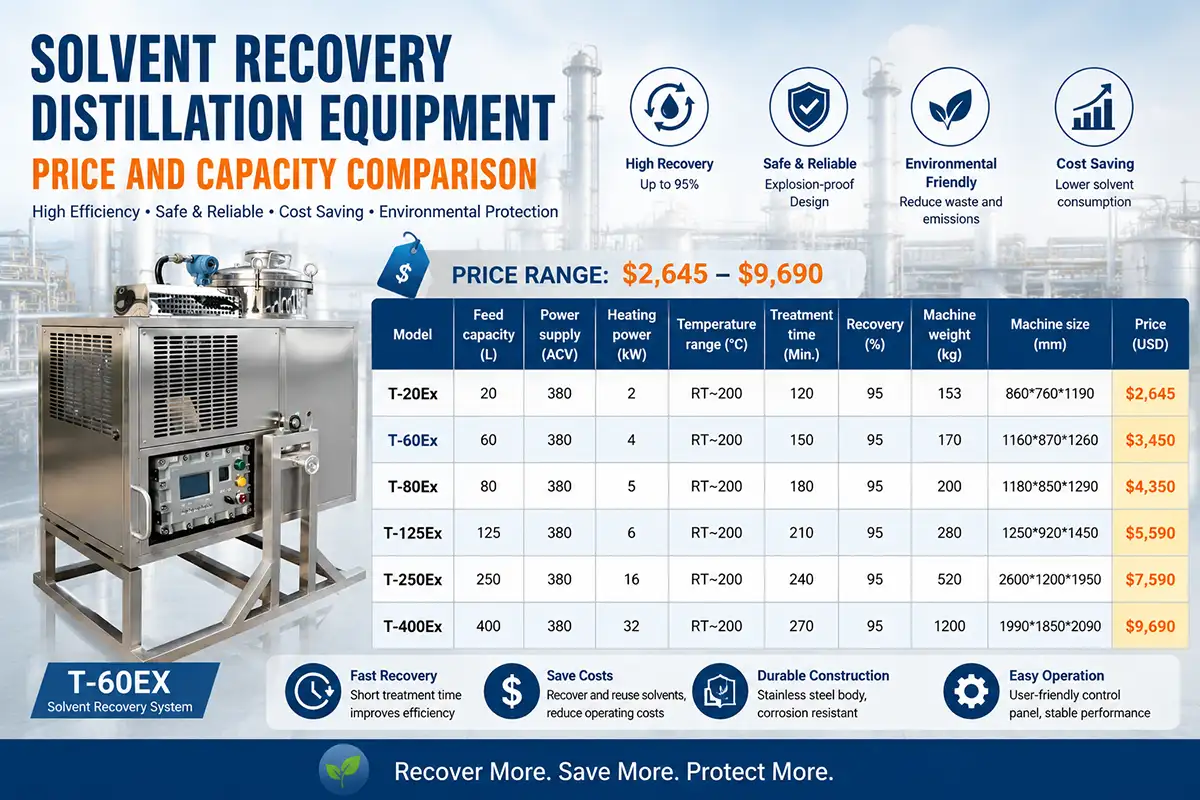
Below is a practical reference table for explosion-proof solvent recovery models. These specifications are useful when estimating throughput, electrical requirements, and installation planning for solvent waste recovery projects.
| Model | Feed Capacity (L) | Power Supply (ACV) | Heating Power (kW) | Temperature Range (℃) | Treatment Time (Min.) | Recovery (%) | Weight (kg) | Machine Size (mm) |
|---|---|---|---|---|---|---|---|---|
| T-20Ex | 20 | 380 | 2 | RT~200 | 120 | 95 | 153 | 860×760×1190 |
| T-60Ex | 60 | 380 | 4 | RT~200 | 150 | 95 | 170 | 1160×870×1260 |
| T-80Ex | 80 | 380 | 5 | RT~200 | 180 | 95 | 200 | 1180×850×1290 |
| T-125Ex | 125 | 380 | 6 | RT~200 | 210 | 95 | 280 | 1250×920×1450 |
| T-250Ex | 250 | 380 | 16 | RT~200 | 240 | 95 | 520 | 2600×1200×1950 |
| T-400Ex | 400 | 380 | 32 | RT~200 | 270 | 95 | 1200 | 1990×1850×2090 |
These models are suitable for facilities that need reliable handling of waste organic solvents while maintaining operational consistency. Plants comparing different machine styles can also visit the main solvent recycler machine page for more equipment-related information.
Cost reference and value analysis
Budget planning is a central part of any solvent recovery project. Based on current in-house price references, smaller lab-support devices and entry-level systems start from accessible levels, while larger industrial machines are priced according to capacity and configuration. For products with multiple listed prices, the lower middle value should be used as a practical reference.
Representative in-house pricing includes:
In many cases, the actual financial comparison is not simply equipment price versus no equipment. It is equipment price versus a continuing cycle of fresh solvent purchasing, waste storage, transport, treatment fees, and production interruption. Once those recurring costs are measured clearly, solvent waste recovery often becomes much easier to justify.
Common application scenarios
Solvent waste recovery is widely used in industries where organic solvents become contaminated but still retain recoverable value. Typical examples include:
Printing and painting
Recovery of thinner, xylene, toluene, and mixed cleaning solvents contaminated with pigments or resins.
Electronics cleaning
Reclaiming IPA and other cleaning agents used in precision component processing.
Extraction and processing
Ethanol recovery for repeated use in extraction workflows where solvent cost and purity control are critical.
Chemical manufacturing
Recovery of process solvents from batch operations, cleaning procedures, and off-spec blends.
For example, acetone users exploring reclaim options can also check this acetone recycling guide to understand process and application considerations in more detail.
Can recovered solvent always be reused directly?
The author’s view is that reuse depends on process tolerance. Some operations can reuse recovered solvent directly for cleaning or rough washing, while higher-purity production steps may require tighter separation, better feed segregation, or an additional polishing stage. The key is matching recovered solvent quality to the actual task.
Safety, compliance, and operational discipline
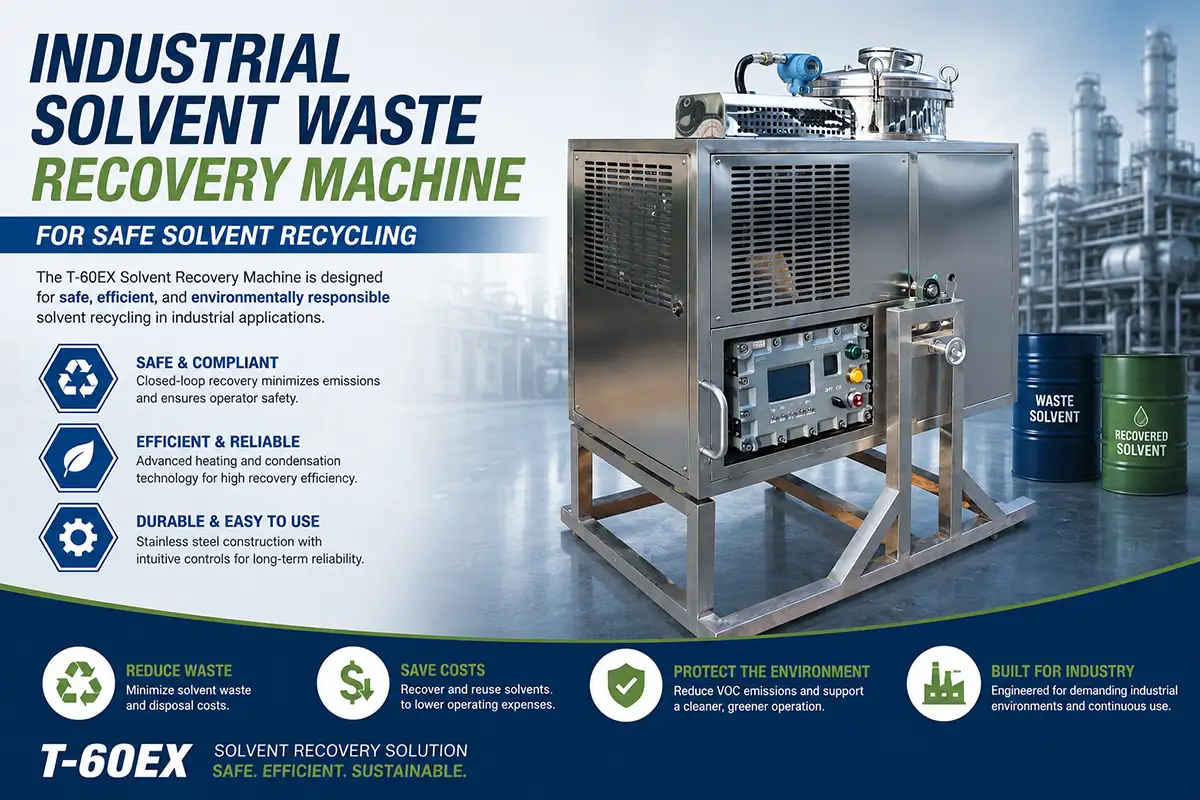
Safety is not optional in solvent waste recovery. Many waste solvents are flammable, and some are handled in hazardous environments where explosion-proof design is essential. Buyers should confirm whether the machine configuration fits plant electrical standards and any hazardous-area requirements. Proper grounding, temperature control, sealed components, vapor management, and routine maintenance all support stable operation.
Operationally, good recovery results also depend on disciplined solvent segregation, residue removal schedules, and realistic batch planning. A machine that is technically capable of recovering solvent can still underperform if the feed stream changes constantly or if incompatible wastes are mixed without evaluation.
A practical path toward lower waste and higher solvent value
Solvent waste recovery is no longer a niche idea. It is a practical operating strategy for companies that want to reduce waste disposal pressure, improve solvent utilization, and create a more economical production model. Whether the need is a compact unit for smaller batches or a larger explosion-proof system for industrial duty, the most effective approach is to size the machine around actual solvent type, contamination level, and daily throughput.
Useful selection signals include:
When these points are defined clearly, equipment selection becomes easier, payback becomes more measurable, and the benefits of recovery become far more visible across purchasing, EHS, and production teams.