
How to Keep IPA (Isopropyl Alcohol) Recovery Purity Stable at 99%?
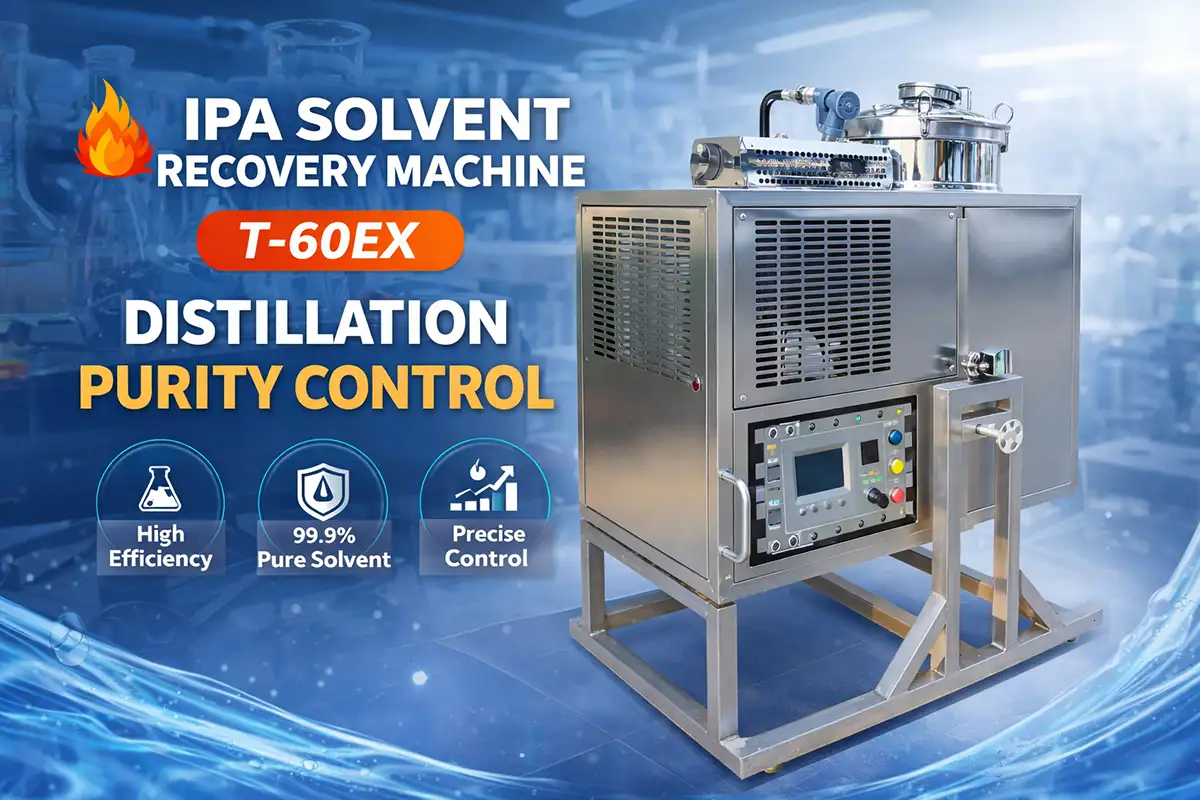
99% IPA is not a “one-time lucky batch.” It is a repeatable result that comes from controlling three variables: water, boiling/condensing conditions, andcontamination pathways. This article explains the levers that actually move purity and how a solvent recycling machinehelps lock them in.
1) What does “99% recovered IPA” actually mean?
Most factories care about cleaning performance, residue, and rework risk—not chemistry jargon.
“99% IPA” usually means 99% by volume (v/v) isopropyl alcohol, with the remainder mostly being water and trace impurities. For IPA, water is the main purity killer because it changes drying speed, can leave marks on optics/electronics, and affects downstream formulations.
2) Why does IPA purity drift during recycling?
If purity drops from 99% to 97–98%, the cause is usually not mysterious.
In real production lines, waste IPA is rarely “just IPA.” It typically contains a mix ofwater, oils, inks, resins,flux, adhesives, or fine particulates. Purity drift happens when:
Water load changes from batch to batch (e.g., more rinse water carried into the tank).
Heating is too aggressive, causing bumping/entrainment (tiny droplets carried into the vapor stream).
Condensation is weak (high coolant temperature or insufficient condenser area), letting mixed vapors pass.
Cross-contamination occurs (dirty collection tanks, shared hoses, or mixed solvent streams).
Because distillation is not only about boiling points. In practice, water canco-distill in small amounts, and it can also be physically carried over byentrainment if boiling is unstable. That is why stable heating and good condensation matter as much as the temperature number on the screen.
3) The controls that keep recovered IPA stable at 99%
Focus on a few “high-leverage” controls instead of chasing every minor variable.
Control #1: Manage water before it reaches the machine
The fastest way to stabilize purity is to stabilize the feed composition. If the waste IPA tank is open to humid air, or if operators rinse parts and dump mixed liquid without separation, water content swings—and so does recovered purity.
Keep waste IPA containers closed to reduce moisture pickup.
Separate aqueous streams (rinsing water, floor wash) from solvent waste.
Use basic settling/filtration so solids do not cause foaming or bumping.
Control #2: Use a stable heating profile (avoid “boil violence”)
Many purity complaints come from overheating. When a batch boils too violently, droplets can be carried into the condenser and end up in the recovered drum. A properly designed solvent recovery system uses controlled heating so vapor is mostly IPA, not a messy aerosol of “whatever is in the tank.”
No. Higher temperature can increase evaporation rate, but it can also increase entrainment and bring more water/contaminants into the distillate. In my experience, the best purity is achieved withsteady, controlled boiling and sufficient condensation—not maximum heater output.
Control #3: Condensation capacity (cooling) is purity insurance
Condensation is where vapor turns back into liquid. If condenser performance is marginal, the system may allow mixed vapors to pass or create unstable reflux behavior. To keep 99% stable, the condenser should have consistent cooling water and enough heat-transfer area.
Control #4: Prevent cross-contamination (often overlooked)
Even a perfect distillation run can be ruined by a dirty receiving container. Dedicated, labeled containers and quick hose flushing reduce “mystery impurities.” If multiple solvents are used on site, do not mix them “for convenience.” Mixing can raise boiling complexity and reduce purity.
For a broader introduction to solvent recovery concepts (beyond IPA), see:What is solvent recovery?and a process explanation inHow does a solvent recovery system work?.
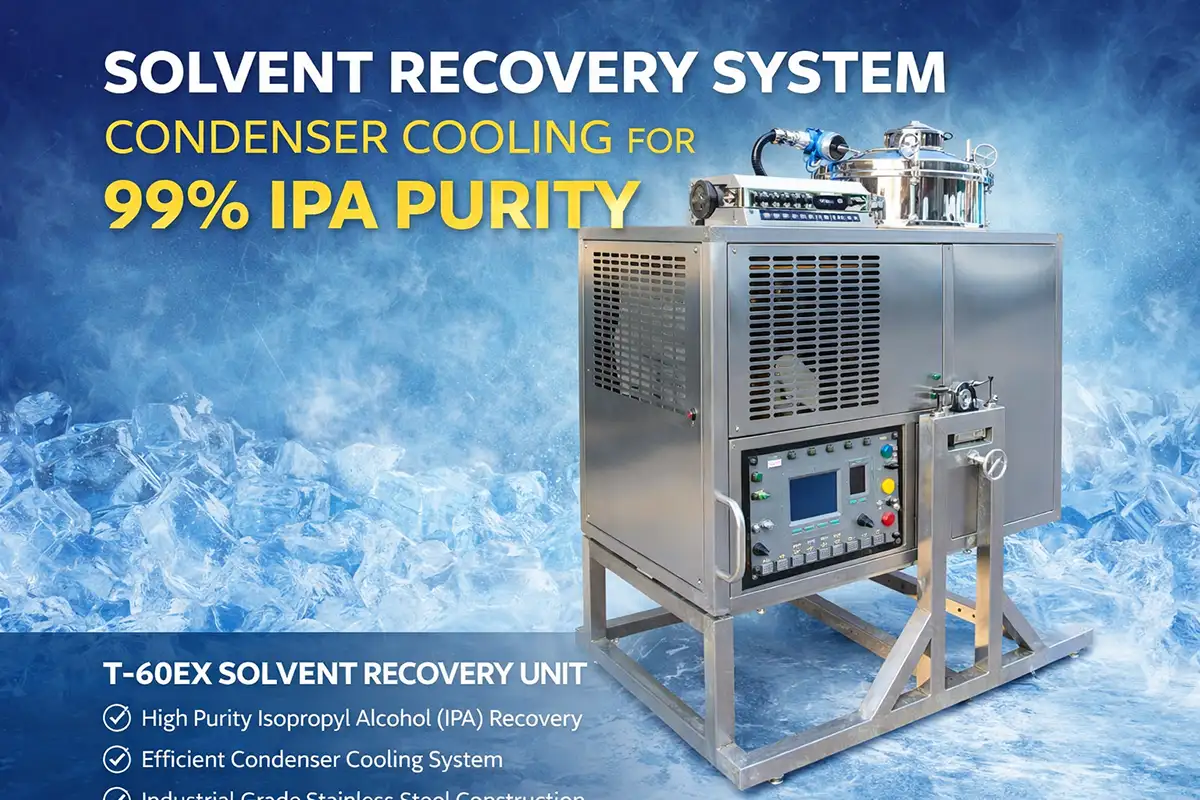
4) Equipment parameters: choosing a solvent recovery machine that supports 99%
Capacity affects operating rhythm, which affects consistency.
A common operational reason for purity fluctuation is running the machine “out of rhythm”: stopping mid-cycle, overfilling, or pushing too many different waste batches through the same day. Selecting a capacity that matches daily waste generation makes it easier to run complete, repeatable cycles.
| Model | Feed Capacity (L) | Power Supply (ACV) | Heating Power (kW) | Temperature Range (°C) | Treatment Time (min) | Recovery (%) | Weight (kg) | Size (mm) |
|---|---|---|---|---|---|---|---|---|
| T-20Ex | 20 | 380 | 2 | RT ~ 200 | 120 | 95 | 153 | 860×760×1190 |
| T-60Ex | 60 | 380 | 4 | RT ~ 200 | 150 | 95 | 170 | 1160×870×1260 |
| T-80Ex | 80 | 380 | 5 | RT ~ 200 | 180 | 95 | 200 | 1180×850×1290 |
| T-125Ex | 125 | 380 | 6 | RT ~ 200 | 210 | 95 | 280 | 1250×920×1450 |
| T-250Ex | 250 | 380 | 16 | RT ~ 200 | 240 | 95 | 520 | 2600×1200×1950 |
| T-400Ex | 400 | 380 | 32 | RT ~ 200 | 270 | 95 | 1200 | 1990×1850×2090 |
Note: “Recovery (%)” above refers to the machine’s typical solvent recovery rate from the waste feed. Final purity depends on feed quality, process control, and handling practices discussed in this article.
For product-focused details, see thesolvent recycling systemoverview.
5) Simple QA: how to verify “99%” without making it complicated
Purity control improves quickly when measurement becomes routine.
Stable purity requires a repeatable check. In many plants, a quick method is measuringdensity/specific gravity at a controlled temperature, or using analcohol meter designed for IPA (not a beverage ethanol tool). For critical industries (electronics, medical, pharma-support), periodic lab verification such as GCprovides higher confidence.
The first check is water content indication (via density or an appropriate meter), because water is the most common reason cleaning and drying behavior changes. Next is checking for cross-contamination in the receiving container and hoses, since that can add nonvolatile residues even when the distillation run was fine.
Practical takeaway: a 99% purity checklist that works
Stabilize feed: keep water out, separate streams, settle/filter solids.
Stabilize boiling: avoid overheating; aim for steady evaporation.
Stabilize condensation: ensure cooling is consistent and sufficient.
Stop contamination: dedicated clean receiving containers and lines.
Measure routinely: quick field checks + periodic lab confirmation if needed.
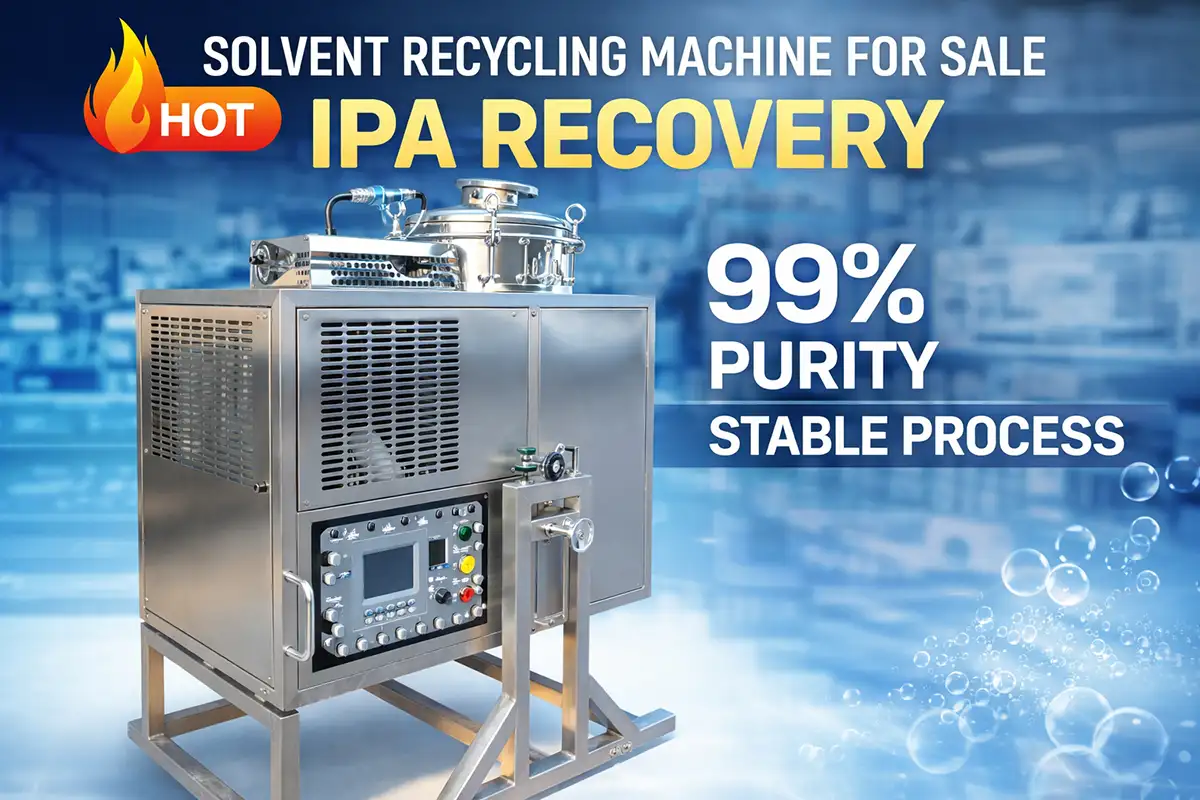
When these steps are built into daily operation, maintaining recovered IPA near 99%becomes a predictable outcome—and that is exactly where a well-matched solvent recycler machine delivers value: reduced solvent purchasing, less hazardous waste, and more consistent process performance.
Recommended reading
Supporting pages that match common IPA recovery questions.
At-a-glance: what usually fixes purity
Purity swings day-to-day: feed water control + closed containers.
Cloudy distillate: reduce boiling intensity; check condenser cooling.
Residue/odor: prevent mixing solvents; clean receiving tank and hoses.